What can universities do to improve the IRB? Zachary Schrag, Professor of History at George Mason University and the author of, Ethical Imperialism: Institutional Review Boards and the Social Sciences, 1965-2009, summarizes what your school can do (in ten easy steps).
Copinthehood.com has moved to qualitypolicing.com
-

Cop Down at MIT
Can we make a new rule for killers?
“Know your victims.”
It may not help the victim, but it does help everybody else.
Update 12:15am: Word is the officer has died. I think it’s safe to assume this is the first MIT police officer to be killed in the line of duty.
My condolences and sincere hopes this situation resolves itself without any other good person being hurt or killed.
Another Update: This is the part that always gets me choked up: “A Wilmington, Mass., police car carrying what appear to be family
members arrived sirens blaring. A few Officers arriving in tears.”A couple of days agoI tweeted this: A nice ode to Boston, from one of the many who frolicked in The Hub. http://www.theatlantic.com/national/archive/2013/04/you-may-leave-boston-but-boston-never-leaves-you/275018/
-
New Tool for Police Officers
Using tech and smart phones to help police. This is great, right? I can’t think of downside. Am I missing something? Kudos to the NYPD.
-
Why You Never Chase
Three years ago I wrote this piecefor a local New York City paper. If you replace New Yorker Karen Schmeer with Baltimorean Matthew Hersl, nothing has changed. Karen Schmeer was the friend of a friend. Matthew Hersl was the brother of a guy I worked with and knew from the police academy. I bought my car from his nephew, I think.
From the Sun:
A Maryland state trooper first encountered the driver on southbound Interstate 83 about 2 p.m.
…
“The black Acura was about a block in front of them. He hesitated at the corner of Saratoga and Holliday. And he takes off as fast as he can at about at least 60 or 70 mph. He tries to negotiate the turn. He didn’t make it. He slammed on the brakes and lost control of the car…. The guy had his back turned. He didn’t see him coming,” [the witness] continued, referring to Hersl. “He hit the guy, knocked him up in the air, hit the tree and turned over.”
Here’s the part that gets me:
“Police emphasized that the trooper had not been chasing the suspect in the black 2000 Acura TL.
The agency has a number of safety factors it considers before initiating a pursuit. “Let me assure you, there wasn’t a pursuit at that point in time,” Black said.
Let me assure you that’s a lie. [Though the “at that point in time” gives him a bit of wiggle room. I suspect the “chase,” if it ever happened, ended right about the time the car accelerated and smashed into and killed Hersl.]
So you’re a cop and a car speeds by… what do you do? Departmental rules don’t allow you to chase a suspect, but you can “follow” one (obeying all speed limits and traffic regulations, of course). You’re not supposed to get involved in car chases, but you do. Why? Because they’re fun. (And besides, you don’t want the bastard to get away.)
Luckily the time I chased a car nobody got hurt. And it wasn’t called off by my sergeant because my suspect drove from the Eastern to the Southeast and I switched to the S.E. District’s radio channel. I thought I was very clever.
But what if the car I was “following” killed somebody, perhaps while driving the wrong way down a one-way street? How would I sleep at night?
The reason police are not allowed to chase suspects in the city is because almost inevitably, chases end in a crash. The only real question is what is going to be crashed into. Too often it’s somebody like Karen Schmeer or Matthew Hersl, a good person just going about their day.
My sincere condolences to Dan and the entire Hersl family.
-
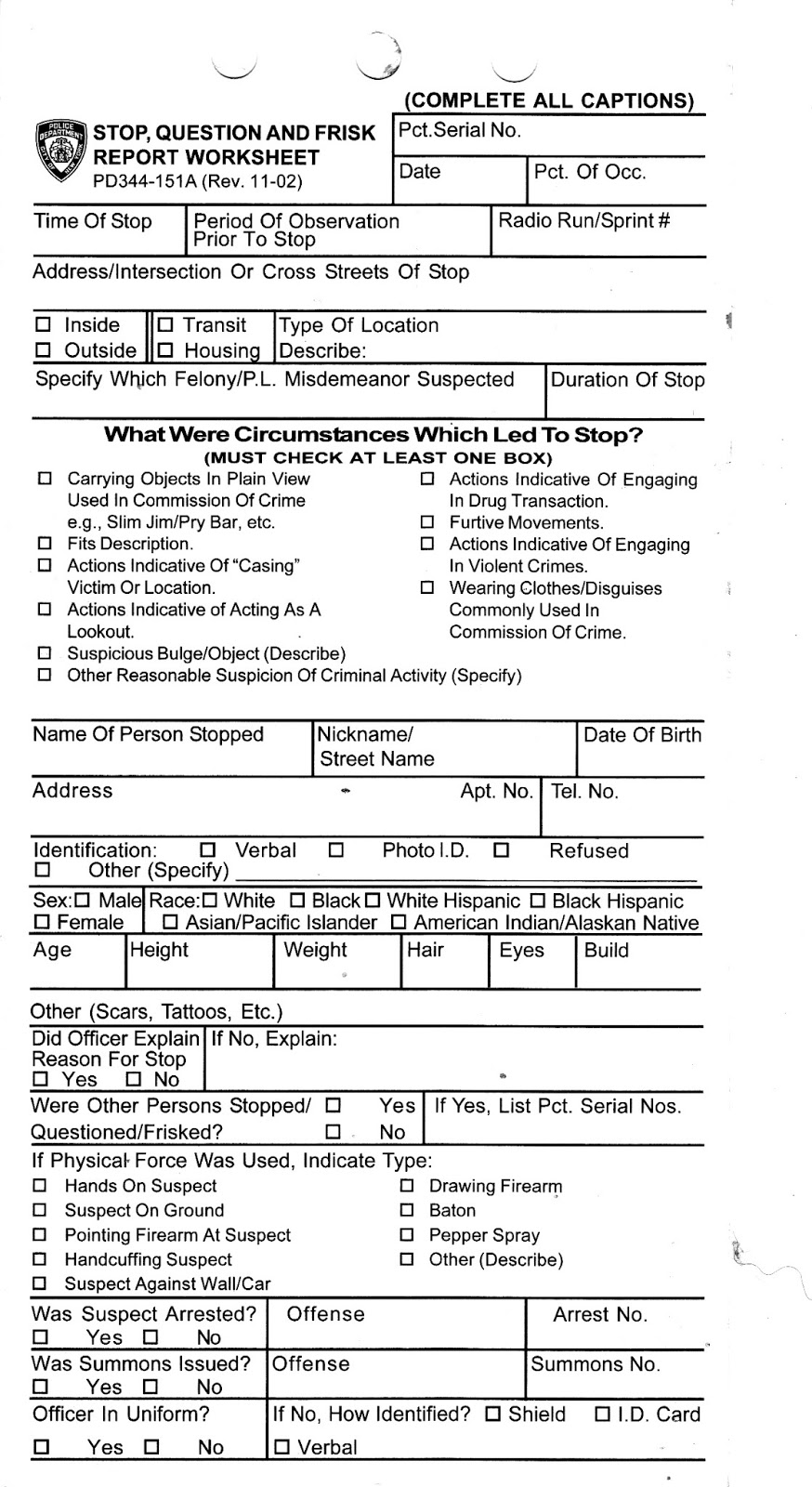
Stop, Question, and Frisk in court
From the Times:
Mr. Esposito insisted that a supervisor could conclude that a stop was legal based on reviewing that form alone.
“If it’s filled out properly, it gives you reasonable suspicion. And if you have reasonable suspicion established, then you do not have racial profiling,” Mr. Esposito said. “It’s as simple as that.”
Except it’s not.
Here’s the “UF-250.”
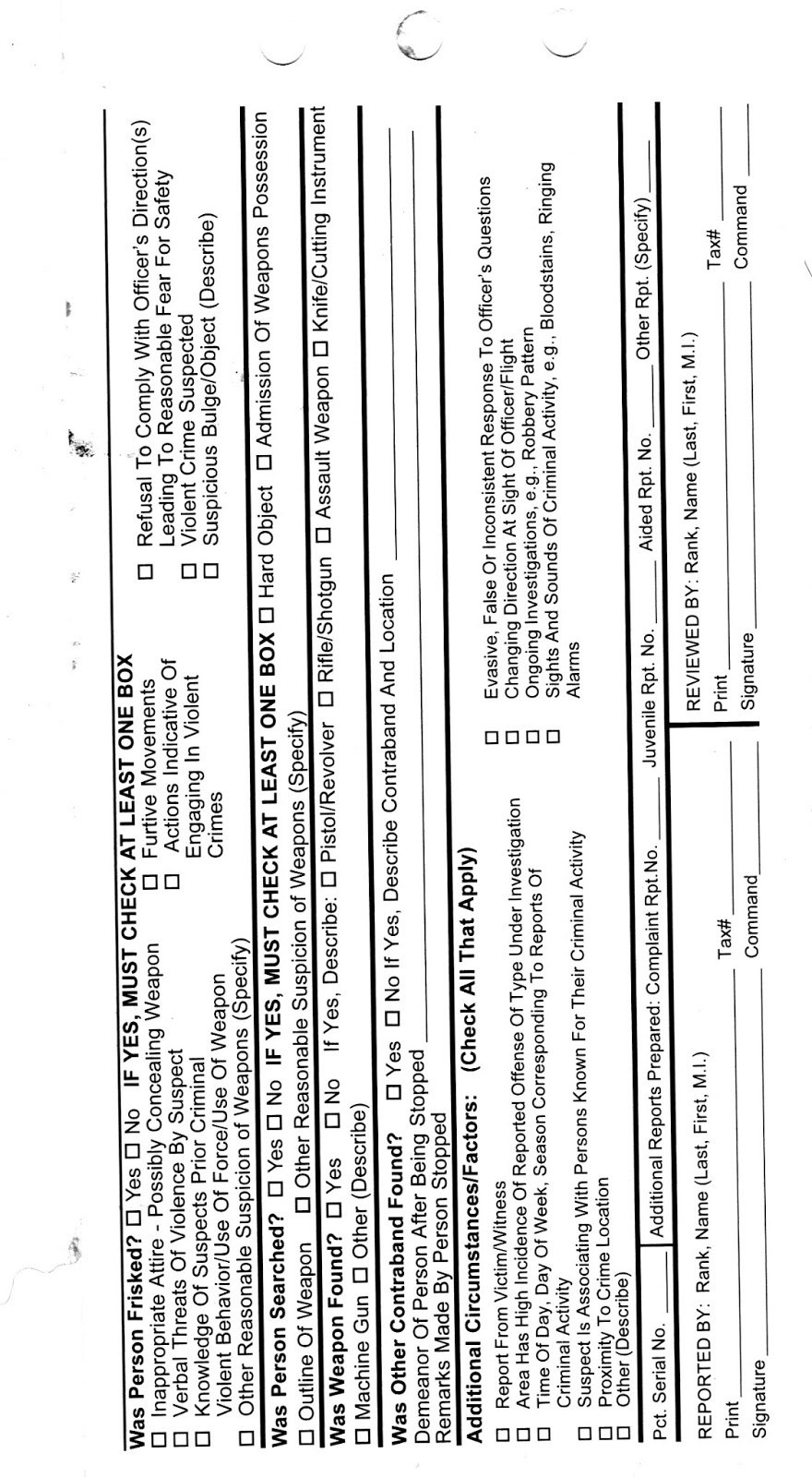
Again from the Times:
But Judge Scheindlin appeared skeptical that the paperwork proved anything.
“Any officer can check off ‘high-crime area’ and ‘furtive movements,’ ” Judge Scheindlin said, referring to two check-box categories on the stop-and-frisk form. “You really don’t know much about the stop, looking at the form, do you?”
No, you don’t.
The Supreme Court has said that officers need to be able to “articulate” (based on the “totality of the circumstances”) why they have reasonable suspicion for a stop or probably cause for a search.
Take Terry v. Ohio, where the whole concept of reasonable suspicion was invented. Detective McFadden wrote:
I noticed two colored men [Keep in mind this was written in 1963] standing at the corner of Huron Rd and Euclid Ave. I noticed one of these men would leave the other and walk West on Huron Rd. He would kind of slow his walk and look in the the United Air which is located at 1276 Euclid Ave but has a rear entrance on Huron Rd. He would then continue to walk West on Huron Rd and stop and then as he came east again he would pause and again look into the United Air lines. When he came back to Huron Rd and Euclid he would talk to the other colored man and the other man would take the same walk and do the same as the other other man pausing in front of the United Air Lines. During the time I was watching them they made about three trips each. While they were together at the corner I saw [a] white man who came east on Huron Rd stop and talk to these two colored men and after he left them he walked west on Euclid Ave. I could not see him after he left these men and can not say where he went or what he did. About five minutes after this white man left the corner these two colored men met the white man again and they stopped and talked. At this point I approached these three men and informed them I was a police officer and told them to keep their hands out of their pockets.
Now that’s reasonable suspicion!
Detective McFadden patted the men down and found a couple of loaded guns.
Today, the NYPD brass has tried to make the process of describing reasonable suspicion so idiot-proof (on the horrible and somewhat self-fulfilling assumption that police officers are idiots) that Detective McFadden would simply have to check a few boxes. For “What Were Circumstances Which Led To Stop?”, I’d go with, “Actions Indicative of ‘Casing’ Victim or Location” and perhaps “Actions Indicative of Acting As A Lookout” and then throw in “Furtive Movements” (whatever that means) just for kicks. And “Was Person Frisked?” I would go with “Actions Indicative Of Engaging in Violent Crimes.” And finally, for “Was Person Searched?” Let’s check “yes” and “hard object” and “outline of weapon.”
Does any of this “articulate” anything about what Mssr. Terry, Chilton, and Katz actually to did? Of course not.
Would it establish reasonable suspicion, thus disproving racial profiling? Esposito says yes. The court is going is going to say no.
One irony of all this is that the “UF-250” only exists because people were worried about too many police stops. Before stops could be quantified, the department couldn’t use them as measures of productivity. Now that they can be counted, the department wants more of them.
As asked in court: “Do you think focusing on the raw numbers gives the wrong impression to your subordinates?”
That’s an excellent question.
And the answer is an unqualified “yes.”
-
Police officers’ opinions on gun violence and gun control
A summary of the results of a survey of 15,000 police officers by Police One.
-
Cops Wearing Cameras
Better for police than most police think. From the New York Times.
-

Gun Guys, by Dan Baum
I finished reading Gun Guys, and it’s very good.
Here’s Dan Baum talking about his book on the BBC. And here he a more in-depth interview with Dan Baum on KMO’s C-Realm Podcast (which just happens to have been recorded in my basement). [Update: and here is Baum in the New York Times.]
Baum makes the point that nothing productive with gun policy unless anti-gun people actually listen to gun guys. And he presents his case from a “liberal Jewish gun-loving” perspective. This book isn’t a defense of the NRA, since the NRA represent but a small minority of gun owners (something like 4 million of 100 million gun owners). But rather an attack on the gut-level reaction so many liberals have against gun, without considering (or worse, mindlessly dismissing) the thoughts, feelings, and needs of hundreds of million of non-criminal gun owners.
A take-away point is that guns are here, like them or not. We can pass all the pointless laws we want, but if we want a safer and less violent America, we need to have an engaging, serious, and rational conversation about guns. Gun Guys does that. How does it make sense to advocate restricting something when the people advocating such restrictions have no idea what they’re talking about? For instance, if the goal is fewer guns, how does it make sense to push for laws that result in a boom in gun sales?
I do think Baum places a bit too much of the onus on people who don’t like guns. It doesn’t seem to much to ask for a less violent America. Even an America with fewer guns (not that those two are necessarily related–the past two decades have seen less restrictive gun laws, more guns, and a reduction in violence). But to say something isn’t politically feasible is different than saying something isn’t a good and even noble goal.
Baum stretches credibility a bit when he makes the analogy that hating gun owners is akin to being racist or anti-semitic. But he’s right in that such mindless hatred is often based in ignorance and fear of people the hater makes no effort to get to know. But what about the mindless and ignorant fear of gun owners who think their guns are going to be taken away or feel an irrational need to protect themselves from some criminal class of people? From my perspective, too much of “gun rights” is linked to “state’s rights” and “protecting a way of life” and fear of some “them” taking over America. Until there is serious discussion about repealing the 2nd Amendment, why such paranoia about an assault on freedom? I mean, I love the 1st Amendment, but I’m not shouting objectionable things in the street to protect my 1st Amendment rights. Why? Because they’re not in jeopardy!
There’s also the point (not in the book) that guns are not freedom. Guns protect freedom. We should be worried about our freedoms being taken away (warrantless searches, mass incarceration, indefinite detention without due process, Presidential-ordered assassinations of US citizens). Having guns without freedom is, to paraphrase Bill Maher, like being in a titty-bar filled with bouncers but no strippers!
Regardless, Baum makes the essential point that simply hating guns and people who own them is counterproductive from any anti-gun or anti-violence perspective. Most guns are not the problem. Most gun owners are not the problem. And until gun-control people get that through their thick liberal heads, nothing productive will ever happen. Certainly this book is a great starting point to any rational discussion on guns and gun policy. It’s also a good read.
At its core (and in its title), Gun Guys is a road trip. Who doesn’t like a road trip? Baum takes the reader on an adventure while he talks to as many gun owners and stops in as many gun shops and gun shows as possible. Entertaining and educational! What more could one ask for?
Now buy his book and read it. You’ll be happy you did.
-
Don’t buy this essay!
Wow. You can buy an essay about my book, In Defense of Flogging.
But it’s not very good. Really. It’s surprisingly crappy. Mostly because it’s not about me book. I would expect more for my money. On the other hand, this does appear to be free.
-
The State of Community Policing
Over at The Badge Guys, there’s a nice series of posts about the current state and evolution of what is called “community policing.”