Tag: compstat

  • Bratton calls out Kelly for calling out Bratton! It’s an NYPD smackdown!

    Bratton calls out Kelly for calling out Bratton! It’s an NYPD smackdown!

    This Kelly vs Bratton feud has been simmering in the backgroundfor a little while.

    But then when Kelly accusedBratton of cooking the books(something Kelly should be familiar with, since book-cooking constantly flared up during his reign)? Well, I’ll just sit back and enjoy the fight.

    And here’s an insiders’ tip: the good money is on Bratton.

    The NYPD took Kelly seriously enough to release an official rebuttal. And hell, Kelly is the former NYPD commissioner. He should be taken seriously.

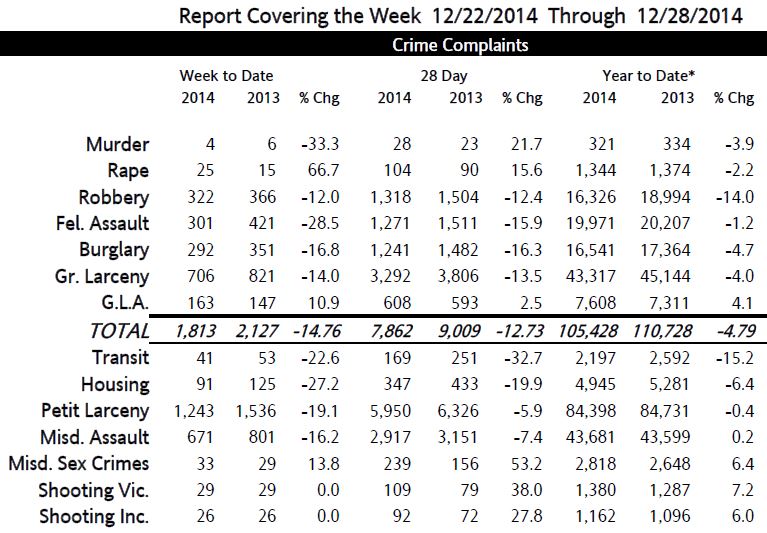
    Now I will admit my initial thought on Kelly’s accusations: it sure is odd this year that shootings are down and homicides are up. How does that happen? What are the odds? So could Kelly be on to something?!

    Turns out: No.

    In the far corner, the former champion, the man who must be in charge, Raymond Kelly. He’s the consummate micro manager, the marine, and the man would wouldn’t let cops administer a heroin antidote (not on his watch). Kelly completely closed the department to outside researchers, transparency be damned! But he kept crime down and avoided a big scandal. (Stop, question, and frisk was not a scandal so much as a strategy.)

    I don’t think Kelly did a bad job. Not at all. But I was happy to see him go. At some level I just don’t like him. Substantively his conservative micromanaging was insane. Everything transfer and shift of manpower had to go through him. His emphasis on stats led to a lot of problems.

    The fact that below I use week-old data copied from a PDF file is entirely Kelly’s fault. And the fact that he could be so closed, on idiotic principle, even with Mike “open data” Bloomberg as mayor? It was all amazing. Kelly ran the department like nobody has ever been allowed to run that department. For 12 years, he was the boss.

    Murders did drop from a low 587 to an amazingly low 334. The last two years of his reign saw a 35 percent reduction in killings(!). And nobody took credit for it. Kelly didn’t want to take credit for a crime drop at the exact moment it was coinciding with a massive drop in stops, since each and every one of those stops, so he said, was absolutely necessary to prevent a rise in homicides. And Kelly’s opponents sure didn’t want to give the big bad NYPD credit for anything at all. So we had the largest drop in homicides since the mid 1990s… and nobody noticed.

    Kelly ran the NYPD, something Bloomberg didn’t want to do. But Bratton is doing what De Blasio can’t do. De Blasio needs Bratton a lot more than Bloomberg needed Kelly, and also much more than Bratton needs de Blasio.

    So in this corner, the current champion, William Bratton. He’s a bit more polished, a bit more educated, some might even say… smarter. Bratton is also conservative, mind you, but in a more intellectual way. Bratton understands the politics of policing. Bratton is also more open to transparency and sharing data. The fact that the same limited NYPD Compstat data is available in 2015 in spreadsheet form? Well, that’s progress, I guess. (But there’s no reason he couldn’t have (Now can we please get open crime data like this.)

    I like Bratton because of his track record, his intelligence, and his support and understanding of Broken Windows policing. Also Bratton, unlike Kelly, understands why, other things being equal, it’s better if people don’t hate the police. Kelly really didn’t give a shit what people thought. He knew he was doing a good job. That was enough.

    I’ll give Kelly the benefit of the doubt and not doubt his motives. Kelly probably really believes what he’s saying. Unlike some former commissioners, at least Kelly is nota crook. Now that he’s not in charge, he knows things must be going to hell. Besides, people are constantly telling him things are going to hell.

    Kelly always surrounded himself with yes-men. He wasn’t a micromanager because he trusted others. And now you’ve got a bunch of old friends who remain loyal to him. Cops hate de Blasio and everything happening right now (the latter is a constant, by the way, no matter what is happening). And maybe there was actually a case of a shooting that was downgraded. It happens. So these old buddies get together with Kelly and, over a soda water, tell him all the bad that is happening. Kelly believes it to be God’s truth, since it’s coming from his people. His loyal people.

    So why did Kelly do this? Probably not just to sell books. Though maybe Kelly found out he enjoys talking to the press. Those with big egos tend to like seeing themselves on the tee-vee.

    But back to the issue at hand. How do you tell if shooting victims aren’t been counted?

    I thought I would look for smoke in the ratio of homicide to shooting victims. But to find out which of the NYC homicide victims were shot, you have to go the UCR data (the FBI’s Uniform Crime Report). So I did that. After a fun couple of hours on SPSS, I got the answer. For the past 15 years, about 60 percent of homicide victims are shot. It hasn’t changed much. No smoking gun.

    Between 1999 and 2013 (but excluding 2006 and 2008, for UCR data quality reasons. And keep in mind, if you run the numbers, the UCR undercounts homicides by about 5 percent because it looks at incidents. Like everybody else, I ignored this and assumed a constant error rate) approximately 60 percent of homicide victims were shot. But I already told you that. But it’s worth pointing out that this number remains pretty consistent over these years, which I was not expecting. And over these years, it turns out the odds of dying if you’re shot in NYC is about 15 percent (which is substantially lower than I thought it was. Much lower).

    In other words, in 2013 there were 334 people killed in NYC, about 195 of those were shot (188 incidents recorded by the UCR plus a few multiple homicides). There were 1,300 shooting victims, according to the NYPD, people with gunshot wounds.

    Now we, the UCR, doesn’t yet have gunshot deaths from 2014, much less 2015. (Though I’m sure the NYPD does, now about that openness…)

    We do have shooting victims and total homicides recording by the NYPD (the former is surprisingly difficult to tease from the UCR, which is yet another UCR problem).

    If the number of shooting victims were being artificially reduced, one would expect the ratio of shooting victims to total homicides to be way down this year. And it is. But just a bit: to 3.9:1 from 4.2:1 in 2014. But it turns out that 2014 is the odd year, not this year. 4.2 is the highest that ratio has ever been. It was 3.9 also in 2012 and 2013. The average over the past 15 years in 3.4. The ratio is steadily increasing, probably due to better medical care. Maybe hospital closings affect this rate. Or maybe it’s just statistical variance (AKA: bad luck). But no, the numbers don’t look funny this year.

    Anybody still with me? One quick double-check: last year (2014) compared to the previous year (2013) the number of shootings should be down and homicides up (the opposite of this year). And yes, indeed, that is the case.

    Look at the “year to date” columns for the two years and the rows “homicide” and “shooting vic.”


    I’m betting on Bratton.

    Update: Gothamist jumps into the ring with a folding chair! And Bratton hits againin the Daily News. And the Inspector General, that’s the new oversight department under the Department of Investigations that is still in search of institutional meaning, stays mum.)

  • Cops rat out cops. Cops get punished.

    Al Baker in the Times:

    Nineteen New York City police officers assigned to a station house in the Bronx face disciplinary action after being charged on Friday by department lawyers with wrongdoing, including incorrectly classifying crimes and downgrading criminal complaints, the police said.

    The administrative charges against the officers, from the 40th Precinct, follow an internal audit that uncovered 55 crime reports that were improperly processed during a four-month period last year, the police said.

    It’s worth observing that a cop called Internal Affairs to rat out other cops for their misdeeds. The cops investigated and did an internal audit. The investigation concludes there is a problem, and some action is taken.

    The system may not be perfect (it isn’t). And lives were not at stake. But in the end, this is one way the system is supposed to work. Sometimes it sort of does.

  • What’s your C.O.P. score?

    You know, “Crimes prevented Over rePlacement.” (Or maybe just “C-POR.”) Like WAR, wins above replacement, but for cops.

    The idea is to break crime down by beat/post and looking at it over time (a long time, like years). Wouldn’t it be nice to know if there actually was less crime on your post while you were policing. Of course would give incentive to under report crime. Still, it would be nice to know. And it’s not like we have anything better.

  • No New News

    I’m about to read the Village Voice’s one-sided new “scoop” about Adrian Schoolcraft. I’m going to predict it says 1) there was pressure to reduce crime stats, 2) the NYPD makes a surprisingly good faith effort to get to the bottom of the issue, and 3) keep in mind (this won’t in the article) everything Schoolcraft has done has been motivated by his desire to sue the NYPD for a lot of money.

    I’ll be happy to be surprised and admit I was wrong….

    Here’s what I’ve written about Schoolcraft in the past.

    Update: Well, not to brag, but I told you so. I’d like to emphasize #2, which of course the Voice holds against the NYPD. Damned if you do. Damned if you don’t.

    I wrote about juking the statsin February, 2010. And I mentioned this problem back as early as April 2009, when I even got on my soap box and warned young officers: don’t do it.

    A year later I wrote this, after Schoolcraft went public:

    All [Schoolcraft] seems to show is something we all should already know. In the NYPD, everybody is under intense pressure to produce good “stats” (arrests and citations) and reduce bad stats (crime numbers).

    Schoolcraft isn’t the first to point this out. He’s just the only one, in my humble opinion, who has tried to martyr himself and turn number fudging into a tidy personal $50 million profit. He and his father have tried twice beforeto sue police departments for money. Maybe the third time is the charm.

    [Update: it was]

    (Update with working links to all the posts on Schoolcraft.)

  • Baltimore Police Department Suspends Comstat

    Last week the BPD announced that they were suspending comstat. I’m not certain if that’s cutting edge or retro.

    Perhaps it’s time to suspend compstat here in NYC. I don’t think anybody wants a police department that doesn’t hold commanders accountable and use the timely analysis of crime data, but (and this is putting it politely) perhaps there is room for improvement. Compstat has accomplished a lot of good. But times change. Perhaps it’s time to think beyond a sh*t-rolls-downhill style of management.

  • It’s back!

    This was taken down for a while but is now back up. The funniest YouTube video I’ve ever seen. Maybe it’s only hilarious if you are or were a cop and don’t speak German. But I think it’s probably funny regardless.

  • Juking the Stats

    A recent report of retired New York City police officers warns that the NYPD is playing fast and loose with the numbers. Knowing when and where crimes occur is essential to good policing and Compstat, a system of crime-data analysis created in 1994, played a large role in bringing down crime in New York City. But ever since, numbers have ruled the NYPD’s roost. If crime numbers are not down, precinct commanding officers need numbers to show they’re doing something—something quantifiable.

    In the police world, two statistical categories are important: Part I felony crimes reported to the FBI’s Uniform Crime Statistics and internal measures of “productivity,” namely arrests, citations, and summonses. There are ways to play with both. But perhaps surprisingly, the police department’s emphasis on the latter, the so-called productivity stats, is a much greater cause for concern.

    Sergeants, lieutenants, captains and inspectors feel intense pressure to produce ever better stats. To some extent this can be good. Police are paid to work. But the pressure to produce more with less is as overwhelming as it is unrealistic. Mind you, the orders never come from above to just make numbers up, but when commanding officers talk about “productivity,” the rank-and-file hear “quotas.”

    “I’d love it if I always had enough good C’s [criminal citations], but I need numbers,” one officer told me, “And if I don’t have enough stats and Compstat is coming up, I don’t care if they’re bullshit. I’ll take whatever the f— I can get!” In a world where “better stats” and “more stats” are synonymous, the tail is wagging the dog. And police are nothing if not creative in finding ways to please their bosses.

    Officers know what they see on the streets. Any desk sergeant who reclassifies or “corrects” a report sends a terrible and destructive message. And these pressures have grown substantially in the past decade.

    When a $2,000 stolen laptop model can be found on EBay for less than $1,000, a felony larceny might be reclassified as a misdemeanor and all but disappear from the stats. Or say a tourist reports a robbery but the police, knowing she’s on the next flight back to Germany, record her loss as lost property.

    Of course statistical errors can run both ways. There’s a lot more false reporting of crime than the public realize, and police are certainly not fools. That German tourist may have simply wanted a police report to scam insurance money. Real life is not easily quantifiable, and trying to determine which bubble on a report best reflects reality leaves lots of room for honest interpretation.

    For statistical errors, data are supposed to be small and random. But for crime data, we’ll generally settle for errors as long as they’re consistent. Given that the distinction between felony and misdemeanor is basically arbitrary anyway, it doesn’t really matter if ten percent of felonies are reclassified as misdemeanors as long as it’s done every year. After all, far more than ten percent of crimes are never even reported.

    The problem with fudging crime numbers for political gain is that you can’t stop. You have to do it every year just to stay even. Eventually you’ll get promoted and transferred, if you’re lucky, leaving your more honest and naïve replacement to deal with surprisingly bad crime numbers.

    Certainly some stats, like murders and car thefts, are more reliable than others. The former are hard to fudge and the latter are generally reported for insurance reasons. And by these measures, the drop in violent crime is impressively clear. Murders alone are down 70 percent from their 1994 peak and 11 percent in the last year alone. This is real. These numbers matter.

    But too many measure of police “production” do little but produce internal stats and pad officers’ overtime pay. Take low-level marijuana possession arrests. In 1994 there were 3,141 of these in New York City. In 2008 they had exploded to 40,383! This 1,285 percent increase was not the result of a epidemic of marijuana possession but a simple change in police tactics.

    To say these arrests caused the crime drop is absurd, akin to claiming that a parking-ticket blitz prevents traffic deaths. These arrests—at great taxpayer expense and motivated only by internal police pressure to produce “stats”—simply pad officers’ overtime pay while sending tens of thousands of mostly poor minority men through the criminal-justice system.

    Messy as they may be, it’s hard to image a police world were numbers didn’t matter. What’s important is that these numbers aren’t produced for their own sake. Statistics need to stay focused on crime and not internal, malleable, and ultimately destructive measures of “productivity.” The hard-working men and women of the NYPD deserve as much.

  • Cooking the books?

    Anonymous posted a comment on the previous post: I can’t wait for the fudged numbers of the NYPD Comp-stat to be exposed…”

    Boy, there sure is a lot of chatter about the fudged numbers in the NYPD (and I’m talking about chatter from NYPD officers). I didn’t hear this nearly so much even just a few years ago. It seems that downgrading crime is becoming part of NYPD culture. And that’s a shame because it takes away from the hard work of the NYPD in actually decreasing crime.

    But I don’t believe the homicide numbers are fudged. According to the latest official crime stats (week of 4/13/09 to 4/19/09), there have been 109 murders this year compared to 142 at this time last year. That’s a 23 percent drop. That’s a real drop. That’s not playing fast and loose with the numbers. That’s saving lives.

    And if the other numbers go down in sync, the drop is probably real even if the numbers aren’t. Sure, maybe felony assault and grand larcenies are a lower than reality would indicate. But if you think about it, as long as the errors are consistent month to month and year to year, those errors don’t have much of an effect. The shame is that any effort put into lowering stats is kind of wasted because you have to keep cooking just to keep even. Once you start cooking the books, you can’t stop. At least not without what will look like a big one-time increase in crime.

    To police officers I offer this bit of unsolicited advice: call it like you see it. Nobody can make youdowngrade crime. Except when they do. Then write the facts as you believe them in the narrative and keep a separate list of notes documenting when, where, and who ordered you to do what.

    If the books are being cooked, one day it will boil over in scandal (and until then it chips away at a culture of honesty and integrity). And when the shit does hit the fan, the brass will cover theirs while throwing a few others under the bus.

    They’ll be covering theirs; you need to cover yours.

  • Fender bender probe could cost NYPD captain his career

    If they want to get you, they can always find a way.

    “A patrol car’s $221 side-view mirror could wind up costing an NYPD captain his career. A story about a double-parked cruiser and a minor fender bender has snowballed into allegations of conspiracy and coverup.” The whole storyis in the Daily News.

    This is compstat pressure. Or traffic-stat or whatever it’s called in this case. See, the captain was worried about getting himself chewed out a new assh*le because traffic accidents in his precinct were up 3.5%. So, the story says, he wanted an accident reclassified as vandalism. Did he do wrong? Yes. Should his career be ruined? No.

    I feel sorry for the captain. Of course if he had told meto file a false report, I wouldn’t feel sorry for him at all. I don’t know. At some point it’s a matter of “he-said she-said.” It’s a messed up situation that now becomes a matter of internal department politics in a micro-managed department. And that’s f*cked up.

    Compstat has done a lot of good for the NYPD and for New York. And I can’t imagine a police world today that didn’t use the timely compilation of statistics to allocate resources and identify problems. Really… what’s the alternative?

    But…

    For stats to matter, they need to accurately represent what they claim to. If you judge performance and crime on stats, it is inevitable that the numbers–and not the incidents they’re supposed to represent–become more and more important.

    When the pressure to produce stats becomes too great, and when the people held responsible for the stats control the stats, then playing with the numbers becomes too tempting and too easy.

    I’m not defending fuzzy math, not by any means (plus there’s always the problem that once the books are cooked, you need to keepcooking them). I’m just saying it should come as no prize when people living in a stat-based world play with the numbers.