I don’t know if this is good or bad, but why does it take years? That’s what’s so f*cked up about police discipline. And these charges were placed only, 18 months later, to beat the statute of limitations. The story in the Times.
Tag: Eric Garner
-
Garner’s Death
I don’t have much to say because I wasn’t sitting on the grand jury. I have no new information. Apparently the good citizens of Staten Island have spoken. From the Daily News:
After four months of reviewing the evidence, a majority on the panel
concluded there was not enough there to charge Pantaleo with
manslaughter, reckless endangerment or criminally negligent homicide. The 23-member grand jury, sources said, was comprised of 14 whites, with the rest being black or Hispanic.I wrote about Garner in the Daily News a few months ago and stand by it. And here’s everything I’ve blogged about the incident. And see this in the Times.
I will add:
A) I’m a bit surprised that the officer wasn’t indicted. My money would have been on an indictment.
B) The cop is lucky as hell he killed a guy in Staten Island (as opposed to Brooklyn or the Bronx).
C) I strongly suspect the officer is a dick. Now this isn’t based on fact but just my own small-minded prejudice. But from my limited experience policing, when you have a group of cops, the cop who first gets physical? The cop who jumps on an unarmed suspect? The cop who, with a half dozen other cops right there still deems it necessary to single-handedly take a guy down? Half a dozen other cops, smart cops, also there at the scene didn’t see a need to get physical right there and then. And one cop decides to get physical? And getting physical is a way you can’t get yourself cleanly out of? From my experience: 9 times out of 10 that cop, the most aggressive cop, is a dick. And 10 times out of 10 the cop who is most aggressive sets the tone for the entire incident.
But being a dick isn’t a crime. Nor is a chokehold.
D) But a chokehold is against departmental rules. That officer is now going to be f*cked by the department. It is written.
E) And yet… I still keep thinking that a fat guy in horrible shape maybe shouldn’t make such a stupid choice as to actively resist arrest. The force stops when the resistance stops. He died. There seemed to be no intent to kill anybody. You might have bad policy, bad tactics, and a tragedy, but even all of that together doesn’t equal a crime.
F) I would love for just one “progressive” liberal to come out against New York City’s crazy cigarettes taxes and prohibition against selling loosies (individual cigarettes). By one estimate (in the Bronx) 76%(!) of cigarettes are now bootlegged! Prohibition has consequences, particularly — historically and today — for minorities.
I’m off to Mexico for a week. Comment nicely and stay safe.
-
Bootlegging: for cigarettes, alive and well in New York City
Story in the New York Times:
The toothpick pressed a hidden button that released a large magnet that kept a secret compartment locked. Deputy Davis lifted the front of the row of shelves like you would the trunk of a small car, and inside were rows and rows, all different brands, of contraband. Not narcotics or pills, but unopened packs of cigarettes, perfectly legal in the state in which they were bought, but not here. Hence the secret compartment.
The moral here is simple. You need some enforcers, but we shouldn’t waste too many resources in regulating a legal product. When there’s a huge market bootlegging, then you need to lower taxes.
Also, I suspect that smoking isn’t down as much as people think as a result of raising taxes. Because if The Man can’t find the cigarettes, than the public health expert things they aren’t being smoked.
According to a great study by Klaus von Lampe (et al), my brilliant colleague:
It was found that 76% of cigarette packs collected [by looking at litter… how cool is that?] avoided the combined New York City and State tax. More specifically, 57.9% were untaxed (counterfeit or bearing no tax stamp), for 15.8% taxes were paid outside of New York City (including other states and New York State only). Only 19.4% of tax stamps collected indicated that New York City and New York State taxes were paid…. The finding that the majority of cigarettes did not have a tax stamp or bore a counterfeit tax stamp suggests that these cigarettes were being bootlegged, most likely from Native American Reservations. It was found that 76.2% of cigarette packs collected avoided the combined New York City and State tax.
And two words: Eric Garner.
-
How to arrest a very large man who doesn’t want to go
Telling officers what not to do doesn’t tell them what they should do. And it’s never going to look pretty. That doesn’t make it wrong.
Here’s my op-ed in today’s New York Daily News:
If you’re a cop, how do you cuff a 6-foot-tall, 350-pound man who doesn’t want to go to jail?
Most arrests happen without a problem. Police order a guy to put his hands behind his back. The cuffs click or zip, and that’s that. But sometimes people make it clear that they don’t want to go. Then what?
Read the whole thing here.
-
I stand corrected
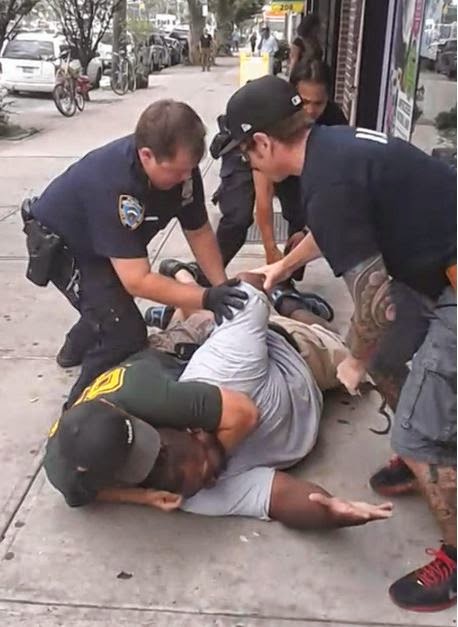
The medical examiner’s office says Eric Garner was murdered. To wit: “compression of neck (chokehold), compression of chest and prone positioning during physical restraint by police.”
Asthma, heart disease, diabetes, and obesity were contributing factors.
His death has been ruled a homicide, and presumably we’re going to be in for a Staten Island trial with Daniel Pantaleo and perhaps other police officers as defendants.
Update October 2014: This is a picture that shows a choke hold. I hadn’t seen it before. Garner was not taken down with a choke hold. But this, once he was down, clearly shows a choke hold.

-
Is Selling Untaxed Cigarettes Now A Capital Offense?
So asks W. James Antle III in the Daily Caller. The answer is no, even with death of Eric Garner. But it is an arrestable offense. And that’s a problem for police. It should be a problem for society. But people love passing stupid laws and then getting upset with police for enforcing them.
-
The chokehold that wasn’t?
Not surprisingly, the preliminary autopsy report in the death of Eric Garner shows, showsthat the “deadly encounter Thursday did not damage his windpipe or neck bones.”
Why is the not surprising? Because I’m still not convinced there was any chokehold at all. It certainly did not happen when Mr. Garner was taken down. There may have been a chokehold later, but as I have said, and without 100 percent certainly, I don’t think there was. But seeing how Garner apparently didn’t suffer any damage from a chokehold, can we at least stop saying a chokehold killed him?
The Daily News, which has been the most harsh of all the NYC newspapers, has repeated mentioned “chokehold” as a matter of fact, even though it may not be. “Chokehold” is mentioned around eight times in a webpagethat ends with, “Sources told the Daily News that a preliminary report found no signs of neck trauma, such as a crushed windpipe.”
There’s something very strange about people who are screaming about “police killing a man with an illegal chokehold” who then don’t care that there perhaps there wasn’t a chokehold. Don’t facts matter? Of course it doesn’t help that Commissioner Bratton himself has called it a chokehold, which seems to sort of settle the matter, at least in the media.
Of course Garner is dead, so it’s fair to ask, “does it matter?” Well, yes. It does. Because (as I’ve said before) there’s a big difference between police killing a man and having a man die of a heart attack in the course of resisting arrest. It matters because the former is a crime and the latter is a tragedy. The guy seems to have died from physical exertion while resisting arrest. Is that the fault of police?
Meanwhile a police officer has been tried in the court of public opinion and found guilty. He very well may be tried in a criminal court — and then there will be further shock and uproar when he is acquitted.
Except for some of the more extreme cops, who believe everybody resisting police should die, most decent people can agree that something went wrong. A man shouldn’t be dead after a minor police encounter over a non-violent crime. That should be a starting point for discussion. But if you start by saying police killed a man — even if it’s not true — it’s hard to have any sort of reasonable or productive discussion.
This ideological anti-police bias is a left-wing lie similar to the right-wing lies I prefer to write about. It’s like Larmondo “Flair” Allen, the drug dealer who, according to a right-wing email being sent around, was receiving $13,500 a month in welfare before he was murdered. “An outrage!” people scream while blaming Obama (“Flair” died in 2004). When I corrected this fact — the real figure would have been more like $550 a month — most people who so outraged by the $13,500 figure didn’t seem to give a damn that it wasn’t true. They want to be outraged! Facts be damned! “Well,” they say, “maybe those numbers are wrong, but that doesn’t change my opinion.” Well… then you’re a fool. If your opinion is based on beliefs that are not true, shouldn’t you perhaps change your opinion? Or at least get your facts right?
Maybe in my next post I’ll try and break down the Garner encounter situation and point out various points where something could have been done differently. Choices, had they been taken, where Mr. Garner wouldn’t end up dead. Certainly things went wrong; a man is dead. But that doesn’t mean the officers on scene killed a man.
[Update: I defer to the medical examiner, who says otherwise.]
-
If you can say, “I can’t breath”…
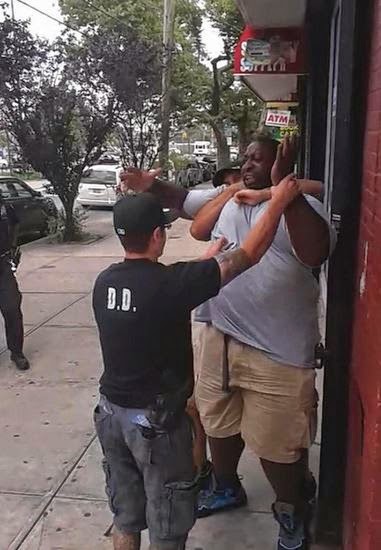
The first thing that jumps to mind in the death of Eric Garneris that somebody who is repeatedly saying “I can’t breath” is, in fact, breathing. It’s a basic rules of choking, first aid, and well, the way we speak. [Update: Seems I’m probably very wrong about this.]
Also, I’m no expert in chokeholds (because most departments forbid them), but what I do know is that a chokehold can either block the windpipe (which won’t kill you, since suffocation takes a while after you pass out) or block the carotid(?) arteries in the neck (which technically isn’t a chokehold but a strangle-hold). The former is done with the arm flat on the windpipe. The latter is more a vice grip, and you’ll go out pretty quickly. It’s pretty lethal. If you’re on the giving end, you have to let go as soon as the person drops if you don’t want the person on the receiving end to die.
I don’t see either of those being a factor here… though it doesn’t look good for the officer in green, Agent 99, who did grab Mr. Garner’s neck, since chokeholds are forbidden. That officer also may have rushed the decision to put Mr. Garner in custody. Generally I’m for a hand-on approach to physically controlling a guy. And it’s not easy to control a man as large as Mr. Garner. I’d be more critical if Mr. Garner died after being Tased.
But this is not a chokehold (though it’s possible one was used later).
And yet the Daily News caption in an article about chokeholds says “Eric Garner was put in a chokehold as Staten Island police tried to subdue him Thursday.” The officer (Agent 99) is using a half nelson and pulling on the guy’s neck for leverage to bring him down and to the right, which he does. He’s not near the windpipe, and this does not seem to be an attempt to choke the guy. So it’s not a chokehold. Does that distinction matter if the guy is dead? Well, yes. Because chokeholds are forbidden, and the guy is dead.
But there’s an important difference between saying “the cops killed him with a forbidden chokehold for resisting” (as I’ve heard people say) and “he died while resisting.” Once you decide the guy is under arrest, what would you do? Mayor DiBlasio said he watched the video like family. Well, I watched it like a cop. And it’s not easy to get cuffs and a large resisting man. Just because he died, which is a tragedy, doesn’t mean he was killed, which is homicide. Certainly it will matter what the autopsy shows.
What you have is a very large and presumably out-of-shape asthmatic man resisting arrest, perhaps because he didn’t deserve to be arrested. (I don’t know, I wasn’t there.) There do seem to be multiple witnesses (actually at the scene, I might add, which isn’t a given when it comes to “witnesses”) saying the same thing: Mr. Garner was a peacemaker trying to break up a fight. [But the officers seem to be arresting Mr. Garner for something else entirely: selling a cigarette.]
Mr. Garner, apparently, has been arrested 30-some times. And that very well may be why police focused on him.
But best I can tell (and again, I may be wrong), Mr. Garner seems to be little more than a repeat offender for the criminal offense of… selling loosie cigarettes! Now of all the idiot war-on-drugs nonsense… illegal cigarette selling should be low on the list of law-enforcement priorities. The guy died for selling loosies? And if he was selling them for 75 cents each (I don’t know the going price for loosies), then they’re cheaper than buying them legally by the pack. If he’s selling them for a dollar, then he’s making a good profit!
Why are about half of all the cigarettes sold in New York illegal? Because the tax is too high, and that has created a very large black market. The thing about legal regulated drug selling is it needs to make sense.
High taxes on cigarettes — $5.85 a pack ($4.35 New York State plus another $1.50 for New York City — were politically popular under Bloomberg, but probably do more harm than good in New York. That, just as much as any chokehold, contributed to the death of Eric Garner.
Selling loosies shouldn’t be a crime.
[The post has been updated. And see this as well, dispelling the idea that if you can talk, you can’t be not able to breathe.]