Tag: homicide

  • Suddenly It Became His Job

    Suddenly It Became His Job

    Well done, Officer Rogers!

    “An officer was actually on this block on another call and actually heard the shots being fired, said T.J. Smith, Baltimore City Police Spokesman. “That officer gave pursuit.” How often does that happen? And what exactly happened? An edited and shortened version of the bodycam footage had been acquired by WMAR, which made me go, “damn!” I asked T.J. Smith if I could view the entire footage, and he was kind enough to post it publicly.

    Here’s what happened. [There’s a timeline, below.] On April 19, 2018, at approximately 15:00 hours, Officer Rogers responded to a 311 call for a landlord-tenant dispute at 1704 N Regester. Probably something like, “landlord says tenant refusing access to her building. Please see Miss Whomever.” The 1700 block is a small block in my old sector. Six homes are boarded up.

    Many calls are for disputes that are not or should not be a police matter. It’s not his job. In civil matters, there’s very little the police can or should do. In Baltimore, as in many places, the sheriff’s office handles law enforcement related to housing issues. [This actually takes a great burden off police, who otherwise would have to be seen as taking take sides in evictions and like.]

    The landlord tries to make it Officer Roger’s matter by saying she has been threatened by the tenant. There’s some debate about “street talk” at if “going all gangster” is a threat. But the officer wisely won’t play this game. Presumably he’s got other calls to answer. It appears he’s already out of sector handling this kind of nonsense.

    [My take: Apparently the furnace broke. That’s a housing violation that needs fixing. Now there is something about hot water, too. The tenant reports this to the city so that he would have legal reason to stop paying rent. But, and here’s the catch, the tenant doesn’t want the violation fixed because as long as the status quo can be maintained, he’s living rent free! So the tenant decides he won’t let the landlord in. The tenant also says he’s moving anyway, which is news to the landlord and no doubt will coincide with the problem being fixed. The landlord says he owes her money. She isn’t going to get it. Yes, this is why people don’t want to be landlords. And basically as a cop you just want to make sure everything is just calm enough — basically that they won’t start fighting — so you can get out of there. Often the show to which police officers have a “front-row seat” is something not worth the price of admission. Again, this isn’t his job.]

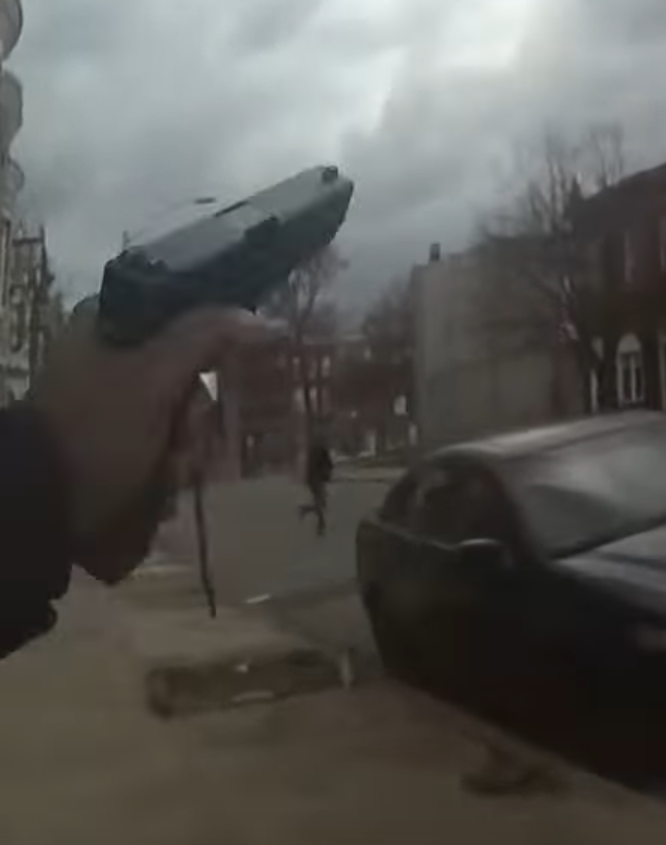
    It’s all very boring and typical. And it lasts for 7 minutes. Just as the officer is looking for a way out, boy does he find one. Gunshots ring out (7min:48sec). There are 15(?) shots in five seconds. Less than two seconds after the first shot rings out (and three seconds before the last shot) Officer Rogers takes off running, toward where the bullets are coming from. Yes, that is what most cops do.

    Walter Baynes, a 30-year-old black male, had just been shot and killed, and George Evans, 69-years-old, reported to be Baynes grandfather, was shot and wounded. One of them, I presume Baynes, had a gun on him when he was shot (13:23). The gunshots sound like they come from one gun, at least to my ears. But given the number of shots fired, it’s possible that Baynes also emptied his revolver at the man who shot and killed him with a semi-automatic. If so, Baynes missed.

    In the video, notice how the people, except for the officer, barely react to gunshots. And just a minute later it’s like things are back to normal. Traffic doesn’t stop. People walk by like nothing happened. Not even a reason to interrupt your dog walk (9:44). People act like it’s routine, because, unfortunately, it is. Sixteen of Baltimore 122 murders this year (to date) have been in the Eastern District. Many more get shot and live.
    Such brave, good police work is also routine. An officer runs toward gunshots and single-handedly confronts a man whom he believes to be armed, a man who just killed a man. He does this by instinct and training. He does this not necessarily because he wants to, but because it is the right thing to do. Because running toward danger is his job. He did good, Officer Rogers did. Very good.

    And then, after all this, all he wants to do is check his bodycam footage to see if the suspect is on it. If it were up to the ACLU and the police-are-the-problem set, police wouldn’t be allowed to do so. That’s crazy. Also, it takes 15 long minutes before somebody will watch the suspect so he can do so.

    Good police work doesn’t go viral like a video of bad policing or a cop doing something stupid. And if all people see are videos of cops shooting black men, they start believing that shooting black men is all cops do. So let’s play the counterfactual game and imagine this went down differently. Let’s say at 8:10 in the video the suspect made a move toward his waistband. Or maybe he didn’t. Either way, let’s say the officer shoots and kills the suspect. Would this be legally justifiable? Probably. Would it be correct? Well that depends if the suspect is armed. Can you tell if the suspect is? I cannot.

    It turns out the suspect isn’t armed, at least not at this moment when he’s caught by police. So now you would have a scenario in which a bad cop has shot and killed an unarmed black man. In Baltimore, no less. Oh, that would go viral. Doesn’t matter if the guy just killed somebody. The gun used to murder Mr. Baynes? Probably ditched in the alley and picked up by somebody else before it even bounced. Doesn’t matter if the cop is African American (implicit bias and all). There would be protests and perhaps worse.

    No matter what would happen now, the officer’s life is ruined. Career over. Thrown under the bus by the department. He and his family will receive death threats. Perhaps they will have to go into hiding. A criminal prosecution would likely occur. Mosby has tried to convict cops for a lot less. All because this officer ran toward gunshots and misperceived a lethal threat. Harsh.

    Should any single split-second decision really be the difference between a narrative of brave hero police officer and protests over an evil criminal cop who is now the only person from this incident on trial for murder? Perhaps we demand too much. We all make mistakes. What was the officer’s intention? Well, to apprehend a shooter. It was not to kill the suspect, though he was prepared to do so.

    Watch the video in real time, between 7:48 and 8:10. We’re talking a total of 22 seconds. How would you react? Of course you might reasonably say, “I don’t know. It’s not my job to react. I’m not a cop.” Ok. So let me ask this: how do you want police to react? Just as this cop did, right? Run towards gunshots, chase a suspect, and not shoot anybody, not even a bad guy. Job well done, right?

    Nope. Not so fast.

    See, the DOJ report on Baltimore Police, the one that opened the door to the consent decree, the one written by “progressive reformers” who have never let lack of police experience get in the way of telling police how to do their job, that report? Well it says Officer Rogers did it wrong. I mean, what if somebody got hurt?

    If circumstances require that the suspect be immediately apprehended, officers should contain the suspect and establish a perimeter rather than engaging in a foot pursuit, particularly if officers believe the suspect may be armed.

    You’re kidding me, right? I don’t even know what “containing” a suspect means, much less how you would go about setting up a “perimeter” to do so. This isn’t idle talk. Last month in Seattle, because of a consent decree, an officer faced discipline for successfully subduing a man with a axe. If police get in trouble for making decisions and acting in the face of danger, there’s really no point to having police at all. And that, of course, might be the “progressive” vision.

    Luckily, back in the real world, we’re left with the happy narrative of a brave officer who risked his life to apprehend a murder suspect. And luckily, in this case, no person-of-color was shot or killed at the hands of police. (Which seems to be just about the only thing reformers care about. The fact that two African-American men were shot, one fatally, doesn’t seem to register much with the “woke” set.)
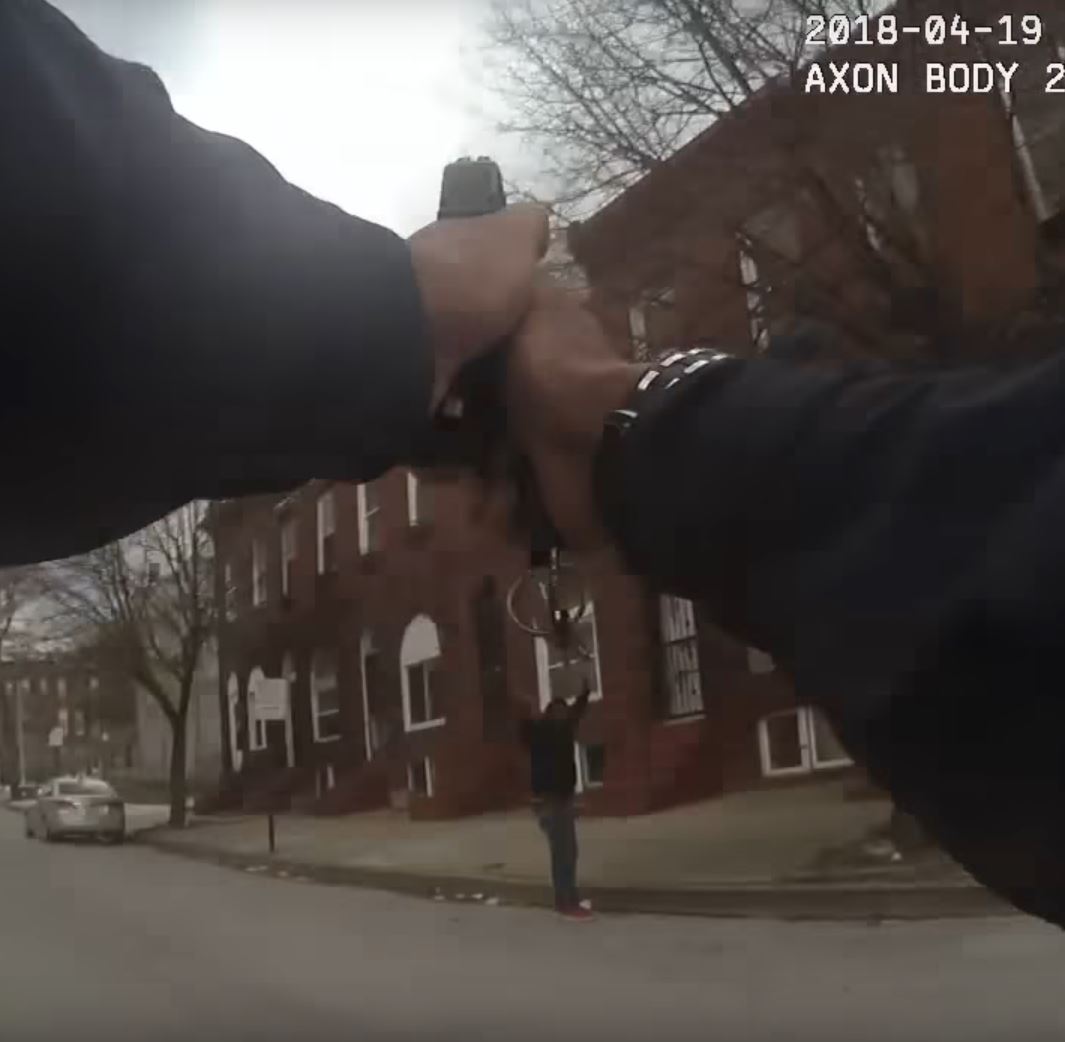
    We have this happy narrative because, as is common, the officer did not shoot the suspect when he might have. We have a happy narrative because the suspect complied with the officer’s orders. (The manner in which the suspect complied — quickly and completely — makes me seriously consider that the suspect isn’t the actual shooter. But I don’t know. He has been charged. Presumably gunshot residue on his hands answered this question.) But mostly we have a happy narrative because, despite all the haters, police in Baltimore and elsewhere are still out there, putting themselves in danger, trying to do the best they can in spite of it all.

    As to the original call, the landlord-tenant dispute? It ain’t going to close itself. At some point the dispatcher is going to need Officer Rogers to give it a code. I’m guessing it got a David-No, for “no police services needed.”

    Timeline:

    0:34— Officer is on-scene at 1704 N Regester for a civil dispute.

    7:48— 1st shot fired.

    7:50— Officer starts running toward gunfire.

    7:53— 15th shot is fired. shooting at 7:48-53 15 shots in 5 seconds

    7:54— Officer gets on radio to report shots fired

    8:00— Officer sees man in alley off to the left

    8:08— Tell man to get drop the gun and get on the ground.

    8:10— Suspect complies

    8:18— Suspect is on ground in prone position

    8:27— Officer: “My location…”

    8:28— In all the excitement, the officer forgets his location. In his defense, he does appear to be out of sector (331 officer on 321 post). But still. Always know your 20. During the next 20 seconds, given he’s out of breath and already said “shots fired,” the dispatcher should be sending officers in the direction of 1700 N Regester, the location of his call. Little things like that matter. A good dispatcher can save an officer’s life.

    8:50— Officer gives his location.

    9:26— Finally, the sweet savory sound of clicking handcuffs.

    9:44— Man with dog walks by and says good job or something.

    9:49— Backup arrives, one minute after location is announced.

    10:35— Officer: “Check that alley…. This dude, I’m up there handling a landlord-tenant dispute. Then all the sudden people start shooting. Shooter’s down right here. This dude I believe is the shooter. He just took his hoodie down. He might have dropped the gun in alley cause that’s where he ran.

    13:23— Radio: “One of the victims has a firearm in his waistband.” We later learn (at 18:34) that this gun is a revolver. It’s not clear if the revolver was fired at all. Either way, that leaves a semi-automatic belonging to the shooter who didn’t get shot, and fired somewhere between 9 and 15 rounds.

    13:30— Officer: “Why was you in the alley? And you just happened up here when the shooter came out, right?” Suspect: “Bro, I was walking up the alley to walk up North Avenue, bro, and I heard some shit. That’s why I started running.”

    14:41— Officer tries to get somebody to watch the suspect so he can review his bodycam footage.

    16:28— Shift commander: “What hundred block of Lafayette is Register at?” Uh, in the 1700 block, Baker-09. Where it’s always been.

    30:08— The suspect assures officer he wasn’t doing nothing.

    30:18— Finally, a kindly homicide detective agrees to watch the suspect the officer can return to his car to check his bodycam footage. “I’m not leaving till you do,” she says.

    30:20— Officer: “I swear. One simple thing. Ask one person to watch him so I can review the bodycam footage so we can close this. But nobody is listening to me. I’m only the one that chased the goddamn dude.”

  • Quality Policing Podcast: Interview With Jeff Asher

    Quality Policing Podcast: Interview With Jeff Asher

    There’s another quality policing podcast in which I talk to data analyst Jeff Asher about the Brennan Center’s latest report on crime. Asher had posted this thread about methodological problems in their data and analysis.

    Brennan has a new report out showing murder down 2.5% nationally, but there are some major issues with that finding.

    1) The figures cited aren’t year-to-date, they’re projected year end numbers based on around midyear counts.

    2) Murder tends to pick up over the second half of the year, and any projection using midyear numbers will almost certainly be wrong.

    3) They found murder -2.5% but included San Fran’s 2016 count in that. There was no count for 2017. Removing SF makes murder -1.5%.

    4) Detroit is estimated to be -27%, but that’s based on Detroit’s open data site.

    5) That’s problematic because the open data site is slow to add murders, so any year-to-date count will be wrong.

    6) Detroit had over 130 murders as of late June according to the Detroit Police Department, and the 220 murders they project would be the fewest there since 1966.

    7) Taking Detroit’s inaccurate count out takes murder in their sample from -1.5% to +0.7% overall. So Detroit’s inaccuracy explains the drop

    8) The Phoenix count is similarly wrong. Phoenix had about 150 murders in 2016 but this report says they had 80 and project 60 for 2017.

    9) The Phoenix figure was reached by using MCCA midyear data and doubling it, but Phoenix only reported Q1 data to the MCCA.

    10) As of May Phoenix had 58 murders year-to-date in 2017 and 56 in 2016. Take away Phoenix and Detroit and suddenly murder is up 1.2% in the sample.

    11) Which is to say nothing of the methodological issue of projecting midyear for 30 cities to a full year and calling it a national trend.

    12) For what it’s worth, my midyear piece for @FiveThirtyEight shows murder up a few % but rising slower than previous years.

    13) Also worth reading is @Jerry_Ratcliffe on why doing year-to-date analysis isn’t a great idea

    14) Larger point is that measuring murder nationally is tough, drawing sweeping conclusions from badly incomplete data is a huge mistake in my opinion

    This isn’t the first time the Brennan Center has released faulty and misleading reports on the rise in homicide. In July, after the last one, I finally made an attempt to talk to one of the report’s authors. Once I laid out my concerns, the correspondence ended. Today I asked the other author (via twitter) if he wished to be interviewed or engage in a civil discussion of methods. No dice, apparently he’s “alright, thanks.” It’s still an open invitation.

    There are numerous problems with their analysis, but the most irksome to me is the straight-up misleading statement. I asked:

    Is this statement [from your report] true? “Notably, 55.6% of murder increase 2014 to 2017 is attributable to two cities — Chicago and Baltimore.”

    Because I know it’s not true, since about 14 percent of the murder increase from 2014 to 2017 is attributable to Chicago and Baltimore. He replied:

    Yes. It’s true for the 30 largest cities (our cohort), not nationally.

    This not an explanation as much as a confession because they don’t say “for the 30 largest cities (our cohort), not nationally” in their report.

    I understand how they got their numbers; on my calculator, I can replicate their methods. That’s good, but not good enough. Their methods are faulty.

    Here are some of my remaining unanswered questions I posted on twitter.

    Since 2013, what is the change in homicides in those 30 cities? I get a decrease in 3 cities and an increase in 27. Is this correct?

    Do you understand problems in saying a “percentage of increase in sample“? Substantively meaningless & statistically absurd.

    If you have three years of data, why do 2017 tables only compare with last year, 2016?

    It may turn out to be true, but still seems a odd choice that only mention of (20%!) 2-year homicide increase is as “short-term fluctuation”

    If twitter can’t do this justice, I’d be happy to interview you for @QualityPolicing podcast.

    I asked if we could “continue w/ a civil discussion of your methods?” Alas, the reply was: “I’m alright, thanks.

    For two main reasons, I’m not OK. I’d like the Left to stay committed to the truth. The generally decent Brennan Center should be above Heritage-Foundation-style BS.

    But more importantly: when you say murder is down when murder is up, it’s not just an issue of truth. It’s also an attempt to make the murder victims — disproportionately poor young black men — disappear from our consciousness. As if they never existed. Do their lives not matter, too?

  • “A small price to pay”?

    “A small price to pay”?

    Last postI presented the depressing fact that at current level of violence, the chance for a man in Baltimore’s Western District to live to age of 35 without being murdered is just 93% [updated to include 2018 data]. Yes, more than 7 percent of black men in the Western District will be murdered unless Baltimore can get a grip on violence. It hasn’t always been so bad.

    Before the riots and failed “reform,” there were about 217 murders a year in Baltimore (2010-2014). That’s not great, mind you. Not at all. Police Commission Davis said:

    They [celebrated] when they got to a certain artificial number of murders. As if 200 murders is acceptable for a city of 600,000 people.

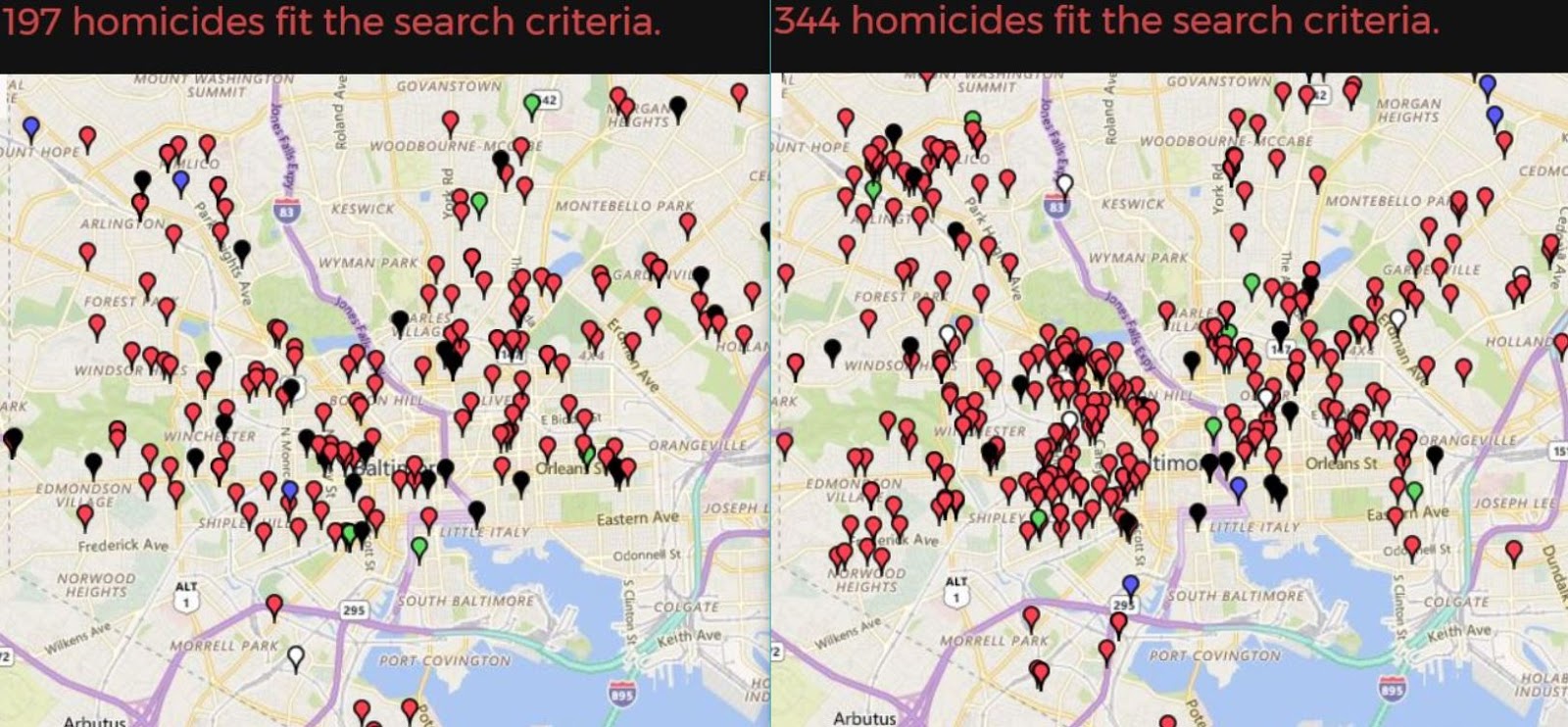
    You know, darn it, at some level he’s right. Two-hundred murders is not acceptable. But… but… the chutzpah. Last year 318 people were murdered in Baltimore. 344 were murdered in 2015. In 2011 murders dropped to 197, the first time in decades murders were below 200. And the current police commissioner has the nerve to disparage city leaders who took a brief celebratory lap? The nerve.

    Right now, for Baltimore, 200 murders wouldn’t just be “acceptable,” it would be a dream. 229 people have been killed this year, and we’re not even out of August.

    (Murders in 2011 vs 2015, Baltimore Sun, click to embiggen)

    It’s not just the violence, it’s that Baltimore’s leaders blame everybody but themselves.

    [Baltimore State’s Attorney Marilyn] Mosby cited zero-tolerance policing as a “failed strategy” that continued in Baltimore long after it was formally disavowed by the city’s leaders. “Those failed policies are what got us to the place we were at in the spring of 2015,” she said, referring to the unrest.

    Blame O’Malley? He left office ten years ago. Violence went up two years ago.

    Davis says:

    “There was a price to pay for” the drop below 200 homicides, a price “that manifested itself in April and May of 2015,” Davis said, referring to the uprising following the death of Freddie Gray.

    Really? So according Davis, years of oppressive policing led to riots. It could be true. (Though I’m shocked to hear Progressives float the idea that repressive policing reduced homicides.) Perhaps the yoke of police oppression led people to rise up righteous indignation?

    Between 1994 and 2014, annual arrest numbers in Baltimore varied from a low of 39,654 to a high of 114,075. You think more than 100,000 arrests each year for four years in a row might spark a riot? Well, it didn’t. That was 2002 to 2005. Murders went up slightly during those years, to 269. If 114,000 arrests didn’t start a riot, it’s hard to imagine fewer than 40,000 doing so. By 2011, arrests were down 50 percent.

    1994arrests: 77,545 — 321 murders

    1995: 81,140 — 325

    1996: 61,403 331

    1997: 77,750 312

    1998: 89,149 313

    1999: 85,029 205

    2000: 86,093 261

    2001: 97,379 256

    2002: 106,117 253

    2003: 114,075 271

    2004: 104,033 278

    2005: 103,837 269

    2006: 93,393 276

    2007: 86,334 282

    2008: 82,656 234

    2009: 79,552 238

    2010: 69,617 224

    2011: 59,877 197

    2012: 55,451 217

    2013: 42,097 235

    2014: 39,654 211

    2015: 27,765 344

    2016: 25,820 318

    Look at at 2007 to 2014, a Baltimore miracle happened! Arrests were cut in half while homicides went down 25 percent, from 282 to 211. This was hard work and good policing. Not perfect, mind you. Sometimes not even good. But better, incrementally, year by year.

    Davis and Mosby are trying to rewrite history, pretending years of progress never happened. Now it’s one thing to be pissed on and be told it’s raining, but these two are pissing all over our feet and telling us we’re better off with wet shoes.

    Go ahead and fix long-term systemic problems. But while you’re doing that, in the meantime, let’s tell police what we want them to do with criminals today. Violence varies independently of poverty, racism, unemployment, segregation, an family breakdown, the so-called “root causes” of crime. These didn’t change in 2015. Policing did. Discouraging proactive legal discretionary policing allowed violent criminals to be more violent. Telling cops not to make legal but discretionary low-level arrests on drug corners was a bad idea.

    There’s only so much decline a city can take. Baltimore’s population is at a 100-year low. And the people leaving, hard-working non-criminal taxpayers, are sick of crime.

    Mosby admits Baltimore “is kind of in transition right now.” I’m afraid Baltimore is transitioning from a city with failures to a failed city.

  • Too much to bear

    Back when I wrote Cop in the Hood, I was horrified to figure out that 11.6 percent of men in the Eastern District were being murdered (see the footnote on pp. 219-222).

    [Updated to include 2018 data and more accurate population figures.]

    From 2015 through 2018, 226 people were murdered in Baltimore’s Western District. 145 were black men age 18 to 34. 36.25/year. This is about twice as high as the pre-2015 rate. There are approximately 7,226 black men aged 18 to 34 in the Western District. (And a total population of 47,600. So the annual homicide rate for 18-to-34-year-old men in the Western District over the past four-years is 419 per 100,000. (The national homicide rate is now about 6 per 100,000; Baltimore’s is 50.)

    What does a murder rate of 419 mean? Well, here’s a survival function:

    1 – (1 – r)^x

    r is the death rate and x is number of years. The death rate is 1 in 239 or .0042. The number of years from 18 to 34 is 17.

    So 1 – (1-.0042)^17 =0.069.

    This means that if homicide levels don’t drop, a 17-year-old man in the Western District today will have a 7 percent chance of being murdered before he reaches the age of 34. And since about one-third of murders in Baltimore happen to those 35 and over, approximately a 10 percent lifetime chance.

    One-in-ten men murdered?! I don’t know what else to say.

    [I thought of some things to say in my next post.]

  • “Biggest Spike in 50 Years”

    “Biggest Spike in 50 Years”

    If only we cared about homicide victims as much as we did about traffic fatalities, we might see an article in the paper about the biggest homicide spike in 50 years. Instead, there is a Times article about distracted driving: “Biggest Spike in Traffic Deaths in 50 Years? Blame Apps.”

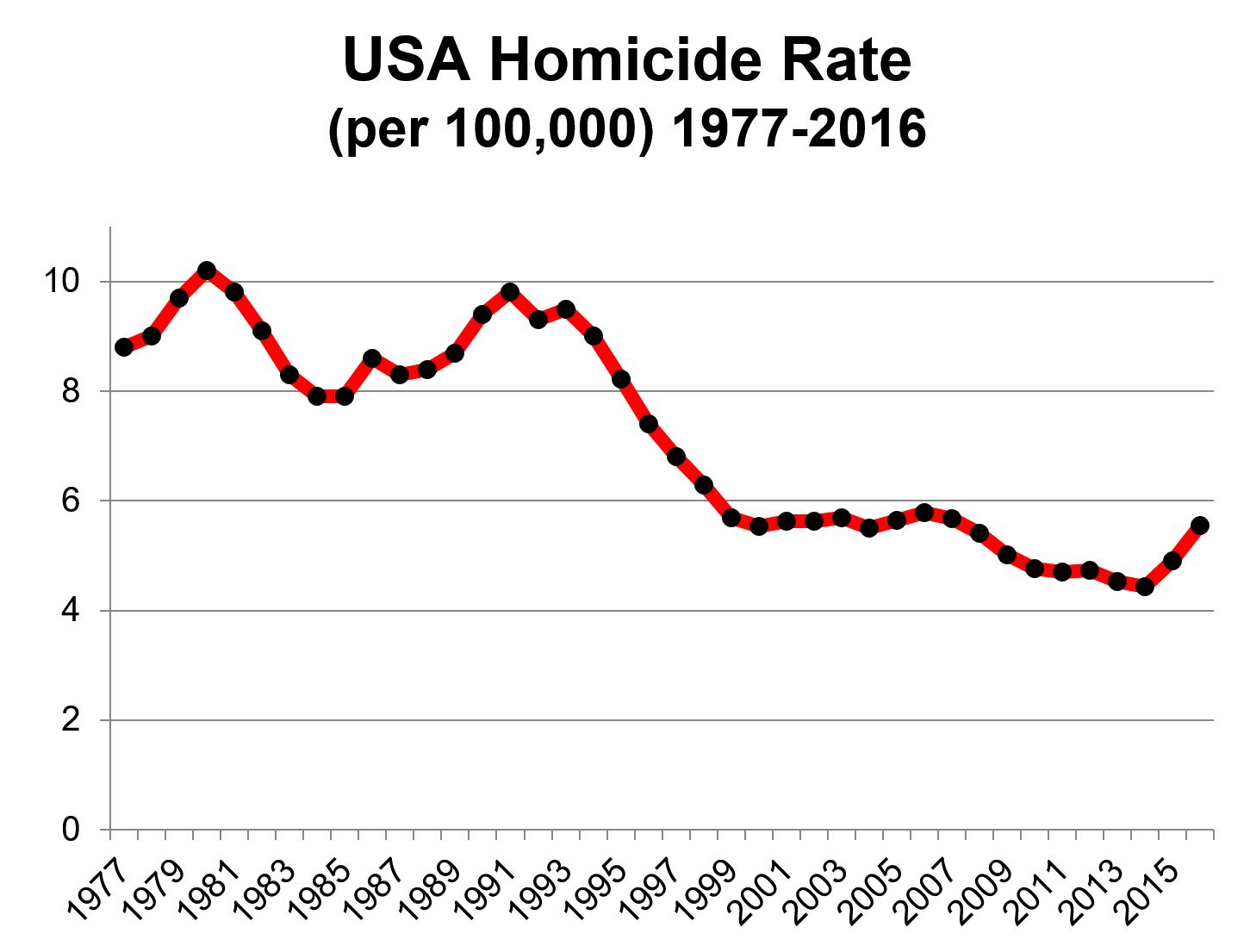
    The rise in traffic deaths — the total number of highway deaths in America (35,000) is roughly twice the number homicide victims (16,000) — has been reported by the Wall Street Journal, NBC, Newsweek, and Reuters. None of these stories talk about a “statistical blip,” or “traffic deaths are still at historic lows,” or “no need to worry, because certain high-speed roads account for most deaths.” No. Nor should they. Because the rise in deaths is real and real people are dying. When it comes to traffic deaths, we take the data and try and figure what is happening and how to prevent it. Why aren’t we doing that with homicide?

    Violence begets violence. And the longer we stick our head in the sand, the worse this will be. I know the phrase “law and order” is right-wing, but the concept that people have a basic right to live is not. The left shouldn’t cede law-and-order issues to the right. Ideological prisms need to be set aside for basic human decency. It’s better to address the violence problem before thousands more are killed.

    I understand, or at least I think I do, the motivations of those on the left who minimize the significance of the homicide increase. There’s a very real concern that those on the right will use crime to push ineffective and even racist policies that hurt the very people most at risk. Or maybe it’s difficult for some to objectively examine the homicide increase in light of everything that has happened, post-Ferguson, with demands that police be less racially disparate and proactive.

    Murder victims are disproportionately poor young black male high-school drop-outs. This is politically awkward at best, certainly when it comes to the matter of black lives. But some on the left have gone so far to say that since “most Americans” aren’t at greater risk of being killed, “warnings” are politically “provocative.” Good God! I mean I know that you , dear reader, are much more likely to be killed in a car crash than be the victim of a homicide. But for many other people, the opposite is true. Because it affects others more than you is reason to care even more.

    So I read this Times article about traffic deaths and notice how much it, word for word, could be applied to the nation’s spike in murder, the one nobody is talking about. Even the graphic could basically be copied (though I made one for murder). I did change a few things in [brackets] — eg: “transportation” to “justice” and “highway fatalities” to “homicides” — to create the article I wish were getting as much press:

    After steady declines over the last four decades, [homicides] last year recorded the largest annual percentage increase in 50 years. And the numbers so far this year are even worse. In the first six months of 2016, [homicide] deaths jumped [13.1] percent, from the comparable period of 2015, according to the [Brennan Center].

    “This is a crisis that needs to be addressed now,” the head of the agency, said in an interview.

    Alarmed by the statistics, the Department of [Justice] in October outlined a plan to work with the [police] and advocacy groups to devise a “Road to Zero” strategy, with the ambitious goal of eliminating [murder] within 30 years.

    The Obama administration’s [Attorney General, Loretta Lynch,] said that the near-term effort would involve identifying changes in regulations, laws and standards that could help reduce fatalities.

    “This is a serious public safety concern for the nation,” [she] said at a recent conference in Washington held by the National [Violence Prevention] Board. “We are all trying to figure out to what extent this is the new normal.”

    Deadly [Murder] Rise

    After decades of steady declines, the number of deaths stemming from [homicide] has risen in the last two years to its highest level since 2009.

    [Posts in this series: 1, 2, 3, 4, 5, 6]

  • Homicide is up, and it’s not Trump’s fault yet

    Somehow, between the Cubs winning the World Series, the presidential election, friends and family visiting, and, you know, my job, I missed this.

    The Brennan Center, which has been repeatedly telling us not to worry about rising homicide, predicts that this year’s homicide increase will be even bigger than last year’s increase (last year’s was 10.4%, this year’s is predicted by the Brennen Center to be 13.1%). The Brennan center says “Nationally, the murder rate is projected to increase 31.5 percent from 2014 to 2016.”

    [Update/correction: Their math, as has been pointed out to me, does not add up. By my math, a 13.1 percent increase after a 10.4 percent increase is a 24.9 percent 2-year increase. I’ve changed a few things in this post to reflect the correct number.]

    Homicides up by 25 percent in just two years? This is the biggest two-year increase ever.

    Their conclusion:

    There is no evidence of a national murder wave.

    What the f*ck? I’m getting these numbers from their report! It’s like Bagdad Bob all over again. I wonder how long they can keep this up.

    Oh, but they do go on:

    Increases in these select cities [Baltimore, Chicago, and Houston] are indeed a serious problem.

    You think? But…

    most Americans will continue to experience low rates of crime. A few cities are seeing murders increase, causing the national murder rate to rise.

    Apparently, goes their logic, as long as homicide goes up more in some cities than others, it’s not really going up elsewhere, even though it is. To say the increase in homicide is due to a few “select cities” is simply not true.

    Chicago, Baltimore, and Houston are not at all creating the national trend. They’re just the leaders of the pack. One could remove “these select cities” — not that you should, mind you, but I have — and we’re still left with a huge increase in homicide, nationwide.

    [And the “most Americans” part really gets my goat. Like we didn’t to worry abut minorities at risk? I’d like to hear the Brennan Center tell that to everybody afraid after Trump’s victory.]

    And mark my words: when the official UCR data on this year comes out next year, those on the Left will be quick to blame Trump and everybody and everything except what has happened since 2014, post-Ferguson, locally with policing and nationally with the DOJ. These past two years have been an unprecedented and unmitigated disaster in terms of rising murder, particularly among poor young under-educated African-American men with guns. And the only person who even pretended to care (and based on his record, I seriously doubt his sincerity) just won the presidential election.

    Speaking of my words, a short while back I wrote this:

    Here’s what scares me right now more than guns: the potential right-wing law-and-order backlash. … It will be the largest [homicide] increase in decades. And yet the Left has been in denial about this (and/or discounts its significance). … we’re virtually conceding law-and-order issues to Trump and the fascist Right. Politically and morally, this is bonkers.

    And this:

    Politically, I don’t want to the only people responsive to rising crime to be Trump and the “law-and-order.” They scare me.

    And that’s the world we live in. The Left wouldn’t address this issue. Well, let’s see what happens now.

  • Spin This: The biggest murder increase in 45 years

    Murder is up. Who knew? (I’ve been saying so since last October.) Eventually, we’re all going to have to accept this (not in a moral sense but in a statistical sense). The accepted liberal reaction to this increase seems to be “it’s not a big deal” and “Don’t freak out.” Let’s not get “hysterical.” Let’s talk about “gun control.” (In the early 1990s, by the way, it was all about “drug treatment.” That didn’t happen either. And crime went down.)

    What I really do not understand is why the Left is willing to concede crime prevention to the Right. (I bet Trump won’t be downplaying this in tonight’s debate.)

    False argument #1: The best violence-reduction strategy is a job-production strategy.

    It sounds nice, but I say bullsh*t. As if unemployed people just can’t help but shoot each other.

    Do not get me wrong: Poverty is bad. But it just so happens that 2015, the year with the big murder increase, also saw the biggest decrease in poverty since 1991. 3.5 million people rose out of poverty last year. That’s great news. It really is. (Full report & summary in the NYT.)

    But we still hear this from people like this St. Louis alderman:

    How do we use that [crime] data to elevate the consciousness of our community? How do we use that data to provide the opportunity for people to get meaningful jobs, with livable wages?

    No. I mean, yes! Please, work on that, too. But the question from these data is how the hell we get police back into policing and crime prevention. Sure, it sucks when dad loses his job, but consider how much worse it is for dad to get killed coming home from work. (I would even say that you can’t have a real job-production strategy until you achieve violence reduction. Who the hell is going to open a business where you will get robbed and workers get mugged walking to their car?)

    The Guardian goes on to summarize the Brennan Center’s position:

    Last year’s national murder increase was not a uniform trend, but a sum of contradictory changes in cities across the country. Early analyses of the 2015 murder increase suggested much of it might be driven by murder spikes in just 10 large cities.

    (Now I see how clever the Brennan Center was to put out their paper last week, so it becomes cited immediately to put things “in context.”)

    False argument #2: It’s just happening a few cities.

    No. It’s not.

    Homicide (and almost all violent crime) is up in every grouping of towns and cities (such as “under 10,000” and “over 1,000,000”). Period. Now that doesn’t mean it’s up in every city. But what a weird and nonsensical standard. Sure, if we remove all the places where crime is up, crime wouldn’t be up. But that’s we have fancy statistical concepts like “overall,” “in general,” and “trend.”

    Even if we were to remove the 6 cities with the largest increase — and I don’t know why we would — but just to see if the problem is isolated in a few cities, let’s take out Baltimore, Chicago, Milwaukee, Washington, Cleveland, and Houston (collectively those cities saw about 420 more murders in 2015) — even without these cities the rest of America would still have 600 more murders and the biggest homicide increase in 25 years. That’s how bad these just released numbers are.

    Now we can say that violence in concentrated in certain neighborhoods. That’s true. But we’ve long known this. Indeed, as you can tell from looking out your window, there aren’t armed marauders outside your castle gates. What matters, or at least should matter, is that more American are being murdered. I find it distasteful (particularly when it comes from the Left) to say “most people” don’t have to worry about crime because the “average person” is still safe. The fact that violence disproportionately affects a subset of Americans may indeed mean it’s not a “national crime wave,” but it is all the more reason to care.

    False argument #3: It might just be a statistical blip.

    But it’s not. I mean, it could be a statistical blip…. If it were just one or two percent. But it’s up 11 percent. The last time we saw an 11 percent one-year increase in murder was 1971. That’s exactly my entire lifetime. And that was in the middle of eight-year run when homicides doubled from ten to twenty thousand. This “blip” was literally the deaths of 1,600 more Americans. The number of people killed went up from 14,164 in 2014 to 15,696 in 2015. That one-year increase negated 5 years of homicide decline.

    If you think this increase in murder “no cause for alarm” and people who care are “overreacting,” to you, I respectfully say “go to hell.” We worked too hard to get to where we are (or were) with lower crime. And a “don’t-overreact” reaction does not help. And it may lead exactly to the right-wing law-and-order backlash you so fear. (But on the flipside, to those who don’t really care but will use these deaths to make some racist point about “black-on-black” crime and “those people,” I say with all my heart, “no really, to hell with you, too!”)

    Why I care (and why you should, too):

    Among academics, it’s quite uncool to blame criminals for crime or give police credit for crime prevention. But then how many statisticians who use the UCR Homicide Supplement can point to a specific row and say, “Yeah, I handled that one.”

    Too many who say they’re for “justice” never really have to think about the injustice of just even one real murder victim (one not shot by police). But then maybe I care because I was a Baltimore cop. Every single cop can tell you a story about a dead person. Why? Because they care. Granted, some cops do care more than others, but you can’t police and not care.

    I wasn’t a cop for long (less than 2 years in total), and even I lost track of how many victims I dealt with. But a few do stand out. And this isn’t even getting into my cop friends who were shot, killed, nearly killed, had to kill somebody, or carry physical and emotional wounds for life.

    I remember the stare of a young black man at the same track we ran around while in the academy. His backpack made me think he was a good kid, on his way home from school. He was shot, perhaps after being robbed. We made long eye contact, even though he was dead.

    I remember the guy with a gunshot to the head one 321 Post. He was still alive when I got to him. But he clearly a goner, with blood and brain dripping from the hole in his head. His sisters were wailing while he died.

    How many Harvard PhD students have the intimate experience of sorted through a victims’ clothes? Clothes that are literally dripping with blood and yet still reeking of body odor. You’re trying to go through everything, looking for pockets, for any sign of identification of the life that used to be. And then there are the death notifications.

    Think of all those deaths. Last year there were 133 more murders in Baltimore than there were in 2014. [This year the numbers are down slightly compared to 2015, and the chutzpah of some people to herald Baltimore’s “crime drop” is shocking.] Take a moment and picture all those dead bodies, almost all shot young black men and teenagers. Visually stack them up like cordwood if you wish, or lay them all head-to-toe. It’s real human carnage.

    If you took all the Baltimore murder victims from just last year and laid them head-to-toe where the Ravens play football, that line of dead bloody bodies could score six endzone-to-endzone touchdowns. And the increase in violence last year happened all after April 27th. All it took was one man’s in-custody death coupled with anti-police protests, bad leadership, a riot, and a politician’s horrible choice to press criminal charges against six police officers in the matter of Freddie Gray’s death. (All charges ended up being dropped after multiple trials without a single conviction on any charge.)

    This is actually one time I don’t care about the historical perspective. Less than the 1990’s crack-crazy murder rate is not good enough. We got down to a homicide rate like Canada (about 1/4 of ours), and maybe I’ll be satisfied. We can start caring now. Or we can start caring after a few more thousand people are needless killed. And if you think I’m over-reacting, consider that you might be under-reacting.

    [Posts in this series: 1, 2, 3, 4, 5, 6]

  • Bad Cop Good Movie: The Seven-Five

    I’m finally getting around to watching The Seven Five, a documentary about the 75 Precinct in the 1980s and criminal cop Michael Dowd. Good stuff… the documentary, that is, not the cop.

    I like how the movie is told through three perspectives: the dirty cops, the cops who caught them, and the criminal the cops worked for. And of course they’re all really charismatic.

    But what amazes me is the reputation for NYC being so crazy back then. I mean it was. Sort of. In 1990, the height of the crack epidemic (the Bronx was already burnt) New York City’s homicide rate peaked at 30 per 100,000.

    And the 75 Precinct was the highest homicide precinct in the city, with 126 murdersin 1993. That’s a rate of about 80 per 100,000.

    Last year in New York City? The homicide rate was 4.

    You know what Baltimore’s homicide rate was last year? 55.

    When I worked the Eastern District the homicide rate was 100.

    Last year in the Western District, the homicide rate was 140.

    Think of what that means, to residents and cops alike.

    [Fun fact: The most ever homicides in any one Baltimore district? The Western in 1972. 87homicides. (Though last year’s rate was probably higher, given the population flight from the area.)]

  • How people get killed

    Murders are usually thought of in the abstract. People “get killed.” Homicides “rates” go up or down. But to each killing, there’s a person who kills and a person killed. This isn’t really understood by those who don’t live or work in high crime areas. (Yes, while murder can happen anywhere… no, murder actually doesn’t happen everywhere).

    Not to glorify snuff films — because, spoiler alert, this guy gets killed [update: or maybe just critically wounded] — but I think it’s important to understand the individual nature or homicides when talking about crime and police.

    From the Daily News:

    Police statistics said that as of Wednesday morning there had been 727 people shot and 135 homicides so far this year in the city of Chicago.

    However, the Chicago Tribune reported at 9 p.m. that nine more people had been shot during the course of the day, including a 23-year-old man and a 43-year-old woman, who were both killed.

    The incident is the latest in the city’s most violent start to a year since 1999.

    Earlier this week a young woman named Camiella Williams, 28, told The Trace that she has lost 23 loved ones to shootings, and is now an anti-gun violence advocate.

    As the story was being edited another one of her friends, 27-year-old Cordero Mosley, was shot six times and died.

  • Good news: Baltimore Homicides in 2016 only up a little…

    Baltimore homicides, year to date, are only up a bit compared to last year. Through March 24th, 50 this year compared to 47 in 2015.

    Rarely is more murder good news. But it’s certainly an improvement from last year, post riot. From May through December 2015, there were 269 murders in 244 days. So 50 murders in 84 days in 2016 is strangely good news. Yes I know it’s low season. But it’s still a good sign. We’ll see if it lasts.