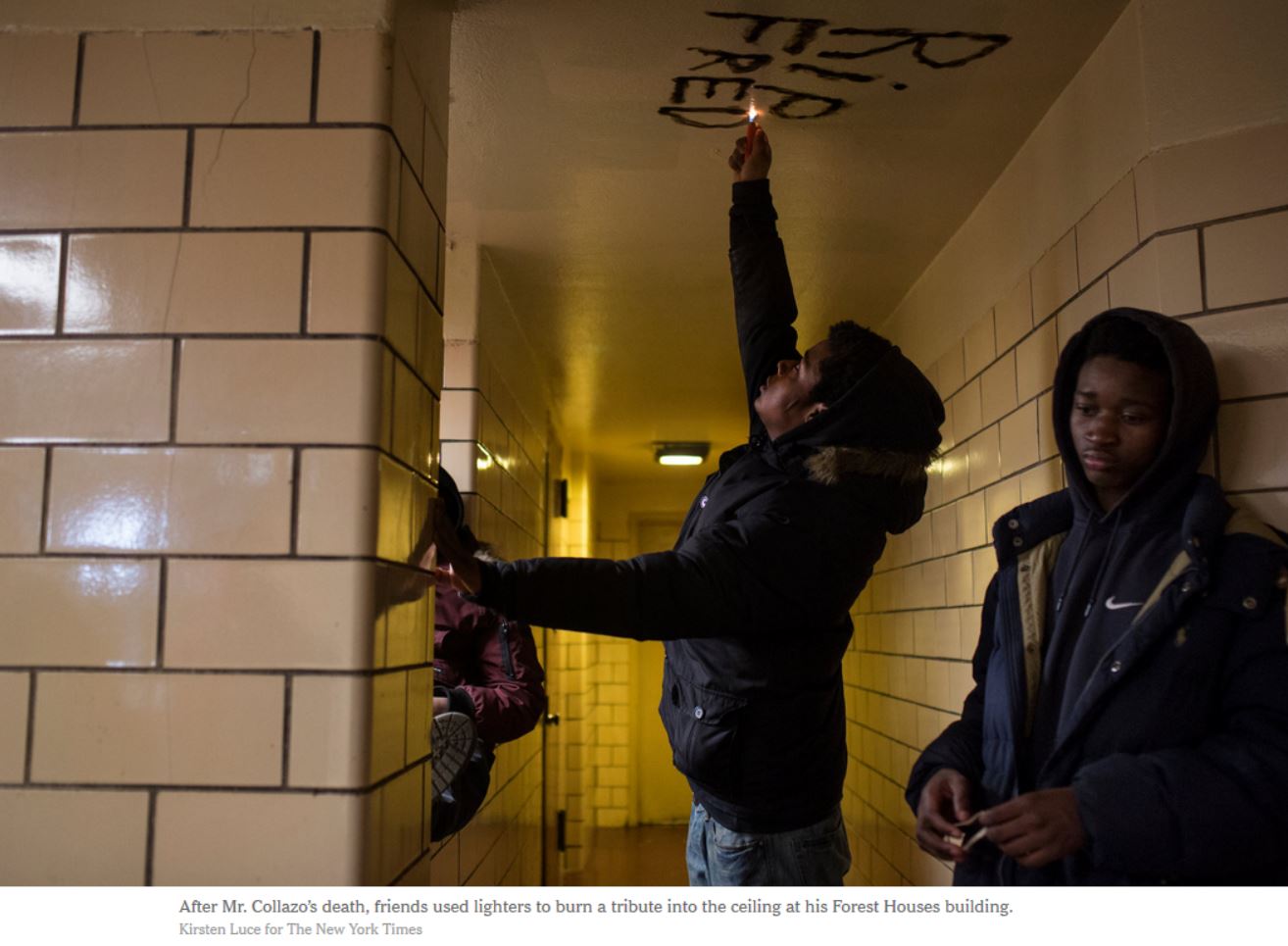
Benjamin Mueller and Al Baker in the New York Times describe one homicide in the Bronx. “To understand why killings persist in an era of historically low crime, The New York Times is reporting this year on each murder in the 40th Precinct.” This is the kind of in-depth story that informs.
If we’re going to improve things, where do we start? Sure, the Collazos need help. But then so do my students who grow up as his neighbors. While Fredo is selling drugs and smoking weed in the lobby — and non-residents complain that “non-violent drug offenders” like Fredo are being harassed by police — my students have to get by him and his crew to get to my class. Some people manage to make better life decisions and finish high school and get jobs and graduate college and get better jobs. In a world of limited resources, who do we help? And how many red flags do there need to be?
A “broken window” in action. Cause nothing says respect to your neighbors like “RIP Fredo” burned into the ceiling of the hallway.
Here’s a name and a face and a life. 20-year-old Freddy Collazo:
Mr. Collazo’s father, who was addicted to heroin, served nearly two years in state prison for drug sales. His parents separated when he was in his early teens.
…
Mr. Collazo’s … slashing in May 2012; his wounds — including cuts to his head, ear, left elbow and right middle finger — were recorded by the police, despite his refusing to talk to officers at a hospital.
…
He got a .32-caliber Smith & Wesson revolver after the 2012 slashing — a requisite precaution, friends and relatives said.
…
But Mr. Collazo was coy, even with close friends, about why people wanted to hurt him. When Ms. Soto asked how she could help, her son acknowledged being in trouble but insisted, “No questions.”
When he was sent to jail on Rikers Island, his father, whose name is also Alfredo Collazo, was already there, having been locked up four days earlier on drug charges.
…
He had expensive tastes in clothes, favoring name-brand polo shirts.
He popped prescription pills, including Percocet, smoked marijuana in the lobby of his apartment building and sold drugs, sometimes under the banner of Forest Over Everything but just as often on his own.
…
Mr. Collazo dropped out of Herbert H. Lehman High School in the 11th grade.
…
Mr. Collazo was arrested again in April 2014, this time for marijuana, but he only had to pay a fine. He walked around as if he were invincible, friends said, relying on his crew for protection as his street feuds piled up.
His ability to keep avoiding prison time created suspicions among his crew.
Last May, Mr. Collazo entered a residential drug-treatment program in Brooklyn.
His anxiety ran so deep that Mr. Collazo once badgered a new student who he thought had been looking at him too much.
…
In late February a hooded gunman crept up behind Mr. Collazo. The first bullet severed Mr. Collazo’s spine and blew through his heart, killing him before he hit the pavement. His cousin, Luis Cruz, ran.
Then the gunman stood over Mr. Collazo, 58 days past his 20th birthday, and with a .45-caliber pistol pumped at least six more bullets into his body, leaving a total of 10 entry and exit wounds.
Sgt. Michael J. LoPuzzo, the commander of the 40th Precinct detective squad, said Mr. Collazo was “assassinated.”
But Mr. Cruz has told Mr. Collazo’s mother that he will not say who the killer is.
“I told him, ‘Please, you was there, go to the cops and tell them what you know,’” Mr. Collazo’s mother, Glenda Lee Soto, said. “He told me he’s not going to do it. He’s not going to go down for a snitch. He’s not going to rat nobody.”
Chief Boyce said people’s reluctance to speak with investigators “doesn’t mean we stop — it just means our task is all the more difficult.”
…
At his funeral the next Sunday, two young men were handcuffed by the police as they entered the funeral home parking lot; the police said they had arrested one person, for having stolen license plates.
…
Friends scrawled tributes on the wall — “F.O.E.,” “For you we gon bang bang,” “Ima put them under dirt” — and raised their lighters to the ceiling to burn “RIP FREDO” into the beige paint.
The lobby became choked with marijuana smoke. Mr. Collazo’s raps blared from his friends’ cellphones and echoed off the walls. The group scattered when two officers arrived, responding to a neighbor’s complaint.
But slowly they returned.
And some people? Out of all this? Of all they could criticize? They would find fault with police for maintaining order in the lobby of a public housing building. Nothing but police harassing innocent children of color as they mourn the untimely death of their friend.