Tag: In Defense of Flogging

  • “As limp as it is dubious”

    So says the Washington Times about my defense of flogging. Though I’d say overall it’s neutral (to mildly negative).

    The reviewer seems upset that the book is actually more about prison than flogging (but of course, that’s the point) and also that I didn’t convince her that flogging is the answer. Oh well.

    Here’s the full quote:

    “Flogging” is intriguing, even in – or because of – its shocking premise. As a case against prisons, Mr. Moskos’ is airtight; as for the case for flogging, it’s as limp as it is dubious.

    Not so positive. A bit critical. But fair enough. It’s not a bad review and certainly could be worse. And, as they say about publicity, at least they spelled my name right!

  • Tuesday One-Two Punch (or lash)

    The Blaze(that’s Glenn Beck)
    and Metro(that’s subway). Metro is new material.

    Oh, and there’s a third punch. Let’s call it an uppercut. The Takeaway (National Public Radio) 7:45 AM (which is really the worst possible hour of the day for me to do anything. If it were any early, I’d just stay up all night and be much happier.

  • Flogging on CNN

    I’ll be on CNN, Sunday, from 7:30 to 7:35pm (Eastern Time) with Drew Griffin. I get to sport the suit I got made for me in Thailand. I’ll probably even wear a tie. If you miss the broadcast, don’t worry, you’ll be able to see the same suit again the next time I’m on TV.

  • “You Rascal”

    “You Rascal”

    I like when Clarance Page calls me a “rascal”! He writes in the Chicago Tribune:

    When Peter Moskos’ new book landed on my desk, I wasn’t sure if it was going to be a treatise on crime and punishment or some sort of kinky sex manual.

    Its title: “In Defense of Flogging.”

    You rascal, I thought. Moskos, a former Baltimore cop who teaches law at John Jay College of Criminal Justice, knows how to catch our attention.

    It’s not giving away too much to say that Moskos doesn’t really want to bring back flogging. But he doesn’t like our correctional system, either. And as long as we insist on fooling ourselves with well-meaning fantasies like the “war on drugs,” he says, nothing is going to get better.

    There already are about 14 gazillion other books that will tell you that. So Moskos uses the horror of flogging to focus our minds on the greater horrors that have resulted from the prisons that were invented to replace the lash.

    Against that backdrop, Moskos’ startling invitation to reconsider the whip, cane and cat-o’-nine-tails doesn’t sound so preposterous. At least it gets us thinking.

    Read the rest here.

  • A Barbaric Hoax?

    A Barbaric Hoax?

    Mansfield Frazier write in The Daily Beast:

    At first glace, the title of Peter Moskos’ new book, In Defense of Flogging, strikes you as a barbaric hoax being perpetrated by some sort of right-wing ideologue or kook. In fact, it initially appears to be an idea so outrageous, so provocative, as to not even rate a second thought; something to immediately be dismissed out-of-hand. Indeed, how can anyone—who considers themselves the least bit humane—even consider such an outdated form of punishment as flogging, even for the most serious and monstrous of law breakers?
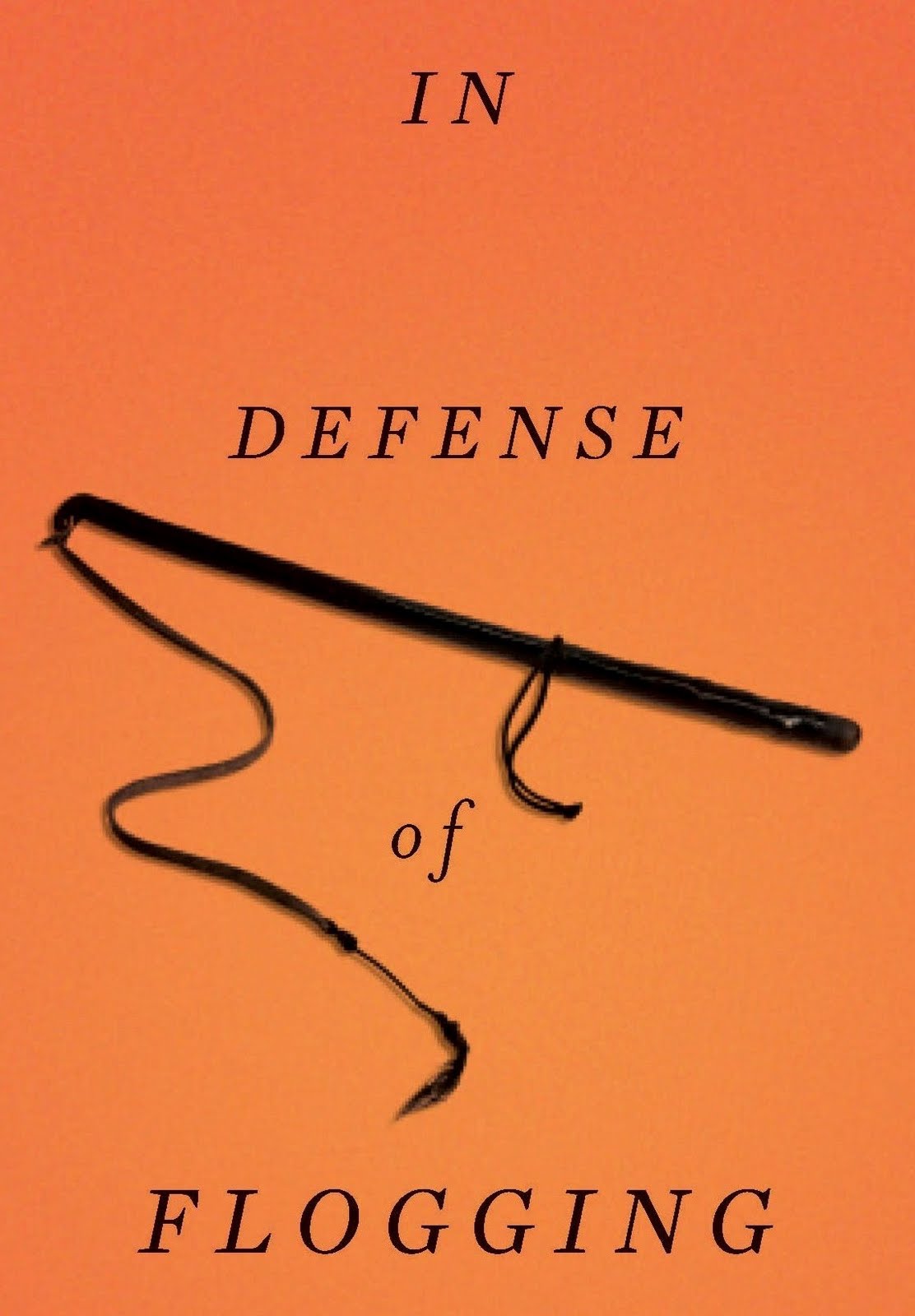
    But Moskos, an assistant professor of Law, Police Science and Criminal Justice at New York’s John Jay College of Criminal Justice, and a former Baltimore cop to boot, is painfully serious (pun intended). And the timing for his book could not be better, considering a recent Supreme Court decision that upheld a ruling ordering California to release about 46,000 inmates in an attempt to relieve its overcrowded prisons.

    Moskos writes that both ends of the political spectrum should look approvingly upon flogging as a substitute for prison. “If you’re a conservative, flogging holds appeal as efficient, cheap, and old-fashioned punishment for wrongdoing… it’s a get-tough approach… and nothing is tougher than the lash. If you’re a liberal and your goal is to punish more humanely, then you must accept that the present system is an inhumane failure.”

    In Defense of Floggingforces the reader to confront issues surrounding incarceration that most Americans would prefer not to think about. While Moskos makes a compelling moral argument for allowing those convicted of crimes to be given a choice, he might have been better served if he had made it a financial argument instead. Most American taxpayers will willingly allow someone to be flogged into insensibility if it means they’re going to save a few bucks.

    Speaking about timing, I spend about four pages in my book talking about that Sheriff Joe Arpaio, specifically how his “get-tough” policies don’t work. So that S.O.B. better not quit on me! (I do begrudgingly applaud him for at least coming up with some ideas that are liked by inmates–and yet the same ideas are often derided by liberal critics as cruel and barbaric!)

  • “Don’t laugh: He makes a convincing case”

    In Defense of Flogging reviewed (favorably!) in Bloombergand today’s S.F. Chronicle. They “get it”:

    And at just over 150 pages of clear, smart and highly readable prose, Moskos’s sharp little volume has a potential audience far beyond the experts who dutifully slog through most tomes like this. It’s the kind of item that could be stacked next to a bookstore’s cash register. Think about it for a Fathers’ Day gift.

    I couldn’t have said it better myself!

    Read the whole review.

  • “Give offenders a choice–prison or FLOGGING; (he’s serious)”

    From CNN’s “In the Arena“:

    ONLY ON THE BLOG: Answering today’s OFF-SET questions is Peter Moskos.

    Moskos’s new book is entitled, “In Defense of Flogging.”

    The Supreme Court has affirmed a federal order telling California to reduce its overflowing prison population, a situation the majority said “falls below the standard of decency.” California now has to figure out how to reduce the population by more than 30,000 prisoners. From your point of view, why does the prison system in the U.S. continue to fail?

    Prisons fail because they don’t do what they were designed to do: cure criminals. And as long as we insist on fighting an idiotic “war on drugs,” nothing is going to better.

    Read the rest of the Q and A here.

  • Makes flogging look better and better

    Louis Theroux visited a Miami “mega-jail.” (You can watch a bunch of his other shows on youtube–I’m quite fond of them.)

    For a bespectacled, peace-loving Englishman, there can be few places less congenial than a berth on the sixth floor of Miami main jail.

    The place has to be seen to be believed. Up to 24 inmates are crowded into a single cell, living behind metal bars on steel bunks, sharing a single shower and two toilets.

    Little of the bright Miami sun filters through the grilles on the windows. Visits to the yard happen twice a week for an hour. The rest of the time, inmates are holed up round the clock, eating, sleeping, and going slightly crazy.

    But what is most shocking is the behaviour of the inmates themselves. For reasons that remain to some extent opaque – perhaps because of the bleak conditions they live in or because of insufficient supervision by officers, maybe because they lack other outlets for their energies, or because of their involvement with gangs on the outside, or maybe from a warped jailhouse tradition – the incarcerated here have created a brutal gladiatorial code of fighting.

    They fight for respect, for food and snacks, or simply to pass the time.

    In some cells inmates boasted that they had a policy of “mandatory rec” for new inmates – meaning any inmate coming into the cell had to fight (or “rec”) for a bunk, unless he was known to other inmates in the cell, in which case he might be granted a reprieve.

    And without privacy, sharing a single shower, many of the men had lost their sense of the normal social barriers – they were around each other continuously, using the toilets, speaking to loved ones on the phone, and, presumably, indulging in other physical functions. And when we were around them, the same rules applied to us – many of them, living like animals, had lost their grip on social norms.

    Another inmate, Rodney Pearson, known as Hot Rod, told me he’d been inside for several years awaiting trial. Prosecutors wanted to give him the death penalty.

    I asked him if, by some quirk of fate, I’d been arrested and sent to their cell, a bespectacled Englishman with a college education who was clearly not cut out to fight, they might let me off the “mandatory rec”. The answer was an emphatic “no”.

    One of the corporals said he thought the county might be happy to make reforms as long as I was happy to stump up the $600m for a new building.

    Keep in mind that these men have not been convicted of any crime (though admittedly most are guilty as charged). And almost all will one day be released, more f*cked up than ever. Can one think of better case In Defense of Flogging?

  • In Defense of Flogging

    In Defense of Flogging


    It’s in, hot, right off the presses!

    Amazon actually has nine copies of In Defense of Flogging in stock, for sale, ready to ship, to be in your grubby hands tomorrow!

    But I just bought eight of them. Still, that leaves one.

    The official release date is June 1. So your local bookstore should have them soon.

  • In Defense of Flogging

    The United States now has more prisoners than any other country in the world. Ever. In sheer numbers and as a percentage of the population. Our rate of incarceration is roughly seven times that of Canada or any Western European country. Despite our “land of the free” rhetoric, we deem it necessary (at great expense) to incarcerate more of our people, 2.3 million, than the world’s most draconian regimes. We have more prisoners than China, and they have a billion more people than we do. We have more prisoners than soldiers; prison guards outnumber Marines.

    It wasn’t always this way. In 1970, just 338,000 Americans were behind bars. From 1970 to 1991 crime rose while we locked up a million more people. Since then we’ve locked up another million and crime has gone down. Is there something so special about that second million? Were they the only ones who were “real criminals”? Did we simply get it wrong with the first 1.3 million people we put behind bars?

    Because alternatives to incarceration usually lack punishment, changes to our current defective system of justice are hard to imagine. I am not proposing to completely end confinement or shut down every prison. Some inmates are, of course, too violent and hazardous to simply flog and release. They are being kept in prison not only to punish, but because we’re afraid of them. But for the millions of other prisoners–particularly those caught up in the war on drugs (which I would end tomorrow if I could)–the lash is better than a prison cell. Why not at least offer the choice?

    That prisons have failed in such a spectacular manner should matter more than it does. But it should come as no surprise, since prisons were designed not to punish, but to “cure.” Just as hospitals were for the physically sick, penitentiaries were created–mostly by Quakers in the late eighteenth century–to heal the criminally ill. Like so many utopian fairy tales, the movement to cure criminals failed.

    Make no mistake: flogging is punishment, and punishment must by definition hurt. Even under controlled conditions, with doctors present and the convict choosing a lashing over a prison sentence, the details of flogging are enough to make most people queasy. Skin is literally ripped from the body.

    Is flogging too cruel to contemplate? But then why, given the choice between five years in prison and brutal lashes, would most people choose flogging? Wouldn’t you? How can offering criminals the choice of the lash in lieu of being locked-up be so bad? If flogging were really worse than prison, nobody would choose it. Of course most people would choose the lash over incarceration. And that’s my point. Faced with the choice between hard time and the lash, the lash is better. What does that say about prison?

    [You can read more about this in the Chronicle of Higher Education and also in the May-June edition of the Washington Monthly (available in better newsstands, but not yet online). Even better, BUY MY BOOK, In Defense of Flogging. Agree with me or not, you should find the argument thought provoking and the book a good, short read. –posted in The Agitator]