Tag: police shootings

  • He was a monster

    I spend a lot of time defending the media. That’s an unpopular position among 90% of police officers. Well I’m not going to defend the S.F. Chroniclehere. Just yesterday the paper decided they needed to report “both” sides of the cop killings in Oakland. In their story, to my great dismay, they did what what lazy or dumb journalists do too often: talk to the criminal’s family to present “both” sides of the story.

    Sometimes there aren’t two sides with the truth lying somewhere in between. It’s up to professional journalists to figure right from wrong. The original story by staff writers Demian Bulwa and Jaxon Van Derbeken reported:

    “He’s not a monster,” said his sister, 24-year-old Enjoli Mixon, who said her 4-year-old daughter’s bedroom in a small apartment on 74th Avenue was the scene of much of the bloodshed. It was there, police said, where Mixon fired through a closet wall at a team of SWAT officers, who then shot and killed him. “I don’t want people to think he’s a monster. He’s just not. He’s just not.”

    “We’re crushed that this happened,” added the gunman’s grandmother, Mary Mixon. “Our hearts and prayers go out to the officers’ families. … This shouldn’t have happened.”

    His family said that while he was behind bars, Mixon married his childhood girlfriend, Amara Langston, and worked briefly as a janitor in Hayward once he got out. He was most recently released from prison in November, his family said.

    Then, about three weeks ago, Mixon skipped a home visit from his parole officer, his family said. Mixon’s grandmother said he had gotten angry at his parole officer because the agent had missed earlier appointments.

    Mary Mixon recalled that her grandson said at one point that he was even willing to go back to prison as a way to get a new parole officer. She said, she did not know where her grandson had been staying for the past few weeks.

    Mixon was having a phone conversation with his uncle, Curtis Mixon, just before the first shooting. “He said, ‘The police just pulled up behind me. Let’s see what’s going on. I’ll hit you back.’”

    Curtis Mixon said, “He never hit me back.”

    Wow. Poor guy finally getting his life together after some bad breaks. Then he just flips.

    Of course that’s not the case. It turns out he isa monster.

    In the reporters’ defense, they’ve redeemed themselves somewhat with some good follow up stories. Jaxon Van Derbeken notes that Lovelle Mixon had been linked by DNA to a rape earlier this year.

    Mixon’s DNA was on file because of his conviction in 2002 for assault with a deadly weapon in an attempted carjacking in San Francisco, for which he served six years in prison.

    Oakland police had also considered Mixon a suspect in the December 2007 slaying of Ramon Stevens, 42, who was shot and killed on the street near the corner of 86th Avenue and International Boulevard. Mixon was detained on a parole violation in February 2008, but homicide investigators could not make a case.

    The victim’s sister said a witness had told her Mixon was the killer, authorities said. But Assistant District Attorney Tom Rogers said Monday that the witness did not want to cooperate, and Mixon was freed in November.

    In March 2002, Mixon and two other attackers tried to carjack a truck, fired a shot and pistol-whipped the driver on Mission Street near Sixth Street in San Francisco.

    In a sentencing report, San Francisco probation officer Yvonne Williams wrote that Mixon’s juvenile record was that of a “cold-hearted individual who does not have any regard for human life.” She said state prison was the only way to “to rein in this man’s proclivity for violence.”

    Demian Bulwa did a much better job following up with this story filled with interesting details about ghetto life:

    “We’ve got to remove the word ‘snitch’ from our vocabulary,” said the woman, who asked not to be identified because she fears retaliation.

    The woman said she was hesitant at first to be seen in public telling officers what she knew…. Finally, the woman said, she found an opportunity to give her information to an officer she recognized.

    She said she has been in trouble with the law in the past, but that on Saturday, “I wish I would have been a police officer.”

    Outside the apartment that SWAT officers stormed, a memorial for Mixon had flowers, candles and balloons. Notes read, “RIP Vell,” ” Money$” and “We gone miss u big cuzn.” A plainclothes police officer went up to it at one point, stared at it for a second and then walked away, shaking his head.

    Activists handed out flyers that invited people to a rally where they would “uphold the resistance” of “Brother Lovelle Mixon.”

    Many people rejected that sentiment, saying they were touched that officers had given their lives protecting others. They said they didn’t understand why some were defending Mixon.

    Police nailed a piece of plywood over the doorway of Mixon’s sister’s apartment early Monday morning, sealing it off. But curious neighbors pried it open and went inside to look around – infuriating Enjoli Mixon, who showed up later.

    One neighbor, who admitted he yanked open the plywood and went inside, said he counted more than a dozen bullet holes in the walls inside the apartment. There was blood in every room, he said. The hallway outside was also scarred by apparent bullet ricochets.

    Asked why he had gone into someone else’s home, the man said, “I wanted to see if it was an overkill.”
  • 4 Police Officers Shot in Oakland

    Here’s the story.

    Update (12:40am): Three of the officers have died, I just read.

    “On Saturday, people lingered at the scene of the traffic-stop shooting. About 20 bystanders taunted the police.”

    Update (Monday 1pm): The fourth officer has been declared brain dead.

  • Another Officer Killed

    Philadelphia has seen seven officer die in less than three years. That is seven too many.

    From an editorial in the Philadelphia Inquirer:

    The police say it’s not their fault that career criminals aren’t in prison; they keep arresting them, but judges’ sentences are too lenient.

    The judges say it’s not their fault; they follow proper sentencing guidelines, but the prisons don’t use the time to effectively rehabilitate.

    The prisons say they have good programs to rehabilitate inmates, but society doesn’t provide the help returning felons need – a good job, for starters – to stay out of trouble.

    Read the whole piece here.

  • Undercover danger

    The Sunreportsthat the wounded officer arrested the same defendant in 2007.

    That’s scary. It’s much harder for a police officer to remember everybody he’s arrested than it is for a criminal to remember the person who arrested him. It’s just a question of numbers, like it’s easier for students to remember their teacher’s name than vice versa.

    It’s also why cops carry guns off duty. The last thing you want as a police officer out on a date is for somebody to come up to you and say, “You remember me?”

  • On backup

    Check the Sun for the latest update on the shot Baltimore City police officer.

    This has got me thinking about when things go bad.

    If an officer needs backup, well first he or she shouldn’t have to askfor backup, because, well, that’s what being police is all about. You’ve got each others’ back.

    But if you would actually like an extra unit to help keep everything under control, you ask for a 10-11. A 10-11 is a request for a meeting. It could be a meeting for any simple purpose (paperwork, coffee, question, or just for the hell of it). It’s not polite to ask another officer his location over the air. Because you have to answer. If you want to find somebody, better to ask for a 10-11.

    But in the context of backup, a 10-11 will cause cops to gently run red lights. But it’s not an emergency. Everything is under control. Better safe than sorry.

    Then, say you chaos in the background of a radio transmission, or the fight is on. If you need help and you need it now, you call for 10-16. That means “backup.”

    You can also get assigned as10-16 to somebody else’s call. But that’s not a big deal. That just means backup is the sense that the call should have more than one officer responding (like for an armed person, a domestic, or anything in progress).

    But when calling for backup, 10-16 is pretty serious. You wouldn’t ask for it lightly. But if you ask for a 10-11 with any sense of urgency the dispatcher will up it to 10-16.

    A good dispatcher needs to keep track of all the units (15-plus in the Eastern, at least last time I checked) and call for backup when needed. Thus they’re worth their weight in gold.

    If you’re really OK, you can do your best to call off the 10-16 saying something like. “No. I’ve got everything under control. I just need a 10-11.”

    There’s no shame in asking for help if you need it. You just don’t want to put other officers at danger for you for no reason. If you need backup, you’ll get it. For a real 10-16, you’re going to haul ass.

    And then sometimes, not too often but often enough, things go wrong. When the shit hits the fan, it hits quickly. Signal-13 is broadcast city-wide and there’s nothing higher.

    There’s a pause when the Signal-13 alert tone comes the radio (it’s always preceded by a special tone). Everyone shuts up for a quick second to hear the details. Usually, it doesn’t concern you. It’s across town or it’s 10-32ed right way by the officer who didn’t really need (or want) the 13. Like if you don’t answer your radio, you’ll eventually get a 13 dropped until you do.

    But if the 13 is for real, the adrenaline kicks in as you hit the gas and go code one. After a second or third 13 comes over the air, half the cars in the city will be heading your way (luckily, I was never on the receiving end of a Signal 13). As backup, you gotta be really careful. It’s a dangerous time to be a cop with lots of fast cars and tunnel vision.

    When everything is under control again, you’ll hear “10-32,” enough officers at scene. But by then, after the 13 went out, it’s a little hard to call off the cavalry.

    Cops will often come no matter. You get to meet your friends from other sectors and neighboring districts. You say hi, swap gossip, call each other names, and make social plans. It’s a little powwow (and can be quite a clusterfuck). Eventually calls-for-service or a higher up will act as the umpire and break it up.

    And if a 13 includes the horrible words, “officer down,” that is not good. In the end, those close to the officer will go to Shock Trauma to be there for the officer and the officer’s family. The sergeant will arrange for family notification and pickup (not a fun part of the job).

    Meanwhile those still working the street have to keep answering the same bullshit calls plus a few extra posts. People don’t stop being stupid just because an officer is down.

    When the next shift comes in at the district, they’ll be filled in informally and then formally at roll call. If things have been really chaotic, you might skip roll call and go right to the street to relieve somebody. Overall, the mood will be professional and much more business-as-usual then you might expect.

    Seven year later, when watching The Wire, I would still perk up and pay attention whenever I heard the Signal-13 sound. And this from a TV show.

  • Update on shot cop

    Here’s the latest form the Sun:

    The officer was shot in the jaw and cheek when he tried to make an undercover purchase, Bealefeld said. His partner returned fire and hit at least one of the suspects, according to police. As the suspects fled, the second officer helped his wounded partner, who was conscious and speaking after the shooting. He was conscious until he was placed under anesthesia for treatment at Shock Trauma.

    And don’t forget about every Baltimore City police officer who has to go right to work and do the job like it’s any other day. If yourcoworker got shot on the job, you might get a day off.

    Not police.

    Stay safe.

  • Baltimore Officer Shot — In Critical Condition

    This terrible news just in at 10:30pm from the Sun:

    A Baltimore police officer is in critical condition at a hospital tonight after being shot in the Seton Hill neighborhood, officials said.

    The plainclothes officer was on duty in the 500 block of Orchard St. about 8 p.m. when he was shot in the face, said Nicole Monroe, a police spokeswoman. A police officer returned fire, she said, but it is not known whether the wounded officer, who was taken to Maryland Shock Trauma Center, was accompanied or alone.

    Shortly after the shooting, a person with a gunshot wound went to a hospital, Monroe said. Police are investigating to see whether there is any connection with the police shooting.

    [update, 10:42pm:I just spoke to a friend of mine. He said word from Shock Trauma is that the officer should live, but did take a bullet in the jaw.

    Also, I don’t know the shot officer. Of course that shouldn’t really matter. But, of course, it doesmatter to me. Regardless, I wish him and his family the best in what will not be an easy road to come. I’m with you.]

  • Getting away with murder

    A jury in Brooklyn on Wednesday night acquitted one of three mencharged in the fatal shooting of Police Officer Russel Timoshenko of murder charges.

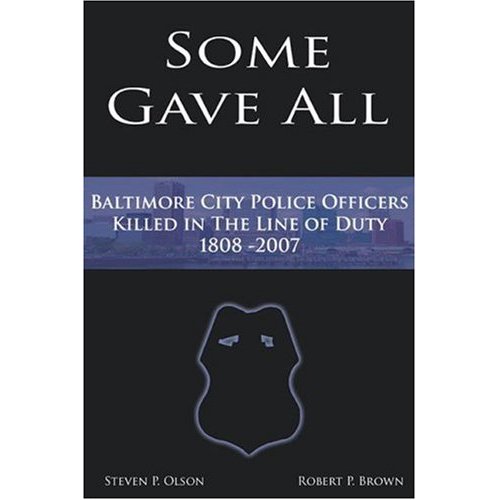
  • Some Gave All

    Some Gave All

    I recently received Some Gave All: A History of Baltimore Police Officers Killed in the Line of Duty, 1808-2007 by Steve Olsen and Robert Brown.

    It’s a very nice work of history and a wonderful homage to those who died serving Baltimore City. While details on recent police deaths tend to be relatively well known, even I leaned some things about the circumstances about the death of my friend, Crystal Sheffield, to whom my book is dedicated.

    Some Gave Allreally shines in the history, going way back in the 19th Century. Most of thesenames have been forgotten. This book gives all these men (and one woman) who gave their lives the respect they deserve.

    There’s also an interesting story out of this. I recently received an email from the author, Sgt. Olsen, about a manuscript he found:

    In the same vein as your work, I have an original manuscript from 1974 by an officer who did exactly the same as you. His work, however, was suppressed by the Command at the time and it wasn’t discovered until 2008. (We found it in a retired Major’s locker.) It was called “The Socialization of the Urban Police Officer.” It’s a pretty neat read.

    We found what appeared to be the only copy sealed in an envelope. In 1975 the notes written on the outside of the envelope it said “Review and Hold” and initialed by someone that’s illegible. 10 years later, the note said, “Someday, somebody should read this.” So, what do police do? We ripped it open and read it!

    Turns out I’ve already read it. It’s by a guy name Mike O’Neil. It was his Masters Thesis at Brown. Later he got his PhD at Northwestern and who do you think signed off on his dissertation? None other than my father!

    Before I finished my dissertation in 2004, Mike got in touch with Howard Becker, because of their common interests in jazz music. Professor Becker told Mike about our parallel stories and Mike got in touch with me. Mike was nice enough to send me a copy. He’s no longer involved in the police world or academia, and doing just fine.

    In 2004 Mike wrote me this:

    Cherry Hill was close to the worst when I was there. Only redeeming feature, the city refused to license a bar in the area. That helped. Pomerlou was chief. Think the pay was about $8,000. Perhaps $5 for court (I don’t remember). The old cops back then also said the job wasn’t as good as the “good old days.” I suspect that that is a universal.

    More recently Mike corrected the record:

    By the way, it was never “suppressed” by the command. I doubt they ever knew about it. I shared it, as I recall, with two civilian police academy instructors and the judge in the Southern district. None officially.

    I recall this advice [about drugs] from my Sgt in Cherry Hill: “We don’t have the time to get involved with that shit. If you see something, go to a pay phone and drop a dime and call the Narcotics Unit; let them deal with it.”

    So it seems that at least in some ways, times certainly have changed.