Tag: race

  • They’re just Sooner to Shoot in Oklahoma

    They’re just Sooner to Shoot in Oklahoma

    Updated: November 15, 2017

    Also see this 2020 update. And an important caveat.

    Using data from 2014 through mid November 2017 (killedbypolice.net for 2014 and the Washington Post thereafter) Oklahoma City Police kill an average of 6.3 per year; NYPD 0.57 a year. The rate in Oklahoma City is 11 times as high. The rate per officer is 27 times higher in Oklahoma City. That means a person is Oklahoma City is 11 times more likely to be killed by police and a police officer is 27 times more likely to kill.

    Original Post:

    I’ve said for a while that when it comes to police use of lethal-force, an exclusive laser-like focus on race is misguided. It’s is a red herring. If one actually wants to reduce police-involved shootings — as opposed to simply being outraged at the latest incident — there are easier ways to do this than eliminating racism and racial disparity in America. There are low-hanging fruits to reduce the overall level at which cops shoot people.

    There will be the next police-incident worthy of outrage. We can go from incident to incident, outrage to outrage, and pretend it’s just about race. But it’s not.

    I’m not saying race doesn’t play a factor. This is American. And indeed, blacks make up a greater percent of unarmed people killed by police. The disparity could be racial bias; it could be related to violence in segregated America; it could be something else. Honestly, we’re never going to settle the debate, and I don’t know if we need to. Police misconduct doesn’t only happen to blacks. And the numbers of innocent unarmed people killed by police is simply not that large. Nor is it increasing.

    Police have shot and killed 706 people this year. Forty-one were unarmed. Fifteen of those were black. (Keep in mind “unarmed” does not mean no threat, and conversely somebody could be armed and not be an imminent threat.) I get the argument that murder is worse at the hands of the state. I even agree with it. I understand police need to be held accountable. But at some point the numbers matter, at least to put things in perspective.

    This is a country of 320 million people. There are 765,000 sworn police officers. There are 15,000 murders (and murderers). What’s an acceptable level of police-involved shooting? What’s the goal? And if you’re not happy addressing that question, or if you think the only acceptable answer is zero, than you’re not a productive part of the solution.

    Look, I know some cops do shitty things. And others make honest mistakes. But there are more cops in America than residents of Baltimore. We can and should criticize individual incidents. But we don’t harp on every crime in Baltimore — and there are a lot — to show how the whole city is filled with evil. (And I do wish we cared a bit more about victims like Michael “Chef Mike” Bates who was just shot and killed even after he complied with the three men who robbed him.)

    Does a bomb in Chelsea mean we should ban Muslims from America? (No, is the answer.) There will be the next horrific crime and the next terrorist attack just as sure as there will be the next bad police-involved shooting. Instead we’re seeing something close to a moral panic, with police as the Folk Devils, we need to reduce how often they happen.

    There are probably a few dozen bad (as in criminally bad) police-involved shootings a year. That’s a couple a month, keep in mind. And if they’re all recorded, that’s one every other week. But far more numerous are shootings which may be legally justifiable but did not have to happen. They’re justifiable but not necessary. We’re talking perhaps something in the rage of a few hundred a year. And the bulk of these happens west of the Mississippi (see a future post). The best way to reduce bad shootings is to reduce the overall level of police lethal force.

    Twenty-five percent of those who are shot and killed by police are black. Since blacks are only 13 percent of the general population, some claim this represents an “epidemic” of police violence against African Americans. But using the overall population as the denominator for interactions with police makes no sense.

    America is filled with racial disparities in poverty, violent crime, calls for police service, and those who felonious kill police officers. I mean, 96 percent of those killed by police are men, and men make up less than half the population. Is there an epidemic of misandric cops gunning for other men? I don’t think so. It’s more likely that men are more likely to pose lethal threats to police officers.

    And this brings me back to Oklahoma, where Terence Crutcher was shot and killed by a police officer even though he wasn’t an imminent threat. A while back I red-flagged Tulsa and Oklahoma because I couldn’t help but notice: they sure do seem to be a hell of a lot of police-involved shootings in Oklahoma. And now we have more data than we did a year ago.

    We’re not seeing an epidemic of police killing black people in particular in Oklahoma. The Sooner State is pretty white (72 percent, 8.6 percent Native American, and 7.4 percent black). The racial disparity in Oklahoma is pretty much in line with the rest of the nation. Since 2014, nationwide, the average annual rate of being shot and killed by police is 3.2 per million. It’s higher for blacks (6.93) and lower for whites (2.37). That’s a 3:1 ratio.

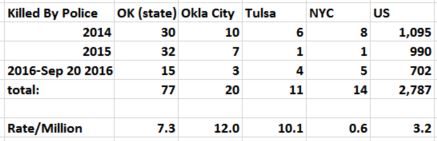
    What we see is that more white people get killed by cops in Oklahoma than all people killed by cops in majority minority New York City. Simply put, police in Oklahoma are shooting a lot of people and the NYPD isn’t. In Oklahoma, cops shoot and kill 28 people per year. In New York City, which has more than twice as many people as the entire state of Oklahoma, police kill about 5 people a year. What gives?

    People in the state of Oklahoma are 12 times as likely as New Yorkers to be killed by police.

    People in Oklahoma City are 20 times [11 times, see update, above] as likely as people in New York City to be shot and killed by police! New York City has about 2.5 times more police officers per capita. That means an officer in Oklahoma City is about 50 times more likely than an NYPD officer to shoot and kill somebody. [27 times, see update above]
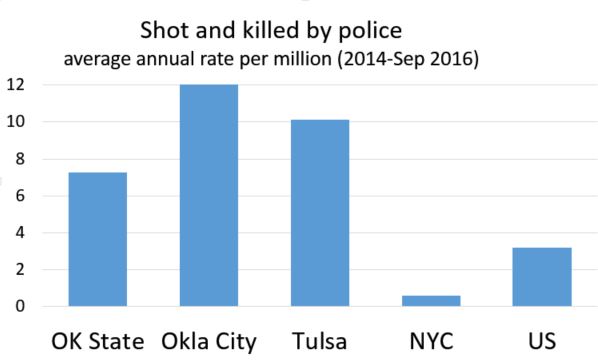
    These differences are huge! Shocking! Unbelievable!

    And yet nobody seems to notice or care. [See all the states in this post.]

    I assume most of the police-involved shooting even in Oklahoma are legally justifiable. I’m not saying these cops are committing crimes, but I am saying a large percentage of these shootings aren’t necessary. They don’t need to happen. I mean, it’s likely cops in Oklahoma will always shoot more people than cops in New York City. Sometimes police have no choice but to shoot somebody. And Oklahoma isn’t New York. But it doesn’t have to be 12 or 20 times more. I can’t conceive of how a per-capita disparity this large could be justified or explained away by any variables except police training.

    So I look at the Terence Crutcher being shot, and I think: maybe that really is how police in Tulsa roll. I don’t know. And I wonder what it is about NYPD training and policy that so reduces use of lethal force. Whatever it is, and I’m sure it’s a combination of things, it shouldn’t be that hard for somebody to copy best practices. Instead of asking what individual police officers are doing wrong (though we can ask that, too), why don’t we figure out what the NYPD is doing right? We have models that work. The solution involves some combination of better hiring standards, better policy, better training, and more accountability.

    Just reducing Oklahoma’s use of lethal force to the national average would save 14 lives a year. That seems doable. And good. It’s good for the people not to get shot. And it’s good for social and racial justice. And it’s also good for police officers who get to go home without killing somebody. Cops don’t want to shoot people. You think Officer Betty Shelby wouldn’t like to go back in time and not shoot?

    And let me mention I’m only picking on Oklahoma because of the recent Tulsa shooting. Oklahoma isn’t even the worst state when it comes to high levels of police-involved shootings. Currently, in 2016, it doesn’t even crack the top five.

    [I did some brief computations on crime (some 2015 UCR data is already out!) because police violence is best predicted by public violence. In 2014 and 2015, Oklahoma has an annual murder rate of 5.4 per 100,000. This is 30 percent higher than New York City’s 4.1. Aggravated assaults and total violent crime, however, are 35 percent higher in New York City. So it seems that Oklahoma does have a violent murder problem separate from any crime problem. But nothing here would even get close to accounting for twelve- and twenty-fold differences in police use of lethal force.]

    Notes: Annual rate is based on the sum total of Jan 1, 2014 to Sep 20, 2016, multiplied by 0.367.

    2014 data: http://www.killedbypolice.net/

    2015-present: https://github.com/washingtonpost/data-police-shootings

    Oklahoma crime stats: https://www.ok.gov/osbi/documents/Crime%20in%20Oklahoma%2C%202015.pdf

    Crime stats: http://www.criminaljustice.ny.gov/crimnet/ojsa/indexcrimes/Regions.pdf

    Race data is from the Washington Post, so it starts in 2015. Annual rate is the sum from 2015 to Sep 20, 2016, multiplied by 0.58. National rates based on 318.9 million with a white population of 200 million and a black population 36 million. Feel free to double check my math. Corrections and comments always welcome.

  • Terence Crutcher shooting

    Terence Crutcher shooting

    I’ll cut right to the chase, I think this is a bad shooting; but not as bad as many people seem to think. (In my very first sentence, I probably just pissed everybody off.)

    Terence Crutcher wasn’t armed. And I don’t think he was an imminent threat when he was shot. Therefore it wasn’t reasonable. And that’s the legal standard for a justifiable shooting.

    One very troubling thing here is why nobody renders aid. It probably wouldn’t have helped (with a bullet going through a body from one side to the other). But you can’t just shoot somebody and not render aid. You can’t. And they did. What they hell were they doing backing up in formation? What weird part of training was that?

    Nor do I like the helicopter guy saying, “he looks like a bad dude.” Would the guy have said that about a white guy? I don’t know. I first thought it was a contributing factor, but from what I’ve read their broadcast was not being transmitted to the officers.

    But what was Crutcher doing? False narratives are unfair. And dangerous, as we just saw in Charlotte. (Keith Lamont Scott seems to have approached officers with a gun, not a book.)

    Despite what I keep reading, Crutcher was not complying. Crutcher was going to his SUV against the orders of cops. This is odd, worrisome even. But it doesn’t elevate somebody to a lethal threat. And Crutcher’s hands were not in the air when he was shot.

    But I still don’t understand why the cop shot at that moment. I like to think, had I been there, I would have taken Crutcher out with my straight baton and a blow to a leg. Tasing would be justified. I don’t want him getting in that car when my partner is telling him not to. Perhaps, if you have the muscle, you just tackle the guy.

    It seems to me Crutcher wanted to get back in his car. And cops are not going to let that happen, because we don’t to be killed like Officer Dinkheller died. What I’m saying is this isn’t Walter Scottbad. It wasn’t Charles Kinseybad. It wasn’t Levan Jonesbad. It wasn’t James Boydbad. It wasn’t Bobby Canipebad. It wasn’t Jonathan Ayersbad.

    Bad is bad, and there’s no reason that every police-involved shooting has to be as bad as the worst shootings to warrant criticism. But I mention those names in part because many of these names are not African American. If people don’t know that cops shoot white people, too, they should. And sometimes these shootings aren’t justified. Too many police are too quick to pull the trigger. And this problem is not evenly spread throughout policing (more on that in my next post).

    Back to Crutcher: As a cop you’re also aware that gunfire deaths of cops are up 50 percentthis year. But you can’t just shoot people because they’re non-compliant and drop their hands. You can’t be a police officer and be that afraid. Damn that Dinkheller video from 18 years ago. Before you shot, you need to wait till you see an imminent threat, like a gun or movement towards what you know is a gun. Look, people should be compliant, but as a cop you know people aren’t going to be compliant. It’s why we have police. People do not act rationally and police officers have to deal with them.

    That said, this wasn’t just a motorist with a stalled car. From the 911 call:

    Caller: There was a guy running from it. He, like ‘somebody was going to blow up.’ I think he’s smoking something.

    Dispatch: Ohh (laughing).

    Caller: I was rude to him too because I got out and was like, ‘do you need help’? And he was like, ‘come here, come here.’ I said ‘well, what’s going on’ and he’s like, ‘come here come here. I think it’s going to blow up.’ I’m like, ‘nah I’m out.’

    Dispatch: OK.

    Caller: He started freaking out and he took off running.

    Crutcher was not acting reasonably. He’s talking about something blowing up. He’s roaming the street in what was probably a drug-induced high (we don’t know for sure, but PCP was found in the car). None of this justifies the shooting. But it does all matter.

    Let’s imagine that Crutcher was going to blow up his SUV or had guns in there. It’s possible (though it wasn’t the case). Then would the shooting be justified? Still, no. (But it sure would be a better narrative.) Even then the shooting would not have been reasonable because at the moment the shot was fired, I don’t think a reasonable police officer would see an imminent threat. At least I don’t. As a cop, you don’t have to wait till a gun is pointed at you before you shoot. You shouldn’t wait till a gun is pointed at you before you shoot. But there’s got to be a gun! I mean, people should be compliant, but as a cop you know people aren’t going to be compliant. It’s why we have cops.

    So now we’ll see how justice plays out. I suspect the officer will be criminally charged, as does happen in many bad shootings.

    So here we have another “incident.” One of many, certainly. And don’t ignore the historical context. But there will be another bad policing shooting. I guarantee it. We can’t base reform on anecdote. Cops kill roughly three people a day. They’re not all good shootings, but most of them are.

    What is the goal? The goal could be fewer bad shootings. The goal could be more accountability for tax-payer funded agents of state. Fine. But we’re never going to have zero bad shootings. Not only is that impossible, it’s not even a good goal. When cops save a life by killing a criminal, it is not an example of “global and national hatred.” Policing is not a pacifist occupation. We give cops guns because sometimes, at certain moments, we want them to shoot somebody. That is the reality. The way forward cannot be continued outrage, incident by incident.

    That said, we can reduce bad and unnecessary police-involve shootings. I’ll get to that in my next post.

  • White-On-White Crime (lots, but without homicide)

    [This relates to my previous post]

    Years ago, like when I was 13, I was with my father, driving from NYC to Chicago, on a baseball road trip (he drove). Between Philadelphia and Pittsburgh, we spent one night in Johnstown, PA. (Remember the Johnstown Flood!). After watching the Johnston Jonnies play baseball, we had dinner in a local bar. My father, known for being gregarious and getting along with all races, religions, and education levels, looked around at the pale depressed clientele and said to me in a hushed tone, “These are not my people.” It’s the only time I ever saw him uncomfortable in a crowd.

    Based on my last post, I looked up East Liverpool, Ohio. It’s very white (93 percent) and quite poor. The median household family income of $23,138 is about half the national average. A quarter of the population (and 35 percent of children) are below the poverty line. The population of 11,000 is down from a 1950 peak of 24,000.

    East Liverpool is the biggest city in Columbiana County, which seems to straddle coal, rust, and rural. The county has a total population of just over 100,000 people and is 96 percent white. It’s also poor, with a median family income of just $34,200 (but interestingly, the poverty rate is below the national average). And it’s increasing Republican. It’s Trump country.

    What I’m saying is, kind of like Obama and Clinton, I’ve never felt much kin with this part of America (the Appalachian Scotch-Irish folk of southeast Ohio, northern W. Virginia, and southwest Pennsylvania). If they’re more worried about immigrants, gun rights, and encroaching Sharia Law than about moving forward and letting people help them get out of poverty and not overdosing in from of their grandson, I’m inclined to let them be and not give a damn.

    But here’s the thing. No matter how hopeless and messed up things might be in East Liverpool and Columbiana County, Ohio; no matter how the jobs are gone; no matter how loose the gun laws are; no matter where junkies are shooting up; no matter how much crime there is; no matter how forgotten by the government and mocked by east-coast elites they might be, the good folks of Columbiana County somehow manage not to murder each other. And there is crime in East Liverpool, Ohio. In fact, if the data is accurate (and that is a big if, coming from a small place), the violent and property crime rates of East Liverpool are twice the national average.

    Neighborhood Scout (not exactly an ideal academic source) puts it this way:

    With a crime rate of 53 per one thousand residents, East Liverpool has one of the highest crime rates in America. With a population of 10,951, East Liverpool’s [crime rate] is very high compared to other places of similar population size.

    Best I can tell, this entire county of about 100,000 has maybe one homicide a year. Some years there seems to be none. Other years maybe two. (I’m basing this on Columbiana County, East Liverpool, and Salem City police departments). This homicide rate, 1 per 100,000, is about 1/4th the national average.

    Meanwhile, Baltimore City has a poverty rate lower than East Liverpool. Baltimore’s median household income is higher than East Liverpool. Hell, the average income even in poor East and West Baltimore is higher than East Liverpool. And yet in the past 365 days (Sep 10, 2014 to Sep 10, 2015) 329 people in Baltimore have managed to put themselves in harm’s way and get killed. Now Baltimore has more than six times the population of Columbiana County. So if Baltimore were 1/6th the size, it would have 55 murders. Columbiana County has 1.

    Even whites in Baltimore managed to get murdered 17 times last year. That’s of course a fraction of the number of black homicides, but whites in Baltimore (fewer than 200,000) get murdered eight times as often as the good folks of heroin-addicted poverty-living can’t-find-work police-are-asking-for-help Columbiana County.

    What gives?

    Baltimore City has more unemployment (7.4 percent vs. 5.3 percent). Yeah, sure. And there’s more poverty and extreme poverty in Baltimore. I’m not saying that doesn’t matter. But deep down, no. Poverty is a red herring. Culture matters. Columbiana County’s unemployment could be 20 percent and the murder rate would still be lower that Baltimore City.

    There’s something else going on. The nexus of violence is not poverty and racism but public drug dealing and drug prohibition. I suspect addicts in Columbiana County buy their heroin from friends and family and coworkers. Not from Yo-Boys on the corner. Push drug dealers inside and violence plummets. But when police try and do that in Baltimore, the DOJ complains about systemic racism.

  • Enough with the “Fakery”

    John McWhorter on the developing taboo of using the phrase “black-on-black crime.” (Spoiler alert: “We need to nip the burgeoning of this new and useless taboo in the bud with all deliberate speed.”):

    “What’s wrong is to refer to black on black crime as evidence of something uniquely pathological about black people.

    [But] to instead classify the term “black on black crime” as a slur, period — and this is what is happening of late — is illogical. Moreover, it detracts attention from genuine concern for black communities.

    And finally, treating “black on black crime” as a new “bad word” will only create fakery, and the way we discuss race in this country already has enough of that. Enlightened people’s impulse to avoid causing offense to black people and to always demonstrate that they are not racists will force a certain attendance to the pox on saying “black on black crime.” It will become a cocktail party cliché to dutifully observe “But white people are more likely to be killed by whites!” and shrug, with the implication that anyone who doesn’t understand that is “one of them,” unenlightened, and likely willfully so, impeded by their inner racists from giving black people are fair shot.

    But under the radar, plenty of people will always know that this taboo doesn’t really make sense, and that it even seems to pull attention away from what real black people living real lives think of as their real problems.

    We should, to the extent we can, use language with clarity and honesty. Pretending it’s always wrong to refer to something called “black on black crime” is antithetical to that mission, and we need to nip the burgeoning of this new and useless taboo in the bud with all deliberate speed.

    I came across thisat the same time I was responding to a request for some data. Somebody asked if there was any hard data backing up an assertion I made that blacks want more (not less) police presence.

    A quick search with the ol’ googlay found this 2015 Gallup poll: 38 percent of blacks want more police presence (and this compares to just 18 percent of whites). Only 10 percent of blacks want less police presence. Wanted more police and wanting fewer bad police are not mutually exclusive, of course.

    People — particularly black people, particular people more likely to be victimized by violent crime — want more police. So when you hear people say blacks are over-policed and want lesspolicing, you might wonder for whom they speak. Meanwhile, the Movement for Black Lives (which is or overlaps heavily with Black Lives Matter) released a platform that is more concerned with the problem of Israel(?) than black-on-black crime. (Did I miss it? Is there really nothing in this platformabout crime when not perpetrated by cops?) Fear of crime and criminals always trumps fear of police and over-policing.

    A short while back another person with knowledge of crime issues asked me if it were really true that blacks are more likely than whites to commit serious violent crimes. It’s good not to highlight this point out of context (lest racists go to town) since poverty and other variables account for much of the racial disparity, but indeed, yes.

    In 2014 (latest UCR numbers, when homicides were fewer) 6,095 blacks and 5,397 whites were murdered in America. There are 42,749,0000 blacks and 247,814,000 whites in America. That comes out to a black homicide rate of 14.3 and a white homicide rate of 2.2 per 100,000. [Just FYI, last year the homicide rate in Baltimore’s Eastern District was 100 per 100,000.] This is a huge disparity. Blacks are 6.5 times more likely than whites to be killed. I kind of thought this was common knowledge. But maybe I’m in too deep.

    So this goes back to the usage of “black on black crime.” I don’t care to engage in semantic debates when lives are at stake. I won’t be silent. But if it helps move the discussion toward solutions, I’m very willing to drop “black on black crime” and talk instead about black homicide victims or something. But talking about black homide victims begs the question of who the killers are. And since most crime is intra-racial, we’re left with a certain circular logic that goes back to “black on black” crime! [And look, I just combined three questionable phrases in one paragraph! Along with “black on black crime,” I’m not really certain if I did “beg the question” or if my logic was “circular.” But my point is to get my point across.]

    Not so long ago a friend of mine commented on the phenomenon of white folks who complain they can’t use the “n-word.” His point was “Why? You gotta ask yourself, why do you want to use it? What are trying to express that demands using this work?” (He was using the abstract “you” and not referring to me, just FYI.) If your point is simply to offend, then maybe it’s best to keep your trap shut. See, the value of political correctness isn’t to march in lockstep with some ideology, it’s to not be an asshole.

    So it’s fair to ask, “Why do you want to use the phrase ‘black-on-black crime’?” And the answer is because too many people are trying to distract from a real problem. Like too many cops, I’ve seen the carnage of “black on black crime” first hand. Last year the homicide rate in Baltimore’s Eastern District was 100per 100,000. I, like many police officers, too often feel that we are the only people who actually give a shit. Murders don’t make the papers; victims won’t even tell you their names. Who else (apart from EMS, nurses, and doctors) spends most of their waking hours trying to save lives? Now this sentiment may not be true, but when you get home after hearing gunshots, canvassing for witnesses, and riffling through the bloody clothes of another young black male victim, it’s an understandable sentiment.

    Call it what you will, but rather than make another phrase taboo, we should, as McWhorter says, pay more attention to “what real black people living real lives think of as their real problems.” Sometimes those voices are too hard to hear.

  • The DOJ is wrong (2): the N-word

    Update: The links have changed (oops!) since these were first published. Here are links to all my August 2016 posts on the DOJ report on the BPD.
    1 https://copinthehood.com/initial-thoughts-on-doj-report-on-2/
    2 https://copinthehood.com/the-doj-is-wrong-1-2/
    3 https://copinthehood.com/the-dojs-war-on-broken-window-2/
    4 https://copinthehood.com/cant-you-take-joke-2/
    5 https://copinthehood.com/the-doj-is-wrong-2-n-word-2/
    6 https://copinthehood.com/the-doj-is-wrong-3-that-damn-kid-on-2/
    7 https://copinthehood.com/the-doj-is-wrong-4-on-diggs-dig-2/
    8 https://copinthehood.com/the-doj-is-right-1-2/
    9 https://copinthehood.com/the-doj-is-right-2-actual-department-is-2/
    10 https://copinthehood.com/the-doj-is-right-3-actual-department-is-2/
    11 https://copinthehood.com/the-doj-is-right-4-actual-department-is-2/

    From Vice Magazine:

    Of course, some former Baltimore cops take issue with the tone of the federal report, which cited 60 complaints of racial slurs against black people.

    “The BPD is not a bunch of white officers calling blacks n****rs,” said Peter Moskos, a former Baltimore cop and professor at John Jay College of Criminal Justice. “I didn’t hear the word used once by a white officer. Not once. I’m not saying it’s never been used, but this isn’t fucking Ferguson. I suspect much of the usage they talk about is from black officers. Doesn’t that matter? But the report doesn’t tell us.”

    [Vice actually printed the whole n-word, which I still find bold. Too soon for me.] Ah, you say, but I wasn’t there for long. True. Or maybe nobody used the word around me. Maybe. I hope that’s the case, because if all it takes is one cop to totally change police culture, man, that is great news. No. I didn’t hear white cops call people n****r because white cops don’t call people n****r in Baltimore.

    [Just as a reality check, I did ask one black cop if he ever heard a white cop use the word in public. He said “no.” (Somewhat reluctantly, I kinda thought.)]

    The report cites race in just one case. And it’s white using the word; we know this because his partner filed a complaint. Good. See, even if some whites wanted to use the word (I’m sure some whites do), you don’t hear white cops in Baltimore calling blacks n****r because, even if for no other reason, there are too many blacks around! Whites are a minority in the city and the police department.

    Now did I hear black cop from black neighborhoods calling another blacks n*****s? Oh, did I. Is this objectionable? I don’t know. Seems so to me. (And apparently it is to the citizens who filed complaints about it!) But far be it for me to white-man-splain to a black cop that his non-standard English using isn’t up to my college-educated standards. But no matter where you fall on this usage issue, blacks being rude to other blacks is not a sign of systemic racism in the department.

  • 20 People Shot at Florida Nightclub (ho hum)

    From the Times:

    Two teenagers were killed and at least 18 people were wounded early Monday when attackers raked a crowd with gunfire outside a nightclub here that had been hosting a party for young people, the authorities said.

    Sound familiar? Yeah, because it is. But this isn’t even the main story of the day.

    It kind of started as news, but then, you see, the victims weren’t gay, or white, or blacks shot by cops, and the shooter (or shooters) wasn’t a “terrorist,” which really means he didn’t have an Arabic last name, nor a “troubled” white kid.

    Obama won’t speak about it; Trump won’t claim he can fix it. You know, it was just one of our “routine” mass shootings. The story is demoted to “Fort Myers shooting: 2 dead outside teen party at club,” like these lives don’t matter. Like this is acceptable in a civilized society. No matter a 12-year-old was killed, it’s just “ghetto” crime. Dog bites man.

    Just think of the news editors who really ask these questions before keeping “Convention Tension” as the lead story of the day.

    What a country.

  • “The False Promise of a ‘Conversation’ About Race”

    John McWhorter wrote this article about race and racial discourse. I doubt most readers here subscribe to the Chronicle of Higher Education. It’s behind a paywall, and you can’t access it back-door style through google. So though this excerpt doesn’t really do his whole argument justice, it’s better than nothing:

    After the horrific shootings in Baton Rouge, St. Paul, and Dallas, we are hearing again that America needs to have a national conversation about race….

    Indeed, America needs a new consensus on the relationship between black people and the police. Feeling under siege and in danger of being murdered by appointed peacekeepers is the keystone to black people’s sense that racism permeates life in modern America.

    But if America finally engages in this conversation, it would be wise to avoid the ideological distortions, idealizations, and missteps that have characterized previous entreaties for it….

    This idea that on race in America there is always a shoe that hasn’t dropped, that a certain vaguely articulated Great Day has yet to come in which whites realize their culpability in black people’s income, health, and educational disparities and in some way act upon it, is the fulcrum of almost all of today’s discussion of, writings about race.

    However, it’s not always clear that these thinkers understand what a radical proposition they are making. Much of the difficulty in convincing whites beyond an educated fringe that they are “on the hook” for black suffering is that, beyond the painfully stark episodes of police brutality, the lines of causation have become so tortuous.

    But for better or for worse, this kind of explanation is a tough sell beyond a certain mostly educated and highly sympathetic fringe of the American population.

    Some conversation advocates will claim that I distort their reasoning, but the question is: What else is it that you are hoping this conversation will be about? Again, police brutality is one thing, and needs to be discussed, but “conversation” advocates are calling for much more.

    This is hardly a call for giving up on the battle against black America’s problems…. However, nothing requires teaching white people that everything that ails black America is because of racism you can’t quite feel, taste, or see but is always nevertheless there.

    It has now been 50 years since the Black Power movement arose…. The Great Day has never shown the slightest signs of coming, it is time to admit that it isn’t going to happen. The “conversation” about race is thinking black Americans’ Great Pumpkin. What we have now is all there will ever be.

    Black people, then, need no “conversation” that isn’t aimed directly at concrete changes, such as eliminating the war on drugs, teaching poor children how to read according to methods proven scientifically to work, and providing as many women as possible with long-acting reversible contraceptives. That is, black America needs policy, not psychological revolution. All of those things could happen in an imperfect America where no “conversation” has taken place, where nonblacks continue to eat their hot dogs on the Fourth of July without a thought of what happened to black people in the past (a scenario that irritates Coates), where whites in psychological tests reveal themselves to have ugly little biases against black faces as opposed to white ones, where Donald Trump continues to pretend not to know what David Duke’s feelings about black people are, and where, in general, black people, like everyone else, grapple with a grievously less than perfect nation and try their best.

    That calls to get real things done rather than to hope for whites to “really understand” are now seen as uncharitable and backward is a testament to how deeply the post-Black Power ideology has permeated the consciousnesses of those seeking to create change for black America…. We need governing not with words, but with words rigorously linked to intended actions. There was a time when this was called activism.

  • Reducing police-involved shooting & “The List”

    This past week John McWhorter and I were both (separately) on Bloggingheads.tv with Glenn Loury to talk about race and all the recent shootings. McWhorter emphasized race as a factor of those shot by police and:

    challenged those who disagree to present a list of white people killed within the past few years under circumstances similar to those that so enrage us in cases such as what happened to Tamir Rice, John Crawford, Walter Scott, Sam Debose and others.

    Well I keep track of these things and through Glenn passed some names on to Professor McWhorter. I give sincere respect to Professor McWhorter for his intellectual honesty today in Time:

    The simple fact is that this list exists.

    When a black man is killed by a cop, do we grieve more because there are 46 million of us as opposed to 198 million whites? I doubt it: most Americans never hear about the white men’s deaths at all.

    Rather, we operate according to a meme under which cops casually kill black men under circumstances in which white men are apparently let off with a hand slap — and occasional cases of just that are what often get around social media, suggesting that they are the norm.

    However, at the end of the day any intelligent engagement with these issues must keep front and center that there was a Daniel Shaver for John Crawford, a Michael Parker for Walter Scott, a James Scott for Laquan McDonald. Economist Roland Fryer’s conclusions, stunning even to him, that cops use more force against black people but do not kill them more than they kill whites is perhaps less perplexing than it seems.

    Unlike McWhorter, I was not surprised by Fryer’s conclusions. Like McWhorter, “I am neither a neither Republican nor conservative.” But unlike McWhorter, I am white. (Though I have written about some of the more egregious cases, it sounds a bit funny to say, Romney like, “I have a binder full of white people!”) I don’t want to be liked and linked to by racists and the “alt-right”.

    But I’ve researched and written about race before. I said, “The idea that police don’t use lethal force in a racist way might be a tough pill for many to swallow.” But if one wishes to reduce police-involved shootings — and all of us do; cops don’t go to work hoping to shoot somebody — there are good liberal reasons to de-emphasize the significance of race in policing.

    Jonathan Ayers, Andrew Thomas, Diaz Zerifino, James Boyd, Bobby Canipe, Dylan Noble, Dillon Taylor, Michael Parker, Loren Simpson, Dion Damen, James Scott, Brandon Stanley, Daniel Shaver, and Gil Collarwere all killed by police in questionable to bad circumstances. McWhorteradded Alfred Redwineand Mary Hawkes. You can probably find others from Washington Post data. What they have in common is none were black and very few people seemed to know or care when they were killed.

    According to the Washington Post, 990 people were shot dead by police in 2015. 258 were black. More significant than racial differences — much of which can be explained by racially disproportionate levels of violence — are stunning regional differences.

    Last year in California, police shot and killed 188 people. That’s a rate of 4.8 per million. New York, Michigan, and Pennsylvania collectively have 3.4 million more people than California (and 3.85 million more African Americans). In these three states, police shot and killed (just?) 53 people. That’s a rate of 1.2 per million. That’s a big difference.

    Were police in California able to lower their rate of lethal force to the level of New York, Michigan, and Pennsylvania — and that doesn’t seem too much to ask for — 139 fewer people would be killed by police. And this is just in California! (And California isn’t even the worst state; I’m picking on California because it’s large and very much on the high end.)

    Now keep in mind most police-involved shootings are not only legally justifiable, they are necessary and good at the moment the cop pulls the trigger. But that doesn’t mean that the entire situation was inevitable. Cops don’t want to shoot people. They want to stay alive. You give cops a safe way to reduce the chance they have to pull the trigger, and they’ll certainly take it.

    I really don’t know what some departments and states are doing right and others wrong. But it’s hard for me to believe that the residents of California are so much more violent and threatening to cops than the good people of New York or Pennsylvania. I suspect lower rates of lethal force has a lot to do with recruitment, training, verbal skills, deescalation techniques, not policing alone, and more restrictive gun laws. (I do not include Tasers on this list.)

    If we could bring the national rate of people shot and killed by police (3 per million) down to the level found in, say, New York City (The big bad NYPD shoots and kills just 0.7 per million) we’d reduce the total number of people killed by police 77 percent, from 990 to 231!

    [Update: Here are more names worth considering, taken from comments to this post: David Kassick, Josh Grubb and Samantha Ramsey(examples of officer-created danger), John Winkler, Robert Saylor. Zachary Hammond. Sal Culosi. John Geer. Autumn Steele (This is rare case of an unarmed white person shot by a black officer.) Michael McCloskey.

    Also, it turns out Bobby Canipe lived. But I’m still including him because, my God.

    And it’s well worth watching Glenn Loury and John McWhorter talk about The List in a more recent Bloggingheads.tv]

  • Philando Castile

    This police-involved shooting is bad. And unlike the killing of Alton Sterlingin Louisiana, I’m willing to call this one before the polls have closed.

    This more recent shooting in Falcon Heights, Minnesota reminded me of Joseph Schultz. Schultz, you probably don’t remember because you’ve never heard of him, got shot in the face in 2003 by FBI agents who were conducting a traffic stop on the wrong car. (Schultz is white, and apparently white people don’t get bothered by being shot by police for no good reason.) I wonder how many traffic stops FBI agents have made before or since. The FBI agents got off. It was called an “unfortunate accident.” No. It was worse than that.

    Over in the twitter world — which is like the real world but somewhat more poor, nasty, brutish, and short — David Simon seems aggrieved (a burden he carries well) about my wait-for-the-facts position on Sterling in Louisiana but my willingness to rush to judgement in Castile’s death.

    I wrote:

    (Actually, I’d bet Louisiana shooting not good either, but I’m not ready to call it yet. And I’m not a betting man.)

    In a ever-so-slightly trolling manner, Simon prodded:

    You don’t need to see the beginning of the video? Or learn all the possibilities of reasonable suspicion and probable cause for car stop? Why not?

    No, I don’t. These shootings are very different. Because one involved a fighting man with an illegal gun.

    In Sterling’s death, I can imagine a scenario — one that may or may not be true but is very much possible when three people with three guns are rolling around on the ground — where the shooting was justified. What if Sterling was trying reach for a gun to kill somebody? My guess is this isn’t what happened, but I don’t know. (And neither do you.)

    But it’s not just that. Castile was a police-initiated engagement. That matters. The victim, judging from post shooting reactions, was compliant. There was no fight. It’s a car stop, which limits the possibilities of motion. That’s relevant less for the possible danger aspect than for me being willing to make some assumptions about what happened before the video. I have no idea what happened before Alton got shot and tased. I know very well how car stops work.

    And I’ll just keep mentioning this: Castile wasn’t carrying an illegal gun.

    Ah, respondedSimon (foolishly trying to find flaw in my logic):

    But video I saw was after shooting occurred. How do you ascertain all of the above other than witness credibility

    And:

    Do you have video of the run-up to and shooting of victim in Minnesota? Maybe I saw something abbreviated.

    There’s no reason to think Castile was a threat or pointed his gun at the cops. The cop, later audio indicates, told Castile to reach for something, and he did. That’s called being compliant. I am willing to give police the benefit of the doubt. But having done that, and also willing to admit I can’t honestly conceive of a way the shooting of Castile was justified (unless there’s really something big we don’t know). And it’s not the first time or even second timea compliant individual was shot by police.

    But it’s sometimes hard to explain nuance in 140 characters. So I left it at this:

    And though I generally think race is overplayed as a factor in police-involved shootings (and geographic region and act of being a lethal threat underplayed). Honestly, in this shooting, with this cop, in this locale, I don’t think there’s a chance in hell Castile would have been shot had he been white.

  • Who speaks for the rapist?

    Apparently, in the Stanford rapist case, the judge. If you’re still in denial that our justice system can be mean and even racist, would you at least consider that it often benefits the rich and privileged? And then can you see that these two statements are essentially one and the same?

    Here’s very interesting take from Ken White, a defense attorney concerning privileged justice, from Mimesis Law:

    Empathy is a blessing. But empathy’s not even-handed. It’s idiosyncratic. Judges empathize with defendants who share their life experiences – and only a narrow and privileged slice of America shares the life experiences of a judge.

    That’s one reason that justice in America looks the way it does.

    Despite what Hollywood would lead you to believe, we criminal defense attorneys do not advocate lenient sentences for all wrongdoers as a matter of policy. Many of our clients are frequently victims of crime themselves, and their lives are circumscribed by criminal environments. We don’t believe, in the abstract, that people who tear the clothes off of young women and violate them in the dirt next to a dumpster should go free. Our role is to stand beside our clients, no matter who they are or what they did, and be their advocates, the one person required to plead their case and argue their interests.

    But most people fed into the criminal justice system aren’t champion athletes with Stanford scholarships. Most aren’t even high school graduates. Most are people who have lived lives that are alien and inscrutable to someone successful enough to become a judge. Judges might be able to empathize with having to quit their beloved college, but how many can empathize with a defendant who lost a minimum-wage job because they couldn’t make bail?

    This means that the system is generally friendly to defendants who look like Brock Allen Turner and generally indifferent or cruel to people who don’t look like him. No high school dropout who rapes an unconscious girl behind a dumpster is getting six months in jail and a solicitous speech from the likes of Judge Persky.

    So you won’t find defense lawyers like me cheering Brock Turner’s escape from appropriate consequences. We see it as a grim reminder of the brokenness of the system. We recognize it as what makes the system impossible for many of our clients to trust or respect. And we know that when there’s a backlash against mercy and lenient sentences – when cases like this or the “affluenza” kid inspire public appetite for longer sentences – it’s not the rich who pay the price. It’s the ones who never saw much mercy to begin with.

    There are two ways to see good fortune and bad fortune. You can say “someone who has enjoyed good fortune should be held to a higher standard, and someone who has suffered bad fortune should be treated with more compassion.” But America’s courts are more likely to say “someone who has enjoyed good fortune has more to lose, and someone who has suffered bad fortune can’t expect any better.”

    Judge Persky and his ilk can’t stop being human. But they are bound by oath to try to be fair. When a judge says you are very fortunate and therefore it would be too cruel to interrupt that good fortune just because you committed a crime, they are not being fair. For shame.

    Let me throw one other contraversial idea out there: six months behind bars for rape is just about right. It’s the “normal” sentences that are way too long! Incarceration is supposed to punish, not destroy lives. If only that standard applied to everybody.

    [Hat tip to Radly Balko’s tweet]