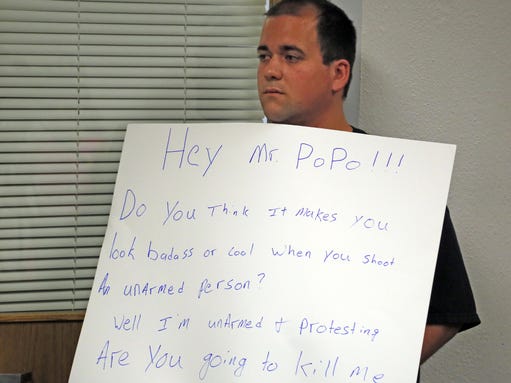
The creators of StreetCredrecently brought their work to my attention. They like data. So do I. They’re trying to flesh out the situations when police kill an unarmed person. Unarmed does not automatically mean a person isn’t a threat. It’s interesting that the majority of these cases are not officer initiated but involve police response to a call for service for a crime in progress.
Of the 125 incidents in which police killed an unarmed civilian, 25% (31) began on traffic stops, and 65% (81) began as a response to a 911-call about a violent crime (robber, E.g.,[i], carjacking[ii], domestic violence[iii] or assault[iv]) or property crime (burglary[v], car theft[vi] or vandalism[vii]) in progress.
In addition to those, there were nine people (7%) whom 911 callers described as being, “crazy[viii],” or, “on drugs[ix]”, “covered with blood[x]”, and “yelling[xi]”, or threatening people[xii]. Three (2%) were wanted[xiii] fugitives[xiv] in the act of escape[xv] — and one was unarmed when he died but was acting as part of a gang of three who were wanted in a recent homicide and were at the time of the incident in the progress of a kidnapping a woman[xvi].
In all, there were 26 incidents that involved an assault by the unarmed civilian against another civilian before police arrived, and in two cases, the murder of other civilians by the decedent.
When Sandra Bland was asked by Officer Encinia if she, “was done,” she actually was. Officer Encinia could have issued a ticket or a warning and walked away. But he chose not to. That was a mistake. Not legally, mind you. But morally and tactically, it was stupid.
“A roadside domestic,” is how my friend and retired Baltimore cop, Leon Taylor put it. (“Code it, David-Yes.”) Yeah, my idea of a fun Friday night is seeing Leon, who happened to be in town unexpectedly, and analyzing the full Sandra Bland arrest video over a beer.
Both Bland and Encinia could have deescalated, and neither did. But it’s not Bland’s job to deescalate. She’s not paid to interact with citizens and make things safer. It’s not her responsibility. She can do whatever the hell she wants. It might end up with her getting arrested. Sure. But it’s only the police officer’s moral and professional responsibility to do the right thing.
The job of a police officer is avoid creating potentially dangerous situations and to deal, professionally, with upset people. To intentionally not do so is bad policing.
Here’s my timeline and transcript of the Officer Encinia Bland encounter. Times are based on the above video. (The transcript isn’t perfect; but it’s the best I could do.) The video starts with Officer Encinia wrapping up what seems to be a very nice car stop. (That car then pulls away from the curb without signaling, I can’t help but notice.)
1:15 Bland makes right turn onto road.
1:20 Cop makes a U-Turn.
At this point I’m wondering why he’s interested in Bland, if he is. It’s not clear if she signaled a right turn (or stopped) or not. But he never mentions this later. Is he just speeding to get coffee? I don’t know. But it does seem like he already intended to stop her. But maybe not.
Maybe he liked stopping cars so he could give drivers warnings instead of tickets. And then he’d leave feeling all warm and fuzzy. I don’t know. But you don’t really deserve credit when you pull people over for bullshit and then choose not to write them up.
I’d guess he’s pushing roughly 35-40 mph in what is 20 mph zone. At 2:00 Officer Encinia pulls up behind Ms. Bland, who changes lanes without signaling. Bland later tells Encinia, quite honestly, that she was trying to get out of the officer’s way. Technically, though, she did failed to signal a lane change.
2:40 Officer: Hello, Ma’am. The reason for your stop is you failed to signal the lane change. Do you have your driver’s license and insurance with you.
[pause or incomprehensible]
What’s wrong?
Officer Encinia checks the car’s front tag and then returns to police car by 4:23. He exits the car at 8:35. Now up to this point, except for a very bullshit nature of the actual violation, it’s hard to fault the officer for any of his his actions or demeanor toward Sandra Bland. For her part, she signals complete verbal compliance. She’s not happy. But then why should she be?
8:39 Him: OK, ma’am.
[Pause]
Him: You OK?
8:50 Her: I’m waiting on you. You… This is your job. I’m waiting on you. Whatever you want me to do.
8:55 Him: You seem very irritated?
8:57 Her: I am. I really am. I feel like you stopped me, for what I am getting a ticket for — I was getting out of your way. You was speeding up, tailing me. So I move over, and you stop me. So, yeah, I am a little irritated. But so that doesn’t stop you from giving me a ticket, so…
Now here Bland is attempting to connect. She actually thought the officer cared what was wrong. After all, he did ask, well, “what’s wrong?”
There’s a long 5 second pause before the officer says, “I’m sorry, Ma’am. I’m just going to give you a warning. Please drive safely,” and Bland drives away.
Oh, wait…. That’s not what happened. But that could have been the happy ending. But it wasn’t.
They both end up taking the low road, but it’s initiated by the police officer. This could have been the perfect time for a cop to win her over. This is how community relations start: not with a community relations officer, but with every damn interaction between police and the public.
Think of everything that has happened in the past year with police. And then think of the stupidity of this stop. And then you ask someone, “what’s wrong?” and leave them for four minutes to think about the answer? Four minutes is a long time to wait for a traffic stop warning, but it’s not crazy long (computers do go down and/or get slow). Four minutes is enough time to sit and fume and think about history and present and want to answer the question, “what’s wrong?”
Let’s rewind a few seconds:
Her: I am. I really am. I feel like you stopped me, for what I am getting a ticket for — I was getting out of your way. You was speeding up, tailing me. So I move over, and you stop me. So, yeah, I am a little irritated. But so that doesn’t stop you from giving me a ticket, so…
[four second pause]
9:09 Are you done?
Oh, no he didn’t!
See this is where things went south. She told him what was going on in her mind. She was willing to receive a ticket. But she wasn’t going to be happy about it. You don’t have to be happy when you think the cops are going to give you a bullshit ticket. Especially for some violation that was caused by the cop’s presence in the first place. You have to obey. And until this point, Bland does obey. And as a cop, that’s all I ever really wanted. But rather than calm down or even listen to Bland, the officer is as rude as you could be in three non-obscene words: “Are you done?”
It’s like the officer is saying, “If I don’t engage you, you’ll never how I really feel.” Or, “Are you through telling me that bullshit?” Or, “I want you to start talking so I can tell to shut the fuck up.” Try that with somebody you love and see how it works. Bland was compliant. She was resigned. The problem from the officer’s perspective seems to be that she wasn’t properly deferential. She wasn’t shucking and jiving:
9:11 You asked me what was wrong and I told you. So now I’m done, yeah.
9:14 OK.
9:20 You mind putting out your cigarette please, you mind?
9:24 I’m in my car. Why do I have to put out my cigarette?
9:29 Well you can step on out now.
I have no idea what Officer Encinia’s intention is here. Except for her tone, it’s her first pushback to his authority. Now don’t get me wrong, authority is important to a cop. But authority is something you receive. It’s something you earn. It’s not something you demand. And the cop quickly becomes an asshole. Why? Because he can.
I guess because she said she didn’t have to put out her cigarette in her car (though legally, she probably would have had to put out, if ordered, based on officer’s perception of safety) maybe Encinia thought, I’ll show you by taking you out of your car comfort zone. And then you won’t give me any lip. This is straight up Southpark shit.
Again, the cop is in his rights, as the Court has defined them (Pennsylvania v. Mimms, 1977), but I don’t see how he’s making himself safer by getting her out of her car. Is she under arrest at this point? I don’t know. But the Court has said that police (in a Texas case) can arrest people for even non-arrestable traffic offenses. Does that make sense? No. But it’s Law of the Land.
It’s possible Encinia knew his he could arrest on any traffic stop and chose to do so. Dickish, but legal. (Often this constitutional right is prohibited by state or local statute, but I doubt I don’t it’s prohibited in Texas). Either way, you can arrest her the moment she refuses to comply with the lawful order to get out of the car. Disobeying a lawful order is a crime. The game is rigged in police officers’ favor, I’m telling you. And that’s why you shouldn’t play.
At any time up to this moment Bland could have also deescalated. She could have said, “yes sir, sorry sir.” And probably she would have gone on her way with a warning. She made a choice. A bad choice. You’ll never win an argument like this with a cop. Nine times out of ten, on strictly legal grounds, the cop is right. And the tenth time? You’re still not going to win.
9:30 I don’t have to step out of the car.
Step out of the car
9:37 Her: No, you do not have the right to do that.
Him: I do have the right. Now step out or I will remove you.
9:45 Her. I refuse to talk to you other than identify myself.
He’s right here. She doesn’t have to make small talk. But she does have to get out of the car. There’s too much bad “know your rights” crap on YouTube. The problem with learning “your rights” on the internet is it’s often flat out wrong. Also, even if it is right in some cases, it may not apply in your case. And there’s no way to know. It depends on a lot of factors you may not know about. And the cop is under no obligation to tell you so. Sometimes, you know, there actually is a time sensitive emergecy.
The best legal advice, my advice that will never get you locked up or shot, is comply like a complying fool, do not run away, do not fight. Period. Is that too demeaning for you? Too much Ethiopian Shim Sham shucking and jiving? Well that’s up to you. But as I tell my students: pick your battles.
But keep in mind police officers do not have to give you a reason for their actions. Ever. You can ask, “why?” They are under no obligations to answer. Ever. Police never have to answer your questions. Now tactically and morally, and just as common courtesy, there are very good reasons officers should sometimes explain their actions, but legally they do not have to. And sometimes (not most of the time, mind you) there are good reasons not to.
And if you insist you have a right when you don’t, well, that’s how you talk your way into handcuffs. Or worse. At 9:48, just 7 minutes after this doomed blind date started, they start bickering like a couple that’s been in bad relationship for 170 years.
9:48: Step out or I will remove you.
Her: I am getting removed for a failure to signal?
Him: Step out or I will remove you. I’m giving a lawful order. Get out of the car now. Or I’m going to remove you.
9:54 Her: I’m calling my…
9:55 I’m going to yank you outta here (take the keys)
OK, you going to yank me out of my my car.
9:59 Get out
10:00 [calls for backup]
This is a dumb move. From a tactical perspective, what the hell is he doing? She is not an imminent threat. So you try and force her in a position where she might be? You want to force her out by yourself instead of waiting for backup that is literally a couple minutes a way. If you’re solo and want to arrest somebody or get a person out of a car (not an easy thing to do), then you, office, shuck and jive and do the Ethiopian Shim Sham until you have backup. There’s no reason to do this alone. And yet he does. Why? I don’t know. I guess because he wants to prove his dominance over her. And Bland knows that. It’s horrible policing.
Her: All right, let’s do this.
Him: We’re going to.
Her: Don’t touch me.
Him: Get out of the car
Her: Don’t touch me. I’m not under arrest, and you don’t have the right.
I can’t help but wonder if Sandra Bland would still be alive if she did actually understand his rights and her obligations in a police-citizen car stop.
10:10 You are under arrest
I’m under arrest for what?! For what?
Failure to obey a lawful order. Or just because he wanted to, based on Atwater.
Officer Encinia then calls for faster backup around 10:15. This is also horrible policing. Other officers now will race to the call. But the only reason you need backup is because you made a bad tactical decision, officer. Racing to calls is dangerous. Officers get killed. And if you make your fellow officers race to your bullshit too often, well, after a while they’re going to go really slow and stop at all the red lights. Safety first, after all.
Him: Get out of the car. Get out of the car, now!
Her: Why am I being apprehended. You’re trying to give me a ticket…
I said get out of the car.
Why am I being apprehended?
I’m giving you a lawful order. I’m going to drag you out of here.
You threatening to drag me out of my own car?
10:30 Get out of the car! I will light you up. Get out of the car!
[He’s holding his Taser. Bland complies.]
Her: Wow. You doing all of this for a failure to signal.
Him: Get over there.
Her: Right yeah, let’s take this to court.
Him: Go Ahead.
Her: for a failure to signal.
Get off the phone.
I’m not on the phone. I have a right to record this. It’s my property.
Put your phone down.
Sir?
Put your phone down. right now. Put your phone down.
For a fucking failure to signal. My goodness.
11:03 Come over here.
Her: Ya’ll are interesting. Very interesting. You feel good about yourself? You feel good about yourself? For a failure to signal. You feel real good about yourself.
Him: Come over here now.
Her: You feel good about yourself.
Turn around. Turn around now.
Why can’t you tell me why I’m being arrested.
I’m giving you a lawful order.
Why am I being arrested?
Him: Turn around.
Her: Why won’t tell me that part?
11:25 I’m giving you a lawful order. Turn around.
Why will you not tell me that part?
You are not compliant.
I’m not compliant because you just pulled me out of the car.
11:30 TURN AROUND!
Her: Are you fucking kidding me. This is some bullshit.
Him: Put your hands behind your back.
11:35 You know this is straight bullshit. And you pull this shit. Full of straight this That’s all is some scary ass cops. Y’all bitch ass is scared. That’s all it is. Fucking scared of a female.
Him: If you would’ve just listened.
See, now we’re just in straight-up bickering couple bullshit. He’s dismissive of her. She’s trying to emasculate him.
11:49 I was trying to sign the fucking ticket! Whatever.
Him: Stop moving.
Her: Are you fucking serious?
Him: Stop moving.
Oh, I can’t wait till we go to court. Ohhh, I can’t wait. I cannot wait till we go to court! I can’t wait. Oh, I can’t wait. You want me to sit down now?
12:01 No.
Her: You was going to throw me to the floor. That’ll make you feel better about yourself?
12:06 Knock it off.
That make you feel better about yourself? That’ll make you feel real good, won’t it? Pussy ass. Fucking pussy. For a failure to signal. You doing all of this. In little ass Prairie View Texas. My God, they must…
Him: You were getting a warning. Until now. You’re going to jail
Her: I’m getting a, for what?!
12:23 You can come read it.
For what? I’m getting a warning for what?
Stay right here.
Her: For what?! You were pointing me over there!
12:29 I said stay right here
Her: Oh, I swear on my life, y’all some pussies. A pussy-ass cop. For a fucking ticket you gonna take me to jail.
[Him to dispatcher: I got her under control. She’s in handcuffs.]
Her: What a pussy. What a pussy. What a pussy. You about to break my fucking wrists.
Him: Stop moving.
Her: I’m standing still. You pulling me, goddamnit.
Him: Stay right there. Stay right here.
Her: Don’t touch me. All this for a traffic ticket
13:00 [Officer 1 to officer 2]: Cover me right over here.
Him: This right there says a warning. You started creating the problem.
Her: You asked me what was wrong. I trying to tell you.
Him: You got anything on you person, that’s illegal.
Do I look like I have anything on me. This is a maxi-dress.
I’m going to remove your glasses.
This is a maxi-dress.
Come on over here.
13:20 You an asshole. You about to break my wrist. Stop. You’re about to break my fucking wrist.
Stop it.
Officer 2: Stop resisting ma’am
If you would stop, I would tell you.
13:34 You are such a pussy. You are such a pussy.
Officer 2: No, you are.
You are dinking around You are dinking around When you pull away from me, you are resisting arrest.
This make you feel good
Officer #2: I got it.
Her: This make you feel good, officer, a female. For a traffic ticket.
Officer #2: I got it. Take care of yourself.
Her: You a real man now. Knocked. Slammed my head in the ground. I got epilepsy you motherfucker
13:56 Him: Good
Officer #2: You should have started thinking about that before you started resisting
14:02 All right. Yeah, this is real good. Real good for a female. Yeah. Y’all strong. Oh. Y’all real strong.
14:09 I want you to wait right here
I can’t go nowhere with a fucking knee on my back. Duh.
And here’s it’s all over but some more shouting.
14:22 Him: You need to leave.
15:00 Sit up on your butt.
16:10 She started yanking away and then Kicked me, and I took her straight to the ground.
16:20 Officer #3: One thing, you can be sure it’s on video.
16:55 Ring got you there?
31:38 Him: She kicked me, started yanking away. I brought her down into the grass. [He did put her down in the grass, which, well, I wouldn’t say it was nice of him, but it was much nicer than bringing her down on concrete, which he could have done.]
You know the funny thing? We’re only talking about it because she killed herself (or was brutally murdered by correctional officers). This is what is messed up about the rest of the criminal justice system. Bland spent three damn days in jail for failure to obey and also, while in cuffs, kicking and scratching a cop without serious injury. And now she’s dead.
As commenter to a previous post put it: “This is a bad job by the trooper… but not the worst I have ever seen.” No. It’s not the worst I’ve seen. But, man… it is bad.
That was cute and all, before Sandra Bland died after being arrested in what was so close to being a warning for a minor traffic violation.
Three(?) times Sandra Bland asserted her “rights.” Three times she was wrong. Now she’s dead. You do have to put out your cigarette as a matter of officer safety. You do have to get out of the car. During a car stop, you are being detained. The 4th amendment barely applies. This isn’t my opinion. These are Court decisions regarding general concepts of officer safety — far more pro-cop than most cops and the public realize — that emphasize the phrase “unquestioned police command.”
Ordering people out of car isn’t like use of lethal force. The latter requires articulation of danger. The Court says car stops are inherently dangerous and thus gives officers the greatest amount of discretion to whatever they see fit. (In a similar way, the Court recognizes the “inherent link” between violence and the drug corner, which gives officers carte blanche to frisk almost everybody on a drug corner, no further articulation of danger required.)
The basic rule, especially in a car stop, is obey lawful orders. Period. Resistance really is futile. Force can used to ensure compliance. I’m not saying this is good. But it is established Law of the Land.
So it pains me to read a legal analysis in a respectable publication that is so patently, even dangerously, wrong.
First let’s get the objective facts right. Then we can talk about the subjective issues.
Jim Harrington, director of the Texas Civil Rights Project, should know better. You gotta get this right. He is wrong:
[The cop] does not have the right to say get out of the car. He has to express some reason. “I need to search your car,” or, whatever; he needs to give a reason.
Wrong, wrong, wrong.
He can’t just say “get out of the car” for a traffic offense.
Uh, yes, he can! What part of “precautionary measure, without reasonable suspicion” doesn’t he understand?
Rarely is the Supreme Court so unambiguously clear. Best I can tell, it goes back to Pennsylvania v. Mimms(1977):
The order to get out of the car, issued after the respondent was lawfully detained, was reasonable, and thus permissible under the Fourth Amendment. The State’s proffered justification for such order — the officer’s safety — is both legitimate and weighty.
…
[T]he only question is whether he [lawfully detained driver] shall spend that period sitting in the driver’s seat of his car or standing alongside it. Not only is the insistence of the police on the latter choice not a “serious intrusion upon the sanctity of the person,” but it hardly rises to the level of a “petty indignity.” [quoted from Terry v. Ohio]. What is, at most, a mere inconvenience cannot prevail when balanced against legitimate concerns for the officer’s safety.
…
[T]he police officers may order the driver to get out of the vehicle without violating the Fourth Amendment’s proscription of unreasonable searches and seizures.
Maryland v. Wilson(1997) reaffirmed and extended this to the car’s passengers as well. Brendlin v. California(2007) re-affirmed again, but added some even stronger language:
We held that during a lawful traffic stop an officer may order a passenger out of the car as a precautionary measure, without reasonable suspicion that the passenger poses a safety risk (driver may be ordered out of the car as a matter of course). In fashioning this rule, we invoked our earlier statement that “the risk of harm to both the police and the occupants is minimized if the officers routinely exercise unquestioned command of the situation.” [quoting Michigan v. Summers] What we have said in these opinions probably reflects a societal expectation of “unquestioned [police] command.”
And in case you’re still hoping for a loophole:
Our conclusion comports with the views of all nine Federal Courts of Appeals, and nearly every state court, to have ruled on the question.
And no, cops don’t have to tell you anything or explain why. Maybe they should, out of courtesy or politeness or tactics. But they don’t have to. They order. You obey. So says the Supreme Court.
Tangentially, not that you asked, this is what bothers me the liberal emphasis on “procedural justice” (See Obama’s Presidential Police Report). This was procedural justice. Nothing the cop did was illegal. Could have the cop acting differently? Sure. Should the cop have acting differently? In hindsight, yes. But did the cop have to act differently? No. The law was followed. And now a woman is dead. It’s not moral justice.
Also, here’s the most complete video:
This reminds me most of all of the Henry Louis Gates arrest. You get into a pissing contest with cops, odds are you’ll lose. “Pick your battles,” I tell my students. A car stop is great place to keep your mouth shut. Seriously, right or wrong, what do you hope to gain from pissing off a cop?
No real point here. Except it happens. And you won’t hear this (except in Des Moines) because there’s no racial element to the story. Does that make the shooting any better or worse? I don’t think so.
Right or wrong, American policing are taught to shoot center mass. And only center mass. The goal is not to kill, though the outcome of center-mass shot is usually death. The goal is to shoot to stop or incapacitate the threat. Once the there is no threat (which often happens before the suspect is killed), you stop shooting. This is how I was taught. This is what I have explained to many people.
It’s simply too hard in the heat of battle to shoot a leg. Most police miss when shooting center mass. Shooting a smaller target is even more difficult. The idea against shooting to wound is ingrained in American police officers.
But here is a fascinating read from 2011 (one, two, and three) on how you can shoot to wound. How training is done in at least one other country (anybody know about others?). In the Czech Republic they do train police to shoot people in the leg.
It certainly makes me wonder if we could do the same. Are American police inherently worse shots? Why can’t we change our training, if need be? If nothing else, training officers to have the option to shoot to wound would give police a justifiable choice. Now maybe you don’t want to have choices in the heat of the battle, but you always have a choice (most officers, myself include, have been in situations where they could have used lethal force, but choose not to). Right now, officers are forbidden to aim for anything but center mass (or the head) (and yet I’ve spoken officers who would consider doing so in some circumstances, despite the prohibition on it).
Some highlights:
“Okay,” I said, “but what if the round passes through? What about the round striking an innocent person who happened to be on the other side of the target?” Now I had him against the ropes, surely these cops are mindful of the dynamic environment in which law enforcement plays out.
Again, he responded without hesitation. “That’s another reason why we aim to the legs. At the distance we usually fire — remember, two to three meters — the bullet has a trajectory towards the ground of only a few feet. A pass through is rare — we use hollow point bullets — but if it does occur, it is not likely to travel much farther.”
…
“Well, what if the guy is shooting at you? Dropping him to the ground with a leg shot may stop the forward attack but it is not likely to stop the threat?” he can still fire at you — and you won’t have time to assess the continued threat to see if he stopped!
He grinned at me, “If he is shooting at you? Well, then we use lethal shots — two to the chest, one to the head.”
He smacked it out of the park. If you are being shot at, well, then you use lethal shots — two to the chest and one on the head. Of course you do!
…
When officers recite the “we don’t shoot to kill” mantra — and believe it — we may reasonably conclude that they are not properly prepared to take a human life. Deluding officers into actually believing that police are not supposed to kill — or are even allowed to kill — creates a deadly mental block that will most likely surface in that critical moment of truth — when ending a life for the sake of the greater good may be necessary.
Further, the mantra sends the wrong message to the community. That message indicates that whenever a subject is killed at the hands of a law enforcement officer, then something must have been done wrong, for surely law enforcement does not shoot to kill — they only shoot to stop.
…
This is probably why American police are reluctant to adopt policies that suggest that shooting in certain scenarios might be intended only to wound, for fear that a wounding shot might accidentally kill. No, it is better for a killing shot to accidentally wound. American police routinely adopt policies that plan for the worst, and hope for the best.
Center mass shots will likely remain the only target area taught and supported by training in the United States. If we don’t have a justification to kill, then we simply teach to not shoot. We prefer a model where we aren’t forced to account so much for accuracy, rather our mission is to describe the elements of using deadly force. We prefer that our accountability virtually end at the squeeze of the trigger.
If the bullet hits and kills, that’s OK — if it doesn’t kill, perhaps that’s better?
The national average, the rate of people killed by police (as they define it, which is pretty loose, but OK) is 0.36 per 100,000. This is over the past 23 months. That’s roughly 1,135 killed per year.
This is based on these data from May 2013 to April 2014. I believe it’s similar to (but a bit messier than) killedbypolice.net. But it’s got city and county data, which isn’t at killedbypolice.net.
Now we already knowthat the rate of being killed by police is a hell of a lot higher in Oklahoma, New Mexico, and Arizona (0.8) — five times higher — than it is in New Jersey, Michigan, and New York (0.15).
But states are big and have hundreds of police departments. I want to break it down by city. The rate in California is twice the national average. I don’t think San Francisco police are shooting a lot of people. So who is?
Well, Bakersfield (rate = 2.1, which includes killing in the city killings both by the Bakersfield PD and the Kern County Sheriff Dept.), Salinas (2.0), Stockton (1.4), Fresno (1.1), and Santa Ana (0.9) come to mind. These are crazy high rates.
Super high seem to be Kansas City, MO (rate = 2.0), Oklahoma City (1.7), St Louis (1.5), Tulsa (1.4), Phoenix (1.2), and Albuquerque (1.1). Remember all these figures are rough. So I don’t mean to rank order, but I do mean to group these cities together.
Bakersfield? Salinas? Maybe it’s been a bad two years, but there are only 363,000 people who live in Bakersfield. Between 2012 and 2013, the NYPD killed 21 people. And in the past 23 months 15(!) people have bit the dust in Bakersfield? Do correct me if I’m wrong. The stats may be a fluke. Or maybe it was a bad two years. Or maybe the numbers are wrong. But it’s still a hell of a red flag!
The rate in Los Angeles 0.5. That’s not quite twice the national average… but it’s one-forth of Bakersfield and Salinas. Baltimore’s rate is 0.9. Chicago comes in at 0.6.
The NYPD? The big bad NYPD? The killers of Diallo, Gurley, Bell, Garner, and so many other?
Zero-point-one-three. New York City’s rate is 0.13. The rate of people killed by police in one-third the national average. This is amazing.
Put another way, Chicagoans are 5 times as likely to be killed by police. Baltimoreans 7 times as likely. And Bakersfield? Lovely Bakersfield? In the streets of Bakersfield you’re 16 times more likely to be killed by police than you are in New York City. [Update 2017: This is no longer true. The number of people killed by police in Bakersfield has declined greatly. But the overall numbers for small- to medium-sized cities west of the Mississippi are still very large.]
[Update: See Nick Selby’s description of those shot and killed by police in Bakersfield. Maybe the streets just really are meaner.]
Think of this, too, as my NYPD friends do. Shootings by NYPD may be tragic, but compared to the rest of the nation, they really do seem to fall in the category of isolated incidents. Whatever the NYPD is doing to shoot so few people seems to be a case of best practices. Maybe the focus should be not to criticize the NYPD but to learn from it. The systemic problems seem to be out west. And maybe people who want to protest police shootings should protest police who really are shooting too many people.
Go west, young man, go west. There is health in the country, and room away from our crowds of idlers and imbeciles.
[I want to emphasize these results are primarily, not double-checked, and based on unverified data. But the even as just ballpark figures, the differences are too dramatic to ignore.]
I know that headline is unfair clickbait, but there are many things that could be said about this video. Here’s a Daily News story.
I think it’s interesting primarily to show what can happen when officers fail to gain control of a situation: a mess. A lethal mess. A cop gets shot. Two of the fighting Graver family get shot, one fatally.
Tactically, clearly mistakes were made, but it’s hard to second guess. It’s rare to find a group that is so willing and able to fight cops. Still, in terms of “things that could have gone better,” one place to look is that fight only started after the cops arrived on scene. That could be a place for improvement. Once the brawl is on, well this is why you always want a fight to be two, three, or four police to one. What a mess. What part of “get on the ground” don’t they understand.
Uh, it’s his own gun. But headline aside (writers don’t write the headline), I like to think I make some good points in this CNN piece about Robert Bates, the Tulsa County “reserve deputy” who thought his gun was a Taser and shot and killed a criminal.
I mention this article by Peter Katel in CQ Researcher (alas, behind a pay wall) because, along with lots of good stuff, there’s a quote I wasn’t expecting coming from my man Norm “a liberal critic of much police strategy” Stamper:
A video of the [Tamir Rice] shooting — showing a police car driving up next to the boy, who was shot two seconds later — demonstrates that the shooting never had to happen, Stamper concludes, saying the officer could have taken cover behind his car and evaluated the situation more calmly.
“A more mature, experienced, confident police officer would have better understood what he was facing,” Stamper says.
At the same time, he says Rice’s parents never should have let him outside with a replica pistol, and schools and police should ensure that children know an essential fact of life: No one seen to pose a mortal threat in the presence of police should expect to walk away, or even to survive.
“If you point a gun at a police officer, you have punched your ticket,” Stamper says. “I don’t care if it’s a toy gun.
Norm is right about a lot of things (like ending the drug war). Add this to the list.
But it might be behind a paywall. If so, here is the good parts version:
Even undercounting, America easily outguns other rich countries: in the year to March 2013 police in England and Wales fired weapons three times and killed no one.
Such comparisons should be read in context. America’s police operate in a country with 300m guns and a murder rate six times Germany’s. In recent years the New York Police Department (NYPD) was called to an annual average of almost 200,000 incidents involving weapons, shot 28 people and saw six of its officers shot (mostly non-fatally). Despite the headlines, it is one of America’s more restrained forces.
…
In a small town policemen are investigated by people they work with all the time. “The prosecutor is the guy who went to your kid’s confirmation,” says Mr Moskos.
…
A more obvious culprit is the way policework is measured. Police managers fret about lazy officers. To keep them away from the doughnuts, most forces judge officers by how many arrests they make. Preventing a rape does not count; busting someone for jaywalking does.
There is a paradox in all this. American cities have become much safer in the past two decades. Too many urban forces do not seem to have noticed. In Cleveland, the DoJ found a sign in a police parking lot that read “Forward Operating Base”, as if it were an outpost in Afghanistan.
…
The federal government stokes the culture of the warrior cop by offloading surplus military kit to local police. The Los Angeles School District Police Department has acquired three grenade-launchers and a mine-resistant armoured vehicle, perhaps to keep its sophomores in check.
…
The number of shots fired by police in New York has fallen by more than two-thirds since 1995.
…
Even with these changes, “There is at least one crazy cop in every precinct,” says a retired NYPD officer.
That last part is so not true. The actual number of crazy cops in every precinct is three.