Tag: war on drugs

  • Legalize It All

    Legalize It All

    Dan Baum has written a bunch of good books about a variety of subjects, and I’ve mentioned him many times on this blog (search for his name, if you want). I first met Dan and his wife, Margaret, in New Orleans in 2007. The title of my book, “In Defense of Flogging,” was coined the night I met them, at dinner.

    Dan is the dandy is the middle with the peach jacket and straw hat.

    His latest piece in Harpers Magazine is about legalizing drugs. He’s been at this for a while. Smoke and Mirrors came out in 1997. If I remember correctly, this was in Smoke and Mirrors. But maybe the time is more ripe now:

    I started to ask Ehrlichman a series of earnest, wonky questions that he impatiently waved away. “You want to know what this was really all about?” he asked with the bluntness of a man who, after public disgrace and a stretch in federal prison, had little left to protect. “The Nixon campaign in 1968, and the Nixon White House after that, had two enemies: the antiwar left and black people. You understand what I’m saying? We knew we couldn’t make it illegal to be either against the war or black, but by getting the public to associate the hippies with marijuana and blacks with heroin, and then criminalizing both heavily, we could disrupt those communities. We could arrest their leaders, raid their homes, break up their meetings, and vilify them night after night on the evening news. Did we know we were lying about the drugs? Of course we did.”

    It’s worth reading the whole thingfor an idea about how we might be able to move forward on this whole drug and this prohibition problem.

    In other words, our real drug problem — debilitating addiction — is relatively small. One longtime drug-policy researcher, Peter Reuter of the University of Maryland, puts the number of people addicted to hard drugs at fewer than 4 million, out of a population of 319 million. Addiction is a chronic illness during which relapses or flare-ups can occur, as with diabetes, gout, and high blood pressure. And drug dependence can be as hard on friends and family as it is on the afflicted. But dealing with addiction shouldn’t require spending $40 billion a year on enforcement, incarcerating half a million, and quashing the civil liberties of everybody, whether drug user or not.

    So consider Portugal, which in 2001 took the radical step of decriminalizing not only pot but cocaine, heroin, and the rest of the drug spectrum. … No other country has gone so far, and the results have been astounding.

    When applying the lessons of Portugal to the United States, it’s important to note that the Portuguese didn’t just throw open access to dangerous drugs without planning for people who couldn’t handle them.

    Decriminalization has been a success in Portugal. Nobody there argues seriously for abandoning the policy, and being identified with the law is good politics.

    As successful as Portugal’s experiment has been, the Lisbon government still has no control over drug purity or dosage, and it doesn’t make a dime in tax revenue from the sale of drugs. Organized crime still controls Portugal’s supply and distribution, and drug-related violence, corruption, and gunned-up law enforcement continue. For these reasons, the effect of drug decriminalization on crime in Portugal is murky.

    Portuguese-style decriminalization also wouldn’t work in the United States because Portugal is a small country with national laws and a national police force, whereas the United States is a patchwork of jurisdictions — thousands of overlapping law-enforcement agencies and prosecutors at the local, county, state, and federal levels…. We cannot begin to enjoy the benefits of managing drugs as a matter of health and safety, instead of as a matter of law enforcement, until the drugs are legalized at every level of American jurisprudence, just as alcohol was re-legalized when the United States repealed the Eighteenth Amendment in 1933.

  • 125 Overdose Deaths a Day

    125 Overdose Deaths a Day

    It makes homicide — which kills “just” 40 Americans a day — look positively benign.

    47,000 Americas died from drug overdose in 2014. That’s a shocking figure. 47,000 is the number of US soldiers who died in Vietnam combat. And that was over 20 years.

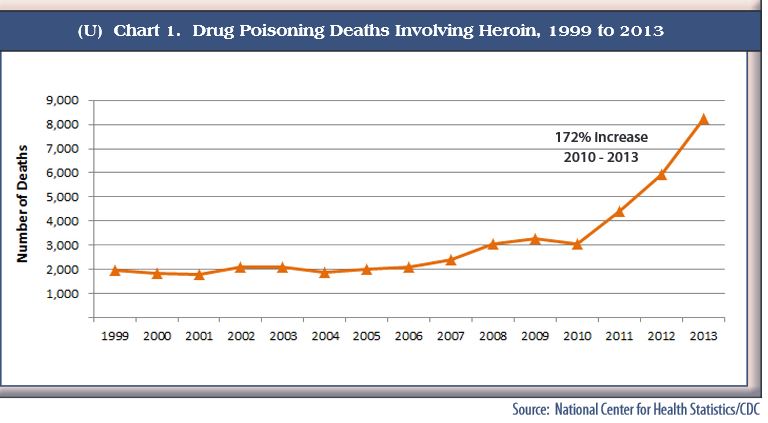
    Heroin deaths have shot up since 2010:

    From the Times:

    The death rate from drug overdoses is climbing at a much faster pace than other causes of death, jumping to an average of 15 per 100,000 in 2014 from nine per 100,000 in 2003.

    Nationally, opioids were involved in more than 61 percent of deaths from overdoses in 2014. [Only 61%? I’m actually surprised it’s that low.] Deaths from heroin overdoses have more than tripled since 2010 and are double the rate of deaths from cocaine.

    From CNN:

    The biggest increase in deaths was from from synthetic opioids, which went up 80%. According to the CDC, the increase in synthetic opioid deaths coincided with increased reports by law enforcement of illicitly manufactured fentanyl.

    The states with the highest rates of overdose were West Virginia, New Mexico, New Hampshire, Kentucky and Ohio.

    Since 2000, opioid drug overdose deaths rose 200%. Nearly half a million lives have been lost to opioid drug overdoses since then.

    Maybe we could look at a country that has come very close (knock on wood) to solving this problem? There are about 100 overdose deathsin the Netherlands. 16.8 million people. That’s a rate of 0.6. Yeah: zero-point-six. Put another way, if the Netherlands were the size of the US, there would be about 2,000 overdose deaths. So what do they do in the Netherlands? Give that shit away for free, literally.

    Or maybe we should just take out another kingpin or two. That always seems to work.

  • The 1 percent

    Out of 12,000 Chicago Cops, 124 are responsible for a third of misconduct lawsuits settled by the city since 2009, costing $34 million. The Tribune(behind a paywall unless you good for the article) reports that 82 percent of the department’s officers were not named in any settlements. (Keep in mind that a good chunk of that 82 percent haven’t interacted on-duty with a member of the public since Richard J. Daley. The proper denominator here would be the number of cops on the street.):

    Of the more than 1,100 cases the city settled since 2009, just 5 percent were for more than $1 million…. [The rest still] cost the city millions of dollars…. A vast majority, 85 percent, were settled for $100,000 or less, which meant the deals did not require City Council approval. And Chicago officers accused of misconduct are rarely disciplined.

    Of course there are many unfounded complaints. Just as there are many BS lawsuits filed for a quick monetary settlement. I know that. But just like a criminal arrest 20 times — God only knows how many crimes he committed without getting caught — a cop with 57 complaints? God only knows how much shit you really did. Not every mope complains.

    While many officers as well as police union officials attribute claims of misconduct to the rough and tumble of working in crime-ridden neighborhoods, complaints against Campbell, Sautkus and their colleagues have often occurred while the group patrolled relatively low-crime areas, focused on quality-of-life issues.

    The three officers have earned hundreds of awards and commendations from the department for their work. They’ve also racked up 16 lawsuit settlements since 2009 among them and two other officers who also live in the neighborhood… The city paid $1.5 million to settle those cases.

    How the hell does one officer get sued (with payout) seven times in seven years and average about 6 complaints a year? Good God. Hundreds of awards. As long as he kept finding the drugs, he gets awards. Doesn’t anybody look for red flags?

    I can’t help but think of my friend and squadmate who retired as a noble patrol officer after 33(!) years on the mean streets of Baltimore. He once confided in me, half gleefully and half sheepishly, that he hadn’t received a single serious complaint in his entire career. Now mind you, in his 30th year, he wasn’t exactly setting the curve in number of arrests. But he did his job and did it well. His secret? He was a good cop. He didn’t take shit, but he also treated everybody with respect, even those who didn’t deserve it.

  • We Got Another Kingpin! (16)

    It’s been awhile since we’ve gotten a Kingpin. Almost a year. El Chapo. We’ve gotten this guy before. Like non-sequel movies, are we running out of Kingpins?

  • Whose fault is this?

    A good piece of journalism in the Sun:

    In Baltimore, where there are an estimated 19,000 heroin users, including 9,500 chronic users, annual spending on the drug is estimated at least at $165 million.

    When the brothers of one local kingpin were kidnapped, he came up with $500,000 for ransom. When investigators searched a stash house and home of another dealer, they found $464,283 and $74,980, respectively.

    But as in the legitimate economy, such wealth is largely limited to those at the top levels of the heroin trade. At the bottom, the so-called “corner boys” who sell on the street can be making as little as minimum wage.

    There seems to be an unending supply of mostly young men willing to do this entry-level work, however low-paying, illegal, and dangerous. Among them was Freddie Gray, the 25-year-old whose death in police custody in April triggered protests and rioting in Baltimore and led to criminal charges against six police officers.

    It is an all-too-familiar cycle in Baltimore: Those with little education and thus few job prospects find their way to the lowest rungs of the drug trade, touting on the corner or serving as lookouts. At some point, they are arrested and end up with a criminal record that makes them even less attractive to the legitimate economy. And so they return to drug dealing, often in the neighborhoods they live in.

    “They’re basically unemployable.”

    And yet they’re eminently arrestable. Not that that does any good.

  • Snitching for Dollars

    This is what the War on Drugs looks like. Just another day. From the Chicago Sun-Times:

    One of Chicago’s most notorious informants — who provided drug tips to the police while secretly killing and robbing people and doing drug deals — was paid hundreds of thousands of dollars for his information with the approval of police supervisors who have since reached the highest levels of the department, records show.

    Saul Rodriguez was a top snitch for the Chicago Police Department’s narcotics section between 1996 and 2001. Over that period, he received more than $800,000 from the department for his information.

    During those years, Rodriguez was involved in two killings and other serious crimes like holdups, according to federal prosecutors.

    Rodriguez, the informant, was a partner in crime with Lewellen, his police handler, federal authorities say. Both men went to prison in 2012 in a federal conspiracy case. Sanchez has never been charged and has denied any wrongdoing.

  • What the War on Drugs was really about: “We knew we couldn’t make it illegal to be either against the war or black”

    Dan Baumwrites about what the Drug War was really about:

    In 1993, I was researching my first book, Smoke and Mirrors, which is the tale, starting in the 1968 Nixon presidential campaign, of how drugs were turned into a political weapon. I tracked down as many people as I could who had been involved in drug policy in the Nixon, Ford, Carter, Reagan, Bush, and brand-new Clinton administrations. Among the first I found was John Ehrlichman, who was at the time doing minority recruitment for an engineering firm in Atlanta. He looked nothing then like he had when he’d been a principal Watergate villain in the early 1970s and an evil god in the bad-guy pantheon of my youth. By 1993, he was fat, and wore an Old Testament beard that extended far below the knot of his necktie. He impatiently waved away my earnest, wonky questions about drug policy.

    “You want to know what this was really all about?” he asked with the world-weary air of a man who, after public disgrace and a stretch in federal prison, had little left to protect. “The Nixon campaign in 1968, and the Nixon White House after that, had two enemies: the anti-war Left, and black people. You understand what I’m saying? We knew we couldn’t make it illegal to be either against the war or black, but by getting the public to associate the hippies with marijuana and blacks with heroin, and then criminalizing both heavily, we could disrupt those communities. We could arrest their leaders, raid their homes, break up their meetings, and vilify them night after night on the evening news. Did we know we were lying about the drugs? Of course we did.”

  • Just another day in the Eastern…

    Sometimes it’s fun to re-read my old field notes. I should write a book or something. This is from Jan 24, 2001 (and better than my average day’s notes):

    [Officer A] and I are walking our 4 miles at 5am: “People say this is a good neighborhood with a few bad people. But it’s not. I’d say that 50% are bad, and most of the rest, another 30% don’t care… The reason things are so bad here is because nobody does anything. If they gave us some information, like stayed on the line and told the dispatcher that it’s that guy in the red jacket and the stash is in that box over there. Then we could do something. But they don’t care… so they get what they deserve.”

    This occurred while I was complaining about [Officer B] locking people up for riding bikes (I had a nice night riding with [Officer B] tonight). And I mentioned, “and that’s why you shouldn’t lock somebody up for riding a bike. Because someone will say I or my nephew got locked up for nothing and they’d be right. Of course they’re not going to like the police.” [Officer A] said, “well, they were doing something.” “I know, it’s a legal lock up. But it’s not a moral one.”

    [Officer B] says regarding lock ups, “the major wants stats, I’m going to give him stats… And I may want to transfer somewhere else someday.” I tell him where he’s going to transfer couldn’t care less if he’s got 40 arrests or 400. It’s still more than they’ve ever got. What they do care about is if he’s got an open IID number. And he’s more likely to get one every time he arrests somebody. [Officer B] also says, “The only reason you don’t like bike lock-ups is because you ride a bike.”

    “Damn right that’s why I don’t lock people for riding a bike. But also because I don’t think riding a bike is a crime.” “But if they don’t have a light, and they don’t have ID….” “Yes, but you’re just locking them up for not having ID. You let them go if they do.” “That’s not true! I’ve written many citations.” “If you’ve written one citation, I’ll give you credit. If you’ve written many, good for you.”

    After walking with [Officer A] I got a newspaper and then hung out at the laundromat at 1900 E Eager. At one point a white women, looked like a junkie with straggly hair and bad skin, comes in honestly upset and says, “I was just robbed.” I’m barely with her, even now, but I need to hear more.

    “What happened?”

    I was leaving the store (she points across street) and a guy grabbed me by the throat and took $13.

    “Where did he go?”

    That way (points East).

    “Where exactly did this happen?” I think she’s telling me right on the corner, though later she says on the next block. Maybe that’s what she meant all along, but I doubt it.

    “OK, what did he look like?” She gives a brief description of a black guy.

    “Where do you live?” On Eastern Ave. (I hate when I hear that, living on Eastern myself.)

    “What are you doing here?” Going to court. (It’s 7AM and court ain’t for another two hours–but that didn’t occur to me till later.) My thought was, no way in hell are you walking through this neighborhood to go to court.

    “For what?” (I ask because I suspect it’s CDS)? I’m on probation.

    “For what originally?” Something to do with her husband (doesn’t mesh because what does that have to do with probation?). I’m sure it’s bullshit (meaning made up, or, given her upset nature, drug deal gone bad).

    I walk to a guy sitting on the stoop two doors down East on Eager. I ask him if he saw anything across the street. No nothing.

    “This woman… this white woman says she was robbed over there [on the corner at the bar]. But you didn’t see nothing?” No.

    “How long have you been sitting here?”

    “Since we was talking and I left the laundromat (I didn’t remember this guy, but I guess he was in the laundromat), must have been a half hour.”

    “All right. Thanks. I appreciate it.”

    So I go back and tell the woman nothing happened on that corner. Then she says it happened up the street, on Ashland. That she got robbed, came down Wolfe, and someone told her a cop was in the laundromat. I start walking towards Ashland and cross the street and tell her to come with me. After crossing the street she says, “where are you going?”

    “To where it happened. To see if anybody saw this.”

    “Nobody was around,” she insists, “and he ran that way [points East].” So I ask her her name (thinking I need this info if I do have to write a report. Always good to have the vital stats). The only thing she’s got going in her favor is that she is a little distraught (probably because she don’t know where she’s going to get her next fix).

    “Aren’t you going to look for the guy?”

    “Well we can take a walk around.”

    “Well can’t you call for a car or something?”

    “Ma’am, it’s been at least ten minutes, it’s not like he’s going to be standing on the corner waiting for us.”

    “It just happened!”

    “I need to know your name.”

    “I can’t believe this! I was robbed and you’re wasting my time.” (Just the opportunity I was waiting for, and excuse to leave.)

    “Well I’m very sorry to waste your time.” I turn and walk away.

    She starts screaming, “PIG! Bastard!” and a few other things I can’t remember well enough to quote. But she wasn’t happy. I go back in the laundromat (so that she leaves) and she walks away.

    I leave the mat to make sure she’s still not still yelling or calling 911 to file a complaint. At this point I’m also thinking: do I have to arrest her to make sure that it doesn’t look bad on me?

    If she’s making a big fuss I could lock her up for making a false statement (my own little favorite cause) but then I’d really have to defend my actions or more likely just for disorderly. But she’s gone.

    There’s a little discussion on the corner given her yellings as to what happened.

    “She says she was grabbed by the throat.”

    “Ain’t nothin’ happen here.”

    “Naw, she says from the store up the street.”

    “That store ain’t open.” A little discussion about that store, who owns it, and they all agree it ain’t open, so she wasn’t leaving it. Then the guy who said “nothin’ happen here” (same guy from sitting on the stoop). Says, “but she came from up this way [points East up Eager].”

    “Won’t be the first time that somebody said they were robbed when they weren’t. What we have here is a business deal gone bad. What’s she doing lying to me and expecting me to do?” Heads nod in agreement.

    This is interesting for many reasons. Most cops’ first thought would be, “I don’t want to write.” That was my second thought. My first was this girl in lying (she was probably about 30. Looked older from the drugs). But you can’t just tell her to piss off because not writing an armed robbery (strong armed in this case) report is a serious offence. So now I’ve got to get enough info out of her to contradict herself or convince me that’s it’s bullshit but also so that if she complains you can defend yourself based on the facts.

    Once I’m convinced it’s bullshit, then it’s simply how to get rid of her. In this case her telling me I was wasting her time was enough. If she hadn’t said that, I probably would have had to confront her (like I’ve seen [Ofc A] do) with just why I thought it was bullshit and I think you’re a lying sack of shit, get her to admit more of the truth–like she gave a guy money for drugs, and then so where does that leave us?

    I was also happy because when I went back into the laundomat Mr. [G] says, just from the beginning of the conversation that he saw, “she wasn’t robbed.”

    All in all though, this was a typical example of the most bullshitty type call (or on-view in this case) you could get. This one there was no doubt that she was either making it all up or at least leaving out important details.

    Reminds me of [Officer A’s] story where a women says she was robbed of $20. Finally the guy says “yeah, but it was only $10!” And the woman says she wants her money or drugs, and he locks them both up. I have to ask him again about this story, mind you he’s told me three times, you’d think I knew it.

    But with drugs being illegal, what should happen when someone takes somebody’s drug money? Is it a crime? Should it be?
  • The War on Drug does create prisoners

    In the New York Times David Brooks repeats John Pfaff’s argument in Slate that the war on drugs isn’t responsible for our crazy high prison population. Brooks vouches for Pfaff as “wonderfully objective, nonideological and data-driven.” That might all be true. Pfaff is probably a swell guy and kind to animals, too.

    There’s something to be said for talking to warm human beings rather than correlating cold data. Now admittedly being “data-driven” does beat the alternative of just making shit up. But the problem one sees in the “data-driven” fields (and Brooks is an economist) is that if you don’t understand the data in the first place, you can be “data-driven” till the polynomial regressions correlate with statistical certainty… and still be wrong.

    Pfaff says:

    The fact of the matter is in today’s state prisons, which hold about 90 percent of all of our prisoners, only 17 percent of the inmates are there primarily for drug charges.

    No shit. But who really thinks that only convictions related to the War on Drug are “drug charges”? (It’s worth mentioning that a violent drug dealer might cop a plea to a “non-violent possession” charge, but still be sent to prison for the crime actually committed.)

    The War on Drugs doesn’t just create “drug” prisoners. Prohibition creates unregulated public drug markets. That’s where the violence is. Prohibition doesn’t lessen addiction. And that’s where you find the property crimes. We need to end the drug war not to release a bunch of pot-heads from prison but to change the violent culture of the streets.

    The main problem with the War on Drugs — and it’s not locking up too many non-violent drug users — is the violence inherent in an illegal public drug market. Pacifists don’t last long slinging on the corner. Arresting a drug dealer creates a job opening for another potentially violent street-corner dealer. Lawyers and economists should be able to understand that.

  • Oh, Habersham County…

    Is there any place in the US that so does more bad policing per capita? This Georgia county has a population of 43,000.

    Why oh why do I even know you exist, Habersham County?

    Oh, because of this.

    And this.

    And this.

    Well, related to drug raids gone bad, we now have this. A sheriff’s deputy was actually indicted:

    “Without her false statements, there was no probable cause to search the premises for drugs or to make the arrest,” acting U.S. Attorney John Horn said in a statement. “And in this case, the consequences of the unlawful search were tragic.”

    The child has undergone 10 surgeries since being injured.

    Maybe the “just the world we live in” is changing a little bit.