Category: Police

  • 1871: Two classes of police officer

    This is from an 1871 newspaper article. It seems as if times never change.

    The average police officer may be divided into two classes, the honest and untiring patrolman, constantly on post when duty calls, alert in performing his rounds, and courageous when confronted by sudden peril or danger, and the one who shirks his duty and skulks at every opportunity. To walk the deserted streets of a great city at the dead hour of the night, requires more courage than the policeman usually gets credit for. He must keep a sharp lookout for suspicious persons, test the fastening of every door on his route, listen for unusual noises in the houses, alleys, or yards, be ready to detect fires at the earliest possible moment, and render assistance on occasions where the lives or persons of individual are in peril.

    The lazy or inefficient policeman is a most deplorable follow. He is always grumbling, now at one thing, now at another. Nothing suits him. If it rains, he is out of temper because he cannot find convenient shelters under awnings. Should it be a fine night, he is dissatisfied because there are so many people out. In warm weather he is too hot to do duty, and in Winter he finds it too cold. You always hear that his captain or the sergeants are hard upon him, and object to his loitering on post or unaccountably disappearing occasionally when in the vicinity of a dram-shop. Averse to honest labor of any kind, the lazy policeman endeavors to cheat his superiors in evading his duties, and invariably finds himself detected and dismissed. From that time forth he predicts the seedy downfall of the system, and secretly wonders how so many men continue to remain in service so long.
  • A Sociologist’s Response To Anthropology

    I have a short article in the journal PoLAR: Political and Legal Anthropology Review. “Policing: A Sociologist’s Response to an Anthropological Account.” You can read the PDF here.

    I love reading other people’s summary of my work. This is from the issue’s introduction:

    In his commentary on Karpiak’s article, sociologist and criminologist Peter Moskos praises Karpiak for presenting an (in his view) unusually lucid example of anthropological writing. Moskos takes particular aim at the pressure in some sociological writing to conform to natural science models for research method and writing, which he feels take the enterprise off course. Instead, he advocates an interdisciplinary and combined-method approach in which qualitative and quantitative approaches can be brought together, in an effort to check the admittedly partial character of the knowledge produced by each method.

    Is that what I’m saying?

    My favorite part (and what will undoubtedly bring me into the glamorous party circuit of the high-rolling world of international poetry) is my haiku version of “Casey at the Bat.” It goes like this:

    mighty casey swings
    oh two two on down by two
    no joy in Mudville

    All kidding aside (not that I was kidding), I do believe that almost everything can (and should) be summarized in 17 syllables. Talk about cutting to the chase; it’s a useful skill. Recently, for my next book, I took my hand at Foucault. I was going to omit Foucault from the book on principle. But then I realized I couldn’t figure out what that principle was (except for me not liking Foucault’s writing). I also didn’t want people to think I didn’t read Foucault. Oh, no. I read Foucault. I thought about him long and hard. I just don’t like Foucault. And every time I read, “As Foucault said,” I reach for my gun. So to help make my point about the Frenchman’s needless verbosity, I attempted to summarize Discipline & Punish in 17 syllables.

    I couldn’t do it.

    It turns out that Foulcault’s classic treatise needs twohaikus:

    society’s norms
    more like prisons every day
    resistance is futile

    from body to mind
    a new system of control
    the Panopticon

    Speaking of my next book, here’s my 17-syllable summary of In Defense of Flogging:

    punish with the lash
    it’s much better than prison
    why not give the choice?

    That’s all you really need to know, but read the book anyway.

  • Success is Not an Option

    Success is Not an Option

    From the BBC: “Mrs Clinton said there was ‘no alternative’ to confronting the cartels, despite rising violence that left more than 15,000 dead last year.”

    Actually, there is an excellent alternative. The US government just won’t consider it.

    “Under a security cooperation programme called the Merida Initiative the US is spending around $1.7bn (£1bn) on helping Mexico and Central America tackle drug-trafficking.”

    Interesting. That’s in the same ballpark as what it costs to prop up the Egyptian government. I guess the going cost of buying-off a government is about $16 per person per year. Not a bad price, when you think about it. Of course it’s not like that $16 goes to every person, which might actually help the country. It goes to guns, police cars (Mexico has very nice police cars–and you can’t drink the water) and into the pockets of corrupt leaders.

    And the ever immoral 1984 perpetual war equals peace kicker: “authorities argue that the rising violence shows that the gangs are being weakened and turning increasingly on each other.”

    Ignorance is strength.

    There’s a nice interactive chart on the BBC page where you can click to look at deaths by region in 2009 and 2010. You can see how the “success” is spreading state by state.

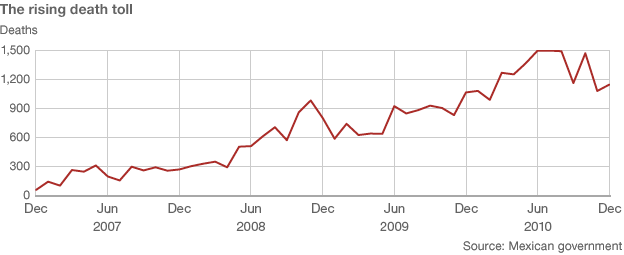
    Here’s the general trend:


    My prediction: soon murders in Mexico will fall (eventually, they have to, right?). Maybe they maxed out in December, 2010. From that point on, the authorities that be will forget their bullshit about murder being a sign of success and instead talk about how their policies are reducing murders. What they will fail to mention is that these numbers will only be down from the absurdly high level they themselves helped create with their futile war on drugs.

  • Not another day at the office

    Video of the police shooting in a Detroit police station.

  • Bike Bangkok

    Here are some more pics from a good day in Bangkok last week.

  • Armed guards kill robbers in Chicago

    A heartwarming tale of bloody death and a robbery gone wrong.

  • Do you know where your comments are?

    Some of you may have posted comments and wondered why they didn’t appear (or think I deleted them). Turns out blogger/google automatically sorts out the spam comments. Problem is all the comments it thinks are spam, aren’t (including some of my own). I’ll try and check that “spam” folder more often, now that I know it exists.

  • Revolution in Egypt

    Inshallah, Hosni Mubarak, the latest in a long line of Egyptian Pharaohs, will soon be history.

    I think about Egypt more than most people. My wife studied in Cairo and speaks Arabic, I’ve visited Egypt three times, and one of my best friends here in New York is Egyptian-American, from Alexandria. He hates Mubarak, of course, and what Egyptian wouldn’t? He’s a bastard dictator and has been for decades.

    How has Mubarak remained in power for so long? In large part because we give him billions of dollars a year. It started as a bribe to make peace with Israel. Do most Americans even think about the consequences of supporting bad rulers? Egyptians and Arabs don’t hate our freedom. But perhaps they should hate us for preventing them from having freedom. Egypt has been under “emergency rule” since 1981. It’s amazing they don’t hate us more.

    Dictators can fall regardless of what the US knows or does. After supporting Saddam Hussein for so long, the US invaded Iraq. And for what? He would have fallen eventually, too. We just made the country worse.

    In terms of foreign policy, this is yet another strong case for us doing less, not more. We get a lot wrong. And since we as a country don’t have as much control as we like to think we do, we might as well support democracy. Sometimes it works and sometimes it doesn’t, but at least we would be on the moral high ground.

    Also, watching pictures of riot police shoot at people and also get routed is a good time to be remember and be thankful that police in the US are civilians–city workers and not soldiers or government agents–even if sometimes everybody forgets this important fact.

    And assuming Mubarak falls (which is a wonderful assumption), will Obama get credit for change in the Middle-East just like Reagan gets credit for the fall of Communism? They’re both equally deserving. Did not Obama’s 2009 speech in Cairo spark the whole democratic movement? I doubt it. But then neither did Reagan. (And did Obama really just say that Mubarak is not a dictator? Of course he’s a dictator. The only question is how bad of dictator he is.)

    If the US doesn’t know which side to be on, why not be on the side againstcorrupt dictators? Who will replace Mubarak? Who knows. Will the next leader be better or worse than Mubarak? Who knows. But that’s no reason not to wish for Mubarak’s fall. And shame on us for supporting Mubarak for so long, pretending he wasn’t a bad man.

    Mubarak is speaking right now and doesn’t seem to be saying much at all. But he’s not stepping down. And he looks healthier than I expected.

    The man of the year, perhaps the decade, could be a humble unemployed university graduate, Mohammed Bouazizi.

  • Thailand Pictures

    I’m back in New York. Twenty-one hours of flight back was not nearly as bad as it should have been. And now it’s good to be home, but strange to see snow after a few weeks in Bangkok.

    Here are some pics from our trip. Mostly of our day trip to the Maeklong market, which features a train running through it. There are lot market shots. We like markets. But also, Thailand is almost one big market. In Bangkok alone, there are an estimated 300,000 to 500,000 food carts. It’s hard to comprehend what this means till you see (and eat) it.

  • Gun Control? “Your Side Won”

    Gun Control? “Your Side Won”

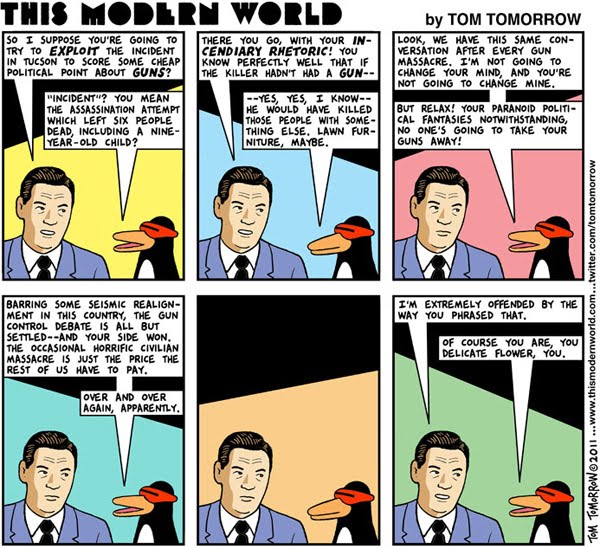
    Tom Tomorrow, one of my favorite cartoonists, summarizes gun control and killings quite well. Click through to read.

    “Barring some seismic realignment in this country, the gun control debate is all but settled–and your side won. The occasional horrific civilian massacre is just the price the rest of us have to pay.”

    As if we need it, the horrible shooting in a police station in Detroit is yet more proof that guns are not a good defense against guns. The gunman shot four before being killed by the police.

    “But relax,” as the penguin says, “Your paranoid political fantasies notwithstanding, no one’s going to take your guns away!”