Category: Police

  • Tone it down

    I wrote thislast night for CNN, about the massacre in Dallas:

    Words have the power to inspire, inflame, provoke. Or else we wouldn’t say them. When words inspire others to kill, however deranged those others might be, we must see the consequences.

    When those on the political right speak against immigrants, Muslims or abortion, those on the left are quick and correct to observe that words inspire crimes of hate and violence. Similarly, when those on the left speak against police officers — not just bad ones, but all police officers — this, too, can have consequences.

    No matter one’s beliefs, we all need to call out extremism and hate, especially given American’s absurdly easy access to guns. No matter how many good people have guns, they cannot always stop a bad person with a gun. An armed society is clearly not always a polite society, so we need to tone it down.

    Police need to realize that some in their ranks make mistakes, both honestly and maliciously. This needs to be better acknowledged by those in law enforcement. But just as decent society does not hold every black, Muslim, or white Christian responsible for the murderous acts of a deranged few, it is a mistake to blame hundreds of thousands of police officers for the bad deeds of a few.

    In my call for common ground and more civility, I received nasty emails or tweets from some A) protesters, B) cops, C) blacks, D) whites, and E) gun nuts. So I must be doing something right.

  • Philando Castile

    This police-involved shooting is bad. And unlike the killing of Alton Sterlingin Louisiana, I’m willing to call this one before the polls have closed.

    This more recent shooting in Falcon Heights, Minnesota reminded me of Joseph Schultz. Schultz, you probably don’t remember because you’ve never heard of him, got shot in the face in 2003 by FBI agents who were conducting a traffic stop on the wrong car. (Schultz is white, and apparently white people don’t get bothered by being shot by police for no good reason.) I wonder how many traffic stops FBI agents have made before or since. The FBI agents got off. It was called an “unfortunate accident.” No. It was worse than that.

    Over in the twitter world — which is like the real world but somewhat more poor, nasty, brutish, and short — David Simon seems aggrieved (a burden he carries well) about my wait-for-the-facts position on Sterling in Louisiana but my willingness to rush to judgement in Castile’s death.

    I wrote:

    (Actually, I’d bet Louisiana shooting not good either, but I’m not ready to call it yet. And I’m not a betting man.)

    In a ever-so-slightly trolling manner, Simon prodded:

    You don’t need to see the beginning of the video? Or learn all the possibilities of reasonable suspicion and probable cause for car stop? Why not?

    No, I don’t. These shootings are very different. Because one involved a fighting man with an illegal gun.

    In Sterling’s death, I can imagine a scenario — one that may or may not be true but is very much possible when three people with three guns are rolling around on the ground — where the shooting was justified. What if Sterling was trying reach for a gun to kill somebody? My guess is this isn’t what happened, but I don’t know. (And neither do you.)

    But it’s not just that. Castile was a police-initiated engagement. That matters. The victim, judging from post shooting reactions, was compliant. There was no fight. It’s a car stop, which limits the possibilities of motion. That’s relevant less for the possible danger aspect than for me being willing to make some assumptions about what happened before the video. I have no idea what happened before Alton got shot and tased. I know very well how car stops work.

    And I’ll just keep mentioning this: Castile wasn’t carrying an illegal gun.

    Ah, respondedSimon (foolishly trying to find flaw in my logic):

    But video I saw was after shooting occurred. How do you ascertain all of the above other than witness credibility

    And:

    Do you have video of the run-up to and shooting of victim in Minnesota? Maybe I saw something abbreviated.

    There’s no reason to think Castile was a threat or pointed his gun at the cops. The cop, later audio indicates, told Castile to reach for something, and he did. That’s called being compliant. I am willing to give police the benefit of the doubt. But having done that, and also willing to admit I can’t honestly conceive of a way the shooting of Castile was justified (unless there’s really something big we don’t know). And it’s not the first time or even second timea compliant individual was shot by police.

    But it’s sometimes hard to explain nuance in 140 characters. So I left it at this:

    And though I generally think race is overplayed as a factor in police-involved shootings (and geographic region and act of being a lethal threat underplayed). Honestly, in this shooting, with this cop, in this locale, I don’t think there’s a chance in hell Castile would have been shot had he been white.

  • Alton Sterling

    Alton Sterling was shot and killed by police yesterday. Maybe you’ve watched the video. I have. And I’ll tell you what: Other than a tussle and Sterling being shot, I have no friggin’ clue what is going on. And I’m what they call a so-called “expert” on these things. So I really don’t know how everybody else has it all figured out.

    It might be a bad shooting. Honestly, it looks like a bad shooting. And even if justified, it’s probably unnecessary in terms of the style of policing that led up to the shooting. Make note: yet another shooting precipitated by the A) failed use of a Taser, B) cops who don’t seem very good at verbal persuasion, and C) cops not doing hands-on well. (Seriously, what’s with the solo tackle?)

    And yet all that said, I can’t get over one pretty important detail: Alton Sterling was armed with a gun. An illegal gun. And cops very clearly saw that gun.

    “Why did police have to shoot that man with a gun?!” is a question I am generally inclined to dismiss.

    A witness to the shooting (who perhaps should have been doing something if he really was “two feet away”) said Sterling had a gun in his pocket, but also that Sterling’s hands weren’t near that pocket. And I’ve read that police were called to investigate a complaint that from somebody who objected to having that gun pointed by Mr. Sterling in his direction. Yes, even in Louisiana that is a crime.

    We don’t what happened before when police approached Sterling. Seems relevant to the discussion. There might be other video. I’d like to know more.

    And a big deal seems to made that Sterling was on the ground and shot in the back. To me this is a non-issue (except to note that police did seem to have the advantage). A fighting man, even on his belly, can reach for his gun. What if he does get his gun? Should police have to wait for him to point and pull the trigger before shooting? Shoot the bullet out of the air or something? Or reach under Alton before shooting, to avoid shooting him in the back?

    I’m not saying this is a good shooting. I’m saying I don’t know what happened. And neither do you.

    [Update: the next shooting]

  • Low Police Morale (or: the more things change…)

    Last night a police captain said:

    I’m in the Department and had better keep my mouth shut. But I must candidly say that I have never known the Police Department to be in such a bad state as it is it right now. One day we receive one imperative order, and on the next another quite different, so that we hardly know what to do. And because we can’t do everything we are criticized by everybody and abused by every ragamuffin. It’s nothing but “orders,” “orders.” And so many orders make nothing but disorders.

    However I’d better not blab — what right have we to blab? — we’re in the Department. But it’s enough to make one swear. As I said before, we’re pitched into by newspapers and by everybody.

    Every complaint against a policeman, no matter how foolish, must be taken down by the clerk and investigated, because he has been ordered to do so.

    But then I won’t say a word. I’m in the department. There may be a reporter about, so I’ll shut up.

    –“A Grumbling Police Captain.” New York Daily Times, Feb 2, 1856 (lightly edited)

  • “My Four Months as a Private Prison Guard: A Mother Jones Investigation”

    Shane Bauer researched and wrote an amazingly important article for Mother Jones. (It’s a book really, at 35,000 words.) Bauer because a prison guard for a few months, took notes, and wrote about it. It can be that simple. You really should read all this. It’s gripping. And big props to Mother Jones for doing real investigative reporting. He became a correctional officer so you don’t have to. It’s the best thing I’ve read all year:

    If I were not working at Winn and were reporting on the prison through more traditional means, I would never know how violent it is. While I work here, I keep track of every stabbing that I see or hear about from supervisors or eyewitnesses. During the first two months of 2015, at least 12 people are shanked. The company is required to report all serious assaults to the DOC. But DOC records show that for the first 10 months of 2015, CCA reported only five stabbings. (CCA says it reports all assaults and that the DOC may have classified incidents differently.)

    I know my field is police. But I wrote a damn book about incarceration. This book of mine, In Defense of Flogging, was favorable reviewed in The Economist and featured in Mother Jones, the Wall Street Journal, Time, the Atlanticand seemingly every other publication in the world. My idea even got me a fabulous speaking gig ever at Sydney Opera House’s Festival of Dangerous Ideas!

    (But no. It didn’t sell at all. Why do you ask?)

    Here’s my point: I give a shit about incarceration in this country. Most people don’t. And then those who do care are too busy bitching about police to notice the real harms — evils even — that are happening to literally millions of American, just out of sight in our jails and prisons.

    Bauer doesn’t go into great depth explaining mass incarceration. He doesn’t offer massive policy solutions to the war on drugs. He doesn’t hide behind sociological theory. What he writes is more basic and all the more powerful. Bauer describes what the hell happens in prison: how it operates, how guards survive, how prisoners survive. Guards are paid $9 an hour (yes, $18,000 a year, though it went up to $10 an hour) and go through minimal training and work 12-hour shifts in one of the world’s shittiest jobs. And yes, of course corruption is rampant.

    Bauer works at Winn Correctional Center in Louisiana, a medium-security prison. It’s not the nation’s best prison nor is it the worst (though it’s certainly well below average). But you can’t run a prison well. At least not on the cheap. Of course the inmates run the prison. But we knew that, right? And what goes on there — to both workers and prisoners — should cause more outrage.

    Meanwhile the CEO of the for-profit CCA made $3.4 million dollars in 2015. (19 times the salary of the director of the Federal Bureau of Prisons.) CCA pinches every penny possible, because every dime not spent on labor or inmates is profit. They’re in it for the money. (They also lobby for more prisoners and tougher immigration laws, which is essentially the same thing.)

    [Keep in mind that private prison only hold about 8 percent of all prisoners, but there’s something particularly horrible about the concept of profiting momentarily from human captivity.]

    Because the prison in understaffed and guards poorly paid, they don’t break up fights. So prisoners fend for themselves:

    He asks us what we should do if we see two inmates stabbing each other.

    We could try to break up a fight if we wanted, he says, but since we won’t have pepper spray or a nightstick, he wouldn’t recommend it. “We are not going to pay you that much,” he says emphatically. “The next raise you get is not going to be much more than the one you got last time. The only thing that’s important to us is that we go home at the end of the day. Period. So if them fools want to cut each other, well, happy cutting.”

    And this:

    One day, I meet a man with no legs in a wheelchair. His name is Robert Scott. (He consented to having his real name used.) He’s been at Winn 12 years. “I was walking when I got here,” he tells me. “I was walking, had all my fingers.” I notice he is wearing fingerless gloves with nothing poking out of them. “They took my legs off in January and my fingers in June. Gangrene don’t play. I kept going to the infirmary, saying, ‘My feet hurt. My feet hurt.’ They said, ‘Ain’t nothin’ wrong wicha. I don’t see nothin’ wrong wicha.’ They didn’t believe me, or they talk bad to me—’I can’t believe you comin’ up here!’”

    His medical records show that in the space of four months he made at least nine requests to see a doctor. He complained of sore spots on his feet, swelling, oozing pus, and pain so severe he couldn’t sleep. When he visited the infirmary, medical staff offered him sole pads, corn removal strips, and Motrin. He says he once showed his swollen foot, dripping with pus, to the warden. On one of these occasions, Scott alleges in a federal lawsuit against CCA, a nurse told him, “Ain’t nothing wrong with you. If you make another medical emergency you will receive a disciplinary write-up for malingering.” He filed a written request to be taken to a hospital for a second opinion, but it was denied.

    Eventually, numbness spread to his hands, but the infirmary refused to treat him. His fingertips and toes turned black and wept pus. Inmates began to fear his condition was contagious. When Scott’s sleeplessness kept another inmate awake, the inmate threatened to kill him if he was not moved to another tier. A resulting altercation drew the attention of staff, who finally sent him to the local hospital.

    Of course you could always escape before you lose you limbs. It’s not like the guards are paying attention:

    Two weeks after I start training, Chase Cortez (his real name) decides he has had enough of Winn. It’s been nearly three years since he was locked up for theft, and he has only three months to go. But in the middle of a cool, sunny December day, he climbs onto the roof of Birch unit. He lies down and waits for the patrol vehicle to pass along the perimeter. He is in view of the guard towers, but they’ve been unmanned since at least 2010. Now, a single CO watches the video feeds from at least 30 cameras.

    Cortez sees the patrol van pass, jumps down from the back side of the building, climbs the razor-wire perimeter fence, and then makes a run for the forest. He fumbles through the dense foliage until he spots a white pickup truck left by a hunter. Lucky for him, it is unlocked, with the key in the ignition.

    In the control room, an alarm sounds, indicating that someone has touched the outer fence, a possible sign of a perimeter breach. The officer reaches over, switches the alarm off, and goes back to whatever she was doing. She notices nothing on the video screen, and she does not review the footage. Hours pass before the staff realizes someone is missing. Some guards tell me it was an inmate who finally brought the escape to their attention. Cortez is caught that evening after the sheriff chases him and he crashes the truck into a fence.

    It is dinnertime, but inmates haven’t had lunch yet. A naked man is shouting frantically for food, mercilessly slapping the plexiglass at the front of his cell. In the cell next to him, a small, wiry man is squatting on the floor in his underwear. His arms and face are scraped with little cuts. A guard tells me to watch him.

    It is Cortez. I offer him a packet of Kool-Aid in a foam cup. He says thank you, then asks if I will put water in it. There is no water in his cell.

    This comes from my book on incareration, In Defense of Flogging:

    Years from now, if we’re lucky, future generations will look back to this age of massive incarceration with bemused wonder, seeing it as just another unfortunate blotch on our country’s otherwise noble, democratic ideals. Either that or they will judge us as willing collaborators in an unparalleled atrocity of human bondage. Let us hope for the former.
  • 10 shootings a day: This is the homicide problem

    10 shootings a day: This is the homicide problem

    The Chicago Tribune has an excellent articlethat starts on the West Side [2 miles from this house]:

    To understand Chicago’s violence, start at Kostner Avenue and Monroe Street and walk west up a one-way stretch of graystones and brick two-flats. There on a boarded-up front door you’ll see the red stain of gang graffiti. On the cracked sidewalk below lies an empty heroin baggie. Hardened young men sit on a porch.

    This single block on the West Side — part of the Harrison police district — has been the scene of at least six shootings so far this year

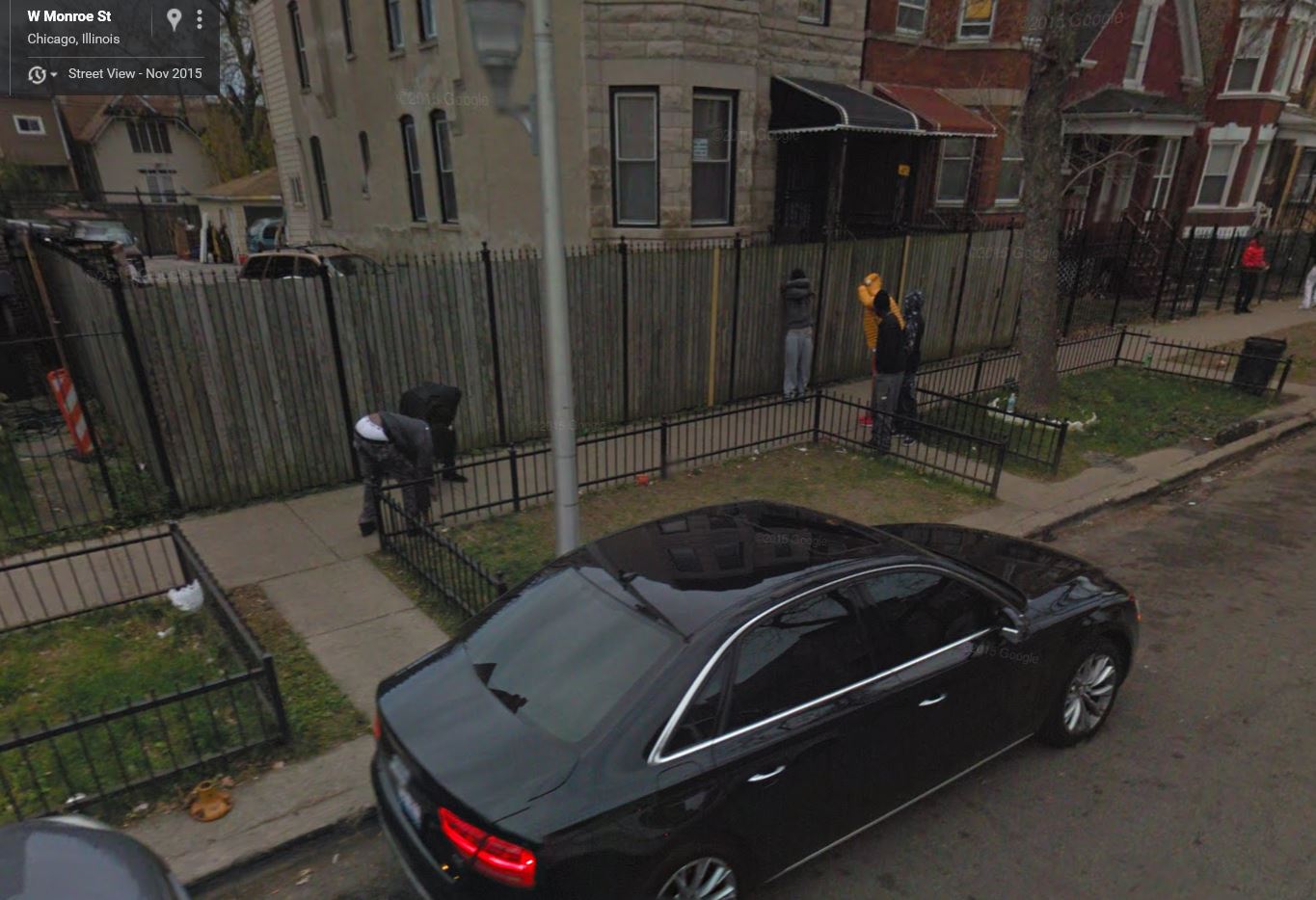
    My father grew up in this neighborhood, a mile away on North Avers Ave. The Greeks are long gone, of course. My father’s family moved to Albuquerque in 1947. I checked Google street view for that block of six shootings:

    These guys are totally not cool with the google car taking their picture.

    Think they’re up to no good?

    Kind of cracks me up.

    Here’s the thing. Those guys you see. Them. There. In that picture right there above. Those guys in front of that fence? They are the problem! Sometimes it really is that simple. Seriously. It’s not rocket science. There they are.

    And police officers know that. But now what?

    Chicago cops aren’t stopping these guys anymore because, well, why should they? The ACLU sues cops and the Chicago Police Departments for stopping six black guys who are just minding their own business:

    All this has led many officers to feel unsure about stopping anyone. Just this week, the president of the police union said many officers feel that “no one has their backs.” Other veteran officers agree that Chicago cops are dispirited and have slowed down on the kind of proactive policing that can remove a gun or criminal from the street.

    The makeup of Chicago’s gangs has changed dramatically over the years. They once were massive organizations with powerful leaders and hundreds of members who controlled large chunks of territory. Now small cliques battle for control over a few blocks.

    Experts also agree that personal disputes increasingly are playing a role in the violence. One veteran cop recalled with disbelief recently how a slaying he investigated boiled down to an insult over shoes.

    Police also said so-called net-banging on social media fuels conflicts. Gang members have been known to post menacing videos on YouTube, showing them furtively entering rival territory, waving guns and issuing threats.

    Ranking officers say reports from the field indicate more gang members are being caught carrying guns than in the past, a troubling trend that could explain in part the surge in shootings.

    Morale plummeted as officers expressed concern about their every move being captured on smartphone video, a Tribune story reported earlier this year. Some have suggested that officers became hesitant to make street stops and arrests for fear of backlash.

    Dean Angelo Sr., president of the Fraternal Order of Police, said street stops had plunged by 150,000 so far this year, but he blamed the more extensive paperwork that officers must fill out this year for every street stop.

    Another veteran cop said the forms are so complicated that they take as long as an hour to fill out, keeping officers from street duty and leading many to reconsider whether a stop is worth the effort. It’s affected the department’s ability to gather intelligence on gangs, he believes.

    The ACLU has disputed the notion that fewer street stops contribute to spikes in violence.

    Of course they have. But the ACLU is wrong. Dead wrong. Look, if you want to argue that these young men shouldn’t be stopped at all, fine. You agree with the ACLU (and don’t live on that block or hear the gunshots). And the ACLU is right in criticizing police who stop people for the sake of making a stop.

    As a cop you don’t (or shouldn’t) harass everybody walking down the block. You harass these guys on this block. And by “harass” I mean, within the law and constitution, make it little less fun for them to hang out in public and sell drugs. Yes, you as a cop give these guys a hard time. Is that fair? Yes. Because there have been six shootings on this block this year. Is it racist? No. Because these guys are the problem.

    If you’re a cop, you need to ask a bunch of questions 1) do you know these guy are slinging and shooting? 2) Should you stop these guys? 3) Are they committing a crime? 4) Are they a Broken Window? 5) What legal basis do you have to stop and frisk those guys?

    [The answers are 1) get out of your damn car and talk to them, or at least watch them disperse in your presence, 2) yes, 3) no, and 4) yes. 5) very little at first, but you can build it, ask for a consent search, or conduct a Terry Frisk.]

    You pull up to them. See what they do. You can crack down on this group by enforcing Broken Windows quality-of-life crimes. You get to know who they are. You can use your discretion and ticket them for something — drinking, smoking joints, jaywalking, littering, truancy, spitting — whatever it takes. You can arrest them when they can’t provide ID (they can’t, trust me). You can harass these criminals legally and within the bounds of the constitution. This is what police are supposed to do. It’s how homicides are prevented. It’s how some kids stay out of gangs. But if cops do their job, then we, society, need to support police officers against inevitable accusations of harassment, racism, and even discourteous behavior in their confrontations with these criminals.

    As a cop you will not win the war drugs, but as long as drugs are illegal you need to fight the fight against pubic drug dealing. But we’re telling cops not to do this. In Chicago cops are listening. And so are the criminals.

  • Lor Scoota got killed

    Lor Scoota got killed

    Yeah, I had never heard of him either. But apparently he was a big deal to a good number people in Baltimore. They liked his music. So what does he stand for? I don’t know. Google and read up if you want. What’s amazing is all the tears shed by some people who had never heard of him.

    I wrote this in a comment to another post:

    I’m not gonna lie. I never heard of Lor Scoota and don’t really give a damn about him. With my bougie life, I may not be keeping it real. I’ve been out of Baltimore too long.

    Artists and musicians should be cut a lot of slack. I mean, Willie Nelson is an unrepentant and repeated drug criminal! So yeah, do the bird flu dance all you want and have some fun. That said, I wouldn’t my kids looking up to a gun-toting drug-dealing robbery-committing motor-dirt-bike-riding victim-of-a-targeted-shooting as a potential role model. But what do I know?

    Clarence Mitchell IV, host of the C4 Show (which I’ve been on a few times):

    asked listeners to look past Lor Scoota’s past and recognize the difference he made in the community at the time he was killed.

    But it’s not at all clear his criminal past was behind him. Not at all. But one a drug dealer doesn’t mean always a drug dealer. Jay-Z worked his way to respectability. I’ve had students who once slung crack. Maybe Scoota was targeted by a hater. Maybe by a criminal rival. Maybe both. But there’s so much BS from people who don’t live in Baltimore and don’t have to be afraid of criminals. There’s so much BS from people who are able to relax and take a nap in the sun in a public park without fear the 12 O’Clock Boys are going to zoom through on ATVs and run you over.

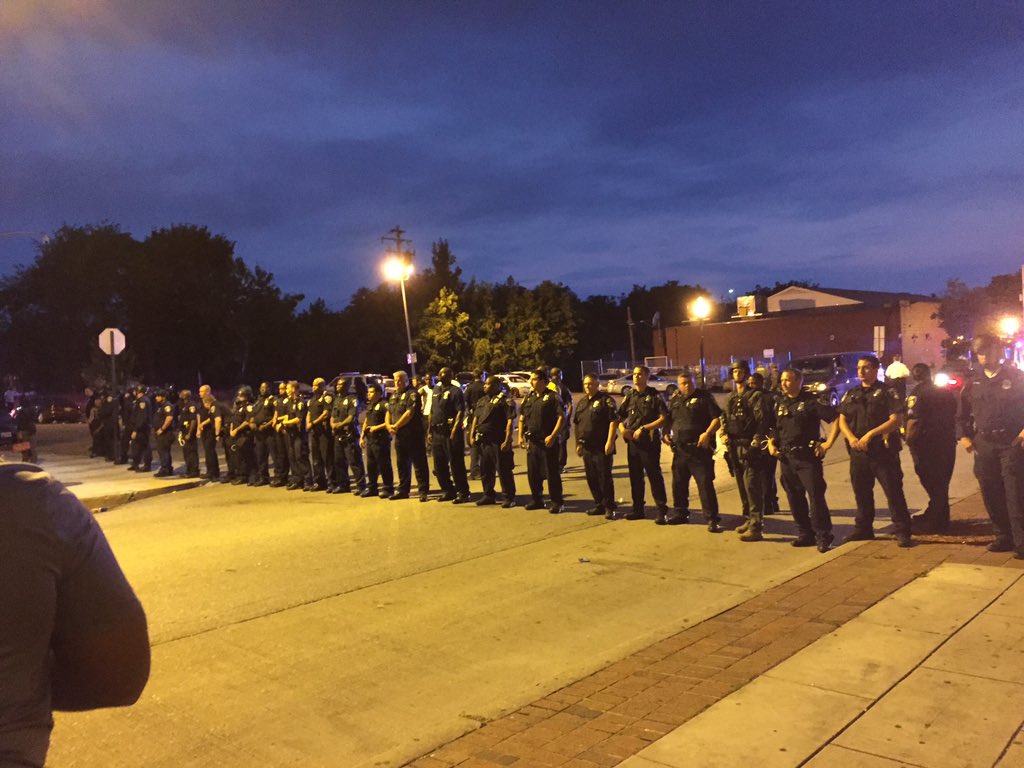
    And there was a tense moment involving police.

    (photo: Baynard Woods)

    This is the best I’ve read, from The Baltimore Chop (worth reading it all, really. But FYI Bird Fluwas Scoota’s one big hit. In half of Baltimore.):

    If Bird Flu was the sound of the streets, it is also an anthem of everything that is wrong with this city. It’s not possible to write a song like that without having lived the experience firsthand. Sure, you could try… but you’d end up sounding as corny and benign as the Beastie Boys did early in their career. It’s not possible to separate Lor Scoota’s life from his music. If he says in the song he was moving weight, he was moving weight.

    And Scoota was carrying a gun, by the way. In this song he serves notice that he was in the habit of carrying a gun constantly. He was arrested with one at the airport a while back which had the serial number ground off. He also had a handful of domestic violence charges against him including a no-contact order. Personally, we don’t believe a serial woman-beater deserves much in the way of community support, catchy hooks notwithstanding. If you consider yourself a feminist, ally, or just someone who cares at all about the general well being of women, maybe sit quietly and think a while about whether or not you want to be the type of person willing to excuse violence against women because the perpetrator has earned some small measure of notoriety.

    And lest you think Scoota was maybe some kind of lovable outlaw, some latter-day Billy the Kid or something we kindly invite you to pull your head out of your ass. Billy the Kid was certainly an awful person to be around, just like our neighbors have been and just like we imagine Scoota himself probably was. He wasn’t selling your cousin heroin or beating up your sister or waving his gun at you, but if it had been you you might feel differently about it, no?

    There’s a wide gulf in Baltimore between people’s words and actions. That much is true of everyone; black and white, rich and poor. In the social media age everyone is hard at work spinning their own narrative every hour of every day but little of it has anything to do with the truth. In the Sun article about the speaking tour the author says Scoota and Moose ‘acknowledge an imperfect route’ to whatever ‘success’ they had achieved. Beg your pardon? What does that mean, exactly? An imperfect route? It means they were terrorizing their fucking neighborhoods and were dealing large quantities of narcotics. That’s not ‘an imperfect route’ it’s a goddamned life of crime. What’s more, it’s not clear that either Scoota or Moose have achieved real success by any measure. As far as we know they were self-releasing music, not exactly the fast lane on the road to riches. A little radio airplay in your hometown market and an Instagram of you with two or three actually famous rappers doesn’t amount to much in the great scheme of things.

    But if you really want to know why the police came ready for trouble it’s because the likelihood of trouble starting was high. Grief does not preclude violence. After all, it was less than a month ago a West Baltimore man shot his father in a church at his own brother’s funeral. To assert that there were no drug dealers, no gang members, and no armed people in that crowd is either disingenuous or foolish. The police know, and the whole city should know that it only takes one half-assed gangster goddamned fool like Meech to turn up in a highly volatile crowd, discharge a gun, and cause utter chaos.

    There are at least three official funeral related events scheduled to take place soon. All of them represent a volatile combination of grief, pain, hatred, resentment, ignorance and anger which could, if not very carefully managed, boil over into further chaos.

    Maybe you think criminal behavior is “normal” for Baltimore, or somehow OK for “those people.” You know, who are you to judge? Well, shame on you. Talk about the bigotry of low expectations! Criminal behavior is not normal; it’s not good. Not even — especially even –in Baltimore City. I say this in particular to my white liberal readers who don’t know Baltimore and also to many of the journalists who just learned of this guy and managed to scratch off a quick sob story in his honor.

    You think it’s cool other people, poor black boys and girls in Baltimore are being told to emulate Lor Scoota as some noble role model? Are you out of your mind? “We selling scramble coke and smack (X7), keep them junkies coming back.” This is the city of Thurgood Marshall, Langston Hughes, Vivien Thomas, Frederick Douglass, Cab Calloway, David Hasselhoff, and ten of thousands of regular people who have wage-paying jobs. They are the city’s role models.

  • “An Enduring Heroin Market Shapes an Enforcer’s Rise and Fall”

    The contrast between this well written piece about a murder victim in the Bronx and that BS pieceabout a murder in Baltimore is striking.

    Not surprisingly, Al Baker is on the byline of the good piece (Benjamin Meuller is first on the byline):

    Over nearly three decades, Mr. Perez held court on this block of East 157th Street off Melrose Avenue in the South Bronx. It was here that he climbed the rungs of the street heroin trade, wooed women, muscled out drug rivals from nearby public housing projects and, as he got closer to middle age, counseled young men to save themselves and to get honest work.

    By turns brutal and vain, comedic and exacting, Mr. Perez survived police raids, stickups, territorial incursions and a transformation of the city’s drug trade as it came to rely less than it once had on hand-to-hand street sales.

    When he was 13, his mother died from complications of H.I.V. His grandmother took him in, but then she died, too. He lived with an aunt until she moved away. A second aunt, Maddie’s mother, took over raising him; about a year later she also died from complications of H.I.V.

    As his crew’s muscle, Mr. Perez was targeted for robberies and beatings, friends said. Going to the police was akin to self-imposed exile. He built a reputation on responding with startling force.

    “In the streets you just don’t make money, and then get power and respect,” said a friend who worked with Mr. Perez, and who like many people interviewed for this article spoke on the condition of anonymity to avoid unwanted attention from rivals or the police. “Hell no. You’ve got to put in some type of work, meaning violence.”

    The police arrested dealers in buy-and-bust operations only to find most of them quickly back on the street, whisked through the revolving door of an overburdened court system.

    Arguably, Mr Perez shouldn’t be honored with a public memorial mural…

    It’s worth reading all these stories about murders this year in the 40 Precinct. So far there’s 1, 2, 3, 4, this one, #5.

  • Police just “perpetuating an already vicious cycle”

    Sometimes the police-are-bad set can be so casual in their negative assumptions about police you just might miss it. But it’s worth calling out, because accepting these lies is damaging, potentially lethal if you’re in a high-crime neighborhood. This is buried in Kate Crawford’s article in the New York Timesabout artificial intelligence:

    Police departments across the United States are also deploying data-driven risk-assessment tools in “predictive policing” crime prevention efforts. In many cities, including New York, Los Angeles, Chicago and Miami, software analyses of large sets of historical crime data are used to forecast where crime hot spots are most likely to emerge; the police are then directed to those areas.

    That’s good, right?

    Nope:

    At the very least, this software risks perpetuating an already vicious cycle, in which the police increase their presence in the same places they are already policing (or overpolicing), thus ensuring that more arrests come from those areas. In the United States, this could result in more surveillance in traditionally poorer, nonwhite neighborhoods, while wealthy, whiter neighborhoods are scrutinized even less.

    And to think, that is “the very least” harm predictive and data-driven policing policing could do. What is the worst-case scenario?

    See, the problem according to this piece — just thrown in there, asserted like God’s truth — is that people in high-crime neighborhoods suffer from police presence. Nothing about preventing crime or the criminals police are paid to confront. Police just “scrutinize” and arrest. To break this “vicious cycle”, should we have fewer police in high-crime neighborhoods? I can’t help but notice that cities that have inadvertently put this strategy to test — less policing, less scrutiny in high-crime areas, fewer arrests — cities like Baltimore and Chicago? They’re not doing so well with the crime fighting.

    [hat tip to my brother]