Category: Police

  • C.I. Payments vs. Criminal Bribery [continued]

    I’ve still very curious about all this and your comments make it all the more interesting.

    Here’s the law again:

    BRIBERY NOT INVOLVING PUBLIC SERVANTS

    S 180.00 Commercial bribing in the second degree.

    A person is guilty of commercial bribing in the second degree when he confers, or offers or agrees to confer, any benefit upon any employee, agent or fiduciary without the consent of the latter`s employer or principal, with intent to influence his conduct in relation to his employer`s or principal`s affairs.

    Commercial bribing in the second degree is a class A misdemeanor.

    S 180.03 Commercial bribing in the first degree.

    …and when the value of the benefit conferred or offered or agreed to be conferred exceeds one thousand dollars and causes economic harm to the employer or principal in an amount exceeding two hundred fifty dollars.

    Commercial bribing in the first degree is a class E felony.

    There’s a similar law for the person receiving such a bribe.

    Here are some comments I’ve gotten:

    I ran this by narco rangers and they said it’s pretty common practice. Same in the Intel division re: terrorists. Vetted by lawyers, those people we depend on for moral rectitude. … I’d be genuinely shocked if the people who make a living defending criminals haven’t already challenged this. It’s as old as the hills.

    I’m rarely shocked, at least not genuinely. (Did you hear that Michael Jackson died!? I mean, he looked so healthy.)

    And this:

    The DEA is not attempting in any way to alter or influence the firm’s business transactions, only learn about them in order to build a case against a criminal. … Compensating a low-level employee for providing the info seems like a sound move, providing it doesn’t circumvent 4th Amendment requirements, which is a different concern than bribery.

    Of course in the past police have also threatened these employees with arrest if they don’t “help” the investigation…. But let’s ignore that bullying behavior for now and just focus on the use of paying employees as C.I.s to turn over business information they have access to.

    There is not debate about “benefit” being offered and the lack of the employer’s consent. It all comes down to the last part of the law: “With intent to influence his conduct in relation to his employer`s or principal`s affairs.”

    Many businesses–from the phone company to apartment rental agencies to car rentals to self-storage to banks–depend on both implicit and explicit (legal) guarantees or trust and privacy. If a bank or any business was known for low-level employees telling me, after I paid $1,000, about what was going on in the business–information I could not find out simply by standing outside the place, information only an employee has access to–how could that not be “in relation” to the employer’s “affairs”?!

    Would it not be a bribe if you had stocks and somebody in the firm managing your stocks, against firm policy, sold your information to a third party? If the ownerof the firm wanted to give it, or even be paid for it, that might be his or her right. But it’s not a right of the employee. And in the case I’m actually talking about, the owner doesn’t want to give the information because turning over customer’s information would violate trust and hurt business.

    Besides, given past experience, he or she simply doesn’t trust the police to snoop around on their whim. That is what we have search warrants for.

    Or take this scenario:

    What if we asked the liquor store worker the contents of Stone Killa’s special orders, because we know when he gets the VSOP it means a party that Friday night where all the local Killas are invited? So we pay the worker and he calls us each week with the special orders, and pay him $50 a week for this. When we collar. The Killas at the party, the liquor store loses all Killa’s business for the next eight years…

    Personally, I think it’s clever but also straight-up commercial bribery. Why wouldn’t it be? Just because you caught the Killa doesn’t really matter with regards to the bribery.

    Let’s say you’re the patrol officer responding to a call for commercial bribery (as if). After going, “commercial what!?” you find the entire district down and your supervisor not be disturbed (screwing his mistress or something).

    You arrive at the Kim’s Liquor and Kim says his employee was paid money by a private citizen, let’s say me, Peter Moskos, to turn over a list of all the delivery orders or the names on credit cards of something. Let’s say I want this because I’m curious if my wife is spending all my money here. Or I run a rival liquor store and want the database. Or I’m doing academic research. Or I want Stone Killa’s address. Whatever my motives, I don’t think they matter one bit for the legal debate.

    The point is I am there, have the business information in my pocket, and confess to giving the employee $1,000 plus one penny for the information. The employee confesses, too. Mr. Kim presents a letter from an angry customer canceling a $251 order (thus meeting both monetary requirements for felony Commercial Bribing in the First Degree).

    Mr. Kim, unmoved by our remorse and tears, wants us both locked up. What do you as the responding officer do? Make two easy felony arrests. Case closed.

    And if it would be a crime for a private citizen, why would it not be a crime for law enforcement?

    [Of course if somebody said, “give me money so I can buy illegal drugs and then use them,” it would be considered a crime for most people–but not narcs in the C.I. business–to give money.]

    If you dig deeper I am confident you will see that this is law enforcement practice that has been approved of and indemnified by government counsel, and that there is probably even case law that makes this clear.

    Maybe. I am trying to dig deeper. I just can’t see how this wouldn’t be commercial bribery. It is against both the letter and the spirit of the law.
  • Not so fine a line after all

    Looks like the line between paying a C.I. and criminal bribery isn’t so fine after all. Thanks to Marc S. for commenting on this post and informing me that what the DEA agent did is in fact a crime. It’s called commercial bribing in the second degree and in New York State it’s a class A misdemeanor. Had the $1,000 offer been one cent higher, it would have been a felony. That makes me think that the guy offering the bribe knew the law a lot better than I did.

    A person is guilty of commercial bribing in the second degree when he confers, or offers or agrees to confer, any benefit upon any employee, agent or fiduciary without the consent of the latter`s employer or principal, with intent to influence his conduct in relation to his employer`s or principal`s affairs.

  • God’s Middle Finger

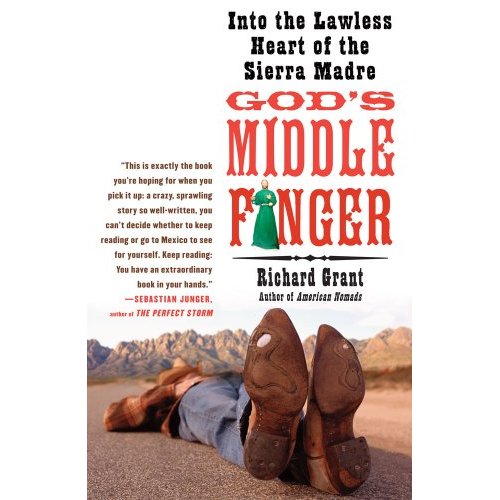
    God’s Middle Finger

    One of the nice thing about school being out and traveling a bit is it gives me more time to read books for fun. My favorite genre is probably the travelogue. Mark Twain, P.J. O’Rourke, Paul Theroux? I love them all. And I’ll even define travelogue broadly to include historical fiction, like my favorite books by Louis de Bernières. Even New Jack by Ted Conover is a travelogue of sorts, since it took me to Sing Sing, a place I’ve never been. Hmmm, I guess by this logic Cop in the Hoodcould be called a travelogue. But I don’t think it is. But I do like my book.

    In the past month, along David Sedaris’s When You Are Engulfed In Flames, I’ve been able to read Gerald Brennan’s South From Granada, which is a very good anthropological-like account of 1920s life in a Spanish village. But perhaps you might only care about life in Yegan if you happen to be hiking through the Spanish Alpujarras.

    Chris Stewart writes about the same region in present times in a much more light-hearted and readable way. I read the third of his trilogy, The Almond Blossom Appreciation Society. Good stuff. And I’ve told myself, somewhat unconvincingly, that I’ll buy and read the first two.

    In a different genre, I was not Swayed by Sway. It does not succeed at being the Malcolm Gladwell book it wants to be. Some of Swaywas interesting, but I don’t need a rehash of one dumb psych experiment after another to tell me that economic rational-choice theory doesn’t have all life’s answers. I wanted more discussion and relevance to the real-world.

    So maybe I should stick with travelogues. For some reason I think the British are the best at this genre. Maybe it’s the old colonialist in them. Maybe they’re don’t mind being culturally chauvinistic. They’re certainly less concerned with style killing political correctness. Perhaps these attitudes are no way to rule an empire, but it makes for good reading.

    Most travelogues either start happy and end happy (“what a wonderful trip with great people and food!”), start unhappy and end unhappy (“oh, my woeful journey into the heart of darkness… and I would kill for a good cup of tea!”), or start unhappy and end happy (“I just couldn’t be happy until I learned to let go of my neurotic hang-ups and be at one with these wonderful if somewhat simple people!”).

    It’s the rare travelogue that starts happy and ends unhappy. And this brings me to the best book I’ve read since Maximum City: Richard Grant’s God’s Middle Finger: Into the Lawless Heart of the Sierra Madre.


    Talk about unhappy! This book ends–and I don’t think I’m spoiling anything because the book starts with a sort of flash forward so you know where it’s going, but skip the next paragraph if you don’t want to read the last line in the book:

    I never wanted to set foot in the Sierra Madre again. The mean drunken hillbillies who lived up there could all feud themselves into extinction and burn in hell. I was out of courage, out of patience, out of compassion. They were sons of their whoring mothers, who had been fornicating with dogs.

    The first line of the book is, “So this is what it feels like to be hunted.” Why does this man, Richard Grant, travel into the lawless, wild, and narco-controlled Mexican Sierra Madre mountains? Well, for some of the same reasons that many sociologists enjoy research and some of the reasons I enjoyed policing:

    We drank four or five gourds each and got nicely buzzed there on the rim of Sinforosa Canyon and it occurred to me that this was more or less the moment I had been looking for when I set out on this journey. Here I was in the heart of the Sierra Madre, about as far from consumer capitalism and the comfortably familiar as I could get, drinking tesguinowith a wizened old Tarahumara and feeling that edgy, excited pleasure in being alive that follows a bad scare. It was an uncomfortable realization. To put it another way, here I was getting my kicks and curing my ennui in a place full of poverty and suffering, environmental and cultural destruction, widows and orphans from a slow-motion massacre. I tried to persuade myself that I was going to write something that would make a difference and help these people, but my capacity for self-delusion refused to stretch in that direction.

    God’s Middle Fingerneeds no rationalization to read, but I could justify my time reading because I wanted to learn about drug production in Mexico. It’s not a pretty picture. And it closely resembles the destructive prohibition-caused drug culture I saw as a cop in Baltimore’s Eastern District.

    Why did drug cultivation increase the murder rate? “Because drugs give people money to buy gun, alcohol, and cocaine,” said Isidro.

    He didn’t think that statement required any elaboration but I asked him to elaborate anyway. “People get more aggressive and paranoid. They kill more easily and then the dead man’s family has to avenge the killings.

    I was reading a fascinating book with a similar thesis. Its title translates asThe Sierra Tarahumara, A Wounded Land, The Culture of Violence in the Drug-Producing Zones. Its author, a professor in Jaurez called Carlos Mario Alvarado Licon, based his ideas on prison interviews conducted with convicted murderers from the Sierra. He found that they were nearly all model prisoners, with no prior criminal record, and no remorse or regret for what they had done. … They told of their crimes “serenely” and were convinced they had done the right thing.

    In the Sierra homicide is no dishonor. Killing is a part of life, a circumstantial action, generally vengeance for another killing. However, on occasion it is a symbol of pride, when vengeance was done and the law taken into one’s own hands…. Homicide is a form of maintaining the social order where the official authority is absent, unjust or corrupt, and particularly where it fails to punish aggression or offense to the family.


    When Isidro’s father was killed, his mother implored him to take vengeance. “It was very hard, but I decided not to because if I avenged my father, I would end up losing my brothers and maybe my uncles. It wouldn’t bring back my father and would bring more sorrow into my family. My mother didn’t understand. She never really forgave me.”

    Don’t go thinking that drug decriminalization in Mexico for personal possession is going solve this. The problem isn’t possession. It’s wholesale prohibition of drug production, distribution, and sales.

  • The fine line between confidential informant and bribe

    A friend of mine, who only wants to be broadly identified as being in a form of “real estate business” in New York City, routinely complains to me about police trying, without a search warrant, to bully and threaten his employees in order to gain access to clients’ private property or information on someone or something.

    My friend is more than happy, even eager, to work legally with law enforcement. In the same law-abiding spirit, he has a very healthy respect for the Bill of Rights, the 4th Amendment in particular.

    Well I get this email today:

    Yesterday, a DEA agent tried to bribe one of my employees to provide him with access to customer information and to provide tips in the future.

    I was pretty pissed. We always cooperate on this stuff to the letter of the law. Then the agent asked to speak to the employee in private and pulled this stunt.

    $1,000 was the amount offered, probably dependent on future information.

    It’s dirty, but as long as the employee was properly signed up as a confidential informant and there was paperwork for it all, it could all be legal and by the book.

    I asked why he thought the employee didn’t take the money. My friend said three reasons: “1. He’s a good guy; 2. He knows we always follow the law; 3. He knows we’d fire him if we found out.”

  • The state of sociology

    I’m sure that just like me, you all are browsing the latest issue of Sociological Forum, the quarterly publication of the Eastern Sociological Society.

    Hmmm, here’s an article called “Anomie Among European Adolescents: Conceptual and Empirical Clarification of a Multilevel Sociological Concept.” The “results lend strong support to the theoretical construct of anomie as exteriority and constraint.”

    O-kay… I’ll think I’ll skip that one. Actually, I usually skip most of the articles in sociology journals. So does the rest of the world.

    But in this issues there’s a series of short pieces relating to Sudhir Venkatesh’s Gang Leader For a Day, probably the best selling sociology book in decades. But Venkatesh has gotten some flack from the Ivory Tower because the book exposes weaknesses in ethnographic methodology and is, well, a memoir.

    I’ve mentioned Venkatesh a fair amount about on this blog because our research and writing has a fair amount in common (not in sales, alas). I think we need more intellectuals like Venkatesh.

    The point of writing is to be read (though Venkatesh points out that 90% of those interviewing him about his book haven’t read his book). The point of sociology is to understand (and hopefully improve) the world around us. Venkatesh succeeds because he is interesting, insightful, and writes in a language we can all understand. There’s no crime in that.

    In the Gang Leaderexchange in Sociological Forum, one author asks, “What does America want of sociology?” Venkatesh answers quite frankly: “I don’t think America cares about sociology. And, unless we change our conventions, our writing, and our relationship to the public, I’m not sure they should.”

    I wonder what the fancy sociological term is for, “Oh, snap!”

  • Police Corruption

    Police Corruption

    Maurice Punch has written another excellent book on policing: Police Corruption: deviance, accountability and reform in policing.

    More than anybody else, Maurice Punch inspired my policing career (well, maybe Punch and John Van Maanen share top prize). Punch’s wonderful and classic study of the Amsterdam Police, Policing the Inner City inspired me into the whole police business, especially my research in Amsterdam.
    Not only can Punch write, but we was always very helpful to me and willing to meet with me whenever I was in Amsterdam. Our semi-annual meetings were always the highlight of my trip to Amsterdam (and Amsterdam has some pretty tough competition when it comes to highlights). And Punch was helpful to me when I was just a young egg-head whipper-snapper with no research or writing or real work to my name. Without a doubt, were it not for Maurice Punch, I would not be where I am today as a professor, former police officer, or published author.

    Now if all this sounds like shameless promotion for a friend… well it is. But I’d also be promoting this book even I didn’t know Maurice. It’s an excellent book and really does delve, smartly and with respect, into the complicated world of police corruption.

    Punch’s short Zero-Tolerance Policing is also a gem that highlights the impact and transition of broken-windows policing in the U.S. to zero-tolerance policing in the U.K. and the Netherlands.

    Come to think of it, I think I still owe Maurice a review of Zero Tolerance Policing. Luckily for me, not only is Punch very smart and a good writer… he’s very forgiving.

  • P.G. County Sheriff Clears Itself In Calvo Raid

    Imagine that.

    The Agitator pretty much sums it up.

    And here’s the story in the Washington Post.

    The best line is: “In the sense that we kept these drugs from reaching our streets, this operation was a success.” But, uh, you already had the drugs, remember? Then instead of taking them off the streets you gave them to the Calvos.

    They really have no shame.

  • Drug Decriminalization in Mexico

    The Mexican legislature has voted to decriminalize possession of up to 5 grams of marijuana, 1/2 gram of cocaine, 40 milligrams of methamphetamine, and 50 milligrams of heroin.

    From the story by Tracy Wilkinson in the LA Times:

    The battle between law enforcement authorities and drug suspects has claimed more than 11,000 lives since he took office in late 2006.

    In May 2006, then-President Vicente Fox … backed down only under pressure from the Bush administration, which complained that decriminalization for even small amounts could increase use.

    But with about two weeks to go before crucial mid-term elections in which his party is struggling to maintain control of Congress, Calderon cannot afford to be seen as bowing to the United States, analysts say.

    Already under intense criticism for the drug-related violence, Calderon needs to maintain good relations with his nation’s Congress, where much of the opposition voted in favor of the decriminalization bill.

    And so, political observers say, he probably will sign it into law.

  • Court Dress Code

    My friend used to joke that the local criminals would come to court “dressed in their best sweat pants.”

    I was reading a David Sedaris book, When You Are Engulfed in Flames, on my flight back from Chicago and came across this passage:

    There were plenty of things that should have concerned me–the blood-spatter evidence, the trajectory of the bullets–but all I could concentrate on was the defendant’s mother, who’d come to court wearing cutoff jeans and aGhostbustersT-shirt. It couldn’t have been easy for her, but still you had to wonder: whatwouldshe consider a dress-up occasion?

  • Shirley’s Honey Hole Turns Bloody

    Shirley’s Honey Hole Turns Bloody

    Generally, the bars in the Eastern aren’t a source of trouble. The yo-boys are too cool to drink in a bar and stay on the corner drinking bottles of malt liquor. Many of them aren’t old enough to be served in a bar, either. The bars are for those willing to pay a dollar or two for a mere twelve ounce can of beer.

    The bars, like Shirley’s Honey Hole, are where the older heads hang out, listen to old R & B, and complain about kids these days. At these places, everybody does indeed know your name; cocktails are served with a heavy pour in those small, heavy duty, short, thick, stemmed glassware; and on holidays you know there’s always a good spread to enjoy. Father’s Day is a always a great time to do business checks on bars in the Eastern.


    According to Annie Linskey in the Sun, two men “walked up to the bar on the 2300 block of E. Oliver St. from North Patterson Park Avenue and fired without warning.” Six were shot, one fatally.