Category: Police

  • Balto Patrol Short Handed

    Peter Hermann reports in the Baltimore Sun.

    Top brass always says patrol is the backbone of the police department. They lie. Roughly half of the police department is assigned to the patrol. When you need officers, you take them from patrol. Backbone my ass! What kind of organization knocks out its own vertebrae?

    When officers are taken from patrol, of course patrol suffers. Fully staffed patrol would be able to better respond to calls. No doubt. Without enough officers, response time increases and patrol officer simply don’t have the time to do the job they could and want to do.

    Poaching from patrol is bad in other ways, too. It kills morale. After the department is done poaching from patrol, you get a “temporary manpower shortage.” A permanenttemporary manpower shortages. That means you can’t get a day off. Or days off get canceled. Then officers have to call in sick to reclaim the day off. You can get in serious trouble for that. But you can get in even more serious trouble if you can’t take your planned wedding anniversary cruise you’ve paid for and for which you’ve had days-off approved for 11 months in advance.

    I’m of the belief that car patrol simply doesn’t serve much purpose at all. The Kansas City Preventive Patrol Experiment proved it… but didn’t change anything. Crime wouldn’t go down even with fully staffed car patrol.

    Better to get the police out of cars and end the charade of rapid response to every call to 911. The problem is most–not many–most calls to 911 and 311 are bullshit: calls to non-existent addresses, drug dealers reporting a shooting to force an officer to move away, kids playing on phones, and calls that absolutely should have nothing to do with police (“my daughter doesn’t want to go to school” or “my boyfriend is putting his feet in my hair”).

    The majority of what’s left is simply not time sensitive.

    In the Eastern District, drug calls are a quarter of all calls. Add drug-related calls and you’ve got about half of the 113,000 calls for service per year. Clearly car patrol hasn’t solved the drug problem. Calling 911 about yo-boys slinging on drug corner does not tell the post officer anything he or she doesn’t know.

    Serious crimes? Assaults by shooting are 0.3% of all calls for service. Same for assault by cutting. Rape calls (most of which do not involve rape) are 0.1% of all calls. Carjacking? 0.04% of all calls. Aggravated assaults? 1.4%

    By comparison, kids calling 911 and hanging up is 6% of all calls. False alarms are 8% of all calls. I wrote about it here for the academic journal Law Enforcement Executive Forum. Chapter Five of Cop in the Hood says much the same thing but in a much more interesting way.

    It would be better to get rid of 911 or at least the lie that every call for service will be dealt with promptly. As it is now, even for real issues, police normally arrive after the fact and are left to pick up the pieces and write a report. Better to have officers walking or biking the beat able but not required to answer every request for police service. This kind of patrol could actually preventcrime and increase public satisfaction.

    Rapid Response should be a division separate from patrol. A few officers in cars could serve as backup and be assigned to those calls in which police really are actually needed right there and then. But these calls are few and far between. And if it’s a bullshit call? Then take a number and we’ll get to it when we can. The promise of car patrol and the illusion of rapid response is not worth the resources of half the police department.
  • NYPD Stop and Frisks

    Al Baker reports in the Times:

    Any officer stopping a person in the street must tell the person “the reason, or reasons, why it occurred,” according to a letter from Police Commissioner Raymond W. Kelly. The policy took effect April 23, according to a departmental order to revise the police patrol guide.

    Street stops jumped to 508,540 in 2006, from 97,296 in 2002, according to data from the police, and reached 531,159 last year, the most on record.

  • Bent MetroCard Is Forgery

    Bent MetroCard Is Forgery


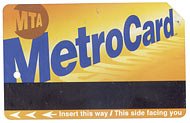
    So says New York State’s highest court, the Court of Appeals. Sewell Chan of the Times reports.

    Unfortunately for the Metropolitan Transportation Authority, Judge Graffeo’s decision contains details that can be used as instructions for bending MetroCards to get free rides. The judge devoted her entire first section, more than two pages, to explaining the magnetic coding of the cards, how the machines read the cards, and how, in essence, to foil the system.

  • International Association of Chiefs of Police, Fraternal Order of Police, embarrass themselves

    The Obama administration said it favors shorter jail sentences for crimes involving crack cocaine.

    Under current law, a person caught with 500 grams of powder cocaine gets the mandatory minimum sentence of five years, while it takes only five grams of crack cocaine to trigger the same sentence.

    “Our stance on this is we shouldn’t be lowering the penalties on crack. We’ve always talked about bringing the powder-cocaine penalties up,” said Gene Voegtlin of the International Association of Chiefs of Police, which includes 20,000 police chiefs and executives.

    “We believe the remedy would be to increase the penalties for powder cocaine so all criminals are treated equally,” said James Pasco, executive director of the Fraternal Order of Police, which represents about 325,000 uniformed officers.

    The whole story by Gary Fields in the Wall Street Journal.

    I don’t want to overstate this point, but I would like to place it on the table: I don’t think there’s much difference between powdery crack cocaine and clumpy powder cocaine. And lab tests don’t distinguish between the two because they’re both cocaine.

    I pity the man who gets caught in the ghetto with 5 grams of powder cocaine in a crack vile or two.

  • Bike Rapid Response

    Strange Queensday Attack in the Netherlands. In the BBC video, notice the first police officer on the scene rides a bicycle. Not a car. Not a man on foot. But a cop on a bike. If the goal is rapid response (at least for short and medium distances), we need more bikes.

  • Safe Injection Facilities Conference

    Safe Injection Facilities Conference

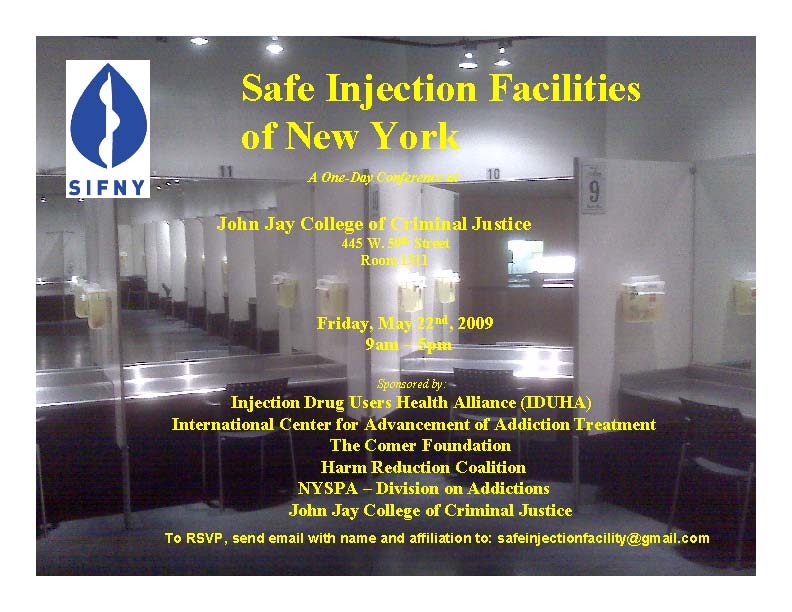
    There’s a one-day conference on Safe Injection Facilities (a legal place where addicts can shoot up) at John Jay College on May 22, 2009.

    The conference organizer is looking for somebody to provide a law enforcement perspective. Any police out there interested in talking about what police officers think about such programs? Email Rick Curtis. It will be fun, interesting, and good place to network with academics and public health people. They need a good law-enforcement perspective so that it’s not all just preaching the choir.

  • Drugs and the Taliban

    In the New York Times.

    Instead of fighting a war we can’t win, we could buy the drugs. Burn it if we want. Sell it if we’re smart. It would be cheaper and better than sending soldiers into harm’s way. Perhaps just $300,000,000 a year. That’s what they say the Taliban makes in drug profits (though I suspect it’s higher). But instead, we’ll fail to end the drug trade and push more farmers into poverty and the hands of the Taliban.

  • Corrupt Narcs in Philadelphia

    I wishit weren’t always the Narcs. And now, because I’m older and wiser (and somewhat shamed by comments to other posts), I’ll add that it isn’t allnarcs. Most narcotic officers do their job and do it well. But corruption always has a vice link. Always.

    Wendy Ruderman and Barbara Laker write in the Philadelphia Daily News:

    RED FLAGS were everywhere. Something wasn’t right.

    Search-warrant applications read like form letters. A confidential informant made drug buys across the city, sometimes just minutes apart, defying the laws of physics….

    Yet police brass apparently failed to notice.

    Again and again, supervisors in the Philadelphia Police Narcotics Field Unit signed off on cookie-cutter applications for search warrants, which are now the subject of an expanding FBI and police Internal Affairs Bureau investigation.

    [After allegidly being robbed by police officers during a drug raid] The 5-foot-1, 110-pound Lu, who had no criminal record, was hauled off to jail for selling little ziplock bags.

    Read the whole story here.

    Evidently, raiding and closing ghetto Korean corner stores for selling small ziplock bags is now standard operating procedure. All part of the war on drugs.

    “The store is closed for six months or so, but on that corner, or one, two blocks away, drugs are sold and guys are armed,” said Patrick Carr, a Rutgers University sociology professor. “They say quality of life – whose quality of life are we talking about?

    “With the store closed, who will sell diapers, milk and bread?”

    Laker and Ruderman have written a series of articles on Tainted Justice.

    Legalizing drugs would be the quickest way to keep police clean. More bureaucratic layers of red tape is not the answer.

  • Plane Scares New York City

    Plane Scares New York City

    Here’s a dumb recipe for a photo-op: take one 747, fly it low around Manhattan, circle around a bit, and follow it with two F-16 fighters.

    Who was the idiot that thought of this brilliant idea? This is pretty inexcusable. And it sure better not turn up in an “Obama 2012” campaign ad.

    The Police Department acknowledged that it had been notified about the event but said it had been barred from alerting the public. “The flight of a VC-25 aircraft and F-16 fighters this morning was authorized by the F.A.A. for the vicinity of the Statue of Liberty with directives to local authorities not to disclose information about it but to direct any inquiries to the F.A.A. Air Traffic Security Coordinator,” the Police Department said in a statement.

    “New York City police were standing right there and they had no knowledge of it. The evacuations were spontaneous. Guys from the floor came out, and one guy I talked to was just shaking.”

    The story in the Times.

    At least the presidential campaign is over so we don’t have politicians running around New York City to wrap themselves in the American flag at Ground Zero before leaving town to bash the entire city as un-American.

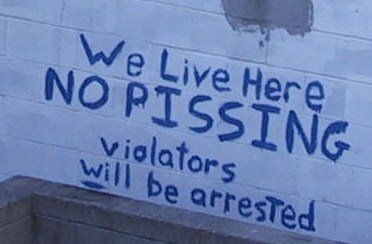
    Does the rest of the country really see New York City as just a patriotic prop or a filthy den of unpatriotic immigrants, liberals, and Jews? Really, now… we’re good people. And we live here. Please stop pissing on us.

    I thought it was just Baltimore where I needed this sign:

  • Vice

    Vice

    I don’t know if I should be proud or ashamed I love ViceMagazine. It’s anti-consumer attitude is completely and unashamedly support by consumer culture and slutty American Apparel ads.

    I don’t know how to describe Vice so I won’t. Let’s just say it’s eclectic and, among other things, sometimes provides a wonderfully unsanitized view of the world. Yes, there is some female nudity in pretty much every issue, but the only thing it has in common with Playboy is that I’ll say I read it for the articles.

    And, oh yeah, Vice is supposed to be free. But then you have to go to the right stores, none of which, evidently, are in my neighborhood. So I’m one of those losers that actually subscribes to Vice.

    The current issue–loosely based on tech–features homemade explosive devices (from the Anarchist Cookbook), pictures on making Scottish Haggish from live deer to cooked meat, a photo-documentary on guest workers in Dubai, and lots more.

    When I started reading Vice I just liked the hipster attitude (and the occasionally topless hipster girl). But then I came along this article and I realized the magazine was for real. Yeah, that’s the prison in the Philippines where the guy makes all the inmates do massive dance numbers (and seems to have a harem of women prisoners on the side).

    Where is all this going? Two good stories of note. The first is what I would call honest drug education about synthetic opiates. I can say no because other people said yes. It’s effective not despite, but because it admits that heroin’s high is as pleasant as “swimming through a sea of warm blankets fresh from the euphoria dryer.”

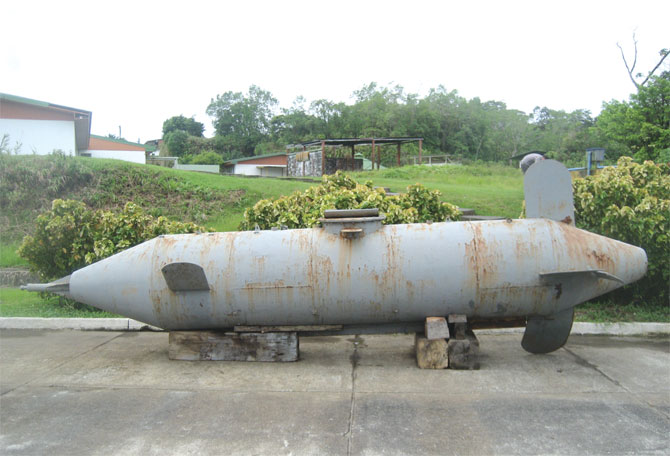
    The second story is about shipping drugs from South America in purposefully designed torpedoes.

    We all know that submersibles are now used to transport drugs. But how many magazines interview the guy who “spearheaded the project”? I’ll be damned if I didn’t learn a thing or two (though I already know the war on drugs won’t be won).

    To give you some idea of the money involved (and why it’s scary to think that criminals and terrorists profit from drug prohibition), in 2000 a kilo of coke cost this guy $2,100. He sold it in Mexico for $8,000 (and more in the U.S.). At three tons per torpedo, that’s a profit of more than $17,000,000 per shipment.

    At the time the street value for cocaine in the U.S. was $161 per gram or $161,000 per kilo. If you want to price it that way (as does law enforcement because it sounds cooler for the evening news), each shipment had a street value of $483,000,000. What wouldn’t you do for $483 million. Now that’san economic stimulus.