More cops. Less crime. Plus it’s good for the economy.
Ready the interesting article by William J. Stuntz in the Weekly Standard.
House and Senate alike are making a serious error. For $5 billion per year–five years’ funding would be about 3 percent of the stimulus package–lawmakers could put another 50,000 cops on city streets. Doing so would likely both reduce crime and reduce the nation’s swollen prison population–a rare combination–and would also help the economy in poor city neighborhoods by making investments in those neighborhoods safer. This is one policy that conservatives and liberals alike could support. If the Obama administration is looking for opportunities for bipartisanship, it should look hard at urban policing.
FBI Deputy Assistant Director Daniel Roberts said, “The goal is to recover kids. We consider them the child victims of prostitution.” Well that’s awfully sweet of him to say. Sounds to me like the FBI is codling prostitutes! Suspicious.
And if, like “they” say, we’re winning the war on drugs, shouldn’t we start on war on prostitutes? That would solve the problem. Besides… just think… if it weren’t for all the prostitutes walking the street, my little John wouldn’t have been pressured into sleeping with that whore! Let’s have mandatory life sentences! Now that would send the right message and keep our streets safe. Either we’re going to get tough with prostitutes or they’ll be prostitutes in your neighborhood!
They say sarcasm doesn’t translate well into writing. So I’d like to make it very clear.
Three years after the police killed Kathryn Johnston the case is almost finished winding through court. Johnston is one of those names you should know, another victim of the war on drugs.
The Atlanta Journal-Constitution has the whole story. It includes these lines:
“Tesler said when he joined the narcotics unit, he was told to ‘sit, watch and learn’ from superiors who cut corners to meet performance quotas for arrests and warrants. ‘I was a new part and plugged into a broken system,’”
“Smith said his moral compass failed when he began to think ‘drug dealers were no longer human.’”
What do you do with an 11-year-old murderer? Really. I have no idea.
Here’s an excerpt of the story in the Pittsburgh Post-Gazette:
Jordan Brown, a fifth-grader from New Beaver, Lawrence County, allegedly killed his father’s pregnant girlfriend, Kenzie Marie Houk, 26. Police say he used the child-sized 20-gauge hunting shotgun his father, Chris, had given him for Christmas. Ms. Houk, who was due to deliver a son in a couple of weeks, was shot while lying on her bed in the family’s two-story farmhouse near New Castle. Her body was found by her 4-year-old daughter, Adalynn.
Mr. Bongivengo described the killing as “premeditated and cold-blooded.” He said Jordan shot his future stepmother, put the shotgun back in his bedroom, got rid of the spent shell casing and rode the bus to Mohawk Elementary School with Ms. Houk’s 7-year-old daughter, Jenessa. Jordan’s father was at work at a local factory at the time of the killing.
The whole store is here. What do you now do with the kid? I don’t know. Any ideas?
Of course, for starters, not giving your 11-year-old a child-sized 20-gauge hunting shotgun comes to mind! Oh, snap! Yes, I didgo there. Sorry, it doesn’t answer the question, but it needed to be said. Am I back sounding like a two-bit commie gun-hating liberal again?
Next year little Jordan is getting a lump of coal for Christmas, that’s for sure.
That line is nothing new coming from me. But it is something new coming from Fernando Cardoso, Cesar Gaviria, And Ernesto Zedillo. Who the hell are they? Just the former president of Brazil, Colombia, and Mexico. In the Wall Street Journalthey write:
Over the last 30 years, Colombia implemented all conceivable measures to fight the drug trade in a massive effort where the benefits were not proportional to the resources invested. Despite the country’s achievements in lowering levels of violence and crime, the areas of illegal cultivation are again expanding. In Mexico — another epicenter of drug trafficking — narcotics-related violence has claimed more than 5,000 lives in the past year alone.
The revision of U.S.-inspired drug policies is urgent in light of the rising levels of violence and corruption associated with narcotics. The alarming power of the drug cartels is leading to a criminalization of politics and a politicization of crime. And the corruption of the judicial and political system is undermining the foundations of democracy in several Latin American countries.
The first step in the search for alternative solutions is to acknowledge the disastrous consequences of current policies. Next, we must shatter the taboos that inhibit public debate about drugs in our societies. Antinarcotic policies are firmly rooted in prejudices and fears that sometimes bear little relation to reality. The association of drugs with crime segregates addicts in closed circles where they become even more exposed to organized crime.
This is the kind of shootings that makes cops smile. Bad guys gets what he had coming. Reminds me of the time in roll call when the sergeant was describing a complicated shooting in Sector One on Barclay St. or Greenmount Ave. It was a confusing tale of a Mexican guy, a black guy, a woman (perhaps girlfriend to one and prostitute to the other), money, a gun, and finally a man shot and killed.
A friend of mine interrupted to ask, “Who got shot? The robber or the rob-ee. I kind of like it when the robber gets shot.” But in that case is was the rob-ee.
Not here:
Sometimes people are surprised to learn that yes, you can (and should) shoot a man holding a gun at somebody. No you don’t need to say anything. No, you don’t need to give a warning. In fact, doing so could endanger an innocent life. If somebody is threatening people with a gun and he points it toward you or anybody else, you cap him. Double tap. Plain and simple. That’s a good shooting.
In this case it just so happened that an on-the-ball 65-year-old retired police captain was working security. If there had been no security guard, it is true that the odds are nobody would have been killed. But those are odds I wouldn’t want to play.
The retired officer shot the robber four times (quadruple tap?) and is not being charged. Nice bit of shooting, I would say.
This robbery and violence related to a legal and regulated drug. That goes against what I say about regulation and drug violence (namely that the former prevents the latter). Too bad there was no legal way for the addict to get his drug. If there were, robbery prevented, addict lives to stay addicted another day, and the retired police officer wouldn’t have to shoot anybody. Everybody wins.
My friend Dan Baum has written an excellent book about New Orleans. Nine Lives: Death and Life in New Orleans. Baum was the New Yorker reporter covering the aftermath of the flood.
And it’s not just me who says this book is great. The New York Times gave it a great review. You can read an excerpt here. Then go buy it. You’ll be happy you did.
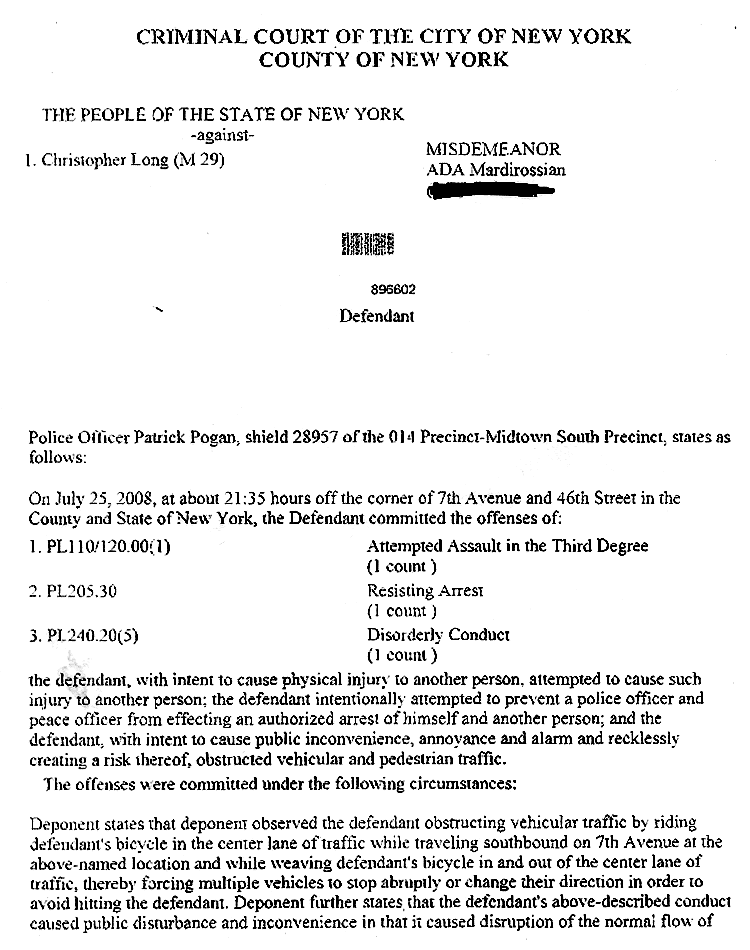
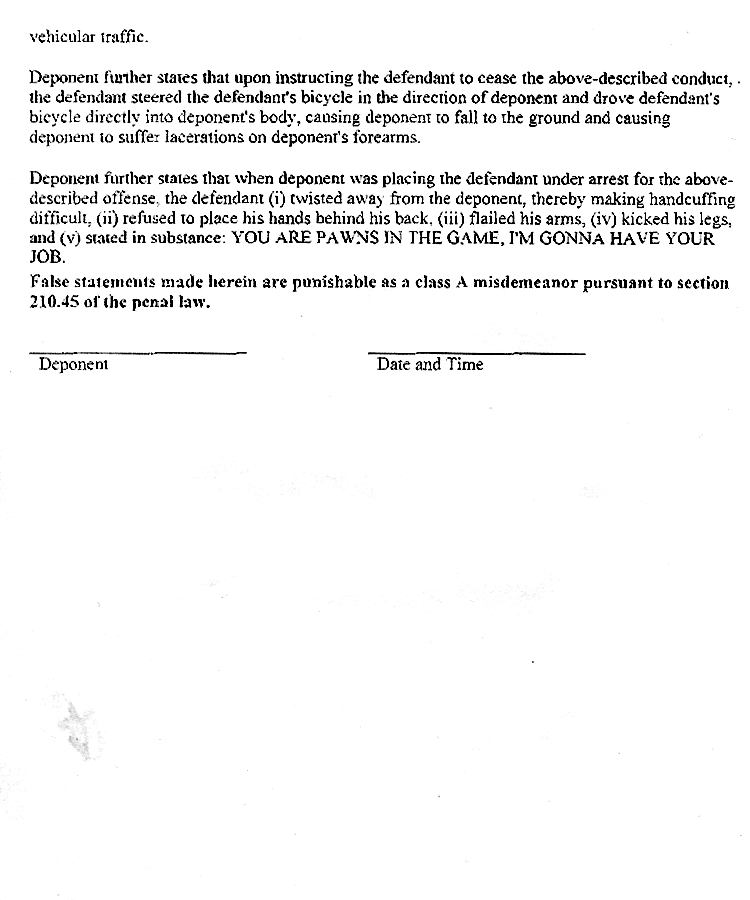
A friend of mine has claimed that there’s “more to the story” and that the officer was specifically trying to stop thisbicyclist. I don’t buy it. If that had been the case, he would have said something about it in his arrest report.
Here’s the officer’s lie-filled arrest report, from The Smoking Gun.


 My friend Dan Baum has written