I got issues with this piecefrom the normally stellar Economist.I just happened to have lunch yesterday with George Kelling. He has issues, too.
For one thing, Broken Windows is not Zero Tolerance.
I got issues with this piecefrom the normally stellar Economist.I just happened to have lunch yesterday with George Kelling. He has issues, too.
For one thing, Broken Windows is not Zero Tolerance.
I just received this interesting email from the po-po in Vermont (oh, I chuckle at my own wit… because somehow I imagine police in Vermont don’t get called “po-po” much).
Professor,
Love reading your web site. I like your perspectives on these issues you write about. I was just reading your articles on “Balancing Security and Liberty” and “Buckle-Up or the Lock-Up.” After reading these two, you need to move to VT as you might like our supreme court. We, the police are losing a lot in terms of search and seizure.
A while ago we lost searching a vehicle without a warrant. Our supreme court said if we have established PC [probably cause] at the roadside, we can offer the operator a “consent search.” If they decline, then we can seize the vehicle and get a warrant. The court at that time felt the vehicle can be easily seized and we take the time to get a warrant. We’ve gotten used to this one.
Most recently we lost or are losing search incident to arrest [that’s the right search somebody after you lock them up]. I and my colleges in VT feel they’re going to far. An officer arrested a suspect for DUI, searched his vehicle incident to arrest. Only the lung-able wingspan and under the operators seat. Under the seat the officer I believe found stolen property or may drugs. He was charged and convicted for it. The suspect appealed his case all the way to the high court. They ruled 3-2 in his favor that the search, under the VT constitution, was unreasonable.
The most recent was another search incident to arrest. The person was arrested on a warrant. He was handcuffed and searched. The police found a small bag or sack in his pocket that had drugs in it. He was charged and convicted. He appealed. The court, on a 3-2 decision ruled that we needed a warrant to get into the bag or sack. These two decision, in my opinion are extreme. We’re way beyond a Terry Stop or a security type search. Even one of the descending justices said just on an officer safety issue, it is justified.
On this one, “Old-School Cops in a New-School World” my chief would agree with you here.
I’ve always liked Vermont. Too bad I don’t ski. Good beer. Good weed, too, I hear (hey, seems like half the kitchen staff I worked with in Boston were hard-core stoners from Vermont).
I’m always torn on these issues of searches. Because as a former cop, I love tools for cops to find shit. But generally I support rules limited police searches. I don’t think the government should have the right to be in everybody’s business. That’s not what the country was founded on.
It really does bother me that people are arrested and cars towed simply because police want to search somebody and their stuff. If you’ve got probably cause, that’s one thing. But it you don’t, an arrest shouldn’t be the answer.
Without knowing much at all about how police work in Vermont (I imagine it’s a little more polite—on both sides—than we police in parts of Baltimore).
But I don’t support search incident to arrest if it means people are arrested so that police can search them. Officer’s need to search for their safety; it’s just so much abused to find drugs. I simply don’t know how you get police to follow the spirit of the law.
In New York State, by the way, any drugs found during a Terry Frisk cannot be charged against the person (though of course the drugs will be seized). I think that’s a great rule. But of course my cop friends here in NYC tell me there are plenty or ways to get around that (like say you found them on the ground). Still, if police are willing to lie to prosecute, that’s on them.
Here police stop and frisk for guns. That’s controversial, but legal and I suspect ultimately good. Stopping and frisking for drugs and both illegal and wrong.
I’ve never understood the logic of being able to search the whole car when you tow it (granted I did, too). I mean, if it’s technically “for inventory,” but we all know that’s bullshit. Why can’t a driver just say no, you don’t have to inventory my contents, I trust you.
I guess it all just comes down to the fact that I’m both pro-police but also pro 4th Amendment and against the war on drugs. I think citizens give up too many rights because of the war on drugs. Too many police push our Constitution to the limit because they want to find drugs. Why are they so obsessed? If we’re concerned about bombs, that’s one thing. Then find bombs but don’t go for anything else. I say this in my “Balancing Security and Liberty” piece–by the way, of all my op-eds, that’s my favorite.
In the New York Times, Christine Hauser writes a very good article about “desk duty” in the NYPD.
“An officer… spent more than 18 months watching surveillance video while authorities investigated an accusation that he had struck a suspect. [He] was eventually cleared of the charge.”
In Baltimore they call getting mired in the department discipline process “jackpotting” because it’s seen as random and doesn’t necessarily have any relation to actually doing anything wrong.
One of the biggest complaints and fears of police officers is seemingly arbitrary discipline and the amount of time it takes to clear innocent officers from bogus charges.
The latest issue of Drug War Chronicle has an excellent reviewof Cop in the Hood.
“As revelatory as it is sometimes disturbing…. Engaging, even riveting”
The LA Times has a series on Mexico’s War on Drugs.
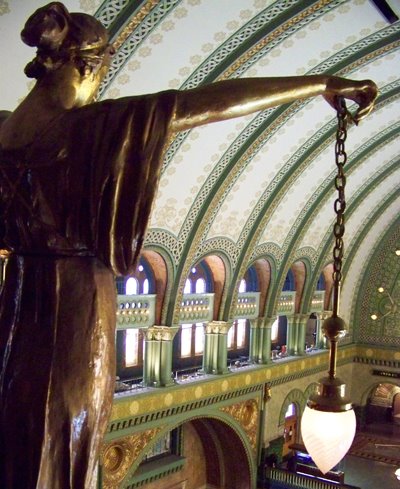
I’m back from St. Louis. Despite growing up in nearby Chicago, I had never been to St. Louis. In my mind, I was thinking the Baltimore of Midwest: Faded industrial glory, local pride, and the answer to one of my own favorite personal trivia questions: What city of a certain size (at least a couple hundred thousand? or perhaps with a major league sports team?)has lost the greatestpercent of it’s population?
The answer?
No, not Baltimore.
Not Detroit.
Not Newark.
St. Louise, M.O.
Yes, St. Louis. From 856,796 people in 1950 to 353,837 today. Almost 60% of the population left.
Why? Of course the usual economic and social reasons. But something had to be different about St. Louis to lose mostof it’s population.
We arrived by train from Chicago. I had St. Louis Union Station mapped out. Silly me thinking that trains actually arrived in the beautiful train station.
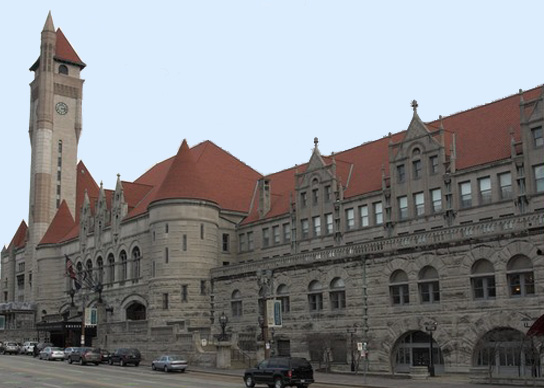
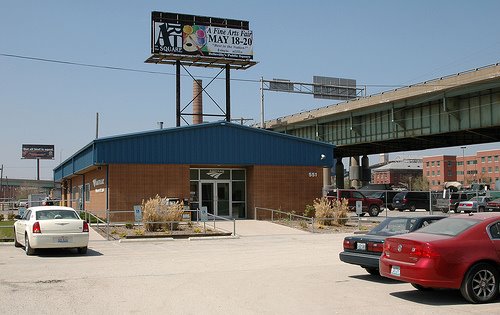
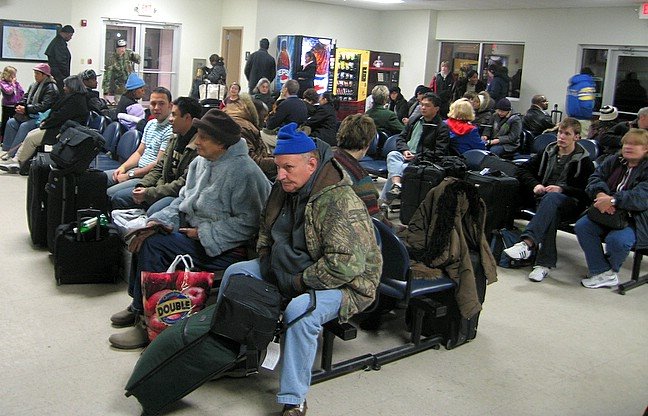
Instead Amtrak pulls up next to one of those Amtrak Shacks. Except it was dark and rainy and muddy when we arrived. Sigh.
 A bad train station alone does not a deserted city make. The sad part is that St. Louis, which does have some very nice parts, coulda been a contender. The city doomed itself in the 1930s when they tore out the heart of the city. Part of this area would, in the 1960s, because the St. Louis Arch (or more ominously officially called the Jefferson National Expansion Memorial). The Arch, by the way, is beautiful.
I guess destroying your city in the 1930s was cutting edge urban renewal at the time. Most cities didn’t tear themselves down till afterWWII. In St. Louis, the old courthouse used to be in the center of the city. Now it’s almost on the Eastern Edge surrounded by some ugly hotels and office buildings from the past few decades.
The old basilica used to be surrounded with glorious cast-iron buildings. Now it’s surrounded by nothing. Why do they do that? What were they thinking? Why do they still do that?
Probably about a whole square mile is gone. And it’s the part with history and character. Like Soho in New York. It’s gone. All of it. Now there’s the Arch area. OK. Fine (though there would be nothing wrong with an arch rising out of real neighborhood). And the rest? Now there’s a freeway. And empty spaces. And lots of parking. Too much parking is always a bad sign.
From the arch you can see the huge space that used to be city.

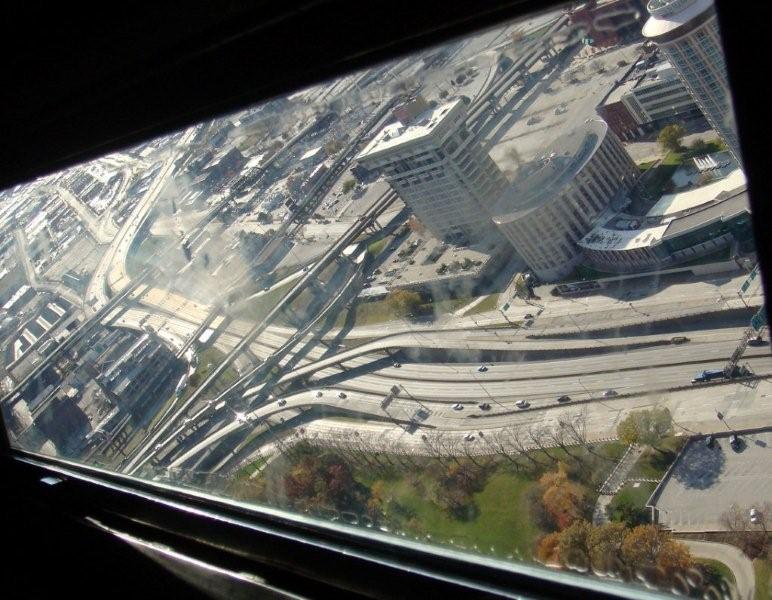
There are just a few buildings in this area left. 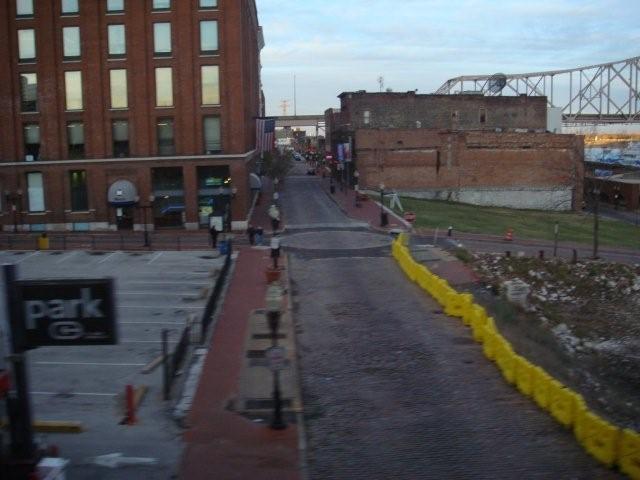 The buildings that are left look like this. Gorgeous.
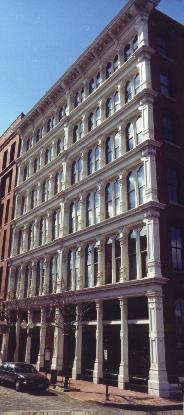
What’s left is filled with a predictable blend of mediocre restaurants and sports bars in an attempt to bring nightlife back to the city.
St. Louis could have been the New Orleans of the North. But they torn down their French Quarter. Instead, well imagine New Orleans without the French Quarter. Or, for that matter, good food or music.
I didn’t get a chance to see North St. Louis, where that half of the city that fled used to live. But in the brief time we had before our flight out, we were able to take the nice St. Louis Metro to Illinois and back. I wanted to see East St. Louis, even if a classic “slumming tour” just through the window of a light-rail train car.
East St. Louis, Illinois, is perhaps the single most f**ked up city in America (and there is tough competition). They lost their city hall in a lawsuit around 1990. That was their only asset. If you’re interested or worried about this kind of thing, you should read Jonathan Kozol on East St. Louis.
Crossing the Mississippi River, you see the casino, the talisman of attempted economic revival: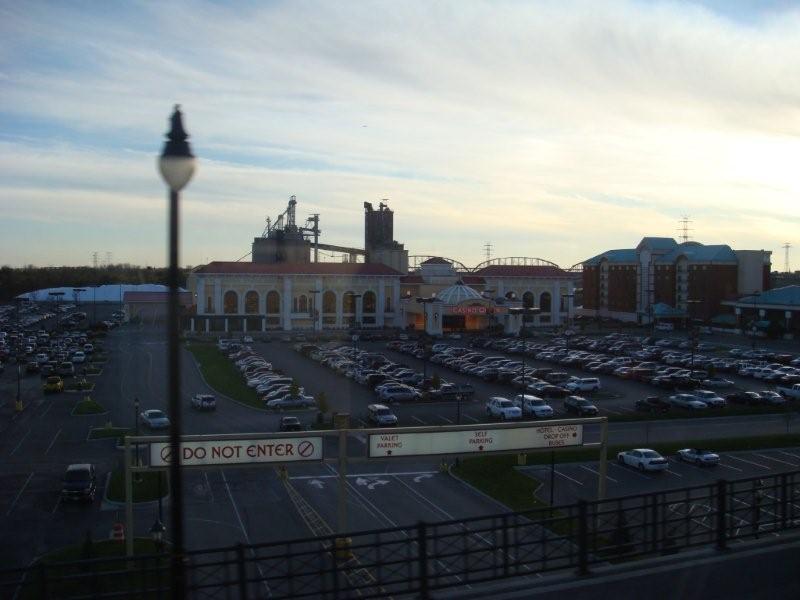
Then you see how there’s just no there, there.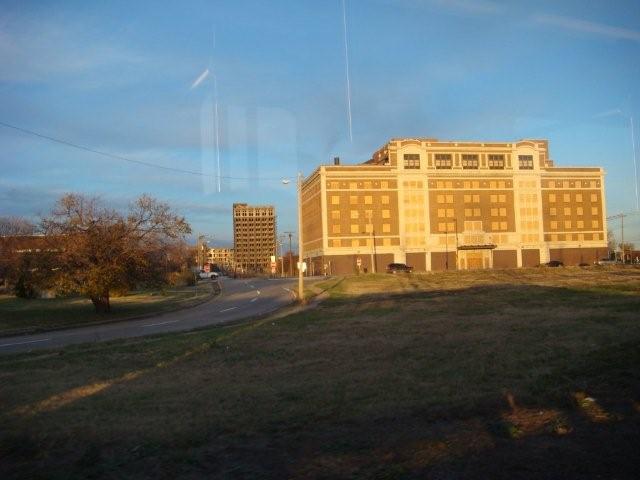
 The arch rising in the distance. Yeah, I know it’s not the most subtle use of juxtaposition.

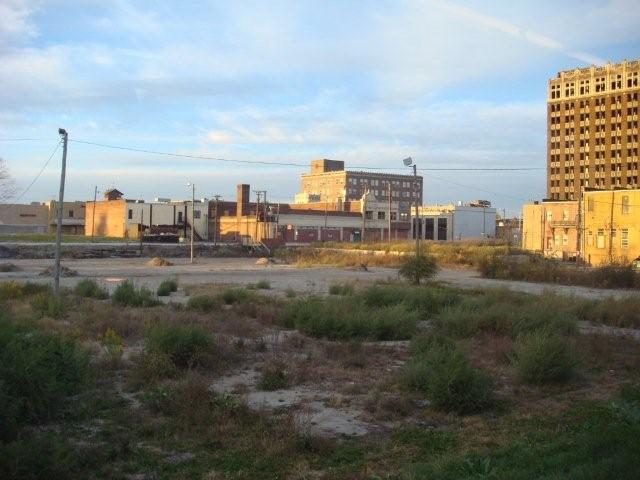 Downtown East St. Louis.
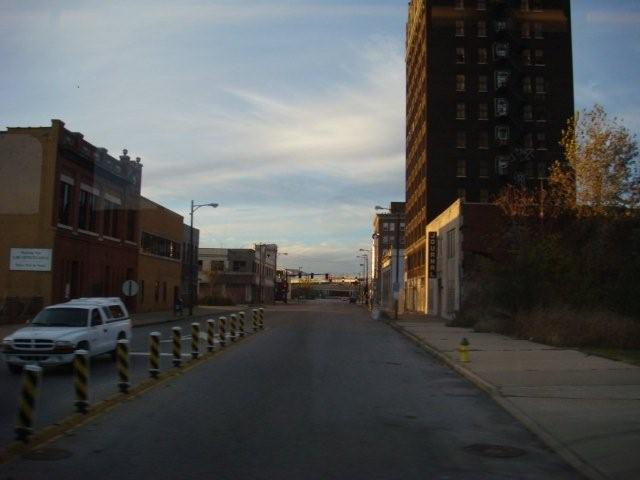

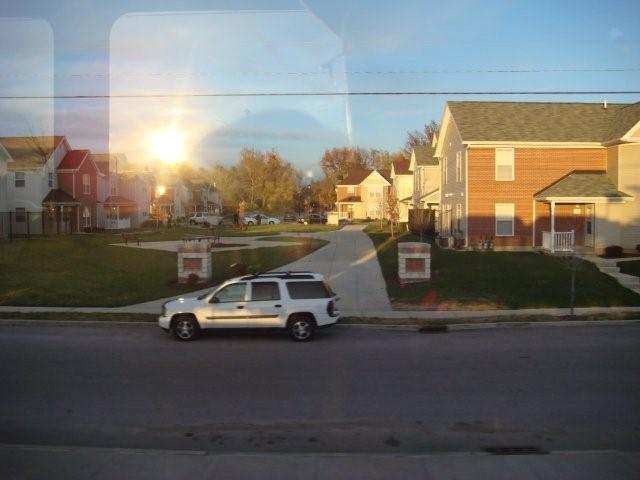 New development.
What the morale? I don’t know. Why do we let this happen? And if you think your city is in trouble… just remember, it could always be worse.
[December 10 addition: Just remembered that part of the reason we got on the light rail was to find a place to eat. The employee at the station told us authoritatively: “There are no restaurants in Illinois.”]
I’ve said that Tasers are overused and too often lethal. But here is a perfect use–as an alternative to lethal force. Well done, BPD. The Baltimore Sunreports:
Baltimore police use Taser to subdue armed woman
November 17, 2008
Baltimore police used a Taser last night to disable a woman who was wielding a handgun in front of a house in the 200 block of W. Lorraine Ave. in the Remington community, said a Northern District shift commander. Sgt. Michael Hennlein said the woman, who is in her 20s, and a girlfriend were arguing in the house about 9:30 p.m. when the woman fired a shot that shattered a window but missed the other woman. Hennlein said several people in the house ran outdoors, followed by the armed woman. During the incident, someone called police to report a shooting. Hennlein said that when officers arrived, the woman was standing outside, bleeding from cuts caused by broken glass and threatening to shoot herself and others. After officers warned her to drop the gun and she failed to comply, one of the officers fired a Taser, striking the woman in the upper body with 50,000 volts, he said. The woman was taken by ambulance to a hospital for treatment of the lacerations and the effects of the Taser. He said charges were expected to be filed against the woman upon her release from the hospital and that no other injuries were reported.
In the morning I’m off to Chicago for a memorial for my father at Northwestern University. Then on Friday to St. Louis for the annual American Society of Criminology Conference (and dude, do theyknow how to party…) I’ll be back next week…

Very interesting article by Vince Beiser of Miller-McCune about drug policy in Vancouver (thanks, Louise). It is also fair and balanced. From the article:
Canada’s third-largest city has embarked on a radical experiment: Over the last several years, it has overhauled its police and social services practices to re-frame drug use as primarily a public health issue, not a criminal one. In the process, it has become by far the continent’s most drug-tolerant city, launching an experiment dramatically at odds with the U.S. War on Drugs.
[…]
Vancouver has essentially become a gigantic field test, a 2 million-person laboratory for a set of tactics derived from a school of thought known as “harm reduction.” It’s based on a simple premise: No matter how many scare tactics are tried, laws passed or punishments imposed, people are going to get high. …Harm reduction is less about compassion than it is about enlightened self-interest. The idea is to give addicts clean needles and mouthpieces not to be nice but so they don’t get HIV or pneumonia from sharing equipment and then become a burden on the public health system. Give them a medically supervised place to shoot up so they don’t overdose and clog up emergency rooms, leaving their infected needles behind on the sidewalk.
Give them methadone — or even heroin — for free so they don’t break into cars and homes to get money for the next fix.
[…]
Though Vancouver is cutting the collateral damage caused by hard drugs, the city is making far less progress in reducing the number of users. Surveys report that drug use is higher in British Columbia than in the rest of Canada. A recent poll found that almost half of all Vancouverites consider drugs a major problem in their communities — a figure double that for residents of Canada’s biggest cities, Toronto and Montreal.With serious drug users come rip-offs, break-ins and holdups for fix money. So it’s no surprise that Vancouver’s property crime and bank robbery rates are higher than most of Canada’s. The city also has more gun-related crimes per capita than any other in the nation, a fact at least one criminologist has linked to the number of substance abusers.

I’m not the first to point out that cops and nurses have a lot in common. This is from a nurse/midwife:
I was reading your book today on the train and thinking about cops and nurses. I was a one-woman nurse academy for the last year and it’s such a maddening process. I had to teach new nurses:
1) the rules of a system;
2) that nurses don’t always follow the rules, they do it another way, but please know the rules; and finally—if the nurses can handle such cognitive dissonance and it doesn’t utterly disillusion them:
3) that the system is misguided and broken, and the informal way nurses do it doesn’t really benefit laboring women or respect birth either. And that just about everything in the labor room goes against evidence-based practice.
I feel some success when the new nurses start talking about home birth. It’s the only sane response to learning about hospital birth at **** (or most NYC hospitals). But then after orientation the nurses have to go out and do the hospital job anyway, which means being asked to fit all patients into the same tight, wrong mold.
I am about halfway through the book. It sounds like nurses have a similar response to cops. There is a lot of dehumanizing of patients, and gallows humor, and gory details over drinks. They get very good at writing reports (documenting in the chart) that fit a certain picture even if not really accurate.
To an extent, nurses have a sisterhood and look out for each other, but there is also quite a bit of undermining and backstabbing (women culture vs men?). And yet it is amazing how often the nurses can still be kind and creative and still see the screaming bleeding whining person in front of them as an individual human needing support.