Category: Police

  • Are drugs evil?

    This is taken from the comments of a previous post.

    Your comparison of a drug dealer to anyone who sells cigarettes and booze is interesting. I believe that even with the huge tobacco lobby at work, most tobacco products will be illegal within twenty years, and rightfully so. Booze is a different story because it is well tolerated by many who use it and not as addictive as amphetamines, opiates or nicotine.

    I can’t argue against legalization of marijuana because too many studies have suggested a low addiction and personal harm factor. The addiction and personal harm factors for cocaine, heroin and meth far surpass those for marijuana though, and I believe that if you are to make an argument for legalization it has to overcome the harm caused by using a substance.

    Even with this academic B.S. aside, you have been to the streets where non-addicted dealers see what their product does to their customers, the desperation the ability to drop all semblance of humanity just to get high. Why do you defend those who lack the moral clarity to continue selling these substances when they see what it does to people? Or to put it another way, I have never seen a male heterosexual cigarette smoker offer to perform oral sex on a male 7-11 clerk just to get a pack of cigarettes. (Same goes for a marijuana user-It’s not the price it’s the drug.)

    I like your last point! And it’s valid. I think the answer is quite simple: cigarettes are not as bad as crack and heroin. Yes, cigarettes kill a lot of people, but a nicotine addict is not like a crack addict.

    But I don’t believe there is a fundamental difference between one addictive drug and another. Alcohol does ruin lives. Cigarettes kill people. But heroin and crack can do it in a particularly ugly manner (not that throat cancer is pretty).

    Here’s the point: regulation does not equal approval. If regulation could lower drug use–and there’s every reason to think it can–then we should regulate.

    Plus I refuse to play the “moral clarity” game. There are recreational cocaine users just like there are recreational drinkers.

    I don’t believe drugs are evil. I think some drugs for some people are bad. I think heroin and crystal meth are very bad for almost all people. Many of my best friends regularly use alcohol, cigarettes, marijuana, and ecstasy without fucking up themselves, their families, or their jobs. They’re not evil.

    But my point isn’t to encourage use. Quite the opposite: it’s to discourage use. And since the U.S. has the highest usage rate in the world for pretty much every illegal drug, it’s safe to say our current war on drugs doesn’t work.

    The idea of condemning the morality of drug dealers to me is a little silly. Unless you’re willing to say capitalize is evil (and though it may be, I’m not), I’m not going to say drug dealing is evil. They used to say that about music, sports, and alcohol. Is it wrong to sell to drugs addict? Maybe. So what about methadone clinics?

    And besides, condemn all you want, if we lock up one drug dealer, another will sell. That’s the problem: we CAN’T STOP drug dealing. Repeat that. We can’t stop drug dealing. Once we accept that, we can figure out the best way to deal bad substances. And if regulation can lower usage, lessen addiction, and raise money all at the same time, why not give it a try?
  • Abandon your child

    Something strange is happening in Nebraska.

    From the LA Times:

    Nebraska’s safe-haven law is unlike similar laws in that it allows anyone, not just a parent, to drop off a child, of any age, at any state-licensed hospital without fear of prosecution for abandonment. The law doesn’t absolve anyone of charges such as abuse or neglect.

    But the fascinating part is that it’s not infants getting dropped off… but teenagers!

    The latest case, as reported in the Detroit Free Press:

    The metro Detroit woman who drove 12 hours and about 725 miles to give her teenage son to the state of Nebraska under its safe haven law did so because she was stressed out and was trying to teach him a lesson, according to the youth’s affidavit to authorities in Douglas County.
    […]
    The youth is in Nebraska custody under the state’s controversial safe haven law, which allows parents to relinquish children up to age 18 to the custody of the state, while most states, including Michigan, permit only the abandonment of newborns and infants.
    […]
    The Michigan teen is the second child from out of state and one of 18 children relinquished in Nebraska since the law’s inception. No newborns have been handed over, said Todd Landry, director of the division of children and family services in Nebraska.

    I know deep down it’s sad, but the cop in me finds the concept of abandoning teenagers hilarious. Sure I’m cynical. All cops are. It’s the ultimate parent threat come true: “I warned you!”

    I came across many parents and guardians in Baltimore who wanted to give up their children. And I’d say the bulk of them were not bad people. Bad parents, maybe. Certainly failed parents. But sometimes kids just don’t turn out right. And before you blame these parents, ask yourself if you’ve ever tried raising a boy in East Baltimore. In poverty.

    Many of these parents pointed out they raised other kids well. Others blamed laws limited their ability to discipline (ie: hit) misbehaving children. I’d say that the ones who told me they wanted to give up their teenagers were notthe worst parents. The really bad parents simply didn’t give a damn one way or the other. At least the parents who want to give up their children understand the child is going down the wrong path. The really bad parents don’t see a problem with their 13-year-old drinking and whoring and slinging.

    I think part of the problem is that we define “child” up to too high an age. A 17-year-old with 2 kids and a job (legal or otherwise) is not a child. I believe in the legal concept of “juveniles,” I just think that 18 is too old. 15 is probably better. By the time an out-of-control kid reaches that age, they’re no longer a kid. And by then, there isn’t much a parent cando. What do you do when you just can’t take it anymore? And after the parent gives up, it becomes the police officer’s problem.

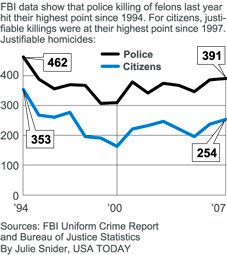
  • Justifiable homicides rise

    Justifiable homicides rise


    The story in USA Today by Kevin Johnson.

  • New Yorkers:

    New Yorkers:

    Mark your calenders for next Thursday, October 23. I’ll be entertaining the crowd with discussions about policing, the war on drugs, and Cop in the Hood. All this at the wonderfully titled “Non-Motivational Speakers Series.” Tell your friends.

    Best yet, this event is at a bar. No, none of that stuffy academic pretension (no pipes or tweed jackets with arm patches). And it’s free.

    You’ll love it. And even if you don’t, what’s it matter? You can drink yourself silly. That’s certainly myplan.

    Happy Ending Lounge
    302 Broome St.
    (between Forsyth and Eldridge)
    212-334-9676
    J/M/Z/F to Delancey
    B/D to Grand Street
    Look for the hot-pink awning with the words “Health Club” on it.
    Doors open at 7:30.
    Event starts at 8 sharp.
    FREE!


    Gelf Magazine

    “This monthly event features an above-average lineup of decidedly non-motivating authorities, each presenting views alternative and overlooked on a veritable goody bag of topics. A different theme is tackled clothesline-style each month, including comedy, culture jamming, religion, amateur pornography, and other such matters of head-scratching import.”

  • More on guns and Florida crime

    ‘Guns are everywhere,’ Orlando police chief says A surge in murder and gunfire locally since the end of the federal assault-weapons ban in 2004.
    […]
    Florida law makes it easy for any adult without a criminal record to buy a gun. Yet many legally purchased guns end up being used by criminals. The state routinely turns up in law-enforcement surveys as one of the top three sources of firearms that turn up in crimes elsewhere.
    […]
    The 9 mm pistol reigns as the state’s most-popular crime weapon.
    […]
    Drug dealing was the most common crime connected to assault weapons in Orange County.
    […]
    Cops consider assault weapons the deadliest firearms on the street. … One riddled a girlfriend’s car for jilting him. Another robbed a gas station, leaving behind his home address on a receipt for the just-purchased assault weapon. A third, who went shooting near his home, simply described himself as angry.
    […]
    Looking over the data, Orange County Sheriff Kevin Beary said that Florida has become much more dangerous — for residents and police officers — since the end of the weapons ban.

    “There should be a huge concern not just here locally but across the nation about the huge increases in the numbers of assault weapons and high-power semiautomatic pistols that our deputies and police officers are coming across,” he said. “This shows that without the ban, the criminal element has definitely taken advantage of the market.”


    Henry Pierson Curtis writes more in the Orlando Sentinel. Read the whole story here. And my previous post on Florida, guns, and crime is here.

  • Homicides down in Baltimore

    Good news from Charm City.

    Justin Fenton of the Sun describes the impact of one police unit. If all this is police’s doing, and it might be, note just how much 250 officers can accomplish (out of a police force of less than 3,000 in a city of 650,000 people).

  • Victory is Near!

    The Agitator has a good post looking at how failure doesn’t stop our drug warriors from claiming success. The news is always good in the Bizarro World of prohibitionists.

  • Prohibition

    Prohibition

    But the old-fashioned kind. Against alcohol. In Alaska. Of course it doesn’t work. Prohibition never does.

    Alcohol abuse and alcohol-related crime is a huge problem in small-town Alaska. After the drinking comes the sexual abuse and rape, often incestuous. A friend of mine is a public defender up there. Oh, the stories he can tell. You know, of good honest small-town values. It’s all too common for a guy to get drunk and then stumble into the next trailer and diddle their sister/daughter/niece/old-lady neighbor.

    Then the guy tells the cops everything that happened (that is to say, confesses) and can’t understand why their lawyer can’t get them off (“but eh, all I did was touch her.”). Finally they ask for a new lawyer… ha, joke’s on them! There areno other lawyers.

    Here’s the story about failed prohibition from the New York Times.

  • What do we think about “shame’”?

    America is more of a “guilt” culture than a “shame” culture. What does that mean? Guilt is something you feel. Shame is what you feel based on what othersfeel toward you. We want our criminals to feel remorse. That’s guilt. Ashamed to show your face in public because your grandma will think less of you? That’s shame.

    Culturally, if you want “shame,” head to East Asia. Shame plays less a role in individualistic societies. We ask people not to commit crime because we hope that they (the criminals) think it’s wrong. But it’s easy to rationalize not feeling bad about your actions. Especially if, say you’re involved in “victimless crime.” It’s easy to not feel guilty about dealing drugs to willing buyers. It’s harder to not feel shame if your grandmother finds out.

    I’m pro shame. I think. If it works as a deterrent. Public punishment is supposed to be shameful. I suspect that cultures that emphasize shame over guilt have less crime.

    Should people arrested (for drunk driving, in this case) be posted online? Arrest records are public. So it doesn’t seem to be a problem, legally. But officially, people are innocent until proven guilty, right? Posting arrests as a matter of fact is OK. But what about posting arrest for the purpose of shaming. Is shame punishment? Should it be? These are ideas I’m trying to articulate ideas on this for my next book. So I’d love to hear your thoughts.

    But the cop in me knows that people arrested are guilty.

    Here’s the story in New York Newsday.

  • I was talking to Charles Rangel

    I was. Last night. On the night train coming back from Boston. I met Charles Rangel in the cafe car. I was chatting with the cafe man and drinking a beer.

    Here is one of the most powerful men in America. Taking the night train. Tired. No entourage. Willing to talk. We did. He knew my father a little bit. They were both proud draftees. Rangel was sad to hear of my father’s death. “But he was young… well, younger than me!”

    “I know,” I said as I gripped his arm sympathetically.

    Rangel got a cheeseburger. I offered to pay for it. I insisted because I knew my father would have loved any story that involved me paying for the Chairman of the House Ways and Means Committee’s cheeseburger.

    So there we are, Charles and I, each trying to get the cafe man to take our money. Because I already had an in with the cafe man, I won (it helped, as I later found out, that the cafe man didn’t know who Rangel was). Rangel thanked me, said a few nice things, and returned to his seat.

    At Penn Station I watched Rangel get off the train. There he was, gentleman, congressman, 78-years-old, carrying his own bags. I offered to carry them for him. But he politely declined. I figure in this day and age you could get in trouble for grabbing a congressman’s suitcase, so all I could do was offer again. He declined again. We went up the escalator and said goodbye. I told him to keep up his good work. There he went, Charles Rangel, walking off alone into the night at 3am.

    It made me proud to be an American.

    It bothers me when people (politicians included) blame politicians and “Washington” for our nation’s woes. Or when politicians encourage cynicism and promote the idea that running our country doesn’t take any special skill set or intelligence.

    Our system ain’t perfect, but it’s the best we got. And if we throw all the experienced bums out, we’ll have mediocre bums leading a mediocre country. Churchill said democracy is the worst system except all other. And I wouldn’t swap it for any other system in the world.

    Two weeks ago I met Maryland Senator Paul Sarbanes. He, a good and honorable man, told me not to be too cynical about politics. I’ll try not to be.