Category: Police

  • Perhaps the worst police-involved shooting ever

    I don’t say that lightly. There have been some bad ones.

    Click on this link or you can jump to about 0:50 sec on this:

    Andrew Thomas, the victim, a drunk driver, is paralyzed. He is white. So is Paradise, California.

    1:35: “I got a male in the car refusing to get out.”

    Maybe, you think, just maybe, it’s because you just shot the mother f*cker for no reason?!

    And yet I hadn’t even heard of this shooting until a Baltimore cop just brought it to my attention tonight. We were talking about Baltimore cops actually do their job pretty well, all things considered. A Baltimore cop would never do this; we can’t imagine this happening in Baltimore. Apparently the officer in this shooting won’t face charges.

    And yet in Baltimore six cops are being tried for failure to seat belt and bring prompt medical care? Has the world gone mad?

    It’s not just that white people don’t care about black lives. Honestly, most white people don’t care about white lives, either.

    [Update: he died]

    [Further update: The officer was found guilty of involuntary manslaughter and sentenced to 6 months in jail.]

  • Cause 911 is cheaper than a shrink

    Here’s a report with some numbers on the problem of untreated mental illness and police response.

    Bottom line, according to these numbers:

    About two percent of Americans have untreated severe mental illness.

    Those two percent of people account for 10 percent of police responses, 20 percent of those behind bars, and 25 percent of fatal police encounters.

    I was going to joke how it’s easier to blame the police than treat mental illness. But I don’t even know if that’s true. We just choose to treat mental illness with police and incarceration. That’s messed up.

    [Thanks to a reader]

  • Page Croyder is mad as hell

    She’s the former prosecutor who has taken to writingabout her former office and its overreaching prosecution of the six Baltimore cops who in the neighborhood when Freddie Gray died in police custody. Here’s her latest:

    I said in my first blogon Freddie Gray, days after Mosby sensationally announced her charges, that she was setting up the false expectation that a crime was committed and that convictions would follow. She showed only the weakest of evidence in her probable cause statement, and it got worse over time. When the autopsy report revealed that she could not prove her case, the Sun said nothing. NOTHING. It had been moralizing and pronouncing legal judgments all over the place (see below), but went silent when the autopsy report made clear that an accident had occurred. The editors never delved into, never elucidated for its readers, the difference between civil and criminal standards of conduct, but instead helped perpetuate the false belief that they were one and the same. All it wanted after the autopsy report was leaked was for the trials to stay in Baltimore, where it was most likely that citizens would also confuse the issues. Take a quote from a citizen in the same edition as the editorial: “The city gave the family all that money. They practically said [Porter] was guilty. How can the jury not find him guilty?” And nearly every other quote from Baltimore citizens expressed surprise at the failure to convict.

    Wouldn’t it have been refreshing had the editors said, “Our bad. We trusted that Mosby had the evidence, that she knew what she was doing, and we were wrong. Instead they wrote two pusillanimous editorials after the verdict defending themselves.

  • Snitching for Dollars

    This is what the War on Drugs looks like. Just another day. From the Chicago Sun-Times:

    One of Chicago’s most notorious informants — who provided drug tips to the police while secretly killing and robbing people and doing drug deals — was paid hundreds of thousands of dollars for his information with the approval of police supervisors who have since reached the highest levels of the department, records show.

    Saul Rodriguez was a top snitch for the Chicago Police Department’s narcotics section between 1996 and 2001. Over that period, he received more than $800,000 from the department for his information.

    During those years, Rodriguez was involved in two killings and other serious crimes like holdups, according to federal prosecutors.

    Rodriguez, the informant, was a partner in crime with Lewellen, his police handler, federal authorities say. Both men went to prison in 2012 in a federal conspiracy case. Sanchez has never been charged and has denied any wrongdoing.

  • Next up…

    Next up…

    Porter’s trial ended on Dec 16 with a hung jury.

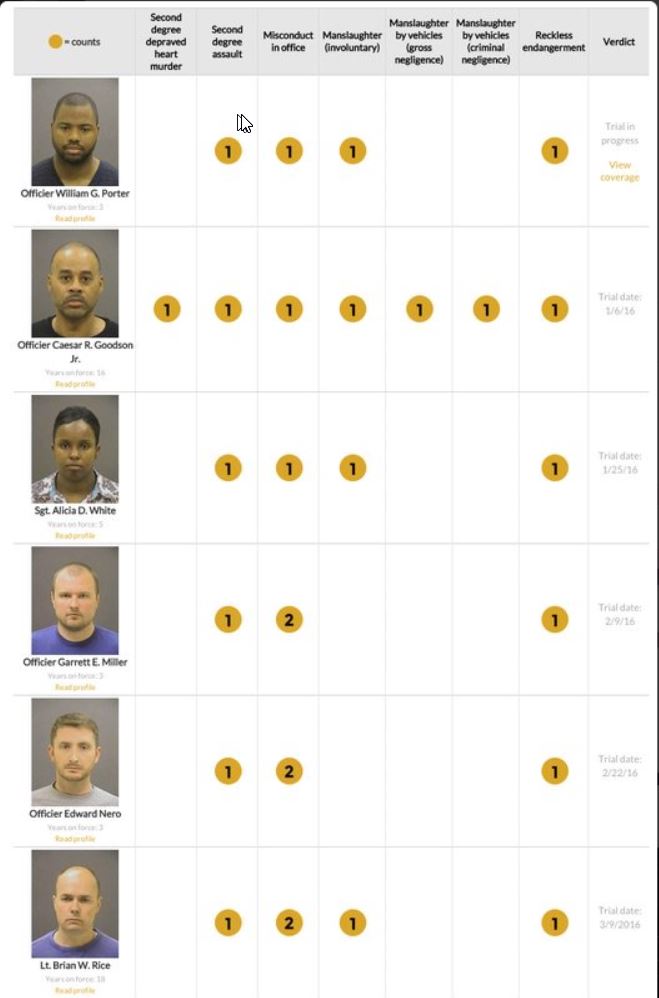
    The next trial, Caesar Goodson the wagon driver, is scheduled for Jan. 6, 2016. Goodson is charged with second-degree depraved-heart murder, manslaughter, second-degree assault, two counts of vehicular manslaughter and misconduct in office.

    Three officers, Porter, Sgt. Alicia White and Lt. Brian Rice face involuntary manslaughter, second-degree assault and misconduct in office charges. White’s trial is schedule for Jan. 25. Rice’s for March 9.

    Officers Edward Nero and Garrett Miller are charged with second-degree assault and misconduct in office. Miller’s trial is scheduled for Feb. 9. Nero’s on Feb. 22.

    (Definitions of those charges.)

  • “What led to a mistrial”

    Luke Broadwater and Ian Duncan summarize the issues in The Sun.

  • Hung Jury in Porter trial

    Hung on all four counts. That is not what I expected. I expected acquittal on the major charges, and perhaps a hung jury on the minor charge of “misconduct.” But no conviction is still a big setback to the prosecution.

    What does this mean? Since I’m no legal expert, best to turn to those who understand these issues. Here’s Richard Thornburgh, former Attorney General, being interviewed by Ali G’s:

    Thornburgh: All bets are off. They have to try him again. Hung jury.

    Ali G: But surely da size of their dongs, whether they is hung or not, won’t affect their judgement.

    Thornburgh: Well, uh, I don’t see the connection.

    Ali G: You was saying dat if you was hung, you know, if all the jury members…

    Thornburgh: No! That’s a figure of speech. A figure of speech. A hung jury is one that can’t agree. It has nothing to do with the physical characteristics.

    Ali G: So it ain’t like 15 blokes that is like well packing down there?

    Thornburgh: No, I’m sorry I should have make that clear.

  • Maryland Pattern Jury Instructions

    The jury, which is currently in deliberation, will be given this (or something very similar to this) to help them decide if Officer Porter is guilty of these charges: involuntary manslaughter, reckless endangerment, misconduct, and second degree manslaughter.

    (thanks to a reader.]

  • Why the stops matter

    Why the stops matter

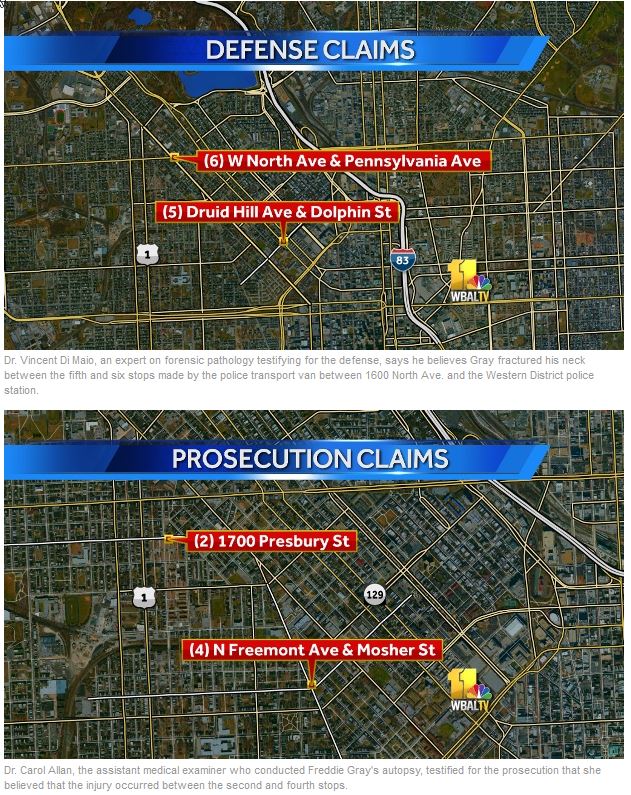
    These stops are confusing and the numbering system is never consistent, but they still matter. Here are some maps from WBAL:

    The summary from WBAL:

    Prosecutors contend Porter is criminally negligent for Gray’s death, because he didn’t call a medic when Gray requested one, and he didn’t buckle Gray into a seat belt at the police van’s fourth stop [labeled 5, above] at Druid Hill Avenue and Dolphin Street, the stop where Porter testified he helped Gray from the van floor onto the bench.

    Porter said he didn’t call a medic, because Gray wasn’t specific about an injury, and he didn’t see any signs of external distress. Porter told the jury, at this point, he assisted Gray, who used his legs and could support his own weight.

    Officer Mark Gladhill testified for the defense Thursday and said at the van’s fifth stop [I’m not clear if this is 5 or 6 above] he saw Gray leaning, but he was supporting his back and his head:

    “You are positive that Mr. Gray was holding his own head up?” [Gladhill] was asked, to which he replied, “Yes. I’m positive.”

    This wouldn’t be possible if Gray had already broken his neck. If Gray wasn’t seriously hurt when Porter dealt with Gray, Porter can’t be neglectful for not taking care of an injury that hadn’t yet happened. There’s still the seat belt issue, but that’s weak in relation to Porter. Prosecutors contend Gray got hurt earlier. (I’m not exactly certain how the prosecution asserts how they know that the injury happened earlier.) Gladhill’s statement is important.

    From the Washington Post:

    Porter responded after the police van’s driver, Officer Caesar Goodson Jr., put out a call for a welfare check on Gray. Porter testified this week that he helped Gray off the floor of the van, asked him if he needed a medic (but never called one) and told Goodson to take him to a hospital. Those actions, [Baltimore police Capt. Justin] Reynolds testified, go “beyond what many officers would have done.”

    From WBAL:

    Porter said he asked Gray at the fourth stop if he needed to go to the hospital and Gray said yes. Porter said he told van driver, Officer Caesar Goodson, that Gray needed to go to a hospital. He said, “I could not order Goodson to do that.”

    Gray wasn’t Porter’s prisoner. That matters. Again from the Post:

    At the fifth van stop, Gray again told Porter that he needed a medic, and Porter told his supervisor, Sgt. Alicia White, that Gray needed to go to a hospital. Reynolds said it was “absolutely reasonable” for Porter to expect the supervisor to get help. White has also been charged in Gray’s death.

    Reynolds said that Goodson was ultimately responsible for Gray’s well-being and that the department’s general orders are “guidelines,” not strict requirements.

    “There are parts of general orders you have to violate to do your job,” Reynolds said. He cited a much-ignored rule that officers be quiet and civil at all times as an example. He added: “Common sense prevails over everything else.”

    If I were on the jury, I’d have more than reasonable doubt.

    If Baltimore were a white-majority city with a white political power structure, the political Left would be screaming at the racism and injustice of prosecutors charging an innocent black man.
  • “When is failing to act a crime?”

    Ian Duncan of the Sun explores the issue:

    David Harris … said American criminal laws are usually of the “thou shalt not” variety, rather than “thou shalt.”

    “We’re pretty stingy in this country and this culture with obligating people to do stuff,” Harris said.

    Legal experts also said it’s difficult to find criminal cases against police officers accused of inaction.

    David Gray … said the jury could decide to convict Porter of manslaughter — the most serious charge that carries a sentence of up to 10 years — based on one of two legal theories.

    Under one, the jury could convict Porter if they find beyond a reasonable doubt that he knew his failure to act posed a “substantial and unjustified risk of death or severe bodily harm,” the professor said.

    Under another, they could convict Porter if they find that he should have known the risk and that “his failure to recognize that risk was so wanton as to represent a gross deviation from the standard of care that any reasonable officer” would have given.

    Philip Stinson, a professor at Bowling Green State University who maintains a database of police misconduct cases, found just two incidents among thousands he has logged between 2005 and 2011 in which police were charged with negligent homicide in a death that didn’t involve a gun or an automobile crash.

    “The Maryland judiciary has, as far as I can tell, produced a surprisingly vague body of homicide law,” [Serota] said.

    Judges have called the state’s laws “treacherously ambiguous,” and “perplexing,” Serota wrote in a recent law article. In Maryland, he noted, the criminal code doesn’t define manslaughter other than to say it’s a felony and to outline the penalties.

    [In another case after a jury convicted a Maryland police officer of involuntary manslaughter], the Court of Appeals threw out the verdict, finding that there was insufficient evidence. The judges ruled that reasonable officers would have acted the same way as [the cop], so he could not be found criminally responsible.

    The judges instructions to the jury will be very important. Are those public?