Category: Police

  • “You’re doin’ fine, Oklahoma!” Not.

    A 73-year old man, Robert C. Bates, liked to play cops and robbers. He thought he was going to get to Tase a bad guy. But instead of holding his Taser, Bob was holding his personal gun. Bang. You’re dead. Oops.

    Bates wasn’t a real cop. He was a “reserve deputy sheriff,” which isn’t necessarily a bad concept, within reason. But this isn’t reasonable. Bates paid to play. He gave money to the Tulsa County sheriff’s election campaign. Maybe he could have been a deputy sheriff without donating money. But he gave cars to the undercover unit to which he had access. And now, irony of ironies, Bates might be convicted based on the evidence provided by the very eye-glass cameras he perhaps gave to the department!

    Bates didn’t even have good reason to even Tase Eric Harris. Cops were on scene. Harris wasn’t getting the upper hand. He wasn’t going anywhere. Despite what Bates later said, I do not think Bates thought Harris was armed. I say this because Harris was flying. Booking. Like a man who does not have a gun in his waistband. His arms were pumping, not going to his dip. Not in what I saw. And this is very much contrary to what supposedly “independent consultant” Sgt. Jim Clark claimed while defending Bates after being paid to investigate the shooting.

    [And Kudos to the cop who tackled Bates. Good job. He was a fast runner and knew exactly where to tell the driver to stop the car, though the driver was a bit slow in doing so.]

    “This horrible situation is going to be about what a corrupt sheriff’s office does after a bad shooting,” said Daniel Smolen, said a lawyer for the SOB who was shot.

    I think Smolen may be right…. wait. Did I just speak bad of the dead? Yeah. And I say this without at all saying the shooting was justified. And I’m certainly not defending an elected sheriff who allowed the guy to be on the scene with a gun. But what a bastard Harris was: Violence. Drugs. Guns. Robbery. Assault on cops. Escape from prison(?!). The whole nine yards. A real life of crime.

    I mention this in relation to my Washington Post article in which I describe how cops were so bothered about the shooting of Walter Scott. That one was different. This was a tragedy. A fuck up. And blame can and should be placed. But if you want cops to shed a tear over the death of Eric Harris, you’re going to be waiting a long time. Harris was a harbinger of violence and doom.

    [Having watched the whole unedited video in the CNN office today, it’s unfair to just air the part where cops say bad things to Harris. One line — “fuck your breath” — out of context is just a gotcha moment. The media should also show Harris yelling at the cops. Now granted, Harris has just been shot. Maybe you wouldn’t like the line even in context, but the context matters. Harris, on the ground after a dangerous chase, is yelling about how he “didn’t do shit.” This is a man who had just ran from police after selling an illegal gun to an undercover cop. My actual thought when I heard his protests of innocence was, “fuck you!” Though I did manage to just think this and not blurt it out in the middle of a newsroom. I also didn’t just have to chase, catch, and restrain this jerk. This situation, to paraphrase Jay-Z, has 99 problems, but the cops’ words ain’t one.]

    Maybe it’s because as a police officer you’re around of lot of death and even a lot of people murdered. So perhaps it’s inevitable to rank order the value of life. It’s one way you cope with dealing with a lot of death. An innocent kid is worth more than a guilty adult. A robbery victim’s life is worth more than the robber’s life. Somebody who could have prevented his own death by complying with lawful orders deserves less sympathy than somebody who didn’t run. The death of a guy killed after some minor vehicle violation is more tragic than a long-time felon who dies after running and selling undercover cops a gun. Somebody killed with intent is different than somebody killed in an accident. And both of those deaths would be different than somebody who happens to die as a result of less-lethal force.

    So Bates had a Taser. And I think Bates wanted to use his toy. Oh, boy! I suspect moments like this were exactly why Bates had given so much to the Tulsa County Sheriff. He wanted to play cop. Bates and the Tulsa County Sheriff’s Department have made a mockery out of professional policing. Clearly Bates should not have have had a gun and a Taser.

    Let us not start to consider “slip and capture” (a term I had forgotten before today) justification for using a gun instead of a Taser. Yeah, apparently it is possible to hold and fire a gun that you think is a Taser. “Slip and capture” reminds me of the invented concept “excited delirium,” which to some people means it’s OK when people die after getting tased. Just because you give something a name doesn’t make it real, or defensible. At best, “slip an capture” is a description. Bates, from everything he said before and after firing one round, obviously did not intend to shoot and kill Harris. But that doesn’t make it OK. And with proper training you don’t do it.

    And it’s interesting to note that both in this case and the shooting of Walter Scott in South Carolina (and the shooting of Oscar Grant on the Fruitvale BART platform), that these victims would be alive if the cops (or, “cop” in the Oklahoma case) had not been armed with a Taser. I’ve never been a big Taser fan. I wonder if this is something to consider. There’s particularly irony in people being killed because officers have less-lethal weaponry. (Not running from cops is also a wise preservation strategy, though that didn’t help Grant.)

    Finally, let me observe that I don’t know much about Oklahoma except a song (and the history and meaning of “Sooner”). But maybe Oklahoma is not “doin’ fine.”

    Oklahoma (together with fair New Mexico) has the highest rate of police-involved killing in the nation! The rate at which people are being killed by police in Oklahoma is twice the national average and five times the rate in New York or Michigan. Five times higher? That’s a big difference. It’s also the subject of my next post.

  • Bad Taser Judgement from Officer Slager

    This is from back in 2014. This is not a good use of a Taser. It actually makes cuffing him harder. The two really hard parts — getting a guy out of a car and getting hands out from under a resisting person — are done.

    This the guy is still resisting, so it’s probably legal and departmentally justified. But it’s morally and tactically wrong. He was seconds away from being cuffed.

    I also just heard some rumor regarding the S.C. shooting (and I don’t know if it’s true) that Slager somehow ended up with a taser dart in himself. I only this mention because even if Scott had Tased Officer Slager, it doesn’t matter. And I don’t think that did happened Based on the video, if a dart did end up in Slager’s leg, it seem more he somehow tased himself. But it’s irrelevant because it doesn’t change the issue about pulling the trigger on a man who was not a threat at the time you pulled the trigger. I’m curious about what led up to the shooting, naturally, but it doesn’t matter. Slager was dead wrong.

  • Videotaping police isn’t quite as legal as you thought

    Honestly, my eyes glazed over a little bit reading (most) of this. But you should still read it. In much of the country, it’s still kind of a legal gray area about whether or not you can record police.

    I did an L.A. radio show a while back and a cop called in with a very insightful comment: older cops are still bothered by people filming them or taking their picture. Younger cops think it’s pretty normal for people to be holding up their phone when something interesting in happening.

    Regardless, the advice I would give to police officers is that it will undoubtedly be legal and protected in the future. So stop fighting it and get used to it.

  • Killed by Police (2 of 3): Race

    Killed by Police (2 of 3): Race

    [See parts 1 and 3 and NYC]

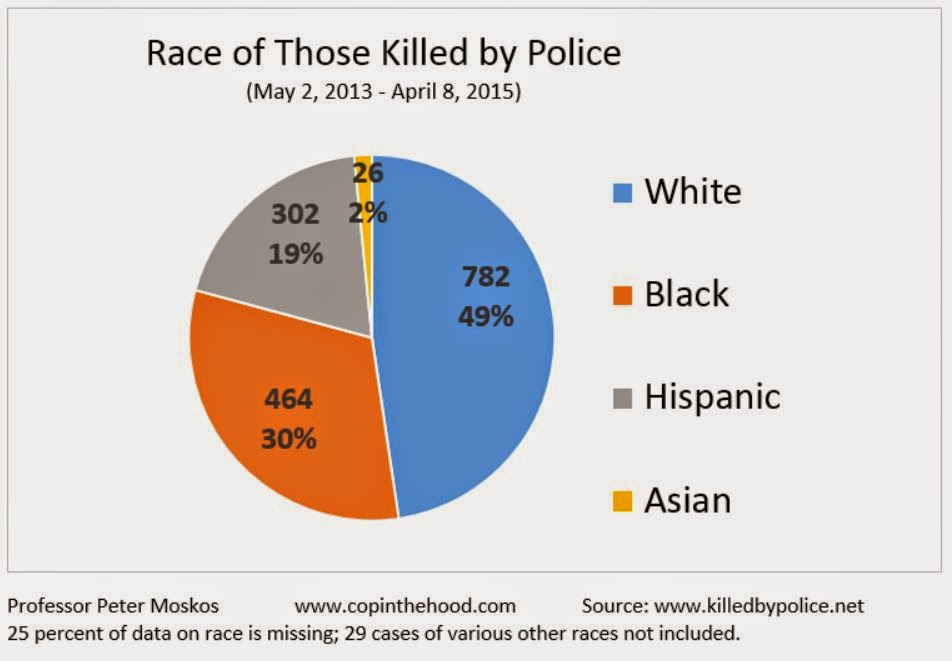
    Using the data from killedbypolice.net, I looked at the race of those killed by police. Though before I give you these numbers, ask yourself this question: what percent of those whom cops kill do you think are white, black, and hispanic. Forgive the callousness, but we’re talking numbers. And this figure will get to the core of the notion that cops are “gunning for” or “hunting” black men.

    [Update: These are based on the best data from April, 2015. As of November, 2015, we have more data, but I don’t believe the conclusions have changed substantively. See also the Guardian and also, slightly better for what they exclude, the Washington Post for more up-to-date numbers on those killed by police. All three data sources are more or less in sync.]

    Given that blacks are 13 percent of the population and whites about 65 percent, what percentage would expect to see among those killed by police? Presumably police are more likely to shoot a murderer than an average Joe. So I wouldn’t think it’s reasonable to expect to find that blacks would be just 13 percent of those killed by police. What percentage would you expect to see. What percentage would mean there isn’t a problem of police shooting African Americans in particular (as opposed to police just shooting too much in general)?

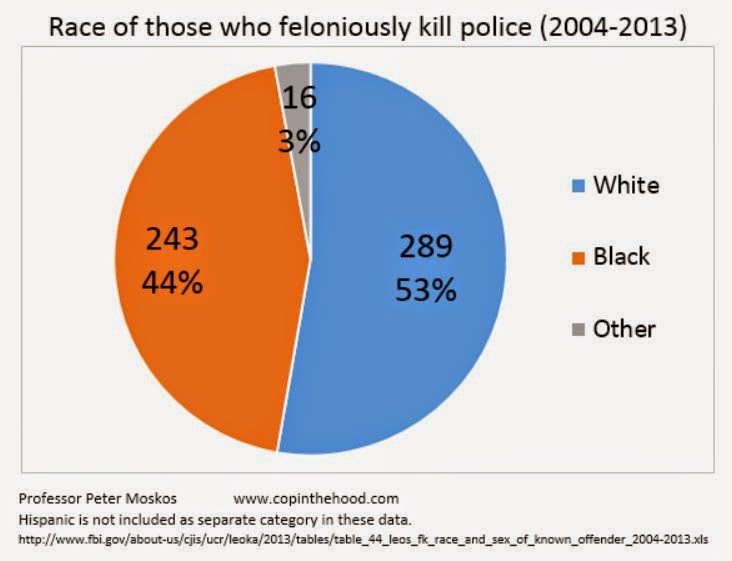
    Presumably police are (and should be) more likely to kill those who are willing or trying to kill other people. [Update: others have used arrest rates as the denominator, which seems like a good way to analyze racial disparities vis-a-vis police interactions.] Nationwide, blacks are also about 50 percent of murder victims (and thus presumably murder perpetrators, since most homicides are intra-racial). Over the past 10 years, according to FBI data that looks at those who have feloniously killed a police officer, whites are 53 percent and blacks are 44 percent.

    [For various reasons, none particularly good, FBI data seems to lumps all hispanics into the white category. The data at killedbypolice.net counts hispanics as separate. But it means that hispanics are invisible in the FBI data but counted in killedbypolice data. And I’m using both. So consider this a fair warning about comparing numbers and figures from different data sets.]

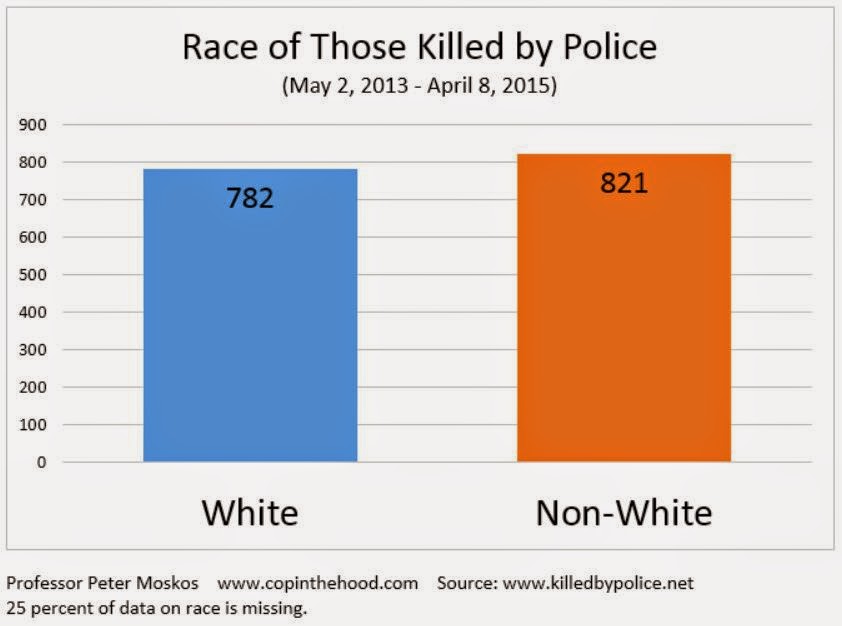
    One would hope that the racial breakdown of police-involved homicides would be not out-of-wack with the racial breakdown of those who kill police. This indeed seems to be the case: 48 percent if those killed by police are white, 30 percent are black, and 18 percent hispanic (the doesn’t-add-up-to-100-percent bit consists of Asian, Indian, Pacific Islander, and other.)

    Though if you’re so inclined, and I see so reason not to, you could spin the same data this way:

    Now the data doesn’t indicate which shootings are justified (the vast majority) and which are cold-blooded murder (not many, but some). And maybe that would vary by race. I don’t know, but I doubt it.

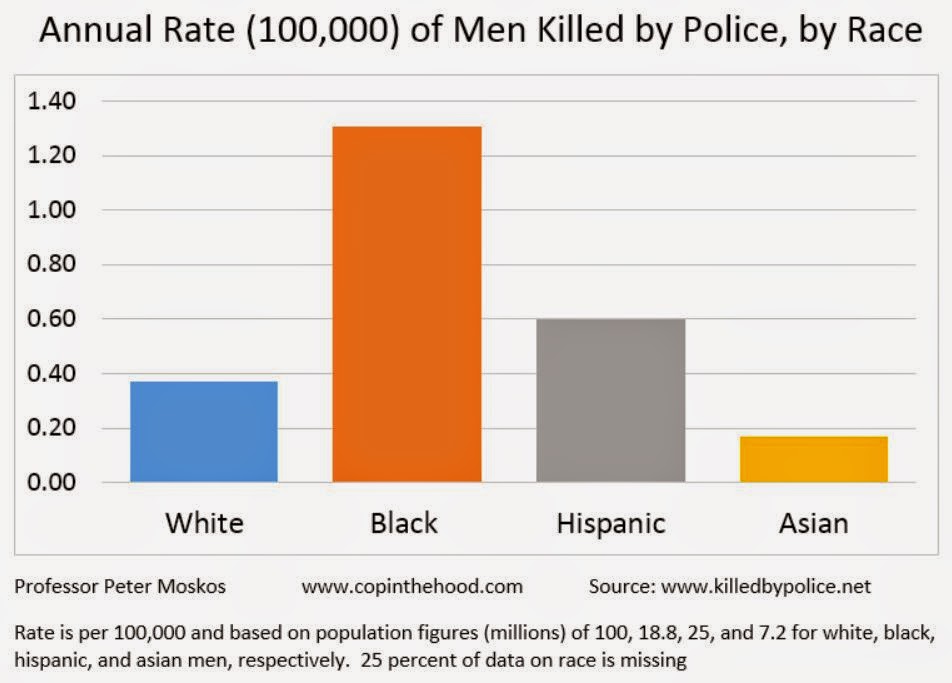
    Still, per capita, blacks are 3.5 times more likely than white men to die at the hands of police. This is now adjusted for population, and only includes men.

    Keep in mind the homicide rate for the entire country of Canada is 1.6. So a homicide rate of 1.3 for black men just killed by police (!) is very high.

    While it is a very damning figure for our country, it’s not necessarily damning for police. There is a 6:1 (per capita) black-to-white homicide rate disparity and a 4:1 black-to-white disparity (per capita) among those who felonious kill police officers. Given disparate rates of violence, it would be naive to expect equal rates among those killed by police.

    Adjusted for the homicide rate, should one choose to do that, whites are 1.7 times more likely than blacks die at the hands of police. Adjusted for the racial disparity at which police are feloniously killed, whites are 1.3 times more likely than blacks to die at the hands of police.

    Another statistic: A black man is 16 more likely to be killed by a cop than kill a cop. A white man is 20 times more likely.

    Though it goes against the all-cops-are-racist narrative, it’s not inconceivable, given an equal threat level, that a white person is actually more likely to be shot by police. I’ve gone into these reasons before, and it’s just speculation, but two I want to highlight are 1) cops in more minority cities face more political fallout when they shoot, and thus receive better training and are less inclined to shoot, and 2) since cops in more dangerous neighborhoods are more used to danger; so other things being equal (though they rarely are), police in high-crime minority areas are less afraid and thus less likely to shoot. Based on experience, I suspect that police in high-crime areas deserve more credit than they get for not shooting. Some of the bad shootings I’ve seen recently… I can’t imagine a cop in Baltimore being so damn scared for no good reason.

    So I am saying that a guy with a gun in the ghetto might actually be less likely to be shot by a cop who is more used to danger and guns. But a guy with a gun who makes a sudden movement in a neighborhood with a cop who has never faced danger in the face? Boom. [Update: it’s not like unarmed white people don’t also get killed by police.]

    All this said, one should keep all this morbidity in perspective. The odds that any given black man will shoot and kill a police officer in any given year is slim to none, about one in a million. The odds for any given white man? One in four million. The odds that a black man will be shot and killed by a police officer is about 1 in 60,000. For a white man those odds are 1 in 200,000.

    But the odds that any given police officer will have to shoot and kill somebody this year? 1 in 1,000. That is not negligible. Add when one adds in the times a cop was afraid for life and didn’t shoot? Or an officer did shoot and missed? Or shot and wounded? And then you multiply that by 20 years? Those are odds most people would not accept in a job description.

    [Go back to Part 1 or forward to Part 3.]

    #

    [My critique of ProPublica’s misleading claims. More analysis from St. Louis NPR.]

    [Corrections welcome. Please double check my work.]

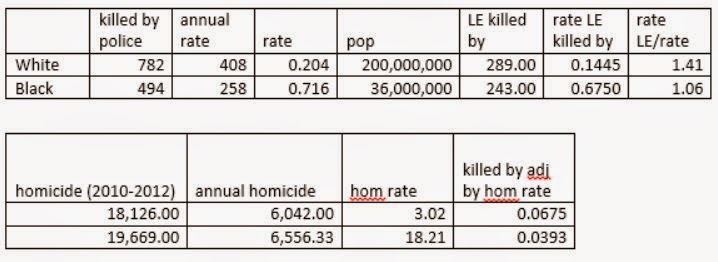
    Those last figures are based very roughly on 1 million cops, 1,000 killed by police, 20 million black men, 333 killed by police, 100 million white men, 500 killed by police. For everything else, feel free to check my math and excel formulas, if you can make sense of this:

    For reference, the top-left cell is Row 13, column A. Annual rate =SUM((B14/2)*(24/23)). Rate: =SUM(C14/(E14/100000)). Rate LE killed by= =SUM(F14/(E14/100000)). Final rate: =SUM(D14/G14). Hom rate: =SUM(J14/(E14/100000)). Killed by adj by hom rate: =SUM(D14/K14).

  • “‘Hands up, don’t shoot’ was built on a lie”

    I thought we all knew this by now, but apparently some people missed the memo. Responding to my Washington Postop-ed, a few people see rather upset that I wrote:

    In Ferguson, as the Justice Department made very clear, all credible evidence supported officer Darren Wilson’s account of a justified, legal and necessary shooting. Brown robbed a store, fought for the police officer’s gun and then physically charged the cop.

    People, this isn’t debatable any more.

    If you still don’t want to believe this and won’t read the DOJ report, read my summary or a very brave piece by The Post’s Jonathan Capehart:

    “Hands up, don’t shoot” became the mantra of a movement. But it was wrong, built on a lie.

    It is imperative that we continue marching for and giving voice to those killed in racially charged incidents at the hands of police and others. But we must never allow ourselves to march under the banner of a false narrative on behalf of someone who would otherwise offend our sense of right and wrong. And when we discover that we have, we must acknowledge it, admit our error and keep on marching. That’s what I’ve done here.

    Or John Maynard Keynes or Paul Samuelson may or may not have said: “When the facts change, I change my mind. What do you do?”

  • Killed by Police (1 of 3): New Data!

    Two years ago a somewhat shadowy person or group began compiling all media accounts of people killed by police. It’s at killedbypolice.net. Best I can tell, he/she/it/they do a pretty good job.

    According to the site: “Corporate news reports of people killed by nonmilitary law enforcement officers, whether in the line of duty or not, and regardless of reason or method. Inclusion implies neither wrongdoing nor justification on the part of the person killed or the officer involved. The post merely documents the occurrence of a death.”

    Not that this list is perfect. Certainly there might be some police-involved homicides that don’t make the local paper or TV news broadcast. But there can’t be too many. From May 2, 2013 to April 8, 2015, there have been 2,177 documented cases of people dying or being killed by police. (The vast majority are shot… but see died after being tased). And one cop killed his own family. Personally I wouldn’t include off-duty and not job related, but that’s a minor quibble, statistically.

    The compiled data is impressive both in its thoroughness and documented nature. And compared to only other data we have, such as the crappy UCR data on justifiable police-involved homicides, this killed-by-police list is gold. It’s the first time — ever — we can start looking at who police are shooting.

    So I played with the data. I refined it and shined it real nice and turned it into a proper SPSS file (and removed the few who weren’t killed in the 50 states plus DC). I have everything from when the list started (May 2, 2013) to April 8, 2015. So it’s just under two years of data. N = 2,177

    So the first thing we learn, which we knew, is that the UCR is a vast undercount. But now we have some idea about how much: a bit more than 50 percent. [For the more statistically inclined, the missing UCR data, at least with regards to race, does seem to be mostly random (which is good), which means the UCR data might be OK for some analysis.]

    So we learn that police in America kill about three people a day. Three police-involved deaths a day may seem like a lot. But is it? America is a big country. It doesn’t seem like an epidemic. In a typical day, 38 Americans will be murdered, 90 will die in car crashes, 110 Americans will commit suicide, and 120 will overdose on drugs. Maybe we have to begrudgingly accept three police-involved killings a day as par for a violent nation. But maybe not.

    I think we could rather easily cut the number of people killed by police in half. That would save the lives of around 500 people a year. But I’ll get to that in the third and final post.

    [Part 2]

  • “This one is different”

    An op-ed of mine to appear in Sunday’s Washington Post:

    This one is different.

    Walter Scott was killed — shot multiple times in the back — by North Charleston, S.C., police officer Michael Slager last weekend. Scott, already running away, was no threat to the officer when the first shot was fired. He was even less of a threat when Slager paused and fired the eighth and final round.

    To non-police, Scott’s death may look familiar: Not even a year after Eric Garner died during an arrest in Staten Island, N.Y., and Michael Brown died in a police shooting in Ferguson, Mo., here was another black man killed by police.

    But to law enforcement officers observing the North Charleston tragedy, the case is nothing like “another Ferguson” — and that’s where the police perspective and the civilian perspective on these events diverge.

    Click through to keep reading.

  • “Suspect is down,” says the dispatcher

    Here’s video of the initial Walter Scott car stop. (Yes, his brake light was out.)

    But what I love, which I suppose is kind minor in the grand scheme of thing, is how fucking amazing this drawling dispatcher is. She is bad-ass and calm.

    “Shots fired. He grabbed your taser. Suspect is down,” she drawls, almost yawning, like it happens ever day. But it doesn’t. And that’s how you want dispatchers to act. The last thing you want, and sometimes it happens, is a dispatcher losing control. She (sometimes he) holds the entire police department in her voice.

    Somebody still needs to write the great book or make the great movie about dispatchers. They really are unsung underpaid heroes. So many lives depend on them.

  • “U.S. police shootings not simple as black and white”

    Good article by Tom Blackwell in Canada’s National Post:

    “If we point to the officer and say, ‘You did something wrong,’ we all feel a lot better, and it’s concrete,” said Marcia McCormick, a criminal-law professor at St. Louis University. “But when the problem is the system — you have racism without racists…. It doesn’t seem as harmful, and [is] so abstract that we have a hard timing figuring out how to fix it.”

    Factor in the differences in demographics — blacks make up just 13 per cent of the U.S. population — and that means African Americans were four times as likely to be killed by police.

    Still, Moskos is not convinced that means black people are being disproportionately targeted, arguing that blacks are five times as likely as whites [per capita] to kill police officers, and that much of the policing in America focuses on black street crime.

    “The narrative that cops are out gunning for unarmed black people is just not supported by the data,” he said. “Cops tend to shoot a lot of white people too, it just tends not to make the news.”

    Moskos is worried that the focus on race is distracting attention from what he considers the real issues. Those include the “criminalization of poverty ” and the aggressive police enforcement of relatively minor offences, such as traffic violations and failure to make support payments, the transgression that relatives say made Scott run from police.

    But the incident in South Carolina points to a concerning mentality, [Eugene O’Donnell] said. The officer appears to have taken steps to make his actions seem legal, until the video blew the story apart.

    “It raises the question of whether there is not a culture in some parts of the country of, ‘We can do anything we want and get away with it,’ ” he said. “I worry that at least some of the many police forces in the country work in a culture like that.”

    Even if blacks are not lopsided victims of police force, a larger issue emerged in Ferguson, and again at protests in North Charleston Wednesday: the widespread sense among law-abiding African Americans that they are in a sense harassed by officers.

  • “We got a dead guest”

    It was an odd feeling to be made-up and mic’d and then walk off the set of a TV show.

    I had just rushed (on a Citibike, no less) from AP’s studios on 33rd and 10th (for Dutch TV) to midtown. It’s a studio I’m very familiar with (though not the show). I was rushed on and given a seat before it became clear that the subject was not the S.C. police-involved shooting I signed up for, but the Boston Bomber verdict. I’m no lawyer. I wasn’t there. I got nothing to say. Hell, I don’t even care if the guy is given life or death.

    You gotta know when to say no. So I wished them well, and they wished me well, and that was that. We weren’t live yet (thank God).

    Leaving, I heard a tech guy said into his mic, “we got a dead guest.” That’s a new phrase for me. He then looked at me sheepishly and say, “uh, not literally.”