Category: Police

  • Quote of the Day

    As more and more states legalize marijuana, New York City still leads the world for arrests for possession of the evil weed. You might wonder who actually thinks it’s a good idea to arrest people for a decriminalized amount of marijuana. Sergeants Benevolent Association president Ed Mullins: “If the current practice of making arrests for both possession and sale of marijuana is, in fact, abandoned, then this is clearly the beginning of the breakdown of a civilized society.”

    Dude, get some perspective. Mullins continued, “If we’re not making marijuana arrests, then we may not pop someone who has a warrant on them or who committed felony crimes…. If the department doesn’t want us to make marijuana arrests, they should introduce legislation to change the law.” Seems fair enough, but there are a few problems here. First, you can run somebody and see if their wanted. If not, you don’t need to arrest them misdemeanor marijuana.

    Second, small scale possession of marijuana is just a violation (not an arrestable offense) until the marijuana is in “public view.” And I don’t want to imply anything, but how the marijuana gets into public view is open to debate. But I think it’s safe to say most of the tens of thousands of people arrested aren’t walking around holding dime bags in their hands.

    Finally, and this is important to policing, back in the old days, hell, even the days I policed, real police would be ashamed to come in with such a crappy arrest. Off the street for hours for what?! If you come across weed, you can throw it in a sewer. Or hell, you could even hand it back. (It’s happened.) There are lots of minor violations that do not deserve zero-tolerance. In the absence of other crimes, in the absence of a person being wanted a warrant, you can warn, you can admonish, or you could even turn a blind eye. Police have a lot of discretion. Use it. If anything will lead to the “breakdown of civilized society,” it won’t be police officers doing their job and using their brain.

  • Better Policing Equals Less Crime

    This is a no-brainer to many, but a lot of people — usually those who don’t like police — still deny or diminish it: cops matter. And national trends are the result not some crime-related miasma but of the collective work in individual cities and neighborhoods.

    Camden, NJ, is worth paying attention to. I haven’t been following it too closely, but what I do know (in part due to my colleague John DeCarlo) is very interesting. Then:

    In January 2011, the state slashed the budget for the city’s police department by nearly 23 percent. The police union was dissolved after half of the uniformed officers were let go. The department – criticized by some as incompetent and ineffective – was then reconstituted as a county-run enterprise. But until new recruits could be brought on, the city suffered under the draconian cuts. There were nights when only 12 officers patrolled the entire nine square miles of the city.

    And now:

    The city – frequently labeled “America’s Most Dangerous” – has recorded as of Friday the fewest homicides in a year going back to at least 2010.

    In addition, during the first six months of 2014, the number of gunshots in the city fell nearly 50 percent over the previous year….

    Despite two fatal shootings in quick succession this week, the number of killings is less than half of that two years ago. By Halloween 2012, Camden had buried 55 victims. This time last year, it had 43. As of Oct. 31, the city had seen 24. In 2010, at this point, there were 30.

    By civilianizing or outsourcing every job that does not require a gun or a badge, the county-run force bolstered the number of boots on the ground.

    Police walking beats are supplemented with “virtual patrols” by civilians, who monitor 120 surveillance cameras bolted to light poles. An additional 40 to 60 private security guards, sporting yellow-and-blue vests, roam the business district, calling in reports to the command center.

    Of course some people still complain, but haters are always gonna hate.

    Meanwhile…

    Vallejo [California] has struggled for years. Crippled by high pension costs and public-employee salaries, it filed for bankruptcy in 2008. Things didn’t get much better after the city emerged from Chapter 9 in 2011: Crime was bad and the city’s police department was perpetually short-staffed. There were 10 murders in 2010, 14 in 2012, and 24 in 2013.

    Obviously both cities cannot simply be reflective of some “national trend.”

  • Strike against cop cameras

    When I was cop, boy did I joke about things I wouldn’t want seen on youtube.

    It might be a tad overgenerous to say what I said were even jokes. But I laughed. I still do. When I get a message on my answering machine that says, “Pete, will you stop touching little boys and pick up the phone!” I know who it’s from. And I’m pretty sure my wife knows I’m not a pedophile. But can references to raping innocent children ever be funny? Well, I think so. And you are free to think less of me, but what I and my friends say in private really is none of your business. Besides, does anybody not say things in private that would be inappropriate in the public sphere?

    So two cops in Austin are recorded on a tape made public, while in their squad car, making tasteless comments about rape (and a few other things). Now that this video is public, you need to react accordingly. But you also need to keep things in perspective. Is what these officers said serious? No. Threatening? No. Did it affect their job performance. I doubt it. And truth be told, this is positively mild compared to things I have said. Let me confess that I too have made tasteless jokes, in private, about sex, race, crime victims, ethnic origin, religion, sexual orientation, and quite frankly every other possible taboo subject I could think of.

    Now cops, more than most people, have a obligation to refrain from bad taste in public, and especially when dealing with the public. But that’s not what happened here. When you’re riding in a car with somebody for eight hours, you get bored. You talk about a lot of things. You joke. You make tasteless jokes. Of course it depends on whom you’re riding with and the camaraderie and relationship you have with your fellow officers. Yes, I can be crude and insensitive in private and caring, compassionate, and professional in public.

    Some of this is gallows humor. And police (and paramedics and firefighters) need it because they have to deal with a lot of unpleasant stuff. But you also need to joke to bring up subjects that would be otherwise be taboo. And police joke because a lot of people you deal with — the vast majority — lie to you. Some lie to you about robbery. Some lie to you about rape. Some lie because they think it will benefit them, they want revenge, or power. Some lie because they can’t tell or don’t know the truth. And cops have to listen to all of them. So back in the car you make jokes.

    A lot of police humor is at the expense of “victims” because a lot (most?) victims aren’t actually “innocent victim.” Now in the current climate of political correctness (especially with regards to sexual assault and rape), it’s not acceptable to even bring up the phrase “innocent victims” because the alternative places some blame on the victim. But police need to make such judgements because the freedom of other people, sometimes innocent victims themselves, is at stake.

    Outside of crimes where the victim isn’t doing anything illegal and doesn’t know the person who committed the crime, there are a million shades of gray. And police need to talk about these shades. And one way to discuss nuances is by joking and making tasteless comments. In private, there’s nothing wrong with that. It’s how you learn. It’s how you cope. On the street cops need professionalism and discretion. In private, police use humor, and sometimes it’s not funny.

    Take two different rape cases. One was a nurse walking to work at Hopkins Hospital who was grabbed and raped by a stranger at knife-point. The other was a prostitute who engages in consensual sex but wasn’t paid the agreed amount. When the former happened, it was all hand on deck. A few days later the guy was caught. But for “failure to pay”? I once helped a supposed rape victim by doing little more than retriving her three jackets. It was cold outside.

    Or take a guy robbed while buying drugs. There were “real” robbery victims. You would know that when you saw a guy running barefoot wearing nothing but his tighty-whities. Now that was a robbery. And we would treat it accordingly. (Mind you, it still wasn’t “an innocent victim,” because he was still there to buy drugs… but the robbery was real.)

    But more than once I got a call for a robbery at the corner of Wolfe and Eager (then a 24/7 drug corner). On scene, the “victim,” a poor addicted white guy, would say he was minding his own business, jumped, and robbed of $20. Well, officer, what do you do?

    Generally people minding their own business don’t like being being taken for a drug dealer by some junkie too cheap to buy drugs in his own neighborhood. So this “victim” asks the first young black male he sees if he’s selling. The pissed-off non-drug dealer says, “sure” and takes his order, his $20, and continues on his merry way. The “victim” calls the police.

    I would try to keep a somewhat open mind on the off chance the “victim” was actually telling the truth. But do I start canvassing the neighborhood, stopping people who “meet the description.” Of course not. So I would conduct a brief investigation, perhaps by asking an old timer if he saw anything unusual, like an armed robbery (something beyond the usual chaos of an open-air drug market). If he nodded “no” with a look of, “you know how that white boy had it coming,” case closed. Call unfounded. Adam-No.

    And then, back in a parking lot, I would meet with a squademate and crack jokes. The guy running in his tighty-whities? “He was fast.” “Or slow.” “He had it coming… did you see what he was wearing?” “Exercise is important.” “I saw you looking at his package.”

    We would joke about anything. We needed to joke about everything. We didn’t joke because we didn’t care. We joked to stay sane. We joked to relieve the boredom. We joked to counter the cruelties of a very harsh and random world. We joked because the only real alternative would be despair. If you care too much — if you breakdown in a situation where any normal person would be unable to do anything but curl up in a fetal position and cry — you’re not a real police officer. We joked because laughing is good for the soul.

    So in this video one officer is telling another how to properly fill out a robbery report. And they they segue to insensitive comments about that robbery and then about about rape. They joke about fighting crime. They joke about ignoring crime. It was said in private, to each other. So I have no problem with it. Police should have a reasonable expectation to privacy when in private, even while on the job. And short of conspiring to commit a crime, there’s very little that should be off limits.

    Here are people who disagree with me. From Buzzfeed, the Huffington Post, and you can google a dozen others. And this news broadcastgives some good context.

    The lesson I see: police need to be more careful about the record button. And I still believe that cameras will be a net plus for police.
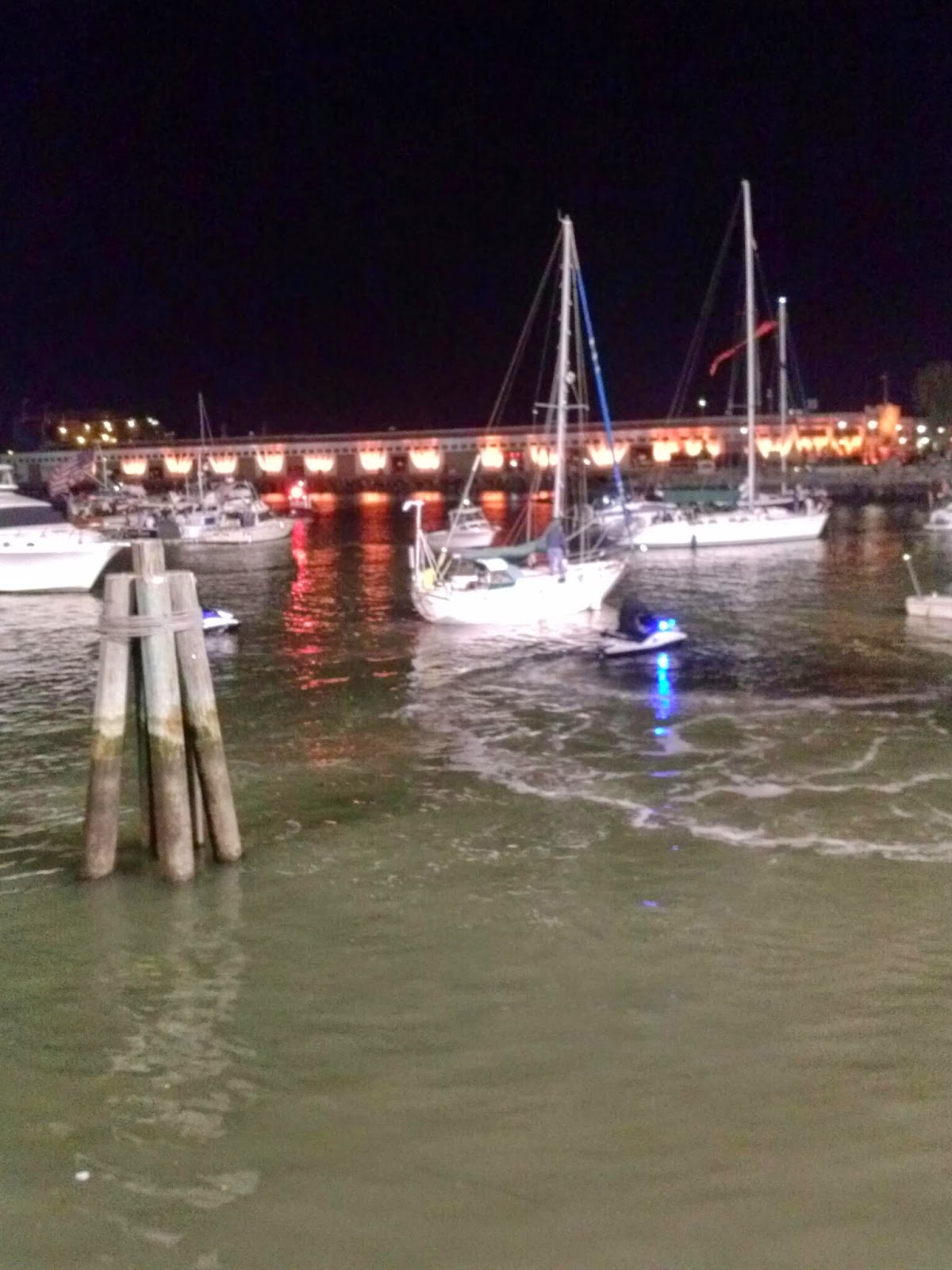
  • San Fran

    SFPD on jet ski outside Giants park. Not a bad gig, if you can get it.

  • Those pesky facts

    What if everything you thought about Michael Brown was wrong? Do you believe in evidence? Science? Evolution? Global warming? Can new evidence change your opinion? Is your conviction that a police officer killed an innocent surrendering black youth in Ferguson, Missouri, so strong that facts and evidence simply do not matter?

    Might you accept that there are racial injustices in the world in general — and perhaps in Ferguson in particular — while also understanding that perhaps the police officer in this case actually acted properly? Just maybe? The Atlantic says:

    A new report on Michael Brown’s official autopsy results appears to support Officer Darren Wilson’s version of the events on August 9, according to two medical experts.

    St. Louis medical examiner Dr. Michael Graham told the paper that the autopsy “does support that there was a significant altercation at the car.” The other expert, forensic pathologist Judy Melinek, went even further, saying that the wound on Brown’s hand “supports the fact that this guy is reaching for the gun” and adding that another shot, which went through Brown’s forearm, means Brown could not have facing Wilson with his hands up when he was shot, an apparent contradiction of the now iconic “hands up, don’t shoot” posture adopted by protesters in Ferguson.

    These recent leaks are meant to prime the public for an inevitable result: a grand jury investigation that ends with no charges being filed against Wilson.

    This is no way changes my belief that the police response to the protests was both tactically horrible and way over-the-top.

  • Score one for cop’s camera

    KOB Albuquerque reports how a lapel camera protected an officer against a woman’s false accusations that he sexually assaulting her.

  • Brrrr… it’s cold outside

    I can’t help but notice — now that another long hot summer is done and a commie mayor and Al Sharpton are running the show and the police have been thrown under the bus and Obama is president and the ACLU stopped letting police stop criminals and there’s no more stop question and frisk and there’s independent oversight and body cameras are coming and it’s open season on cops and people don’t show any respect and society going to hell — but crime *still* isn’t up (-4% by stats I don’t trust. But what I *do* trust is 249 homicides to date compared to 262 in last year’s record low. Shootings are up 6%). I know it’s in good part because of the hard work of the men and women of the NYPD, but I’d still like just one Republican, one conservative cop (or maybe somebody like Heather MacDonald) to admit he (or she) was wrong. It’s all very strange to me.

    Or maybe the only thing keeping New York City from become The Warriors are all the marijuana arrests or the bike ticketing blitz in Crown Heights? Nobody really believes that, right?

  • If crime doesn’t pay, why is it so expensive?

    And in case you were wondering, the cost of housing a prisoner in jail on NYC’s Rikers Island is now officially $100,000 per year! You get what you pay for, they say. $1.1 billion dollars. 42 percent higher than seven years ago. “During the same period, there was a 124 percent increase in assaults on the staff by inmates at city jails, and triple the number of allegations of use of physical force by guards.” Mazel Tov.

  • Bootlegging: for cigarettes, alive and well in New York City

    Story in the New York Times:

    The toothpick pressed a hidden button that released a large magnet that kept a secret compartment locked. Deputy Davis lifted the front of the row of shelves like you would the trunk of a small car, and inside were rows and rows, all different brands, of contraband. Not narcotics or pills, but unopened packs of cigarettes, perfectly legal in the state in which they were bought, but not here. Hence the secret compartment.

    The moral here is simple. You need some enforcers, but we shouldn’t waste too many resources in regulating a legal product. When there’s a huge market bootlegging, then you need to lower taxes.

    Also, I suspect that smoking isn’t down as much as people think as a result of raising taxes. Because if The Man can’t find the cigarettes, than the public health expert things they aren’t being smoked.

    According to a great study by Klaus von Lampe (et al), my brilliant colleague:

    It was found that 76% of cigarette packs collected [by looking at litter… how cool is that?] avoided the combined New York City and State tax. More specifically, 57.9% were untaxed (counterfeit or bearing no tax stamp), for 15.8% taxes were paid outside of New York City (including other states and New York State only). Only 19.4% of tax stamps collected indicated that New York City and New York State taxes were paid…. The finding that the majority of cigarettes did not have a tax stamp or bore a counterfeit tax stamp suggests that these cigarettes were being bootlegged, most likely from Native American Reservations. It was found that 76.2% of cigarette packs collected avoided the combined New York City and State tax.

    And two words: Eric Garner.

  • “Why we need to fix St. Louis County”

    Well said by Radley Balko in the Washington Post:

    When a local government’s very existence depends on its citizens breaking the law — when fines from ordinance violations are written into city budgets for the upcoming year as a primary or even the main expected source of revenue — the relationship between the government and the governed is not one of public officials serving their constituents, but of preying off of them.

    When the primary mission of a police department isn’t to protect citizens but to extract money from them, and when the cops themselves don’t look like, live near or have much in common with the people from whom they’re extracting that money, you get cops who start to see the people they’re supposed to be serving not as citizens with rights, but as potential sources of revenue, as lawbreakers to be caught. The residents of these towns then see cops not as public servants drawn from their own community to enforce the laws and keep the peace, but as outsiders brought in to harass them, whose salaries are drawn from that harassment. The same goes for the judges and prosecutors, who also rarely live in the towns that employ them.

    This isn’t as much about a police shooting as it is about the release of residual anger over an antagonistic system of governing that virtually requires its poorest citizens to live in misery and despair.

    If Bel-Ridge wasn’t collecting the equivalent of $450 in fines each year for each of the town’s residents, the town of Bel-Ridge probably wouldn’t exist.

    This is what St. Louis County government is built upon. And this is what needs to be changed.

    When I was a cop, I knew my ticket money went to the city. Hell, I was happy to help Baltimore. But I never felt that my job depended on me fining residents.

    New York City gets about $500 million annually from parking tickets, which is the biggest chunk of about $820 million overall in fines. New York’s overall budget is about $70 billion. So we’re talking one to two percent of the city’s budget coming from fines. I don’t know about court fees, but I doubt they’re a money maker for the city.

    I don’t think a big-city perspective really gets at what is going on in these small towns where government seems to exist for the sole purpose of taking money from residents: “Pine Lawn, with an embattled mayor facing federal charges of steering towing jobs to a particular company, brought in close to 70 percent through its courts last year. At least four other St. Louis County municipalities — Beverly Hills, Bella Villa, Calverton Park and Cool Valley — all took in more than half their general revenue that way, according to reports submitted to the state.” And “It’s illegal: “The city of Bourbon was breaking state law. Under Missouri law, a city is only supposed to make 30 percent of its revenue off tickets.”

    Thirty, 40, 70 percent of budgets comes from fines and court fees? Mandatory private garbage collection? Per person occupancy permits? It sounds like a straight-up criminal racket, and one enforced by police and the courts.