Category: Police

  • Prelude to a post

    Prelude to a post

    Homicide is going up. It’s been going up for two years. And yet educated people still act shocked.

    I’m tired of refuting the homicide-increase deniers, but their arguments comes down to these collectively nonsensical points: A) homicide isn’t up in every city; B) homicide is up a whole lot in some cities; C) the increased risk of homicide isn’t spread equally among society but disproportionately concentrated among poor young black males with access to guns living in neighborhoods with historic and systemic issues of racism and segregation; and D) homicide is still lower than what it was when it was really high. To which I say A) statistically speaking, that’s why we look at averages; B) indeed, that’s a big problem, but it doesn’t negate the general increase; C) no shit, Sherlock, same as it’s ever been; D) ah, go fuck yourself!

    You see, writing about this same old topic has made me cranky because I can’t believe I still have to. And I’m disappointed that so-called progressives waste time building a denialist house of cards instead of rolling up their sleeves and doing something to prevent poor black men (disproportionately) from getting murdered. But for whatever reason, a few years back, many of the left ceded crime prevention to conservatives. Somehow I missed the meeting where we decided that the only important criminal justice issues were to be police misconduct and the use of lethal force against African Americans (well, that and Mass Incarceration). And when generally respectable institutions like the Brennan Center make false statements about murder — repeatedly — we’ve got a problem.
    To wit:

    • Alarmingly, Chicago accounted for 55.1 percent of the total increase in urban murders.
    • A similar phenomenon occurred in 2015, when three cities — Baltimore, Chicago, and Washington, D.C. — accounted for more than half (53.5 percent) of the increase in murders.

    Since 2014, violence has increased. And it’s increased a lot. But Chicago neither accounted for “55 percent of the murder increase last year” nor “55.1 percent of the total increase in urban murders”! To say so once might be a mistake. To say it a few times might reflect statistical idiocy. But to do so again and again? I don’t get it. If forced to confront this false statement, they’ll probably end up saying, “it was poorly worded and we meant 55 percent of the total of the cities we looked at.” [Update: yup.] But regardless, it makes no statistical sense. Talking about the percent of total change one city makes in a small sample is bullshit, statistically and morally. Because it’s possible to pick a sample in which Chicago is 100 percent of the increase. I don’t think they’re idiots. But if not, are they trying to deceive? Or do they just get there by accident? If Chicago’s increase of 254 accounted for 55 percent of the murder increase last year, that would mean a total increase of 208 murders outside Chicago last year, nationwide. The actually increase in murders in 2016 is probably 2,000 more than 2015. And 2015 was 1,500 higher than 2014.

    Second, in 2015, Baltimore, Chicago, and DC accounted for nothing close to half of the increase in murders. The national increase (2014-2015) was around 1,500. 255 is 17 percent of 1,500, not 53.5 percent. So how do they come up with these numbers? I’ve figured it out. Put it this way, if your sample only included Baltimore, Chicago, and DC, you could say these cities accounted for 100 percent of the increase in murder. Add a few cities, and that’s basically what they’ve done.

    There’s a method to what, when, and why they do what they do. They don’t just pull number from thin air. They use faulty methods until they get a number they can replicate. And then they just put it in words, knowing nobody ever checks these things. Either that or the authors are complete statistical idiots, but I doubt that.

    Baltimore just finished the first half of 2017 with 170 homicides, the most since 1992, when the city had 115,000 more residents.

    An assistant city health commissioner who oversees anti-violence initiatives was jumped and robbed in downtown Baltimore on his way back to work after having a sandwich for lunch. In the hospital, skull fractured, he said, “I think we need to look into what is causing people to engage in this kind of behavior.” No. Actually, we don’t. Cause I’ll tell you the cause: bad or absent parenting on top of 500-years of systemic racism combined with 20th-century government programs designed to segregate and limit the ability of blacks to succeed. I can speak the liberal shibboleth. I even believe the liberal shibboleth! So what? Now what? One can and should acknowledge history, but that won’t change it. And the greater point, at least when it comes to crime and violence, is that none of this is new. Somehow, despite social injustice and white supremacy, crime and violence had been going down for basically 25 years. The violence problem has gotten worse just in the past two years. Talking about historic social issues, as important as they are, is nothing more than a distraction to avoid dealing with today’s issues of criminals and wrong-doers.

    Crime wasn’t supposed to go up, of course. Crime reduction, say some, is just part of the grand social justice and intersectionality equation. DOJ reports (on policing in Baltimore, for instance) focused exclusively on improving police, necessarily as that is, and ending racially disparate policing. They managed this without even talking about crime prevention and racially disparate rates of violence. This recent crime rise needn’t and shouldn’t have been politicized, but, as I warned, if the left won’t even acknowledge an increase in violence (disproportionately among poor black men) we effectively cede any crime “solution” to the “Trumpian right.” So now we get BS talk crime and terrorism, like somehow crime and terrorism is mostly due illegal immigrants and Muslim grandmothers. So yeah, I’m cranky in my middle age.

    But the past two years, 2014-2016, has seen the largest two-increase in homicide, in, well, probably ever. And the response of otherwise smart people is either to A) scratch their head and go, gosh, gee, maybe it’s poverty and guns and historic policies of racism. Except those haven’t changed in the past two years. Or B) it’s not a problem because, well, homicide is really up in Chicago? I don’t even know how to counter that. If you care more about right-wing overreaction to murder than the lives of those murdered, you win. Don’t care. But for people with a conscious that trumps ideology, read on.

    Here are the cities I looked at: Albuquerque, Atlanta, Austin, Bakersfield, Baltimore, Boston, Charlotte, Chicago, Cleveland, Columbus, Dallas, Denver, Detroit, Durham, El Paso, Fort Worth, Fresno, Hampton Roads (Norfolk, Newport News, et al), Houston, Indianapolis, Jacksonville, Kansas City, Las Vegas, Long Beach, Los Angeles, Louisville, Memphis, Miami, Milwaukee, Minneapolis, Nashville, New Orleans, New York, Oakland, Oklahoma City, Omaha, Philadelphia, Phoenix, Pittsburgh, Portland, Raleigh, Richmond, Sacramento, San Antonio, San Diego, San Francisco, San Jose, Seattle, St Louis, Tucson, Tulsa, Washington, Wichita.

    I got the homicide numbers best I could for each city going back as far as possible. It’s a lot of grunt work (but actually a bit easier than it used to be, thanks to journalists keeping track).

    For those cities, 2013 was the least violent year ever, with a collective 4,900 homicides. It could have gone lower; God did not ordain an urban homicide rate of 9.8 be the bottom below which no more lives could be saved. Generally, overall, homicide had been decreasing for 25 years. It could have continued to go down. But alas, people decided that police were the problem. And the problem to bad policing wasn’t better policing but less policing. How’d that turn out?

    I’ll push the data in the next post.

    [Posts in this series: 1, 2, 3, 4, 5, 6]
  • Tweet this

    I’ve got over 2,500 posts on this blog. But I can’t help but notice I’ve only posted six times in the past three months. That is a record low. So what have I been doing? Well, I do have a job. But also I’ve been on twitter a lot more. See, writing is work. And this work here? It don’t pay.

    Twitter scratches much the same itch for me as posts here, but with a lot work from my end. In terms of being engaged intellectually in police issues, Twitter is more interactive. Plus, on twitter I get to “meet” people like Jeff Asher. [See my previous post.]

    Jeff has written some great stuff over at 538.com, which for some reason I simply did not know about until today. Take thison the effect which people insist shall not be known by the Ferguson Effect. Or on the rise in violence in Chicago, in particular, or nationwide, in general.

    And I’m not shutting this blog down. And these things go in phases. Right now police simply aren’t in the news like before Trump was elected. But if you want to know what I think about some current police issue and don’t see it here, I’ve probably written something about it, but in 140 characters or less.

  • How to make people care about violence

    How to make people care about violence

    Over at Nola Crime News, Jeff Asher tweeted this graphicjust now.

    Click on it; it moves! So while people are dying, I’m thinking about data presentation. There’s something about a moving line that may make one pay attention to dead people in a way that actual dead people don’t.

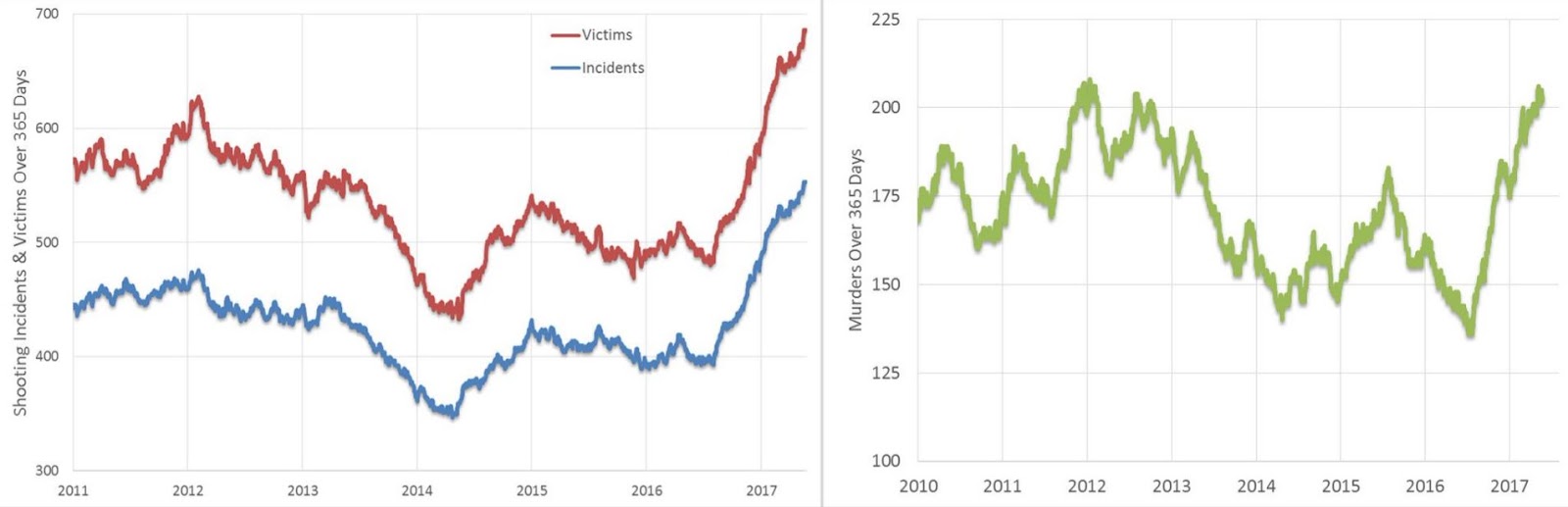
    Jeff’s graphic looks at Baltimore City shooting victims over the past 365 days. Each data point tallies the total number of shooting victims over the past 365 day. This nullifies seasonal change, which is worth a lot. But by taking a past-year average, you lose the “BAM” of what happened literally overnight, after six police officers were criminally charged for the death of Freddie Gray. The violence didn’t just “increase.” It stepped up, by two-thirds. Overnight. After April 27, 2015. The visual above indicates a rapid but continuous increase over the course of a year. But it’s still a good visual and can’t think of better one.

    I don’t know how to present a good visual that shows what has happened in Baltimore. In the past I’ve tried with a pre- and post-riot trend line. Not just once, but twice. But that’s hardly convinced the masses that police (or more dead bodies) matter.

    People are already talking about the rise in violence in Baltimore in terms of poverty or drugs or police legitimacy or blah-dee-blah. And sure, all that matters. But stop it! None of that, not any of that, explains the increase in violence. Police because less proactive because A) innocent cops were criminally charged and B) Political pressure (from the mayor, the police commissioner, and the US DOJ) told police to be less proactive as a means to reduce racial disparity in policing. You see it Baltimore. You see it Chicago. You see it in New Orleans. The problem is you’re seeing it basically everywhere.

    Here’s New Orleans, again from Jeff Asher.

    These increases are no joke. This is a “holy shit” type increase in violence. And the chart under-presents the quickness of the increase.

    What happened in New Orleans? I don’t know NOLA as well as Baltimore or New York. But the NOLA PD has seen a 30 percent reduction in manpower and a massive reduction in proactive policing (as measured by drug enforcement. I also suspect the consent decree hasn’t helped police in terms of crime prevention, since, and this is important: crime prevention isn’t one iota of any consent decree. Somehow, crime is supposed to manage itself while police are better managed.

    The only big city of note without an increase in violence is NYC. And even here, people objectto the exact kind of proactive policingthat keeps crime from rising. Luckily, at least in New York, even liberal Mayor de Blasio isn’t listening to the “police are the problem” posse.

  • “You Get the Police You Ask For”

    Since I’ve been remiss at writing anything here recently, I’m going to link to a piece from Jim Glennon at Calibre Press:

    [Baltimore] Mayor Pugh then thanked federal officials for their assistance in the arrest of a man who murdered a three-year-old in 2014.

    The Mayor’s expectation that the FBI can assist in the day-to-day in Baltimore not only won’t happen, it can’t. The Feds, and I am not one to bash them, are great at what they do. But what they don’t do is don uniforms and walk a beat.

    The Baltimore cops may be undermanned but that isn’t the reason for the surge in crime. They have been understaffed before. What’s different in the past two years? An absence of proactive policing. The surge in crime began immediately after the cops pulled back. Though no division of the elite political class, few criminologists, no mainstream media outlets, and no legal activist groups like the ACLU will openly acknowledge this.

    Why? Because they are the ones who wanted proactive policing stopped in the first place.

    The anti-police pundits blather on about how the violence isn’t as bad as in the early 1990s. They’ll yammer about how the crime surge is only in about 75 of the country’s counties. They’ll wax poetically about economic issues, past history, immigration, lack of trust between the police and the community, and then they will go back to their security-controlled TV studios and gated communities, sip chardonnay and chitchat about law enforcement ills with like-minded peers.

    Meanwhile, real people are dying, and the FBI, the CIA, the DOJ, and the VIPs won’t be able to stop the carnage.

    So politicians, pundits, etc., you got what you asked for. The question is: Did the citizens ask for it?

  • Not how I was trained

    I’m curious what cops think about this police-involved shooting in Portland, Oregon:

    Hearst, a seven-year bureau member who became a police officer after graduating from Multnomah University’s bible college, said he never saw Hayes with a gun, but was trained not to wait to see one. [emphasis added]

    “Because if I let him get his hands on his gun, he will be able to pull that gun out and shoot me or my coworkers before I’m able to react to it.”

    To be clear, this was an armed robber who was shot. But he didn’t have a gun. (His replica gun was nearby.) The “trained not to wait to see one” rubs me the wrong way. Thoughts?

  • “A police officer’s view from street level”

    San Francisco Sgt Adam Plantinga always had good insight on policing. A few years back I posting a bunch of excerpts from his book: 400 Things Cops Know.

    Plantinga was interviewed recently in The Christian Century and addresses some tough issues. It’s worth reading the whole interview, but in case you don’t:

    There’s a 90-10 rule in law enforcement: 90 percent of people are decent, 10 percent aren’t, and as a cop you deal with that 10 percent about 90 percent of the time.

    All of this has a tendency to make you skeptical and disillusioned—to distort your worldview. It’s part of what’s known as compassion fatigue…. In its most damning strain, goodness starts to look something like weakness.

    What the police must strive for is equality under the law. If that isn’t happening, attention must be paid. But in some people’s minds, every time a white police officer has a negative encounter with a black suspect, racism is clearly afoot. To be sure, racism is threaded through every institution in our country, from mortgage lending to how kids are disciplined in school.

    But if a police controversy is about race only because some people arbitrarily decided to make it about race, the damage that can be done is much more than simply the Boy Who Cried Wolf syndrome. Accusations of racism are incendiary.

    Some of these recent cases generate such a visceral reaction that they demand a response. The Walter Scott case in North Charleston, where the officer shot Scott while Scott was running away, looked to me like a straight-up assassination. The shooting of Terence Crutcher in Tulsa bears all the trappings of an officer tragically overreacting to a perceived threat.

    The governor of Minnesota was quick to say that if Philandro Castile had been white, he wouldn’t have been shot by police. I’m not sure how fair that is, but it seemed to resonate with a lot of people as true. But if Michael Brown were a large white man going after Wilson’s gun after slugging him in the face, would Wilson have just brushed it off as the misguided antics of a fellow Caucasian? That doesn’t strike me as plausible.

    Then there are the cases, and I believe they are rare, where a life is lost because officers didn’t know how to properly use the equipment on their duty belt or they panicked or they simply made an awful decision that they can never take back. There may not have been malice involved but the damage is done. Those officers’ cases should be decided in criminal court where they are entitled to the same due process as anyone else.

    And ask any street cop and she’ll tell you about a host of times she could have justifiably used deadly force but elected not to.

    That’s why cops bristle when they see a protester screaming that the cops are indiscriminately murdering people as he holds up a sign that says “It Could Be My Son Next.” Good sir, if your son comes at the police with a knife or a gun, then yes, God help him, he could be next. Otherwise, your son has about as much chance of being murdered by the police as he has of dying while canoeing.

    Anytime an officer fires his weapon, it should be subject to intense scrutiny. The police are to uphold the sanctity of life whenever possible and must justify every bullet we fire. But don’t overstate the problem.

    You build trust in a lot of ways. It starts by getting out of your patrol car and talking with people. The neighborhood’s contact with you must be more than simply knowing you as the arresting officer. You’ve got to explain to folks why you’re doing what you’re doing. It doesn’t always work, but it’s still a worthy endeavor.

    A prevailing police weakness is the habit of brushing off people’s questions, as well as an inability to seriously consider a point of view other than our own. The public might be wrong on some issues, or have unrealistic expectations of the department. But we have to listen to them.

  • “The corrupt and brutal ones always work together as if pulled by some magnetic force”

    “The corrupt and brutal ones always work together as if pulled by some magnetic force.” (Perhaps said by a Chicago cop, but I can neither cite nor verify.) I think the reason why, might be as simple as the fact that nobody likes to be given the stink-eye by their colleagues. So if most people disapprove of what you do, you eventually get drawn like-minded folk who appreciate your work ethic and style. In the police world, for the more aggressively inclined, this means a specialized unit that focuses on arrests for drugs (and guns and maybe vice). And then, in precious semi-isolation, you feed and build on the habits of those most similar to you.

    I wrote about the federal indictment of seven Baltimore City police officers yesterday (the actual indictment is here) and said: “This is about bad apples. But it’s not just about bad apples. There’s the barrel that allows these apples to rot.”

    Who else is to blame? How do we prevent this from happening again? Who said, “Crime is up! Get me guns! And take all the overtime you need”? Who ignored complaints because the “numbers” were good?

    I don’t have the answers. But these are sincere questions. Because true organizational change best happens from within. Things sure didn’t improve when innocent Baltimore copswere criminally charged after the death of Freddie Gray. And the solution sure won’t be found in some faddish mandatory training course in implicit-bias or gender-based stereotypes. Bad reform does more harm than good. Good cops will work less; bad cops work harder.

    Last year I spent a fair amount of time criticizing the DOJ’s report on the Baltimore City Police Department. And for good reason. The DOJ report was anonymously written, horribly researched, and basically per-ordained boilerplate designed to document just enough systemic bias to activate the legal trigger needed to implement a federal consent decree while simultaneously absolving current political and police leaders of any and all accountability for the current mess Baltimore is in. These so-called investigators went to Baltimore while this crap was going on and the worst they could find were some poorly written arrest reports from five years ago?

    But I also wrote this:

    Mixed in with questionable methodology, intentions, and anecdotes, there’s some of God’s awful truth in this DOJ report. Yes, the department is a dysfunctional organization that keeps going only because of the dedication of rank-and-file who do their best, despite it all.

    I tried to highlight what the report got right. I hoped things would get better, but I didn’t think they would:

    Maybethis DOB report will improve the department despite itself. Though I might be wrong, I doubt it. I suspect people will ignore [what’s wrong with the organization] and just focus on eliminating discretionary proactive policing that saves lives. If policing has taught me anything, it’s that things can always get worse. Or, as has been said: “I have never seen a situation so dismal that a policeman couldn’t make it worse.”

    It did get worse.

    I also wrote this about the DOJ report:

    Accountability ends above the civil-service ranks. Why is that? Where is the leadership and accountability on high? Nobody blames the bosses — the mayor and police commissioner in particular — for the dysfunction of the department they control.

    You think cops like working with (the very small minority of really) bad cops? Hell, no. But the system has no way to get rid of them. So you make do. You have to.

    I defend most police officers because I’ve been there. … I’ve had to work with cops I wouldn’t trust as far as I can throw.

    So fix it, dammit. Good cops want to, but they can’t.

    And thenwe get to a failed discipline process.

    [From the DOJ Report:] The system has several key deficiencies.

    It is clear that the Department has been unable to interrupt serious patterns of misconduct. Our investigation found that numerous officers had recurring patterns of misconduct that were not adequately addressed. Similarly, we note that, in the past five years, 25 BPD officers were separately sued four or more times for Fourth Amendment violations.

    You might call that a red flag.

    How much do you want to bet that one or more of the just-indicted officers are on that list? But did anybody do anything?

    You know what might help: figure out who didn’t do the wrong thing. What you have here is an inadvertent integrity sting. Now I know you’re not supposed to get credit for doing what you’re expected to do. But you might find something out from who (if anybody) in that squad didn’t abuse overtime. Whose name didn’t come up in a wire tap? Who entered the squad, had a look around, and left right away thinking, “maybe uniform patrol isn’t so bad after all”? But that’s not the way these things work.

    [Update: According to Justin Fenton in the Sun these seven were the entire squad. As to spending your career “risking your life” to protect others as a defense, this clip from Scott and Bailey comes to mind.]

    It’s not that good cops cover for bad cops as much as they stay the fuck away from them. Why? Because if you know enough to rat somebody out, you’re already in way too deep. And if you don’t know enough, well, what are you supposed to do? Go to Internal Affairs and say, “I’ve heard rumors”? And what if some of the rumors happen to be about Internal Affairs? Nope. What you do is put on blinders to cover your ass. Why? Because when the shit hits the fan, you don’t want to be anywhere near it. This is not a Blue Wall of Silence as much as a Blue Cone of Silence. And when the bad cops are off segregated in their own unit, it makes it so much easier to see no evil. If your Spidey Sense tingles, you stay the hell away.

    And the solution — and this is always the case — needs to focus on the wrongdoers rather than be collective punishment on the majority, who are good. From my book, Cop in the Hood:

    Some officers enter the police department corrupt. Others fall on their own free will. Still others may have an isolated instance of corruption in an otherwise honest career. But there is no natural force pulling officers from a free cup of coffee toward shaking down drug dealers. Police can omit superfluous facts from a police report without later perjuring themselves in court. Working unapproved security overtime does not lead to a life in the mob. Officers can take a cat nap at 4 a.m. and never abuse medical leave. There is no slope. If anything, corruption is more like a Slip ‘N Slide. You can usually keep your footing, but it’s the drugs that make everything so damn slippery.

    As to overtime, from 15 year ago:

    To control overtime pay, superiors also discourage late discretionary arrests. While a legitimate late arrest may result in a few extra hours of overtime pay, the sergeant signing the overtime slip is likely to ask details about the arrest to confirm the legitimacy before adding an extra hour or two and giving very explicit instructions to “go straight home.”

    This “rounding up” of overtime was pretty common. And I’ll even defend it as one of the only carrots a boss has to reward somebody for doing a good job. Regardless, it is a far cry from what seems to have happened here.

  • Seven Baltimore cops indicted

    The Feds arrested seven Baltimore City cops today. I don’t know all the details yet, but the robbery charges seem major. “Robberies while wearing a police uniform,” I just heard. But you know what? Even without knowing the details I can go out on a very short limb and predict a few things. Why? Because it’s always the same. And that’s what makes it so frustrating. It’s like we never learn.

    Articles in the Wall Street Journal and the Baltimore Sun. And an unrelated scandal in Chicago. Though I will read these stories thoroughly. It bothers me that I don’t have to. Some things are always the same. Always:

    • Drugs. Always drugs. I’m not one for “root causes” theories in the abstract, but if you want to end police corruption, you’ve got to end drug prohibition. That’s it. Until then, this will happen. This only question is when, where, and how often. The drug game is dirty. And it is a game with arbitrary rules. It taints all involved, even the honest cops.

    • A specialized unit, removed from the generally non-corrupt culture of most police officers.

    • A selective unit, in that people don’t just get assigned there. Officers need to self-select. And the more aggressive cowboys do. And this aggressive hot-headed police sub-culture can feed on itself. Here’s something you may not know: most officers have no desire to work with those cops. Why? Because most cops don’t like they way they operate. Do cops know they’re dirty? No. But they certainly suspect things aren’t kosher. So the good cops stay away. You stay away because there’s guilt by association in the police department, and when the shit hits the fan, and it always does, you don’t want to find yourself in the jackpot.

    • Red flags galore. Let me guess, the officers involved had tons of overtime (this seems to be one of the charges). Too much legal (or illegal) overtime is a red flag. But usually what now happens is the department cracks down on all overtime. Collective punishment, in essence. And that will only piss off the honest cops who are trying to do their job.

    I bet a few of these cops are “highly decorated.” Yes, too many awards is a flag.

    I’m also going to guess there were a lot of complaints against these officers over the years. Now of course if you do aggressive work you’ll get more complaints than some lazy hump who never gets out of their car. And you need to be careful not to see every complaint as legit, because most are BS. But still, when you get a dozen complaints — use of force, discourtesy, the whole nine yards — in a year or two? I think of the line from the Wire:

    “…which for Herc will make an even four in the last two years.”

    “None sustained.”

    “But all of them true.”

    On the flip side, you can’t treat every complaint as a career hold. That’s how you get the maxim, “If you don’t work you can’t get in trouble.” Flags aren’t guilt. That’s why they call them “flags.” You notice them. You investigate. And maybe there’s nothing to them. But sometimes there is. Somebody up top needs to notice these flags. And somebody with authority, you know, a “leader,” needs to put their neck on the line and take action.

    • High “productivity.” You want guns and drugs and cash on the table? You reward officers for arrests? Then you get this. (Not always, mind you. Not immediately. Not all officers. But yes, eventually it is inevitable). It’s not easy to balance “productivity” on one hand with “laziness” on the other. But I’m telling you, there’s a huge middle ground into which fall 80 percent of cops.

    • Bad supervision. The sergeant got arrested, and this implies the squad was rotten to its core. So, I can’t help but wonder, who was the Lieutenant? Go on up the chain of command, for a change. Not just to punish and blame, but to inquire, reform, and figure out how this happened. Did the LT close his or her eyes because of pressure from higher up? I don’t know. Where exactly was the communication breakdown? Because this is about bad apples. But it’s not just about bad apples. There’s the barrel that allows these apples to rot.

    The military-like chain-of-command does nothing more efficiently than suppress open communication. In a police department, it’s too easy to put on blinders and not know what is happening around you. In fact, you’d be a fool to do otherwise. This is not the same as a “blue wall of silence,” mind you. But it is a problem. But even if those higher up don’t know about the crimes happening under them, it’s still a failure of leadership.

    Anyway, I’m just writing about scandals in general. But if these facts are true in this case — and I bet they are — isn’t that, as they say in the police world, a clue?

  • Milwaukee Chief Flynn: “We can predict who’s going to get shot. We do. If we could only predict where and when, we’d be doing a great job. We can’t do that.”

    [See my previous post on Ed Flynn.]

    Flynn isn’t new at this.

    A few years back, Flynn was answering questions about a controversial police-involved shooting. At a community meeting, some criticized him for being “disrespectful,” because he was on his phone. His response is well worth watching.

    The cop involved in that shooting was later fired. Officers voted Flynn a nearly unanimous vote of no-confidence. Like I said, he gets it from all sides. He must be doing something right.

    But crime is up in Milwaukee, and here he is talking about police backing off (at 7:16).

    Later is that same interview he talks about deadly violence, and it’s worth quoting at length (at 8:28):

    We need to focus on the fact that it’s a finite group of people. There aren’t ten-thousand run-amok criminals out there. There’s a finite number of people who have prior arrests for weapons possession or other violent crimes overwhelmingly shooting people like them.

    And unfortunately the system doesn’t act like a system.

    There are a lot of other variables out there, and so far most of them have escaped accountability.

    No matter where you start looking at the co-location of victimization in this city or any city like us, every single negative social indicator is in the same place where the dead bodies are. There are a lot of moving pieces to the problem. Many of our most violent offenders have been identified at early times in their careers by both the juvenile justice system or even by the schools. We know the statistics: how many children exposed to violence end up replicating the violence; how many children that were the victims child abuse or physical abuse will replicate that behavior later on; how many of our most violent offenders committed their first violence when they were young juveniles.

    The data is there to focus resources on those with the most potential for violence. When we do network analysis we constantly find out that there’s 20 percent of our homicide victims in any given year have been witnesses or involved in other shootings and homicides. We can predict who’s going to get shot. We do. If we could only predict where and when, we’d be doing a great job. We can’t do that. We can do a network analysis, we give you the names of ten people in the next 18 months, at least six of them will be shot. The challenge is there’s no one to parse any of this information off to. Probation and parole are broken. Juvenile courts are broken. Nobody visits these folks at home except the police.

    So there are challenges out there. They are not simplistic. There are things that need to be done on the front end with young children that will pay dividends in years, and they need to start now. Same token, there’s more than most be done with young offenders. I’m not saying they all need to go to jail. But if they get neither services nor sanctions, why should their immature brains think something is going to happen to them when they turn 18 or 19? Time and again we see it. We keep grinding out the data. Other actors have to start stepping up. It’s going to cost money, but that’s what we pay taxes for.

    [Comments are open on my similarly themed previous post on Flynn.]

  • Milwaukee Police Chief Edward Flynn: “We’ve got to get beyond the finger pointing that does nothing except to depolice at risk communities”

    Milwaukee Police Chief Edward Flynn is smarter than your average flatfoot. Generally considered a progressive in the police world, he’s the type of chief who should at least be embraced by the political left. But Milwaukee is one of the latest police department to be sued by the ACLU for racially disparate policing. But Flynn refuses to de-police the city’s most violent streets. For this, Flynn gets heat from all sides: Republican senators, the anti-police crowd, and conservative Sheriff David Clarke (the Milwaukee County Sheriff better known for his Trump-loving cowboy-hat wearing general buffoonery).

    Most recently, Flynn didn’t take kindly to lawsuits from the ACLU making him and his police department out to be the bad guys. This is worth watching. “Disparity is not the same as bias,” Flynn says. That’s an important point that needs to be said loud and clear. If not, we abandon those most at risk. Here’s an edited six minutes of Flynn:

    [The full version is here.]

    Flynn understands the political equations. He frames the right questions. He give the right answers. And he can talk about “ellipses” of social problems, explicit and implicit biases, negative social indicators, evidence-based policing, and the history of racist policing in America. As my father always said, if you get criticized for all sides, you must be doing something right.

    [my next post on Flynn]