Category: Police

  • Alcohol and drug use down among teens, despite what the headline says

    Let’s play a game called “write the headline.” Here’s the story from the New York Times:

    According to the latest federal figures, which were part of an annual survey, Monitoring the Future…. The report looked at a wide variety of drugs and substances. It found, for example, that drinking was steadily declining, with roughly 40 percent of high school seniors reporting having used alcohol in the past month, down from a peak of 53 percent in 1997. Abuse of the prescription painkiller Vicodin is half what it was a decade ago among seniors; cocaine and heroin use are at historic lows in almost every grade.

    Cigarette smoking has also fallen precipitously in recent years. For the first time since the survey began, the percentage of students who smoked a cigarette in the past month dropped below 10 percent. Roughly 8.5 percent of seniors smoke cigarettes on a daily basis, compared with 6.5 percent who smoke marijuana daily, a slight increase from 2010.

    [Also] More than 12 percent of eighth graders and 36 percent of seniors at public and private schools around the country said they had smoked marijuana in the past year. About 60 percent of high school seniors said they did not view regular marijuana use as harmful, up from about 55 percent last year.

    How would you summarize this story in one headline?

    No matter what you pick, I bet you can beat what what the Times editor came up with: “Increasing Marijuana Use in High School Is Reported“! The exclamation point is mine.

  • 14 years on, if I were still a cop

    Today is my EOD, just FYI. The day before the day that will live in infamy. I’m thrilled I don’t have another 9 to go.

  • Broken Windows does not equal Zero Tolerance

    This article in Slate by Justin Peters is perhaps not the stupidest thing I’ve ever read on policing. But it is the stupidest thing I’ve read about Broken Windows since Bratton was announced as the next NYPD commissioner about 20 hours ago.

    Peters writes, “Broken-windows strategies and zero-tolerance policing strategies go hand in hand.” Well, no. They don’t. Bill Bratton is not a defender of Zero Tolerance policing. He never has been. In fact, Broken Windows is the philosophical opposite of Zero Tolerance. Bill Bratton can tell you why this is so. George Kelling can tell you why this is so. Kelling is the guy who coined the phrase and write the “Broken Windows” article (coauthored with James Q. Wilson) in the March, 1982, issue of the Atlantic. (I took a class from Kelling back in the 1990s when I was a graduate student at Harvard.) And I can tell you how. This and why so many seemingly rational people oppose Broken Windows — often on an ideological level — is important. And I will tell you this, but not tonight. It’s late and I’m going to bed. But I leave you with this:

    The equation … between police order-maintenance activities (“broken windows”) and “zero tolerance” for disorderly behavior raises issues that go beyond semantics. … It is an equation that I have never made, find worrisome, and have argued against, considering the phrase “zero tolerance” not credible and smacking of zealotry.

    –George Kelling “‘Broken Windows’ and Police Discretion.” NIJ (1999).

  • Good news from Chicago

    NBC Chicago Reports via Atlantic Cities:

    Chicago closed out the first 11 months of 2013 with 380 murders, a drop from 474 in the same period of 2012, according to police data. That’s the fewest for any year in Chicago since 1965, according to Adam Collins, the Chicago Police Department Director of News Affairs.

  • “Taxpayers” Riot in Nebraska after Cop Killed. South Omaha Greektown burned and looted!

    “Taxpayers” Riot in Nebraska after Cop Killed. South Omaha Greektown burned and looted!

    What? It’s true!

    (Even if it is from 1909.)

    Why do I mention this? Maybe because it all started when a Greek-American shot and killed South Omaha Police Officer Ed Lowery. Or maybe not.

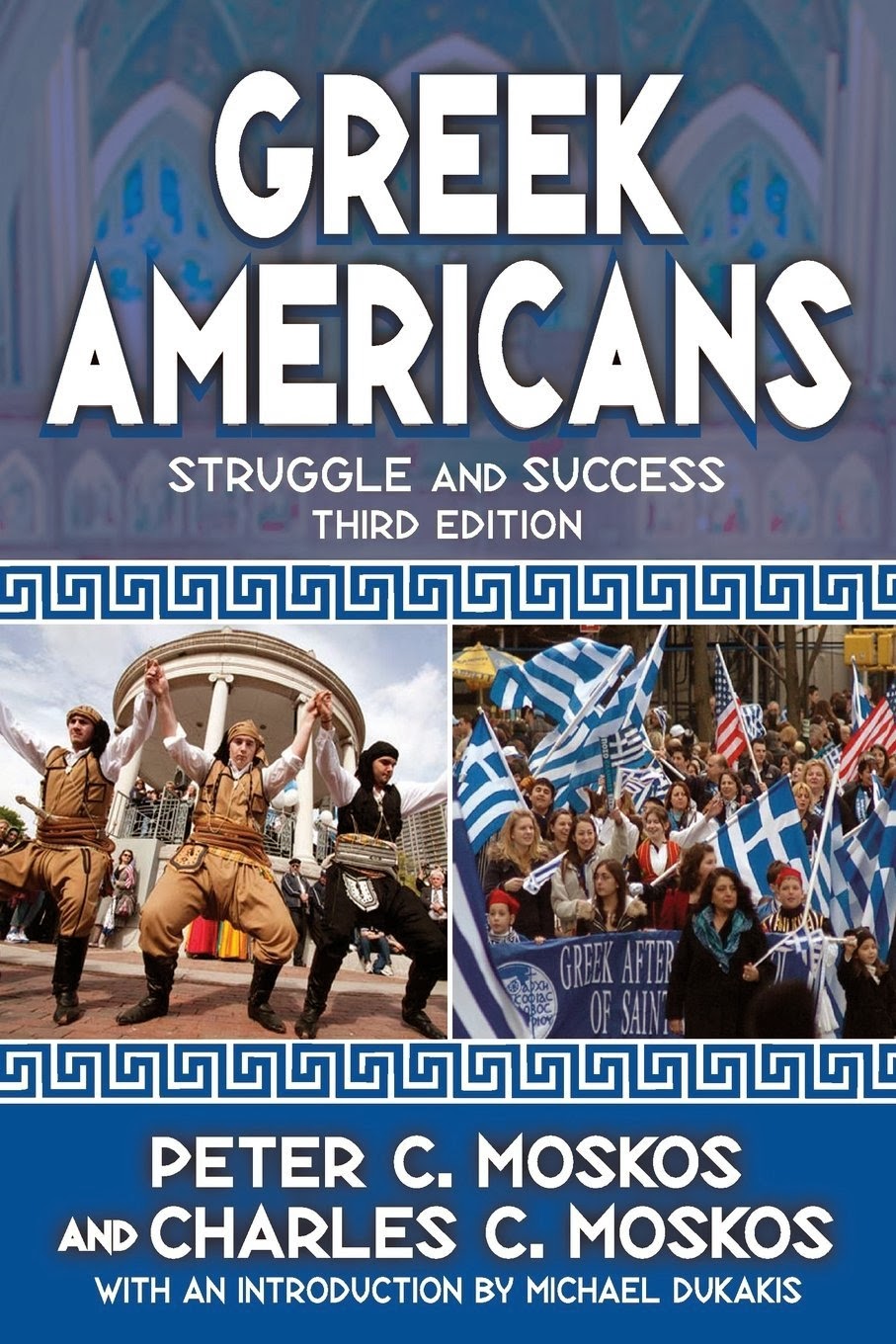
    Look, this has nothing to do with police (except for the aforementioned killing), but my third book is finally out. It’s done. It’s a Moskos and Moskos production. It has a dorky cover. And you can buy Greek Americans on Amazon.

    Greek Americans makes a great Christmas present…

    But let’s be realistic: I know you’re not going to buy this book for yourself. But you might buy it for that Greek guy or girl you know. And come on, you do know a Greek. We’re everywhere. And Greek Americans are guaranteed to love a book on Greek Americans. Why? I don’t know. We just do.

    And just think… if give it to that Greek who runs that diner you like, you might get free baklava for life! Why? Because that’s how we Greeks roll.

    The killing of South Omaha Police Officer Edward Lowery

    Excerpted from Greek Americans: Struggle and Success (3rd Edition):

    On the outskirts of South Omaha, Nebraska, was a shantytown of perhaps 3,000 Greek laborers, a number swollen by unemployed railroad workers waiting out the winter. Anti-Greek feeling in South Omaha was already intense owing to the carousing and gambling of the Greeks and, possibly, because many of them were viewed as strikebreakers.

    The precipitating incident occurred on February 19, 1909, when one immigrant, Irish-born Police Officer Ed Lowery, arrested fellow immigrant, the Greek-born John Masourides. Lowery was a family man with a labor background. He joined the police force after losing his job at a lard processing plant for refusing, in sympathy with striking workers, to cross a picket line. Thirty-six years old when he left a Peloponnesian village near Kalamata in 1906, Masourides was in many ways a typical Greek immigrant.

    He was dark and of medium height, wore a mustache, could speak no English, but could read and write some Greek. He left behind a wife and four children and made his destination Sunrise, Wyoming, where he planned to join his brother Gust. In Wyoming, John worked as a miner for several months after his arrival. The brothers then decided to come to Omaha to start a grocery and confectionary. This they did in South Omaha.

    Masourides was with seventeen-year-old Lillian Breese when Officer Lowery arrested him for vagrancy. Some claimed the policeman was drunk and enraged at seeing a Greek publicly walking with a “white” prostitute. Other accounts say Breese was an English teacher and Masourides her student. These two accounts, it should be noted, are not mutually exclusive. Regardless of Breese’s primary vocation, what isn’t in question is that Masourides shot and killed Officer Lowery on the way to the police station.

    In court, Masourides said he was attempting to throw his pistol away to avoid being held for carrying a concealed weapon, and was forced to defend himself after the officer began firing. Other witnesses said Masourides fired first. After a failed attempt to lynch Masourides, a petition was circulated and published in two local newspapers:

    The so-called quarters of the Greeks are infested by a vile bunch of filthy Greeks who have attacked our women, insulted pedestrians upon the street, openly maintained gambling dens and many other forms of viciousness.

    More ominously it declared:

    Therefore be it resolved: That we, the undersigned citizens and taxpayers of the city, hereby believe that a mass meeting should be held on Sunday afternoon, February 21, 1909, at the city hall to take such steps and to adopt such measures as will effectually rid the city of the Greeks, and thereby remove the menacing conditions that threaten the very life and welfare of South Omaha.

    During the meeting, the crowd was encouraged with anti-Greek speeches. One witness recounted hearing, “One drop of American blood is worth all the Greek blood in the world!”

    Following the meeting, over the course of many hours, a mob rampaged through the Greek quarter, burning most of it to the ground. Some thirty-six Greek businesses were destroyed and all the Greeks—and many other immigrants who were mistaken for Greek—were driven by the mob from the city. Later, Mary Demos, the owner of Demos Brothers Confectionary, would testify that when she called the police station for help against the mob, the officer answering “laughed at [her] over the telephone.” Her shop was subsequently wrecked and looted by a group that Demos claimed included police officers.

    Another newspaper, which was considered more moderate toward immigrants (and did not publish the anti-Greek petition), still managed to rationalize, if not justify, the rioters’ behavior:

    The thing that sticks in the crow [sic] of the anti-Greek element is that they work cheap; live even more cheaply, in groups; are careless of many of the little details that Americans set much store by; once in a while are impudent, ignore the restrictions of American law that lay heavily on the true patriot—in short, do not mix, are not “good fellows” like the citizens we get from northern Europe, for instance.

    The press coverage of the riots triggered copycat anti-Greek demonstrations, sometimes violent, in Kansas City, Kansas, and Dayton, Ohio. The irony of immigrant-on-immigrant xenophobia was not lost on at least one newspaper, the Shreveport Journal (Louisiana): “We note with interest that Mr. O’Shaughnessy of Omaha objects to the ‘Greeks taking America.’ As if the O’Shaughnessys and the O’Tooles and other Irish had not already grabbed it.”

    One year later, Masourides was found guilty of second degree murder and sentenced to fourteen years in prison. He was furloughed by the governor after five and one-half years, deported, and emigrated, perhaps to Egypt.

    The South Omaha riot was given wide coverage in the Greek American press and in Greece. The Greek government lost no time in protesting the acquiescence of the local authorities to the brutality of the mob. The Greek government, along with the Austro-Hungarian and Ottoman Empires, lodged a formal demand for compensation. In 1918 the US Congress did indemnify the Greeks, but for just $40,000 (equivalent in 2012 to $618,000) and not the $288,000 claimed.
  • NYPD Aims Better in 2012

    It’s being reportedthat fatal NYPD police-involved shootings were way up in 2012. They are, but it’s a non-story. Indeed, fatal police-involved shootings increased from 9 to 16, but better aim and luck were probably the reasons why. Police-involved shootings were only up by 2, to 30. (And this even though the average distance from which officers shot was further away in 2012.)

    The real story (though you should always be leery basing a story on what might be a statistical one-year fluke) is that the number of NYPD officers shot went up from 4 in 2011 to 13 in 2012. Luckily none of those 13 was killed. 13 officers shot is the most since 1998. In 1997 27 officer were shot, 4 fatally.

    30 police-involved shootings is an incredible low number for a city as big as New York. It is also part of a long-tern downward trend (that correlates, not surprisingly, with the crime rate). In 1990 there 111 police-involved shootings. Going back even further, in 1972 there were 211 people shot by cops!

    To put this in comparison, Baltimore, with a fraction of New York’s population and about 3,000 officers, had 22 police-involved shootings in 2009 (the last year I have numbers for).

    Here’s the NYPD report.

    Update: Houston police, with 5,300 officers has shot an average of 24 people a year (10 of them fatally) for the past five years. Many were unarmed.

  • “You can’t stop me! You can’t do that no more! There are new rules!” says gun-toting idiot

    The Post reports (and some cops confirm) that word on the street is that cops can’t stop anybody anymore. Of course that’s not true. But it still make for some chilling anecdotes.

    “You can’t be stopping me, yo! The cops can’t be harassing us!”

    He was still frisked.

    And yet there is still no apparent increase in violence.

    [thanks to J.S.]

  • Crime is up no wait down: NCVS

    There are two main clearinghouses for crime stats in this country, the UCR (The Uniform Crime Report) and the NCVS (National Crime Victimization Survey). The former is collected from police departments and thus only includes reported crime as recorded by the police. The latter is conducted by surveys and sampling and asks people (160,000 per year) if they were a victim of crime. They both can be useful in different situations, though I’m much more partial to the UCR.

    Now here’s the thing: The UCR says violent crime in 2012 is down 3% compared to 2010.

    The NCVS says violent crime is up 39% in the past two years.

    They can’t both be right.

    And I seriously suspect the NCVS is wrong.

    Update:

    I believe in 2015 the NCVS surveyed but a *total* of 260 black male crime victims. For a national sample. (From 20,837 “black only” sampled.) Just 100 black male victims 35 or under? That seems problematic. Weighting is about 2,700 per individual.

    Also, blacks are 11% of respondents, undercounts population approx 17%. (whites are overcounted at +5%) And there’s no reason to assume non-respondents/missing data are random. I would assume non-respondents have higher rates of being victims.