Category: Police

  • Five charts Ray Kelly Doesn’t want you to see!

    Five charts Ray Kelly Doesn’t want you to see!

    (Can you guess I was just on buzzfeed? A better headline would be “Murders way down in NYC. And so are stop and frisks. And nobody seems to care.” But what kind of clickbaite would that be?)

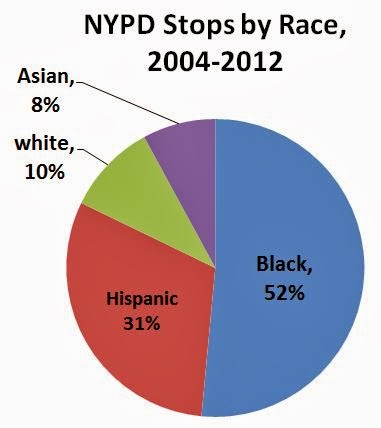
    1) Breakdown of NYC stops by race.

    Indeed, as often reported, 83% of stops have happened to black and hispanic people.

    2) Breakdown of NYC homicide victims by race.

    But ninety-one percent of homicide victims were black or hispanic. Wow. Actually, this is the chart Ray Kelly wants you to see. Critics of stop and frisk generally don’t like talking about this issue (as if the racial disparity in violent crime will just go away if we ignore it). But it is relevant. It may not excuse the racial bias of stop and frisk, but it goes a long to explaining it. Cops are where the violent crime is. Cops stop people where cops are assigned. Ergo cops stop black and hispanics disproportionately. “Racism without racists,” it’s sometimes called. It’s not that individual cops are racists in their day-to-day work, but the end result of a stop-and-frisk policy can still racist.

    3) Hit rate for stops of black people.

    (this and then next figure are taken from Mother Jonesand the data from the Center for Constitutional Rights)

    One in 143 stops of blacks yields guns, drugs, or other contraband. Compare this to the rate for whites who are stopped.

    4) Hit rate for tops of white people.

    One in 27 stops of white people yields guns, drugs, or other contraband. Same yield with 19 percent of the stops.

    Wow.

    One way to interpret these data is that white people must be 5.4 times as likely as blacks to be packing heat or drugs! Of course that’s unlikely. So why is contraband 5.4 times as likely to be found on white people? Because white people are more likely to be stopped based on actual suspicion (there is much less pressure to produce stats in low-crime neighborhoods). Black people are being stopped because Compstat and “productivity” pressure in high-crime neighborhoods mean some officers stop people simply because the feel they need to stop people to fill out the UF-250s (the stop, questions, and frisk form).

    So how about this for a goal: get the “hit rate” for blacks up to the same level for whites. Not only would this be fair, it would be good policing. It would also go a long way to mitigating the problem of excessive stop and frisks. And it’s not hard to do. Make smart stops, not more stops.

    5) Stops and homicides are both down!

    For years Bloomberg and Kelly were basically saying that every one of the five, six, and seven-hundred-thousand stops was necessary to keep the city from exploding in crime. An inevitable part of the crime drop in New York City.

    And yet stops have plummeting in the past two years (2013 figures are estimated year-end totals based on latest available data). In part this is from pressure from the top and in more recent part instructions from the PBA.

    And homicide? Must be way up, right? Because Bloomberg and Kelly have insisted we need all these stops to keep homicide down. And yet we’re on track from just over 300 homicides for the year in NYC. (Again, estimated year end total).

    What did I just say New York City is on track to have just 318 homicides this year?! That’s amazing. Why is this not front-page news? This 22 percent reduction is not from a crack-fueled high of the late 1980s but from the record low year of 2012! The 2013 homicide numbers are an amazing accomplished. (I mean Baltimore City used to top 300 homicides with just 650,000 residents.)

    Homicides in New York City are down 22 percent this year and nobody seems to want to take credit! Attackers of stop and frisk never like to highlight any evidence that might be used to imply stop and frisks are effective. But defenders of stop and frisk can’t reconcile a huge crime drop that correlates with an even larger decline in stop and frisks. In two years stops have been cut in half and homicides are down by one-third. (Of course there might be a delayed link between the end of stop and frisk and a rise in crime, but I think the past year or two should be enough time to see such a lag effect).

    So for crying out loud, give the NYPD some credit! Just last year academics, once again, were saying crime had bottomed out; crime won’t go down; crime can’t go down any more. And yet, once again, it did. This was not inevitable. This is not irreversible. But as Bill Bratton likes to say, “Cops count and police matter.”

    So give the NYPD credit for a record low number of murders, but remind them that this amazing reduction in homicide has happened without unnecessarily stopping and bothering another 350,000 innocent black and hispanic New Yorkers this year. That matters.

    We now know that all these stops were not needed. Throw out that bathwater! But be careful, because there is baby somewhere in that murky water. Surely some of these stop are needed. You know, the stops based on officers’ reasonable and honest suspicion.

    The crime reduction can continue at the same time unnecessary stop and frisks and ended. One goal should be to raise the hit rate for blacks stopped to the same level as found for whites who are stopped. This alone could reduce the total number of stops (and misdemeanor marijuana possession arrests) more than 80% from the 2011 high. The good news is we’re already half way there.

  • Defending Flogging Down Under

    Waste an hour watching my dangerous idea at the Sydney Opera House’s 2013 Festival of Dangerous Ideas:

    There’s also me on a panel “Getting Soft on Crime”:

    You can watch all the Dangerous Ideas here. What an amazing weekend and amazingly well run festival! Thanks to everybody at FODI.

  • Father calls cops who shoot son

    The chase was well called out by the pursuing officer, I have to say. The shooting, in my humble opinion, justified. It’s too bad police had to down two police cars because of this idiot.

    Should the police have chased? No. They rarely should. And particularly not when you know the identity of the suspect and where he lives! (And it’s odd to me as a former police officer that the the pursuing officer is never ordered to call the chase off. Instead the suggestion of calling off the chase is offered a few times. I know — right or wrong — that I would not have followed that “suggestion.” Why? Because as a cop I want to catch the crook. And as a guy, car chases are fun.) What do you want to bet that police in Ames, Iowa will make a more restrictive pursuit policy very soon?

    But the moral? I think it’s rather simple: don’t call police to teach your child a lesson. Seriously. That’s not what police are for. Why, because your child might be a fool and end up getting shot. (Also, it wastes police time). [Update: to paraphrase a comment below: “You play stupid games, you win stupid prizes.”]

    From Salon: “He took off with my truck. I call the police, and they kill him,” James Comstock told The Des Moines Register. “It was over a damn pack of cigarettes. I wouldn’t buy him none.”

    You wouldn’t buy your son a pack of cigarettes and he got pissed off and so you called the police to report a stolen vehicle?!

    The second link here gives you the full audio.

  • Right Wing Lies (IX)

    Right Wing Lies (IX)

    Turns out Obama was a cross-dressing teenager who turned gay tricks for coke! This one must be true. Why? Because I read it on the interwebs!

    Man, I wasted far too much time today responding to comments from people who still comment about what a shame it is that the government provided “hundreds of thousands of dollars” to a murdered two-bit drug-dealing father-of-many married-to-none black man, Larmondo “Flair” Allen. This single post got 4,000 hits yesterday (and all from google searches, which is the tough way to find something. Usually massive spikes are due to some prominent site posting a link). That’s about 3,500 more than an average day.

    The problem, of course, is it’s not true. I mean the looser “Flair” existed, but he wasn’t living large sucking the government’s tit.

    Call me crazy, but if people believe an email that says some loser with nine kids gets $13,500 per month in free government cash (the real figure is closer to $550), how much of a lie does something have to be before idiots might reconsider something that goes against their world view?

    And how many people need to believe a lie before these people dictate social policy based on that lie?

    [For a more a real conception of who receives welfare, read this.]

    In many comments (and tens of thousands of page views) regarding “Flair,” not one person — not one — said, “Gosh, I guess since my facts were wrong, I’ve got to reconsider what I believe.” Not one. Turns out for some, the facts don’t matter. As a professor who enjoys a good political debate, I find that very frustrating.

    To hate something based on truth is one thing. But to hate based on lies? It’s the foundation of fascism.

  • Shira Scheindlin Stop & Frisk Smackdown

    I’m in beautiful Sydney. Spring is in the air and the birds make funny sounds just to remind me that I’m on the other side of the planet. Despite my focus on the Festival of Dangerous Ideas, I couldn’t help but notice that everything Judge Scheindlin decided regarding stop and frisk has been put on hold! The New York Times reports:

    A federal appeals court on Thursday halted a sweeping set of changes to
    the New York Police Department’s policy of stopping and frisking people
    on the street, and, in strikingly personal terms, criticized the trial
    judge’s conduct in the litigation and removed her from the case.

    “In taking these actions, we intimate no view on the substance or merits
    of the pending appeals,” the two-page order stated.

    In its ruling, the panel … criticiz[ed] the judge for improperly applying a
    “related-case rule” to bring the stop-and-frisk case under her purview.  

    This is a fair smackdown of the judge. For a judge with a strong opinion on a case to make sure she gets a case so that her decision becomes law of the land makes a mockery of the concept of an independent judiciary. I mean, we all knew how she was going to rule.

    In an age of political cynicism, I’m actually thrilled to see that such shenanigans are not the way the system is supposed to work. And the system self corrected. (though it seems like this should have been decided before she heard the whole case.)

    I might be the only person in the world who agrees with this reprimand and (most of) her original decision. (And I still hope the cameras on cops pilot program proceeds.)

  • Terry v. Ohio. Happy 50th Anniverary, Detective McFadden!

    Fifty years ago today on the streets of downtown Cleveland, Detective Martin McFadden, plain-clothed and without a walkie-talkie (two-way radios didn’t become standard for another decade) stopped and arrested John Terry and two other guys after observing them casing a storefront for United Airlines.

    This arrest lead to the landmark 1968 Supreme Court Case of Terry v. Ohio (the two poor other guys unremembered). In an 8-1 vote, the Supreme Court made perhaps the most pro-police decision of the 20th century.

    I love the the original police report filed by Detective McFadden. Sure, the report is filled with typos and corrections (and “colored” was just the polite term back then), but it’s a great police report. Who would have imagined that not only would we remember it fifty years later, but that it would be taught in college courses?

    Detective McFadden wrote perhaps the best arrest report/statement of probable cause I’ve ever read. He doesn’t just say he was suspicious of these two guys. He explains, in great and explicit detail — ie: he articulates the totality of the circumstances — just what made him suspicious. He builds a scene of three men about to rob a business. McFadden paints a picture.

    Why, after reading this report, how could one not be suspicious of the actions of these three gentleman?

    Then, and without backup or a radio, Detective McFadden pushes these guys against a wall, pats them down, and finds two illegal guns. Finally, the good officer gets somebody in the store to call police.

    Talk about “real police”!

    But here’s the problem: Detective McFadden did not have “probable cause” to think these guys were armed. And how can you search somebody without probable cause? The Fourth Amendment is pretty clear about this matter. But it certain makes sense, as a police officer stopping these guys, to fear that they might be armed and to check and make sure they’re not, or disarm them if they are. But the case went to court, asking if the gun seizure was constitutional and legal even without probable cause or a warrant?

    The Court said yes.

    In doing so, the Supreme Court invented the concept of “reasonable suspicion” in which an officer may pat down the outer clothing of a suspect for weapons in order to ensure the officer’s safety. It’s hard — actually impossible — to imagine policing without Terry v. Ohio.

    The Court concluded, in affirming a lower court’s decision:

    Purely for his own protection, the court held, the officer had the right to pat down the outer clothing of these men, who he had reasonable cause to believe might be armed. The court distinguished between an investigatory ‘stop’ and an arrest, and between a ‘frisk’ of the outer clothing for weapons and a full-blown search for evidence of crime. The frisk, it held, was essential to the proper performance of the officer’s investigatory duties, for without it ‘the answer to the police officer may be a bullet, and a loaded pistol discovered during the frisk is admissible.’

    And yet it’s important to remember the words of the lone dissenting judge, Justice Douglas, in this eight-to-one affirmation:

    The opinion of the Court disclaims the existence of ‘probable cause.’ If loitering were in issue and that was the offense charged, there would be ‘probable cause’ shown. But the crime here is carrying concealed weapons; and there is no basis for concluding that the officer had ‘probable cause’ for believing that that crime was being committed. Had a warrant been sought, a magistrate would, therefore, have been unauthorized to issue one, for he can act only if there is a showing of ‘probable cause.’ We hold today that the police have greater authority to make a ‘seizure’ and conduct a ‘search’ than a judge has to authorize such action. We have said precisely the opposite over and over again.

    To give the police greater power than a magistrate is to take a long step down the totalitarian path. Perhaps such a step is desirable to cope with modern forms of lawlessness. But if it is taken, it should be the deliberate choice of the people through a constitutional amendment….

    There have been powerful hydraulic pressures throughout our history that bear heavily on the Court to water down constitutional guarantees and give the police the upper hand. That hydraulic pressure has probably never been greater than it is today.

    Yet if the individual is no longer to be sovereign, if the police can pick him up whenever they do not like the cut of his jib [his style], if they can ‘seize’ and ‘search’ him in their discretion, we enter a new regime. The decision to enter it should be made only after a full debate by the people of this country.

    Happy 50th Anniversary!

  • Waltzing Matilda

    Waltzing Matilda

    Should you just happen to be in Sydney next week, wonder over to the Opera House and check out the Festival of Dangerous Ideas. I’ll be there, spreading dangerous thoughts about flogging and the war on drugs.

    Did I mention they’re flying me over there all fancy? Like in business class? Classy, those Aussies are!

    It should be a blast.

  • And no thanks to the PBA

    The PBAis the Patrolmen’s Benevolent Association. One of the two police unions (I was FOP, which for some reason I still think is slightly better in actually caring about public safety).

    A representative of the PBA recently came to roll calls in New York City and told police officers to stop stopping anybody. If crime does go up, don’t expect the union to hold itself accountable.