
Category: Police

  • The Intellegence of the NYPD’s Demographics Unit

    The Intellegence of the NYPD’s Demographics Unit

    I am a day late and a dollar short on this, because these AP reportson the NYPD Intelligence Division “Demographics Unit” came out in 2011 and 2012 (mostly when I was out of the country). The reports are from 2006, but only now am I fully appreciating them. Here’s New York Magazine’s more recent take on the whole operation. Of course the NYPD has a long tradition of mapping “seditious ethnic groups,” so it’s not exactly earth-shattering news. (Less traditional is spying on student organization at my school.)
    The NYPD went out and collected (very basic) information on groups of Muslim immigrants. Here are the reports on those from Egypt, Syria, and Albania. Some, myself included, might say that the NYPD should know where different groups hang out. Indeed, at a very basic level this should be considered very basic police knowledge. Too bad they get it wrong.

    Any actual beat officer would know this information. Just as people who live in the neighborhood do. But apparently the NYPD lacks day-to-day knowledge of the communities they serve and protect, so they have to rely on undercover officers to “rake” the community. This is wrong. As is much of the information the NYPD gathered.

    I could have told the NYPD information about the locations in my neighborhood (including a place near me they missed because it’s a few blocks away from where “they” usually hang out).

    The report expressly says it excluded Egyptian Christians from surveillance. So it’s explicitly a religious witch hunt, but the dumb “intel” officers include a lot of Christian places by mistake. Apparently the “rakers” who are supposed to keep us safe from Muslim extremists can’t tell the difference between Christians and Muslims. They all look Arab, I suppose.

    And the facts about the country in question are so mindlessly copied from the web that we get to read about the “richness of the annual Nile river flood.” I’m surprised there wasn’t clip art of the pyramids.

    Naturally the first place I looked up was the place I know best: Kabab Cafe. The owner, Ali, is a friend of mine.
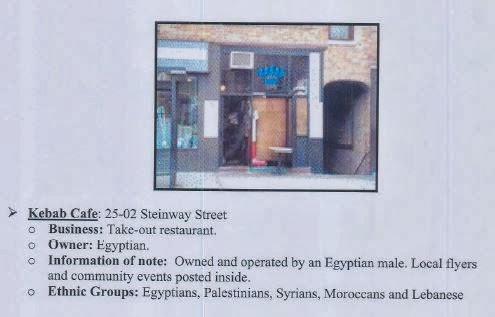
    I can tell you a lot about Kabab Cafe, but I’m not a trained and active “intel” officer. So what did the NYPD’s Demographics Unit come up with? For starters, they misspelled the name of the restaurant. It’s Kabab with two A’s. And they got the address wrong. It’s located at 25-12 Steinway. Good work, guys. Maybe next time check out a Zagat Guide.

    The “ethnic groups” that might be found at said location of interest? “Egyptian, Palestinians, Syrians, Moroccans, and Lebanese.” That’s also wrong. Ali does draw a diverse crowd, but his place is not an Arab hangout. Truth be told, at $30 to $50 per person, this place is kind of pricey for Queens. If I had to categorize, I’d say those who dine at Kabab Cafe are predominantly “hipsters” and “Jews.”

    And the “local flyers and community events posted inside”? No. Not there. Unless you think that’s what the anti-Mubarak poster is.

    The NYPD lists my friend as an “Egyptian male.” That’s arguably correct, even though he’s non-religious and has been an American citizen longer than I’ve been alive.

    It’s amazing that so much incorrect information can be packed into just 35 words of “intel”!

    But that’s not all. The business is listed as a “take-out restaurant,” which happens to be wrong. If you ask politely Ali will do take-out, but it’s not really his gig.

    You’d learn a lot more reading about his restaurant in the New York Times or New York Magazine. Or perhaps you saw Ali on TV, as he was featured in Anthony Bourdain and Andrew Zimmern’s TV show. He also starred in an episode of Jammie Oliver’s American Road Trip (an episode that also features my wife, just braggin’).

    Across Steinway Street is another place, listed as “Egyptian Cafe.” My wife tells me that’s not the name of the place, which is clearly written in Arabic. But my wife reads Arabic, which apparently the “rakers” didn’t (though maybe they did, in which case they’re just really really stupid). Also, this Queens location is listed as being in Brooklyn.

    Why is Kabab Cafe a “location of interest”? Naturally, “detectives gravitated toward the best food.” I would. New York reported:

    It nagged [Lieutenant] Berdecia to see his talented detectives sitting around eating kebabs and buying pastries, hoping to stumble onto something. If it was worth writing up a report, it was worth conducting an investigation. “It irritated me to send a lot of second-grade detectives and first-grade detectives to sit in coffee shops with nothing going on. If we hear something, then let’s do more proactive police work. Let’s run plates. Let’s follow guys.” But as the years passed under Berdecia’s supervision, the Demographics Unit never built a single case. “It was a bunch of bullshit,” Berdecia said.

    Now of course my friend isn’t a terrorist, and he’s got nothing to hide. So no harm done, right? Except the information gathered by the NYPD is completely and comically wrong. And that is potentially harmful.

    So I don’t know what bothers me more, that the NYPD spies on people solely on their perceived religion and nothing else, or that the NYPD has done so with such complete and total incompetence. I mean, how can I focus on the morality and constitutionality of the Demographics Unit if they can’t even spell the names right and write down the correct address?!

    But short of some fact checking (have they heard of google?), this police work should not be done undercover. No police work should be done undercover unless it has to be. Not only does does a uniform or badge make the difference between honest police work and a secret state security apparatus, but undercover officers are less effective. If you want basic information, you need a beat cop (or a resident) who has an eye, an ear, and half a brain.

    But how, you might say, would police discover terrorist plots while walking the beat in uniform? Good question. First, good people might actually talk to police, if only they saw police to talk to. This is how the NYPD foiled the 1997 subway bombing that wasn’t. People snitch. This is how most big arrests are made. And it’s a bit harder to feel the love if you’re being spied on, which is what you call secret police work based on no actual suspicion of criminal wrong doing.

    Second, the secret Demographic Unit didn’t uncover any plots. The latter point is important — perhaps not a moral and constitutional level — but certainly an operational and police level.

    The only actual “intel” from this report seems to be which of these places believed to be run by or cater to Muslims watch Arabic-language Al-Jezeera news on TV. Well, I hate to break it to you Fox News believers, but Al-Jezeerais an actual news channel. And truth be told, it’s a pretty good one.

    Just because Al-Jezeera has an Arabic name does not mean it is a terrorist organization. That might be the real take-home lesson.

  • Baby Hope

    Good work by the NYPD:

    October 14th, 2013

    BY ORDER OF THE CHIEF OF DEPARTMENT, THE FOLLOWING IS TO BE READ AT ROLL CALL TO ALL MEMBERS OF THE SERVICE AND POSTED CONSPICUOUSLY WITHIN COMMANDS:

    On July 23rd, 1991, twenty-two years ago, the body of a four-year-old girl was found in a cooler off the Henry Hudson Parkway. She had been starved and sexually assaulted. Despite a citywide appeal, the 34th Precinct Detective Squad was unable to locate her relatives. All leads were soon exhausted without even learning her name. Using their own funds, the squad bought her a burial plot and a headstone. On the day she was buried, they Christened her Baby Hope.

    As life in a city of eight million people went on, the men and women responsible for Baby Hope’s memory never forgot about her. At the time, Assistant Chief Joseph Reznick was the 34th Precinct Detective Squad commander. No matter where his career took him, he would return to Baby Hope’s grave each year to collect evidence from the flowers and memorials left there. Each year, investigators would canvass neighborhoods in an attempt to locate witnesses or her relatives. In 2006, her body was exhumed to profile her DNA. Whenever he spoke to new detectives and executives, the chief would remind them that so long as Baby Hope’s case was unsolved, we could not consider our work done. The effort spanned careers and lifetimes.

    On Saturday, October 12th, 2013, a man was arrested for the murder of Baby Hope. The case broke when a CrimeStoppers tip led to a witness who wanted to share what she knew after years of silence. What followed was the culmination a careful and thorough investigation, the type that our detectives are known for. It pointed towards one person: Baby Hope’s cousin. The suspect, 51, was apprehended at his job as a dishwasher at a restaurant in Greenwich Village. He went on to make statements to detectives implicating himself in the murder.

    Please take a moment to reflect on what Baby Hope’s case signifies. The promise to deliver justice to New Yorkers is only as good as the men and the women who keep it. As long as our leaders are relentlessness, our detectives have patience and compassion, and the Department perseveres with even its oldest cases, there can be hope for justice. NYPD detectives have once again lived up to their reputation as being “The Greatest Detectives in the World.” Twenty-two years later, a man will be held to account for the rape and murder of one of our city’s youngest and most helpless victims, a child abandoned by her own family. Her name, we have learned, was Anjelica Castillo.

  • Can you say “Contagion Shooting”?

    They then opened fire. The authorities would not estimate how many rounds were discharged. Mr. Gainer, the sergeant-at-arms, said he believed that five to seven officers had fired.

    Possible Clues in Fatal Chase, but No Motive — Miriam Carey Was in Car When Police Fired, Official Says

  • Union Effin’ Power!

    Do Carnegie Hall stage hands really make $400,000 a year? I first thought this was some urban right-wing anti-labor myth (I was all ready to file this under “right-wing lies”).

    But actually, well, they do. (Or at least close to it.) Holy sh*t!

    Susan Adams of Forbes wrote this great piece explaining the why.

    In short, why do they make so much money? For the same reason dogs lick their… boo-yah: Because they can!

    Carnegie Hall’s executive and artistic director pulled in $1,113,571. Why not complain about that?

    These aren’t government employees. You don’t pay their salary (unless you’re a patron of Carnegie Hall). So just what makes you so upset? These are skilled private workers. And, unlike some manual labor, actually, no, you cannot do their job.

    Think of it this way: why is it OK for baseball players and executives to make as much as they can… but as soon as people who actually work and sweat for a living make as much as they can, people start bitching.

    John Hammergren. Ever heard of him? Me neither. But he was paid $131 million last year. His net income was more than $1 billion! What the f*ck?! Michael Fascitelli? Doesn’t ring a bell. And he lost his shareholders money last year while being “compensated” $64 million (his net income? $830 million). George Paz? Maybe him I should know him. Because he’s the CEO of Express Scripts. That’s the annoying company that makes me mail-order my asthma medicine and charges me too much for the inconvenience. This is the kind of medicine, like most medicine, that is cheaper when I buy it without “insurance” while traveling in foreign countries. Mr. Paz also lost money for his shareholders last year. Meanwhile his “compensation” was $51.5 million (with a net income of $1.29 billion). About $1,000 of that is mine, motherf*cker!

    So more power to the Local One for making buko dough! Don’t be a hater just because you’re jealous. Just tax the high-earning SOBs! And if you want to make more money for your work (and who doesn’t?), perhaps you should start supporting rather than breaking your local unions.

    And, just for the record, the stage hands were not striking over money. They were striking to defend the strength of the union that has given them so much power. And, in my humble opinion, the settlement seems fair.

  • Bait Car naps bait

    Cause it’s always fun to watch crooks get caught. Full story here.

    [thanks to David Bratzer]

  • Celebrating six years as a blockhead!

    Like fellow “blockhead” Jay Livingston, I can’t believe I’ve been doing this “writing for free” crap since 2007. Like Jay, I decided to look back at my more popular posts. Unlike Jay, blogger/google doesn’t allow one to look at the past year. The choices jump from “last month” to “all time.” So let’s look at my five most popular posts of all time.

    Starting with number 5, with 4,629 page views, a 2008 post in which I cast a critical gaze at St. Louis. St. Louis: Coulda Been a Contender. I’ve found that any time you say something bad about a place people call home (whether it’s St. Louis or Newburgh, NY), some people kinda get upset. Who would’ve thunk it? (Luckily, Baltimoreans have thick skin.)

    With 4,766 page views, coming it at number 4, is Sneak-and-Peek from 2011. I observed that parts of The Patriot Act are used not to fight terrorism but the War on Drugs. I have no idea why this simple repost from New York Magazine got so many views. I can only guess it comes up high on some google search. Or maybe all the views are from the NSA.

    Number 3, with 8,231 views, is a funny picture montage What they think I do. This must have gotten shared on some police sites.

    Number 2, with 9,499 views, features my pictures and Memories of a Baltimore Crack House. The Atlantic linked to this. The Atlantic has always supported me and my work. Somebody there must like me. I don’t know who that person is, but thank you!

    Coming in at Number 1, my most popular post of all time (by a wide 3:1 margin with 27,623 page views), is the Right-Wing Lies of the “welfare” of Larmondo “Flair” Allen. I’m proud to play a small role in the liberal quest for truth. Apparently some 27,000 folks also received a B.S. right-wing email and had the bright idea to actually see if it true. It’s not.

  • Two more prohibition deaths

    These twodidn’t die from MDMA. They died from whatever they took that wasn’t MDMA. Why? Because of prohibition.

    To blame drugs rather than prohibition is exactly the same as when, during Prohibition, “alcohol” caused blindness, death, and (my own favorite) Jake Leg. These are prohibition problems. Of course during Prohibition, prohibitionists blamed the prohibited drug rather than their policy of prohibition. They still do.

    If you’re not ready to end drug prohibition, how about testing booths? Testing booths would have saved these two lives. Clubs in Europe have them. But no, not here. You’d get arrested. Why? Because we want our drug users to buy from criminals and die. I mean, seriously, we don’t have a system that prevents recreational drug users from dying because prohibitionists, perhaps yourself included, say: “it sends the wrong message!” Because preventable death is such a good message. For shame.

    Every weekend, throughout the world, countless hundreds of thousands of people take recreational drugs, have a good time, and live to tell about it. The fact that anybody dies from taking what they think is ecstasy is as absurd (and real) as partial permanent paralysis from a shot of booze.

  • This is a big deal

    This is far more radical than anything Judge Scheindlin ruled in her well publicized stop and frisk decision.

    In a 3-2 decision (People v. Johnson is not long and worth reading in its entirety) the court managed to rule the following unconstitutional:

    In a New York City Housing Authority building, which the testifying officer characterized as a “drug-prone” location, the officer observed defendant descending the stairs to the lobby. Upon seeing the police, defendant “froze,” “jerked back,” and appeared “as if he was going to go back up the stairs,” although he never retreated up the stairs. The officer asked defendant to come downstairs, and defendant complied. The officer inquired whether defendant lived in the building, and defendant replied in the affirmative, whereupon the officer asked defendant to produce identification. Defendant immediately clarified that he was visiting his girlfriend, who lived in the building, and informed the officer that his identification was located in his pocket. As defendant moved his hands to retrieve it, the officer’s partner grabbed defendant’s left arm and pulled his hand behind his back, revealing a handgun inside defendant’s coat pocket. The officer seized the gun and placed defendant under arrest.

    Seems like good policing to me. This is from the dissent:

    Defendant initially told the officers that he lived there. However, when asked for identification, he began to stutter, and changed his story to say that he was visiting his girlfriend. Although defendant stated that he had his identification in his pocket, he began moving his hands “all over the place, especially around his chest area,” which the officers interpreted to be threatening and indicative of possession of a weapon. To “take control of the situation” before it could “get out of hand,” an officer grabbed defendant’s left arm and brought it behind defendant’s back, which caused defendant’s open jacket to open up further and reveal a silver pistol in the netted interior coat pocket. One officer removed the pistol from the pocket, and another handcuffed defendant.

    You can also read the New York Times article.

    What are police officers now allowed to do? Where exactly in this arrest did police overstep their bounds? I don’t get it. The court said it had a problem not with subsequent stop and frisk, but with the initial questioning!? I cannot fathom (maybe somebody can explain to me) why this isn’t covered under what is known as the “common-law right of inquiry.” See, for instance, People v. Moore, which limited but defined that right.

    I don’t see how to downplay this decision and say it’s no big deal (which is my usual reaction). If you were trying to get police to stop policing, telling officers they don’t have the right to question suspicious (and, in the end, armed) suspects seems like the ideal way to do so.

  • IRB: The Censorship You’ve Never Heard Of

    Unless you’re an academic, of course. From Commentary and worth reading in its entirely (if you care about this sort of thing):

    Since the 1970s, the government has overseen the establishment of bodies called Institutional Review Boards, and these “IRBs” have suppressed vast amounts of talking, printing, and publishing—even mere reading and analyzing—for hundreds of thousands of Americans. This is utterly unconstitutional, and in stifling research and its publication, it has proved deadly.

    [thanks to the Institutional Review Blog]