Check this out by Michael Corbin in Baltimore’s City Paper: Better of Two Evils. Makes me sound like such a intellectual bad-ass. And potty mouth. Fuckin’-A!
Seriously though, it is very powerfully written. Makes me want to re-read my own books.
Check this out by Michael Corbin in Baltimore’s City Paper: Better of Two Evils. Makes me sound like such a intellectual bad-ass. And potty mouth. Fuckin’-A!
Seriously though, it is very powerfully written. Makes me want to re-read my own books.
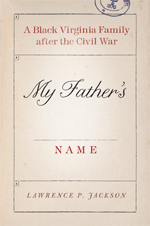
The end of the semester means I get caught up on some of my reading. I finished The Autobiography of Ben Frankin (good stuff) and David Foster Wallace’s “A Supposedly Fun Thing I’ll Never Do Again.” (The footnote on the necessity of formal wear would have been very useful to read before we crossed the Atlantic on the QM2 last September).
 But more relevant to this blog, I read Lawrence P. Jackson’s excellent My Father’s Name: A Black Virginia Family after the Civil War. This is a historical ethnography about a man who decides to trace his family’s Virginia roots back to ante-bellum days. Jackson tells us that blacks in America generally only have have
their accounts recorded for posterity if they were very good, very bad
(criminal records), or sold in slavery (and not always then). Jackson’s
family seems just about average for the time and place, which makes his
ability to delve into the past and bring it to life all the more impressive.
It doesn’t help that Jackson is a common name. It also doesn’t help that Lawrence Jackson, an introverted academic, doesn’t actually seem to be very good at talking to people. But Jackson is great in the library and the county records office. And he can write. Before you know it, you’re tasting the red dust of unpaved roads and hoping the good guys win the war. My Father’s Name is a bit detective novel, a bit Roots, a bit Fox Butterfield’s All God’s Children (but without the homicides), a bit Ta-Nehisi Coates (they’re both self-reflective and perceptive men from Baltimore), and all with a pleasant meandering pace of Twain’s Life on the Mississippi.
Jackson also writes with what I can only describe of a pleasant undercurrent of anger. This is not unjustified blind rage but rather controlled anger which is the inevitable result of unearthing the horrors of chattel slavery not in some abstract historical sense, but in the very real way of how it defined your kin and our country and continues to do so in the present day.

The massive overcrowding in California prisons has eased up a bit (thanks to court order). Of course much of the problem has just been kicked down to the county level, but the symbolic double- and triple-stacked bunks in gyms-turned-massive-dorm are empty, says the San Diego Union-Tribune.
I rarely talk about college, except negatively. But this is the funniest thing to come out of Princeton since… I don’t know, what ever funny comes out of Princeton?
I went to Princeton, Bitch! (And yes, all the cool kids were in Terrace. Food does indeed equal love.)
Well done. I wasn’t expecting things to go so well with the NATO summit. But they did. Kudos to Police Superintendent McCarthyand all the men and women of the Chicago Police Department. Lesson can be learned (particularly by West Coast police departments that don’t seem to be so good at this) and proper preparation is key.
1) Don’t tolerate minor disturbances. Because they will grow to big disturbances, especially when those disturbances are perpetrated by people intent on chaos and damage. And once you lob the tear gas, you’ve already lost control.
2) Intel.
3) Target individuals who are doing things and not the crowd en mass.
4) Have the top brass out there with the rank-and-file. This seemingly minor point is vitally important. And when a good word about McCarthy comes from the lips of Second City Cop, you know he’s done something right.
Sad and yet strangely touching story about dementia and sociologist Irwin (not Erving) Goffman in the New York Times.
Once as a cop I remember spending hours with a very nice and well dressed elderly man. He knew all his info except where he lived. I drove him around the neighborhood. I walked with him around the Monument Street Market asking other people if they knew him. Nothing. Finally, as my shift was nearing its end, he saw a church and said he wanted to be dropped off. The church was closed, but he insisted he knew that church and everything would be OK there. So I let him go.
It felt good to try and help somebody, though I’m not certain if I actually did.
My department at John Jay College of Criminal Justice (Law, Police Science, and Criminal Justice Administration) has three full-time assistant-professor tenure-track lines we’ll be hiring for in the fall. Two are for general criminal justice and one is for police. If you know of anybody — a promising PhD candidate or a professor who wants to move to what just might be the greatest city in the world — get in touch with me.
I’ve always admired the Guardian Angels. They made me feel safe when in high school and riding the L alone, late at night. A man was being robbed, and they — unarmed — intervened. They got stabbed. From the Sun Times.
Meanwhile in Chicago, a group of 100 white out-of-towners take a stroll through the Southside.
The Sixth Amendment states, in rather uncompromising terms: “In all criminal prosecutions, the accused shall enjoy the right to a speedy and public trial, by an impartial jury.” But the system can’t handle those rights. That’s why but a very small fraction of cases is decided by a trial, much less a jury trial (the other option is a “bench trial,” where the judge decides.
The problem is that if you choose to exercise this right, they’ll throw the book at you. Because they want you to plead guilty. From the Houston Chronicle:
“Our criminal justice system is broke; it needs to be completely revamped,” declared Terry Nelson, who was a federal agent for over 30 years and is on the executive board of Law Enforcement Against Prohibition. “They have the power, and if you don’t play the game, they’ll throw the book at you.”
Castillo maintains her innocence, saying she was tricked into unknowingly helping transport drugs and money for a big trafficker in Mexico. But she refused to plead guilty and went to trial.
In 2010, of 1,766 defendants prosecuted for federal drug offenses in the Southern District of Texas – a region that reaches from Houston to the border – 93.2 percent pleaded guilty rather than face trial, according to the U.S. government. Of the defendants who didn’t plead not guilty, 10 defendants were acquitted at trial. Also, 82 saw their cases dismissed.
The statistics are similar nationwide.
Is this case a 56-year old grandmother and first-time offender was convicted of conspiracy to smuggle a ton of cocaine from Mexico. She maintains her innocence. Had she plead guilty, she would have got a few years behind bars. But because she demanded her constitutional right to jury trial, they sentenced her to life without parole.
I heading down to Baltimore for the weekend. It’s been awhile. Watch out, because there’s going to be a run on crab cakes and Natty Bo.