Category: Police

  • Tiger Tiger Tiger, Siss Siss Siss, Boom Boom Boom, meh.

    Caleb Kennedy wrote a nice feature on me for the Daily Princetonian.

    “I was not particularly happy at Princeton,” [Moskos] said, explaining that he felt much of the student body came from a “New England prep school culture” that he was not used to.

    But I loved my professors. And one of them called me a “star student.” It makes me beam.

  • Occupy Federally

    An interesting development in the Occupy movement is the presence on 25 protesters on the steps of Federal Hall on Wall Street (with live stream). Federal Hall is is policed by the National Park Service Police and not the NYPD. I assume the NYPD could have jurisdiction. But I’m not certain. And it’s not clear if Park Police (and there aren’t that many of them in NYC) were policing the protesters or keeping the NYPD away from them (initially the latter). When the protesters first appeared, Park Service Rangers (who are not police) could do nothing but say, “Er, we kinda don’t want you here, but there’s nothing we can do to stop you.”

    Here’s some coverage from Gothamist.

    And I like that there’s a noise limit. I’m much more sympathetic to protests that do not involve damn drum circles!

    And a bit advice: more American flags (respectfully displayed). Maybe put a few on the police barricades. What is the NYPD going to do, take them down?

  • I Don’t Care if Zimmerman is a Racist

    I think there’s too much discussion about whether George Zimmerman is racist. I don’t care. I don’t think it matters. What matters is what Zimmerman did (and lest we forgot: suspect, pursue, shoot, and kill an unarmed and innocent Trayvon Martin).

    Part of the problem is the racism is too broad of a label. Since there’s no simple definition, it’s difficult to place the label (well, it’s easy to place the label, it’s difficult to do so accurately). Certainly some people simply hate other people because of their race. And this goes for people of all races. Deep down-to-the-core racism. But to say you have to be this racist to be racist is setting the bar too low.

    I give George Zimmerman the benefit of the doubt and say he does
    not hate black people. But he did behave like a racist. And this begs the question: is someone who
    behaves like a racist a racist? Maybe, but I think it sets the bar too
    high. Everybody has at some point behaved like a
    racist, and a term that applies to everybody isn’t too useful as a psychological or
    sociological concept.

    It reminds me of how some people love saying police are racist. Once I (half jokingly) accused a partner of
    mine of being racist when he said something disparaging about the multitude of petty
    thieves, drug dealers, and junkies milling about Rutland and Barnes in 325 Post
    (back before those blocks were torn down). He got a bit offended and
    said, “I don’t hate black people. I hate these black people.”
    Yes, indeed he did, and not because of the color of their skin. He hated
    them for the content of their character. This was more about class than race.

    Of course many of those quick to judge don’t know police (or any working-class people, for that matter). Blue-collar views are often misunderstood by the smug
    liberal progressive suburban set, especially when it comes to race. When I was at the retirement party for another police friend of mine (who is not known for his liberal progressive beliefs) I couldn’t help but notice
    that there were a lot more black people present (30 percent?) at his house than there probably will be at my retirement party. Now I know it’s a
    cliche to say you’re not a racist because “some of your best friends are
    black.” But certainly it’s better than not having black friends! As a white-collar professor, my professional and personal world is much less diverse (and much more white) than it was as a Baltimore police officer. 

    In the long run I guess I’d prefer to judge people on how they act than try and gauge the depths of their soul. I
    don’t think anybody doubts that had one of Trayvon’s white friends been
    walking down the same street and spotted by the same George Zimmerman, the white
    kid
    would still be alive. Clearly race mattered. And that matters more than whether we call Zimmerman a racist.

  • Gotcha!

    I’m always amused whenever conservatives get to play “gotcha” when some liberal says something politically incorrect, or expresses a belief more in tune with Republicans. Because you know those same conservatives don’t really care about the issue; it’s just a brief moment when they finally get to win a round in a game they never wanted to play (hell, they’re still trying to figure out the rules).

    One again I turn to Ta-Nehisi Coates, who got me thinking about this. He writes:

    I think this sort of thinking is endemic to how the conservative
    movement thinks about racism. For them it isn’t an actual force, but a
    rhetorical device for disarming your opponents…. Even if you have a record of
    calling out bigotry voiced by people deemed to be “on your team,” it
    doesn’t much matter because there’s no real belief in it existing to
    begin with.

    The conservative movement doesn’t
    understand anti-racism as a value, only as a rhetorical pose. This is
    how you end up tarring the oldest integrationist group in the country
    (the NAACP) as racist. The slur has no real moral content to them. It’s
    all a game of who can embarrass who. If you don’t think racism is an
    actual force in the country, then you can only understand it’s
    invocation as a tactic.

    That
    tradition of viewing racism, not as an actual thing of import, but
    merely as rhetoric continues today. To abandon that tradition, I
    suspect, would be cause for an existential crisis.

    And it’s not just about race. The same could apply to global warming and probably a few other things as well.

  • Baltimore City Hall

    Baltimore City Hall

    Circa 1900. Courtesy of Shorpy.

  • Only if it can kill

    “The absurdity of banning squirt guns but not being able to do anything about real guns is patently obvious.” Indeed that is absurd.

  • Food Deserts: Quantitative Research at its Sketchiest

    Food Deserts: Quantitative Research at its Sketchiest

    The New York Times reports today on a RAND study (behind the Great Damned Elsevier Pay Wall) by Ruopeng An and Roland Sturm about the lack of “food deserts” in poor neighborhoods. Or more precisely about the lack of link between food deserts and obesity. More specifically, it questions the very notion of food deserts. From the Times:

    There is no relationship between the type of food being sold in a neighborhood and obesity among its children and adolescents.

    Within a couple of miles of almost any urban neighborhood, “you can get basically any type of food,” said Roland Sturm of the RAND Corporation, lead author of one of the studies. “Maybe we should call it a food swamp rather than a desert,” he said.

    Sure thing, Sturm. But I suspect you wouldn’t think certain neighborhoods are swamped with good food if you actually got out of your office and went to one of the neighborhoods. After all, what are going to believe: A nice data set or your lying eyes?

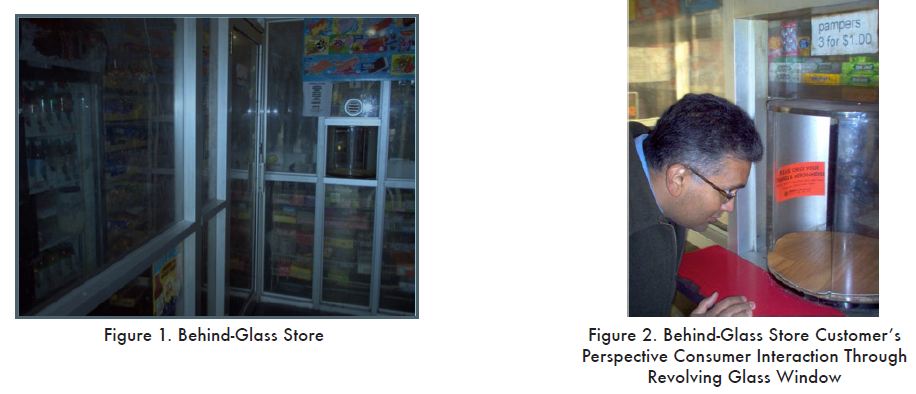
    “Food outlet data … are classifıed using the North American Industry Classifıcation System (NAICS)” (p. 130). Assuming validity and reliability of NAICS occupational categories is quite a red flag. It means that if something is coded “445110,” then — poof — it’s a grocery store! What could make for easier analysis? But your445110 may not be like my445110. Does your supermarket look like this:

    Well the NAICS says it does because they’re both coded 445. New York is filled with bodega “grocery stores” (probably coded 445120) that don’t sell groceries. You think this matters? It does. And the study even acknowledges as much, before simply plowing on like it doesn’t. A cigarette and lottery seller behind bullet-proof glass is not a purveyor of fine foodstuffs, and if your data doesn’t make that distinction, you need to do more than list it as a “limitation.” You need to stop and start over.

    Here’s one way to do it: a fine 2010 Johns Hopkins study edited by Stephen Haering and Manuel Franco. They actually care about their data. Read the first page in particular for the problems of food-store categorization. It matters. And notice the sections titled “residents personal reflections on their local food environment” and “food store owners’ attitudes regarding stocking healthy food.” What a concept for researchers to actually talk to people! (The picture above is from this study.)

    I find this so frustrating because so much quantitative analysis is so predictably problematic, over and over, again and again, in exactly the same way. Here’s the mandatory (and then ignored) disclaimer (p. 134, emphasis added):

    Possibly even more of a limitation is the quality of the … business listings, although this is a criticism that applies to all similar studies, including those reporting significant fındings…. More generally, categorizing food outlets by type tends to be insufficient to reflect the heterogeneity of outlets, and it is possible that more detailed measures, such as store inventories, ratings of food quality, and measuring shelf space, would be more predictive for health outcomes. Unfortunately, such data are very costly and time consuming to collectand may never exist on a national scale.

    So let me get this right, because “all similar studies” use this flawed data, it’s OK? And because getting good data may be “very costly and time consuming to collect,” we’ll simply settle for what we have at hand? Bullshit!

    You know, perhaps we never will have good data on a national level about what produce is sold in each and every store in America. I can live with that. But it is neither very costly nor time consuming to simply go into every store in any one neighborhood and see what is there. Do a spot check. Or at least read and learn from the John Hopkins study. I just found it on google without even trying. They managed just fine. And if a corner store sells three moldy heads of iceberg lettuce and some rotting root vegetables, it is not the same as Whole Foods simply because they’re both coded 445!*

    Ironically, An and Sturm may still be right about their conclusions, but more by accident than design. Maybe the focus on food deserts is barking up the wrong tree. Perhaps obesity is notcaused primarily by lack of access to good food. Maybe people do not want to eat healthy foods. Or maybe people simply don’t know how to cook. Maybe we need to bring back Home Ec. I don’t know. Certainly, I think we can agree, culture matters. But quantitative people don’t like looking at culture because it’s so hard to count. And who has the time to do time-consuming ethnographies when we’ve all got to get our name on as many co-authored quantitative peer-reviewed journal articles as possible?

    There actually is (or was?) an excellent produce store in Baltimore’s Eastern District, Leon’s Produce. Conveniently it was right by a busy drug corner. Talk about one-stop shopping! Seriously, as a cop, I could suppress the corner drug market and buy onions and carrots. And yet people would indeed pass up this local family-run store to buy a cheesesteak or yakomee.

    Maybe the problem is intense neighborhood isolation. Drawing a geographic circle around somebody and saying a grocery store is “close enough” may not matter if you’ve never left your neighborhood, don’t have access to a car, or are afraid to walk down the block. Speaking of cars, Sturm also uses CHIS data in which “Only 3% of households … report not having access to a car.”

    Well there’s another red flag.

    What does “access” mean? I suspect to some it is gathering $10 for a gypsy cab or knowing somebody who may let you borrow their car in an emergency.

    The authors acknowledge the limitations of CHIS data, and then go right on using it: “The response rate … remains low, and the current study sample has a large proportion of missing values” (30%, in fact!). If you’re looking at the problems of poverty in America and believe data that say 97% of people have access to a car, you’ve got your head up your ass.

    And if you have bad data, it doesn’t matter what fancy quantitative methods you use. It’s putting lipstick on the damn pig of correlation. Garbage in, garbage out:

    The primary dependent variables (i.e., counts of food consumption) are regressed on the explanatory variables using negative binomial regression models, a generalization of Poisson models that avoids the Poisson restriction on the mean-variance equality.

    Wow! Negative binomial Poisson regression models to avoid the mean-variance equality restriction. I (to my shame) no longer have any idea what that means, even though Poisson regressions were all the rage when I was in graduate-school. But I do remember the fatal flaw of non-random missing data.

    I’m not against quantitative methods. I’m against bad research.

    And I also believe you need to talk to the people you’re studying no matter what methods you use. I don’t trust your study on poverty if you’ve never talked to a poor person. I don’t trust your research on police if you’ve never talked to a cop. I don’t trust your research on crime if you’ve never talked to a criminal. Nor do I trust your research on obesity if you don’t talk to a fat person. And if you’re going to write about food deserts, you’d better talk to some people who live in one. If you’re not careful, you may learn something before it’s done. Once you quant-heads actually talk to the people you’re studying, then you can go ahead and run all the regressions they want.

    *Update (April 29): As one commenter pointed out, a Whole Foods is not coded the same as a corner store (because the Whole Foods is larger). Indeed. But you still get my point.


    And here’s a picture of a corner “deli-grocery” in Crown Heights, Brooklyn (NYC):

    It was in the Daily News because 14 were arrested for a running a drug ring from it. I strongly suspect it wasn’t a good place for quality groceries.
  • UC-Davis Pepper Spray

    From Jack Stripling in The Chronicle of Higher Education:

    The pepper spraying of student protesters at the University of California at Davis in November, an incident that provoked international outrage, constituted an unjustifiable use of force in an operation that was bungled by failures of leadership and communication at nearly every level, an investigative report issued on Wednesday asserts.

    The damning report, which was commissioned by the university system’s president at the request of the campus’s chancellor, highlights a series of missteps that culminated in what it calls a “critically flawed” and unauthorized police action.

    The report’s major findings include [Still quoting the Chronicle but I’ve added the numbers]:

    1) The use of pepper spray “does not appear to have been an objectively reasonable use of force.”

    2) Davis campus police officers used a type of pepper-spray weapon they were not authorized to use, were not trained to use, and did not correctly use.

    3) Davis’s chancellor, Linda P.B. Katehi, failed to communicate that police officers should avoid using physical force.

    4) The command and leadership of the Davis police force is “very dysfunctional.”

    5) There is little evidence that protesters attempted violence against the police and weak factual basis to support the officers’ contention that they felt trapped by a “hostile mob.”

    6) Davis should develop accepted rules for regulating campus protests and commission an outside review of police protocols.

    To that I say: 1) yes, 2) don’t know, 3) rings true, 4) ditto, 5) ditto, 6) sounds good, probably bullshit.

    I have two other posts on this incident. You can find them 1) here, and 2) here.

    You know, one thing I learned at NPIA, Bramshill (the excellent UK police college where I was last semester) was a better way to handle crisis situations. The Brits do it with “Gold,” “Silver,” and “Bronze” positions of leadership. I don’t know if it’s the best way. It’s probably not the only way. But it’s a damn good way to know who is in charge and who is doing what. Now I have not risen through the ranks of a US police department. And I had the wonderful honor of taking part in an international police leadership class in the UK (a very expensive class at that). I was pretty impressed at the UK way. For instance, if you get promoted to a high rank, you go to (and live at) Bramshill and take a 10-week class. That’s leadership training.

    Because here’s the thing… I have the sneaking suspicion that most US police departments have noleadership training. From my experience, it was first officer on scene and then anybody else could pull rank. That is not a plan. That is not leadership.

    And yes, as always, please do comment and correct me if I’m wrong.

  • Zimmerman Charged w/ 2nd-Degree Murder

    The storyin the New York Times. Shouldn’t he also be charged with lesser degrees of murder? And assault?

  • More Evidence of Creeping Sanity

    By Cesar Gaviria, Ernesto Zedillo, and Fernando Henrique Cardoso.

    Gaviria is former president of Colombia, Zedillo former president of Mexico, and Cardoso former president of Brazil. All are on the Global Commission on Drug Policy. They say:

    The facts speak for themselves. The foundations of the U.S.-led war on drugs — eradication of production, interdiction of traffic, and criminalization of consumption — have not succeeded and never will. When there is established demand for a consumer product, there will be a supply. The only beneficiaries of prohibition are the drug cartels.

    The stunning reduction in the consumption of tobacco in the Americas shows that prevention and regulation are more efficient than prohibition and punishment.

    A paradigm shift, combining repression of the violent drug trade with increased investments in treatment and prevention, would be the best contribution that Latin America — a region that has suffered so much under drug prohibition — could make to global reform of drug policies.

    [Thanks to J.B.]