Copinthehood.com has moved to qualitypolicing.com

  • Drug Warrior Drug Dealers

    El Paso County Commissioner Willie Gandara Jr. recently said:

    Legalizing drugs is the coward practice of combating cartels, it is an insult to our men and women in law enforcement, and the laziest form of parenting our children and youth about the effects of drugs…. Unfortunately, on this upcoming primary election we will have many wolves in sheep’s clothing running for office who are seeking election with an ulterior agenda to legalize drugs.

    Keep fighting the good fight, right? Standard talk from a prohibitionist politician. But makes this interesting…

    Gardara was just arrested on federal drug-trafficking charges including possession of marijuana with intent to distribute and conspiracy. How about that?

    [thanks to Drug WarRant]

  • Another Day at the Office (II)

    From Sarah Armaghan in the Daily News:

    Sgt. Craig Bier and Officer Donnell Myers [were] in an unmarked car … when the gunfire started.

    Myers, who was in the driver’s seat, whipped his head around to see Chinloy squeezing off shots from a .40-caliber Glock handgun at some people in front of a store, police said.

    “When Officer Myers looks over his [left] shoulder, he sees the muzzle flash on the firearm as the guy is shooting toward the group,” a police source said. “They were right there.”

    When Myers stopped the car, Chinloy came charging at them – the gun still in his hand, a police source said.

    With their guns drawn and badges on display, the cops ordered the man to drop his weapon.

    The Crip threw his weapon to the ground, police said.

    Bier – who has spent four years of his 14-year NYPD career in the gang unit – and Myers, an eight-year vet with three years in the gang unit, quickly collared the teen, police sources said.

  • Police versus Disciples in Chicago

    There’s some good reporting by Frank Main of the Chicago Sun-Times. He goes beyond Police Supt. Garry McCarthy’s bombast (“We’re going to obliterate that gang,” he told police brass in a meeting in June. “Every one of their locations has to get blown up until they cease to exist.”) to talk to actual gang members. I’m generally tempted to dismiss “get tough” language as ineffective bombastic bravado, but I have faith in Superintendent McCarthy. And so far what police in Chicago are actually doingseems to be working.

    “Maniac Latin Disciples members are now under gang orders to keep violence to a minimum because of the police crackdown, the ranking member said.”

    Well now, isn’t that the idea? The gang member continues, talking about their cars:

    “Most of the shorties don’t have licenses or insurance,” the ranking member said. “They’re easy to pick off.”

    He said a lot of them aren’t reclaiming their seized cars because they don’t have the money. Some of the seized cars contained hidden guns the police didn’t find, he added.

    Asked if he thinks the police will let up, the gang member acknowledged, “Stopping the violence is the only way. They know we’ll always be selling drugs. The cops will tell you, ‘I won’t trip out about you having weed in your pocket to feed your kids.’ But when you start shooting across schoolyards and shooting little innocent kids and s— like that, they’re not going to tolerate that. I get mad. I’ve told the mother-f—— shorties in our mob to stop doing that f—— b——-. How do you think the parents feel? That’s our neighborhood.”

    Surprisingly, the gang member said he didn’t know police Supt. Garry McCarthy’s name — even though the superintendent is the source of the Maniac Latin Disciples’ recent troubles.

    But he does know McCarthy’s face from the TV news as the “top dog who gives the orders to the foot soldiers.”

    “All I know is that people are hiding under rocks because of him,” the gang member said.

    Between Jan. 9 and Feb. 5, for example, there weren’t any shootings in the district, compared to seven for the same period of 2011, police said.

    Beat 1423 saw calls for police service drop from 127 for the last six months of 2010 to 56 for the last six months of 2011.

    Let’s keep an eye on this and see whether it lasts. That’s what separates a dumb crackdown from smart policing. You can always flood an area with cops, and that will reduce crime. But you can’t afford to keep an area flooding with cops. And what happens after police leave is the real test. Violence stays down when police patrol and police intel and the DA and probation and patrol all get on the same page.

    I mention this because there’s a tendency among academics to fail to notice the key moment when police do something right. If violence does stay down, in a few year’s time the SPSS set will say, “Correlation doesn’t equal causation. We can’t say police were the cause because there was no proper control-group study (or any study at all).” And then later, looking back, you’ll hear, “well, the neighborhood got better” and “there were a multitude of factors” and “community efficacy really coalesced.” Sociologists will look at the community and might credit the positive transformation of gang culture; economists will notice a greater involvement of gang members in the legal workforce; teacher will credit themselves; preachers will credit God. Well, yes, but sometimes it all starts with the good, smart, aggressive policing.

    In effect, academics assert that if we can’t prove (to a level of 95-percent statistical certainty) that police are the cause of a crime drop, then it would be misguided (at best) to give police (or, God forbid, an individual police chief) credit. Think about it… we use our own ineptitude and short-sightedness to justify our dismissal of effective policing. That’s a nice little trick!

    The time to do research isn’t after the fact, from your office, but right now, on the streets around Humboldt Park, Chicago.

    Maybe what’s going on in Chicago isjust a few months of police overtime and a few extra arrests. Maybe next year everything will be back to normal and cops will be sitting in their cars waiting for the next shooting. But maybe not. It would be nice to know.
  • “Your stated interest is in being a cowboy”

    Ta-Nehisi Coates has good thoughts on the New York Times piece by Binyamin Applebaum and Robert Gebeloff describing how people vote against the government programs they receive. This isn’t necessarily against their own interests. As Coates says:

    What I strongly suspect is the sort of shame you see in Mr. Falk’s is neither crazy, nor ignorant, nor shocking, once you think about it. We all want to be cowboys. More, we sometimes want leaders who push toward that imagined self, as opposed to our statistical self.

    As I have always said, this not a matter of voting “against your interest.” Your stated interest is in being a cowboy. The way to engage that person is not to condescend to them and assume they just have less information than you. It’s to try to get them to game out where cowboy logic leads.

  • Jeffrey Goldberg on the crime drop in DC

    And talking to Washington’s police chief, Cathy Lanier. Bloomberg.com:

    Lanier outlined some of the changes in the way her department does its job — procedural, technological and investigative changes that I suspect have more to do with the drop in homicides than sociologists might credit.

    I suspect the same.

  • My most requested record

    My most requested record

    This may surprise you, but my all-time most-read post, by far, has (almost) nothing to do with police or the war on drugs.

    This post has gotten more hits (by more than a 2:1 margin) than my next most-read post. And the latter was featured in the Atlantic Wire.

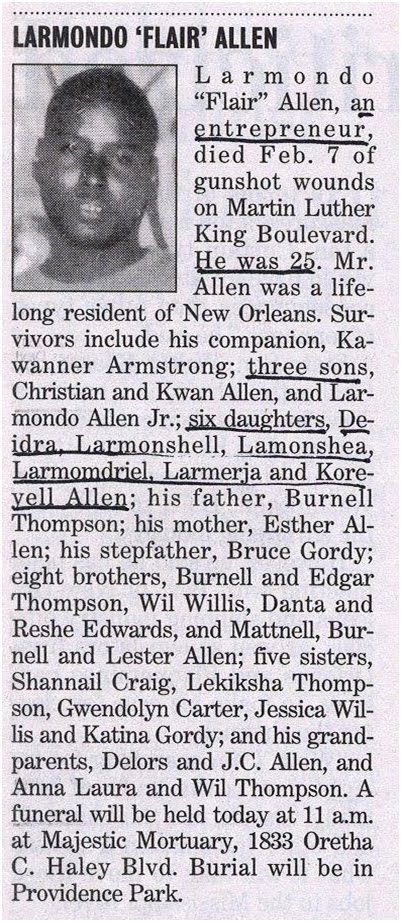
    My most-read post is about a young black man of no particular note who died a violent death in New Orleans. Very much a father-to-many-married-to-none kind of guy. He was also a drug dealer. His obit–I think tongue in cheek–called him an “entrepreneur.”

    So somebody reads the obit and gets upset. He writes an email to his buddies complaining about liberal values and welfare. The email goes viral. The problem, of course, is that the “facts” in his email aren’t true. So I tried to set the record straight.

    People continue to get this email and a few of them run it through google. My post comes up. I’m definitely not preaching to the choir on this one. It’s worth a read.

  • Up with Up with Chris Hayes

    I’ve always loved doing radio interviews and never been keen on TV. Partly because most TV is so stupid. Why should I put on a suit to get driven to Manhattan (they don’t like it if you make your own way to the studio) to stare into a camera and then say a talking point to somebody I can’t see (and can barely hear)? And then, after the ever awkward slight audio delay, say one more thing. Then somebody says something and the host pats himself on the back for such an in-depth discussion. Sometimes, rarely, it might even last 5 minutes.

    Roger Ebert once said, “When writing you should avoid cliché, but on television you should embrace it.” Unfortunately, that’s true. TV is a strange medium. And that’s what you’ll be thinking when you’re done.

    Or maybe it’s one of those craaazy shows. Think about it the next you see somebody on TV–especially somebody huffy and “passionate,” particularly if he’s conservative and on some trading floor or doing an infomercial (I’d love to see a conservative infomercial on a trading room floor–not certain what they’d be selling)–think of how crazy (and scarily skinny) most TV people would look if they were behaving that way and weren’ton TV. It’s a very silly game to play.

    Up With Chris Hayes was different. Don’t like the political slant? Get over it. (Whatever happened to it being unpatriotic to criticize the President during wartime? Oh, I guess that only applied from 2001-2009.) But leave that aside and think of what “Up With Chris Hayes” actually does.

    It’s an actually conversation. With real live human beings. People with whom, as a guest, you can make eye contact with and touch. It also is long (time flies when you’re on the air… but I think I was there for 40 minutes). It’s somewhat free form. And yes, the conversation really does continue unabated during the commercial break. (Usually there’s just some mindless shuffling of paper until some techie gives the all clear.) Up with Chris Hayes is like the best of radio… but in living color. And at least now, a few years after my first TV appearance, I finally have a suit that fits.

    Also, I was really tempted by those pastries in the center of the table. I wonder if they were tasty? I really wanted to shove them into my pie hole and sit back contently spitting out bits of sugar every time I talked. Hey, free is free! You can take the cop out of the uniform… but then you might have trouble getting the uniform back on the cop.

    Here’s the link to the video. It’s segments 4 through 6.

    [You can read more about the TV experience in general on one of my older posts.]

  • Me on “Up with Chris Hayes”

    Tune in tomorrow (Saturday) around 8:40AM (Eastern Time) to MSNBC.

  • PTSD in the BPD

    An article by Peter Hermann in the Sun on an important but little talked about subject, the effect on police of police-involved shootings:

    Union leaders say city police do a good job of providing counseling to officers in the immediate aftermath of a shooting, but fall short in recognizing long-term psychological effects. Psychiatrists and police officials interviewed all caution that each shooting is different, as is the reaction of each officer.

    One active-duty officer, Andrew W. Gotwols Jr., said he was never offered help after he shot and killed two people nine months apart in 2006 and 2007. He still has nightmares that “guys are trying to shoot and kill me, and that I’m trying to shoot and kill them.”

    And a retired police commander who was one of the officers involved in the 2005 shooting with Willard said he suffers no ill effects from the incident, but added that after a time, “you start thinking, ‘There’s another close call, hopefully I can make it through my career without running out of luck.’”

    My own experience in the aftermath of a horrible cop-on-cop car crash (in which a friend of mine was nearly killed) was that a shrink was made available to me and others on scene. I didn’t feel the need to use the services. That was that. (My friend was lucky to live, and never policed again.)

    I will vouch for the fact that as a cop, work/anxiety dreams are never fun. Now, as a professor, I just have the occasional dream of not being able to get to class on time. It’s laughable compared to the dreams I would sometimes have as a cop, always involving guns and danger. (Of course everything about my job can sometimes be laughable compared to what I had to as a Baltimore cop. Anyway… work-related dreams are something I do not miss about policing–just one of the reasons teaching is better.)

  • Good guys win one in subway shootout

    Denis Hamill writes in the Daily News:

    For all the criticism the cops are taking these days for the out of control stop-and-frisks, for the questionable shooting of Ramarley Graham in the Bronx, let’s take a deep breath and not lose track of the vital, life-risking work these guys do every day in this big scary city.

    And kudos to Officer Herlihy for successfully returning fire after taking one in the arm.