Copinthehood.com has moved to qualitypolicing.com

  • What they think I do

    What they think I do

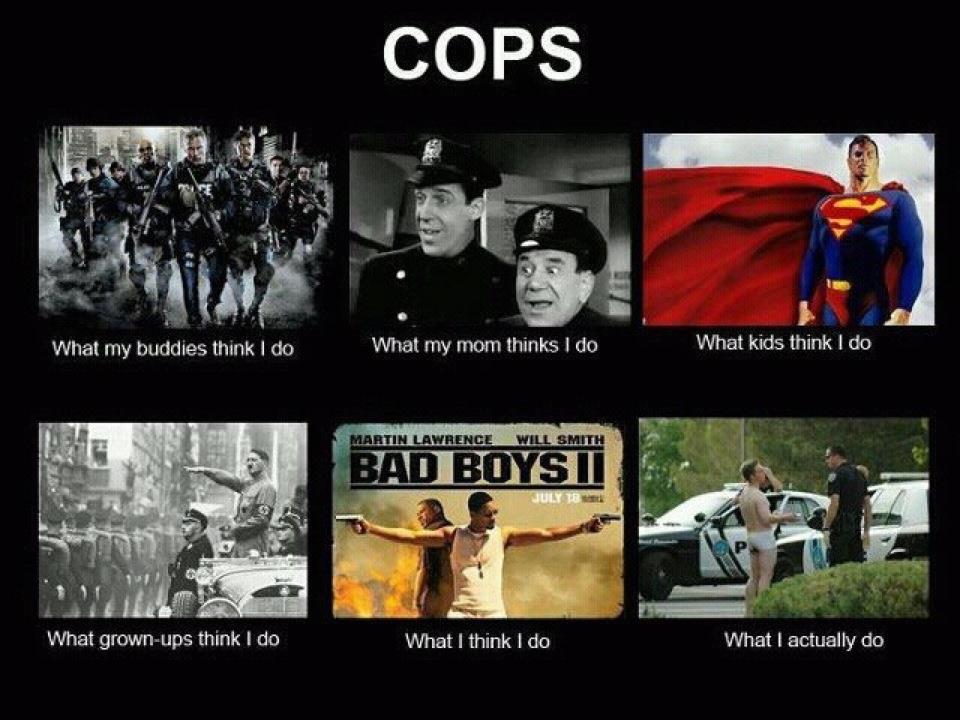
    There are a lot of these “what people think I do” versus “what I do” gags going around. Some are pretty funny. Here’s one on policing. The intellectual in me thinks of the Rashomon Effect. The kid in me just giggles at seeing Lou Costello in a police uniform.

    [thanks to Stef the Greek]

    [Hey all you folks, consider buying my book, Cop in the Hood. It’s good.]

  • Poor Greece

    Poor Greece

    Well the bastards burnt down my favorite movie theater in Athens.

    Perhaps in the big picture of cultural destruction, it doesn’t rank up there with the destruction of the Buddhas of Bamiyan, but man, those red seats were comfy.

    Supposedly the theater will be rebuilt. (And supposedly a train will once again connect Athens and Patras).

    Meanwhile minimum wage in Greece is to be cut drastically to about €600/month. That’s less than $5/hour (and not even that, if you’re under 25). You try living on that. Thank you, Angela Merkle.

    Why should you non-Greek don’t-give-a-damn kind of person care?

    Because it’s the Republican solution. Cut spending. Cut pay. Balance the budget. No welfare. Limit unemployment to a year. Don’t worry so much about getting the rich to pay their taxes (after all, if they paid tax, they may not produce all those jobs for swimming pool cleaners).

    Screw the economy because it feels morally right. Gotta balance the budget. F*ck the working poor. After all, I heard on the radio they’re kinda lazy.

    Bet it won’t work.

  • Misquoted in Salon

    Not me. But my father. And he died in 2008.

    Linda Hirshman seems to have a bone or two to pick. She writes in Salon.com:

    If any evidence of this [“warfare is the business of heterosexual men, the penetrators”] agenda were needed, the same person who created and defended the dreaded “don’t ask, don’t tell” — military sociologist Charles Moskos — was the loudest advocate of excluding women from any combat roles.

    Woman’s “compassionate nature” Moskos speculated in a 1990 Washington Post op ed, would be a real hindrance.

    That doesn’t sound like my father. It just didn’t ring true.

    So I looked up the Washington Postop-ed (“Women in Combat: The Same Risks as Men?” Feb 4, 1990) and could not find those words or that meaning. I wonder where the quote is from. Regardless, it seems low to misquote a dead man.

    In fact, in that op-ed my father made exactly the oppositeargument: “The problem of a trial program of women in combat roles is not that it will prove women cannot fight, but that it will prove they can.” He thought society wasn’t ready to have women forced into combat situations. Twenty-two years ago, he might have been right.

    But I guess such facts get in the way of Hirshman’s agenda.

  • Congrats to Officer Brennan

    Who left the hospital today after being shot in the head. He too, was just doing his job.

  • Round up the Usual Outrage

    An officer, who heard over his radio that a drug suspect was armed with a gun, kicks down the door of his apartment, finds the suspect hiding in the bathroom (probably trying to flush weed down the toilet), thinks the suspect is going for his gun, and shoots and kills the suspect. The problem is that the suspect, according to police, wasn’t armed. (Remember this the next time you think officers carry a drop gun.)

    The officer made a big bad lethal mistake. And he was very quickly thrown under the bus by the Commissioner and the department. But I don’t know what I would have done in the same situation. Probably the same thing. The cop fired not because he wanted to kill an unarmed man and destroy his own life and career, but because he thought he was going to be killed. Unfortunately for everybody, he was wrong.

    When this kinds of events happen, don’t be be surprised or shocked or outraged. This is what happen with drug prohibition and the war on the drugs. The courts destroy the 4th Amendment. Police bust down doors. Police assume (with the courts’ blessing) that drug dealers are armed. Sometimes police make mistakes, and unarmed people get shot.

    I wouldn’t say it happens all the time. But it sure does happen a lot. And it will continue to happen as long as we keep fighting the bad fight and refuse to seriously consider changing our laws against illegal drugs. In the meantime, let me know when we start winning.

  • Those were the days… The Evanstonian

    This isn’t about policing in the old days. It’s about me. Or more specifically, my old high-school newspaper, the Evanstonian, in the late 1980s.

    I was just cleaning house (which, admittedly, is a rare activity) and stumbled across my old bound collection of Evanstonians.

    Sara Agahi (nee Rubin), my former student editor (before I became one), still likes to take credit for all my writing success. Perhaps she deserves it. So did Mr. Ronald Gearring, my sophomore English teacher (who I believe passed away a few years ago — Most amazingly, to anybody who knows ETHS, is that Mr. Gearring kinda secretly lived across the street, on the 1600 block of Dodge Ave… just a few doors down from the house from which a student on the high-school front lawn was shot in 1988).

    But pitty poor Mr. Rodney Lowe, the fine journalism teacher and faculty adviser of the Evanstonia. He took over from a legendary journalism teacher and had to deal with a declining school paper… and me.

    From the March 10, 1989 Evanstonian, I came across this line, written by me: “I have succeeded in my goal as a writer if people read my words and think, discuss, and questions — whether in agreement or opposition — the issues I raise.” I couldn’t agree more. But, hey now, what was that about?

    Well, in just two issues of the school paper, I had managed to insult a vengeful Dean (“Why doesn’t my dean use correct grammar? Or are double negatives and ‘ain’t’ just a post-modern liberal approach to student relations?”), bring attention to the Superintendent (“The day Robert Goldman tries to dry his hands with flimsy toilet paper will be the day all bathroom are stocked with paper towels.”), and, with this line, provoke a girl to track me down and seriously threaten me: “Does anybody out there have a Coach Sheehan photo album?”

    [Turns out this girl was the very same he took pictures of! In his defense, they did get married during his trial for child pornography, for which he was found guilty.]

    I went to a great high school. Seriously!

    But poor Mr. Lowe. What a pain in the ass I must have been. Mr. Lowe may not have loved what I wrote, but he did support me, and probably more than he wanted to. And should you read this, Mr. Lowe, thanks for getting me out of all those classes I ditched!
  • Teaching Chicago Police How to Write

    And not just reports. Monica Davey writes an interesting story in the New York Times.

  • Ethical Imperialism

    Ethical Imperialism

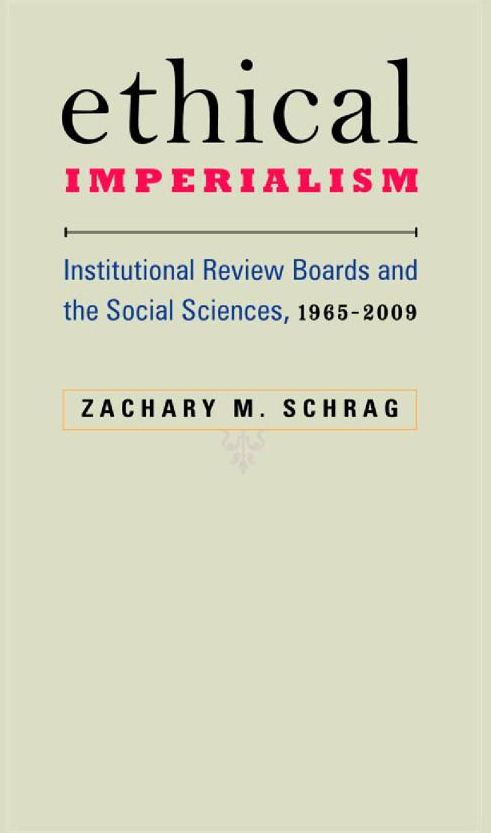
    A quick shout-out to Ethical Imperialism: Institutional Review Boards and the Social Sciences, 1965-2009. It’s exactly what it says it is. And it does it well. It’s a book about the IRB. If you don’t know what an IRB is, it’s not your fault, it just means you haven’t done research at a university. (Trust me, then the book isn’t for you.)

    But if “Institutional Review Board” makes you wake up in a cold sweat or has made you do worse research (and that just about covers all social-science researchers), you owe it to yourself to buy and read this book.

    Zachary Schrag is a Professor of History at George Mason University and trust me, he’s thought much more about the IRB than you ever will. So thanks for schooling us, Zach.

    Amazon link here.

  • Couldn’t have said it better myself! (II)

    So after an email correspondence with an editor at The New Yorker, they responded at length and denied pretty much everything: “The particular facts and comparisons you cite…don’t seem specific to your work.” Really? I beg to differ. But what can I do?

    I still think Adam Gopnik needed to cite me in the magazine.

    Gopnik now says rather nice things about In Defense of Flogging online. Had he just done so in the article, parts of which were, so, let us say, “inspired,” by my writing, I would be pleased instead of pissed. And despite Gopnik’s ever-modest insistence, he does manage to “unpack” my argument rather well:

    Peter Moskos’s In Defense of Flogging … depends on an extended analogy, difficult to unpack in summary form. Moskos, a professor of law (and, not incidentally, a former Baltimore police officer) both does mean his “case for flogging”–he thinks that the system is so rotten than even restoring the cat would be better–and rather strongly, I think, doesn’t mean it. He doesn’t really want to flog the evil out of prisoners. He wants to flog the indifference out of the rest of us. Moskos (who, I’m informed, seems to have coined the phrase “natural rate of incarceration”) rightly calls prisons “an insidious marriage of entombment and torture,” and his provocative book makes many sanely provocative points; it is one I’ve urged on those who want to do more reading on the subject, and I’d urge it again now.

    I’m sure glad Gopnik liked my book. I’m also sure it would have saved a lot of hassle had he just said so earlier.

    [Also, just FYI, I’m not a professor of law. Never have been. Never taken a law class in my life. The confusion comes from the name of my department: “The Department of Law, Police Science, and Criminal Justice Administration.” Call me a criminologist or a sociologist or, if you must, a professor of police science.]

  • NYC marijuana and jail

    Two good posts from Zachary Goelman. One on the latest death caused by marijuana (prohibition). The other on the new jail in Brooklyn.