 Brought to you by your local constabulary.
But what if I need to bake a last-minute cake for me mum?!
[I’m on blogging break. Regular posts will resume in February.]
Brought to you by your local constabulary.
But what if I need to bake a last-minute cake for me mum?!
[I’m on blogging break. Regular posts will resume in February.]
Neil Steinberg wrote a good review of In Defense of Flogging in my old home-town Chicago Sun-Times.
I’m particularly impressed that caught what I thought was obvious:
Moskos has brilliantly used the old PR trick of marrying a complex, off-putting topic to a fascinating one. If you want to trick people into reading about penal reform, brandish a whip. And be brief.
Steinberg goes on:
In Defense of Flogging is 154 pages long. I read it in less than a day, and it is an eloquent cry to address a problem that we spend billions of dollars trying to ignore. “We’ve run out of options,” Moskos writes. “What we have in America is a massive, terrifying and out-of-control experiment in incarceration.”
There’s no arguing about that.

From a 1970s Readers Digest.
[I’m on blogging break. Regular posts will resume in February.]
The Commissioners wish to remind the constables that, in every case when it is judged necessary to dismiss any man, the whole of his pay accruing from the last pay-day will be forfeited.
Source: Metropolitan Police. Instructions Orders &c. &c.1836. London: W. Clowes & Sons.
[I’m on break. Regular blogging will resume in February.]
The paperwork begins.
Some instances of rudeness on the part of individuals of the Police towards persons asking them civil questions have been reported to the Commissioners of the Police. the Commissions therefore call upon the Superintendents to instruct their officers and men.
The Superintendents will receive a book of instructions for every man and officer of their respective Companies; each man’s name will be written , and it is to be produced to the Inspector at least once a week, and the Superintendent will take care that those books are taken from the men that are dismissed, and are given to the men that replace them.
The Police Constables are desired to pay attention to that part which immediately concerns their own Duty, and having made themselves well acquainted with it, they may, by studying the others, endeavour to fit themselves for promotion.
The Superintendents of divisions will take special care that all orders given out are carefully read from time to time, when it may appear necessary, to impress on the minds of the men the several subjects to which orders relate.
Source: Metropolitan Police. Instructions Orders &c. &c.1836. London: W. Clowes & Sons.
[I’m on break. Regular blogging will resume in February.]
The Commissioners have again to express their great regret that the pay-day has not passed over without the occurrence of several cases of intoxication by members of the Police. The Commissioners have, in the execution of their duty, been compelled to dismiss the individuals guilty of a crime which renders them completely unfit for the Police service, and which cannot and will not be suffered. All the Police are, therefore, for their own sakes, again cautioned to be more on their guard against committing it.
Duly noted.
Source: Metropolitan Police. Instructions Orders &c. &c.1836. London: W. Clowes & Sons.
[I’m on break. Regular blogging will resume in February.]
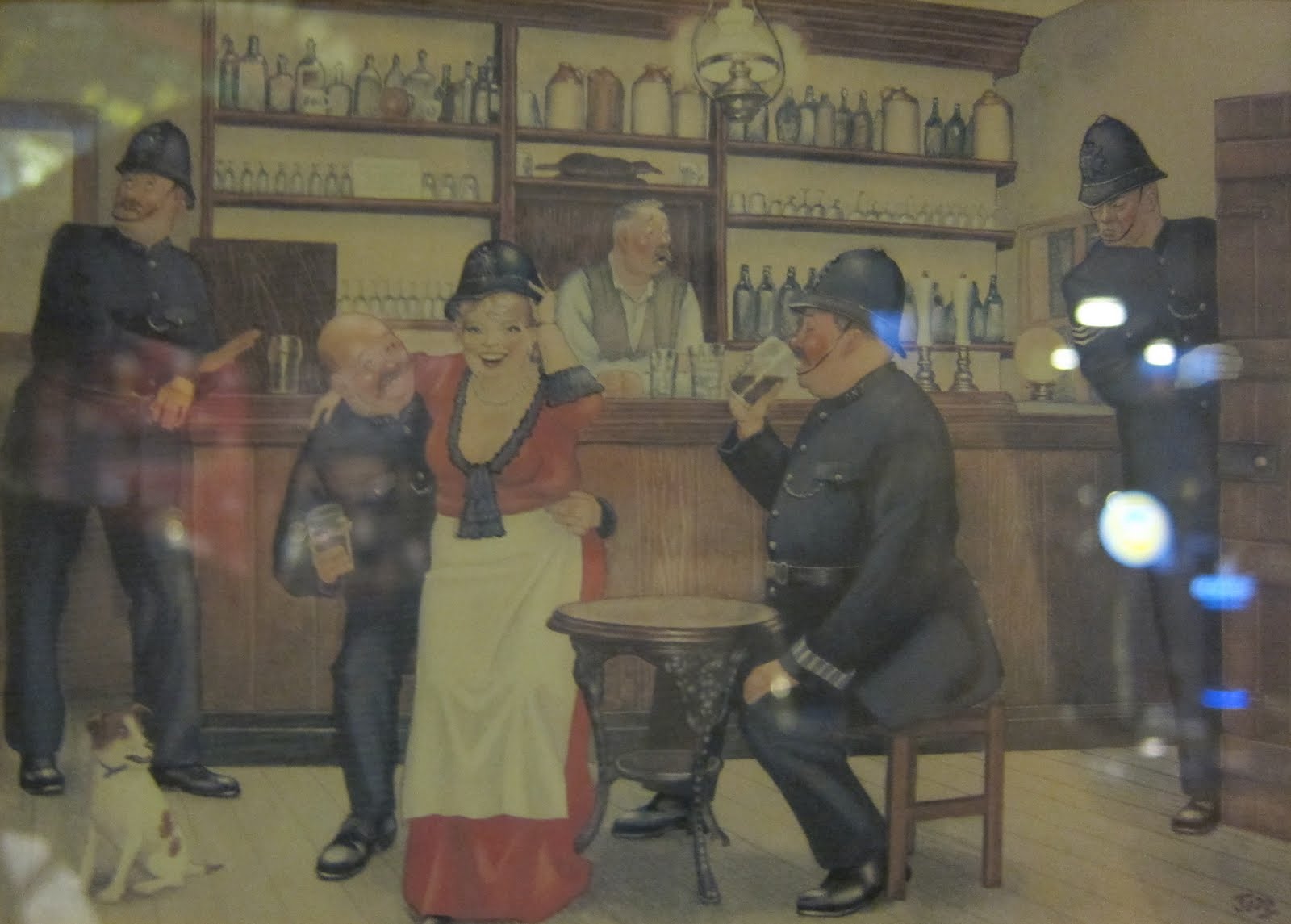
The Constables are not to go into public houses at night to order the landlord to close his house, or interfere in any other manner with the management or regulation of the house.
If public houses are disorderly, notice is to be given to the Serjeant, who will report the case to the proper authorities.
Sergeant: “What are you doing in that bar?!”
Officer: “I was [hic] just closing it down.”
Source: Metropolitan Police. Instructions Orders &c. &c.1836. London: W. Clowes & Sons. And the picture from a pub near Bramshill, England.
[I’m on break. Regular blogging will resume in February.]
Any man reported for endearvouring to conceal his number, or refusing to shew (sic) or tell it when properly asked, will be dismissed, as such concealment or denial can only be caused by having done something he is ashamed of.
Source: Metropolitan Police. Instructions Orders &c. &c.1836. London: W. Clowes & Sons.
[I’m on break. Regular blogging will resume in February.]

The Atlantic’s annual list of Brave Thinkers just came out. I’m in it (and with some pretty impressive company)!
Mind you, this doesn’t actually mean I’m a goodthinker… just a brave one.
From the WSJ via the Atlantic:
“It was a great mistake to put routine drug offenses into the federal courts,” he told the Senate Judiciary Committee Wednesday. The Wall Street Journal went on to report Scalia’s belief that the laws forced Congress to enlarge the federal court system, and diminished “the elite quality of the federal judiciary.”
…
The federal War on Drugs is diminishing the quality of our federal justice system. As far as I can tell, no one contests that conclusion. It would be one thing to bear that cost in exchange for a policy victory. After decades of failure, however, no one even expects the drug war to be won.Returning drug policy to the states would be a first step in the right direction.