Copinthehood.com has moved to qualitypolicing.com

  • Reasonable Doubt

    An NYPD officer were acquitted of rape today. Did I think he’s guilty? Yeah, I do. But I’m not surprised he was acquitted. (He and his partner were found guilty of lesser charges and promptly fired.) In fact, last week I predicted this exactoutcome (but just to my class… you’ll have to take my word). Why? because even I had doubt. You might even say “reasonable doubt.” Apparently the jury thought similarly. And that’s enough to acquit.

    It’s not easy to convict in this country. Especially if the accused has a good lawyer. Whether that’s good or bad, you decide. But that’s the way it is. And one reason it’s hard to convict police officers is that police know all too well how to play this game we call justice.

    I first had doubt after I heard the whole so-called “confession” tape, a secret recording the woman made while confronting the ex-cop outside a police station [which I can’t find a link to, but I know it’s out there because I heard it… can anybody find me the link?]. It’s hardly a confession at all. In some ways, it’s consistent with an innocent man simply trying to appease a potentially hysterical woman at his place of employment. Yes, he said he wore a condom. But it was only after a longer talk where he denied, repeatedly, ever having sex. She said she was only concerned with the consequences of unprotected sex. So finally he tells her what she wants to hear: he says he wore a condom. It’s not hard to believe that any innocent man would say the same thing in the same circumstance.

    Of course a guilty man might have said likewise. But that’s the point about doubt. You don’t have to believe somebody is innocent to vote to acquit.

    Do guilty people get away with crimes? All the time. A similar but far greater travesty of justice happened when a burglar was later caught on tape admitting to rape. He too was acquitted (stupidly, the jury wasn’t allowed to know he had a history of burglary, which was a pretty key piece of evidence with regards to him being in the house!)

    And of course being convicted of something and loosing your job is hardly getting away scot-free. But it’s usually only big headline news when it happens to police (for instance, how much did you hear about the case I linked to above? Exactly). Don’t like it? Blame the criminal justice system. That’s what police do all the time.

    [Hell, you can even blame O.J. Simpson. His trial set the bar way to high in terms of conclusive “scientific” evidence.]

    [Update: Here’s a story about the jurors’ decision. I’m with this alternate juror: “I definitely thought some funny business went on…. Is it possible they raped her? Sure.” But that’s not proof beyond a reasonable doubt.]

  • “Don’t laugh: He makes a convincing case”

    In Defense of Flogging reviewed (favorably!) in Bloombergand today’s S.F. Chronicle. They “get it”:

    And at just over 150 pages of clear, smart and highly readable prose, Moskos’s sharp little volume has a potential audience far beyond the experts who dutifully slog through most tomes like this. It’s the kind of item that could be stacked next to a bookstore’s cash register. Think about it for a Fathers’ Day gift.

    I couldn’t have said it better myself!

    Read the whole review.

  • Where does that $50,000 go?

    California spends more than $50,000 per prisoner. A few years ago, back when it only costs $49,000 to lock a person up for a year, Mother Jones did a breakdown of where that money goes:

    Security: $20,429

    Medical services: $7,669

    Parole operations: $4,436

    Facility operations: $3,938

    Administration: $2,871

    Psychiatric services: $1,403

    Food: $1,377

    Education: $687

    Records: $513

    Vocational education: $289

    Inmate welfare fund: $282

    Clothing: $152

    Religion: $53

    Activities: $23

    Library: $23

    Transportation: $15

    Sources: Bureau of Justice Statistics; California Department of Corrections and Rehabilitation; National Association of State Budget Officers

    And just think, if we cut all those “activities” and “libraries” we give to prisoners, we would be spending only $49,954 per prisoner per year.

  • “Give offenders a choice–prison or FLOGGING; (he’s serious)”

    From CNN’s “In the Arena“:

    ONLY ON THE BLOG: Answering today’s OFF-SET questions is Peter Moskos.

    Moskos’s new book is entitled, “In Defense of Flogging.”

    The Supreme Court has affirmed a federal order telling California to reduce its overflowing prison population, a situation the majority said “falls below the standard of decency.” California now has to figure out how to reduce the population by more than 30,000 prisoners. From your point of view, why does the prison system in the U.S. continue to fail?

    Prisons fail because they don’t do what they were designed to do: cure criminals. And as long as we insist on fighting an idiotic “war on drugs,” nothing is going to better.

    Read the rest of the Q and A here.

  • Crime Down in Baltimore

    Homicides in Baltimore dropped from 238 to 223, giving the city its lowest homocide rate since the late 1980s. Baltimore is now fifth in murders, after New Orleans, Flint, St. Louis, and Detroit. The Baltimore Sunhas the story.

  • Highway Robbery

    From over at The Agitator.

    It’s reached the point where these “drug war” police don’t even pretend to be anything but money-hungry mercenaries.

  • Makes flogging look better and better

    Louis Theroux visited a Miami “mega-jail.” (You can watch a bunch of his other shows on youtube–I’m quite fond of them.)

    For a bespectacled, peace-loving Englishman, there can be few places less congenial than a berth on the sixth floor of Miami main jail.

    The place has to be seen to be believed. Up to 24 inmates are crowded into a single cell, living behind metal bars on steel bunks, sharing a single shower and two toilets.

    Little of the bright Miami sun filters through the grilles on the windows. Visits to the yard happen twice a week for an hour. The rest of the time, inmates are holed up round the clock, eating, sleeping, and going slightly crazy.

    But what is most shocking is the behaviour of the inmates themselves. For reasons that remain to some extent opaque – perhaps because of the bleak conditions they live in or because of insufficient supervision by officers, maybe because they lack other outlets for their energies, or because of their involvement with gangs on the outside, or maybe from a warped jailhouse tradition – the incarcerated here have created a brutal gladiatorial code of fighting.

    They fight for respect, for food and snacks, or simply to pass the time.

    In some cells inmates boasted that they had a policy of “mandatory rec” for new inmates – meaning any inmate coming into the cell had to fight (or “rec”) for a bunk, unless he was known to other inmates in the cell, in which case he might be granted a reprieve.

    And without privacy, sharing a single shower, many of the men had lost their sense of the normal social barriers – they were around each other continuously, using the toilets, speaking to loved ones on the phone, and, presumably, indulging in other physical functions. And when we were around them, the same rules applied to us – many of them, living like animals, had lost their grip on social norms.

    Another inmate, Rodney Pearson, known as Hot Rod, told me he’d been inside for several years awaiting trial. Prosecutors wanted to give him the death penalty.

    I asked him if, by some quirk of fate, I’d been arrested and sent to their cell, a bespectacled Englishman with a college education who was clearly not cut out to fight, they might let me off the “mandatory rec”. The answer was an emphatic “no”.

    One of the corporals said he thought the county might be happy to make reforms as long as I was happy to stump up the $600m for a new building.

    Keep in mind that these men have not been convicted of any crime (though admittedly most are guilty as charged). And almost all will one day be released, more f*cked up than ever. Can one think of better case In Defense of Flogging?

  • Alphabet City Memoirs

    When I re-posted those pics of a Baltimore crack house, I found one of the comments so interesting I asked the commenter to turn it into a guest post. Eddie Nadal, retired NYPD, graciously agreed. These are his words:

    I recently visited the Lower East Side in New York, the same LES where I was born, where my grandma lived for over fifty years, and where I worked as a cop for seven years in the 1980s. I felt like I’d stepped into an alternate universe. The Lower East Side that I knew back then was, to put it plainly, a drug-infested hellhole.

    At the first “feeding time” (the early morning hours when junkies venture out to get their first fix of the day), the streets looked like an open-air market. Drugs were openly bought and sold, and hundreds of people congregated on the four corners of Avenue B and 2nd street. The neighborhood was overwhelmingly Hispanic — the only time you saw a white person down there was if they were on their way to cop or leaving after copping.

    The city’s leaders announced that they’d had enough of the lawlessness and crime of the area, and to clean up the neighborhood, the NYPD started Operation Pressure Point in early 1984. The LES was flooded with cops who were given carte blanche to kick-ass first, take names later. I was one of those officers.

    Maybe I was just young and naive, but I truly believed that we were cleaning up the neighborhood for the benefit of the people who lived there, people like my grandma, people who were just trying to get by and live a decent life among so much squalor. Because despite the crime, junkies, and dealers on every corner, there was still life on those streets. There were still the corner bodegas, the panaderias with their delicious cafe con leche, the salsa music coming from open windows.

    Now those bodegas and panaderias are mostly gone, replaced with organic wine bars and trendy art galleries. As it turned out, real estate developers had had their eye on the area long before we moved in to clean it up, buying up properties at bargain basement prices and waiting for the moment when the neighborhood became safe enough to be profitable. Millions upon millions of dollars were made in the following years. The city had no intention of cleaning up the neighborhood for the decent people who lived there — there was too much money to be made by forcing out the poor and working class residents and instead turning those buildings into luxury apartments renting for $3,500 a month. Rent control and rent stabilization did exist, but not nearly enough to keep the neighborhood intact.

    The risks we took and the sacrifices we made back then were not to benefit the community I knew — a community that no longer really exists — they were to make money for the city and for the developers. Ihttp://www.blogger.com/img/blank.gift’s hard not to feel a bit resentful of that on some level. And to me personally, it’s upsetting to see that the neighborhood and culture I knew has more or less disappeared.

    Eddie Nadal has a new blog, 10-66 Unusual Incident. (Hmmm, 10-66 must be another one of them fancy NYPD terms I hear around town, like “perp,” “skell,” and “RMP”.)

    [update: here’s an article from the New York Timeswith a bit of the same theme.]

  • Why you’ll never be Batman

    By your second week, you’re unhappy that 90% of the crimes you’ve even seen up-close are just pathetic junkies buying crack from another pathetic junkie selling drugs to support his/her own habit. And nothing makes you feel LESS like Batman than scaring sad, homeless crackheads. You tried to chase down a kid when you saw him punch a lady and take her purse, but you can’t really pursue that kind of thing by running on rooftops, you gotta do it the hard way by chasing him on foot down the sidewalk… in your full Batman costume, where everybody can see you. People are taking photos on cell-phones, and yep there’s a cop car at the intersection and he saw you, and now he has his lights on and it’s YOU he’s after.

    The police draw their guns and order you to stop. You turn and grab for the smoke pellet on your belt to help hide your getaway, but unfortunately for you the cops see you reaching for something and open fire… and you suit’s armor is already a mess from the shotgun blast earlier. Uh oh.

    From Mark Hughes [and thanks to a comment by Simmmons].

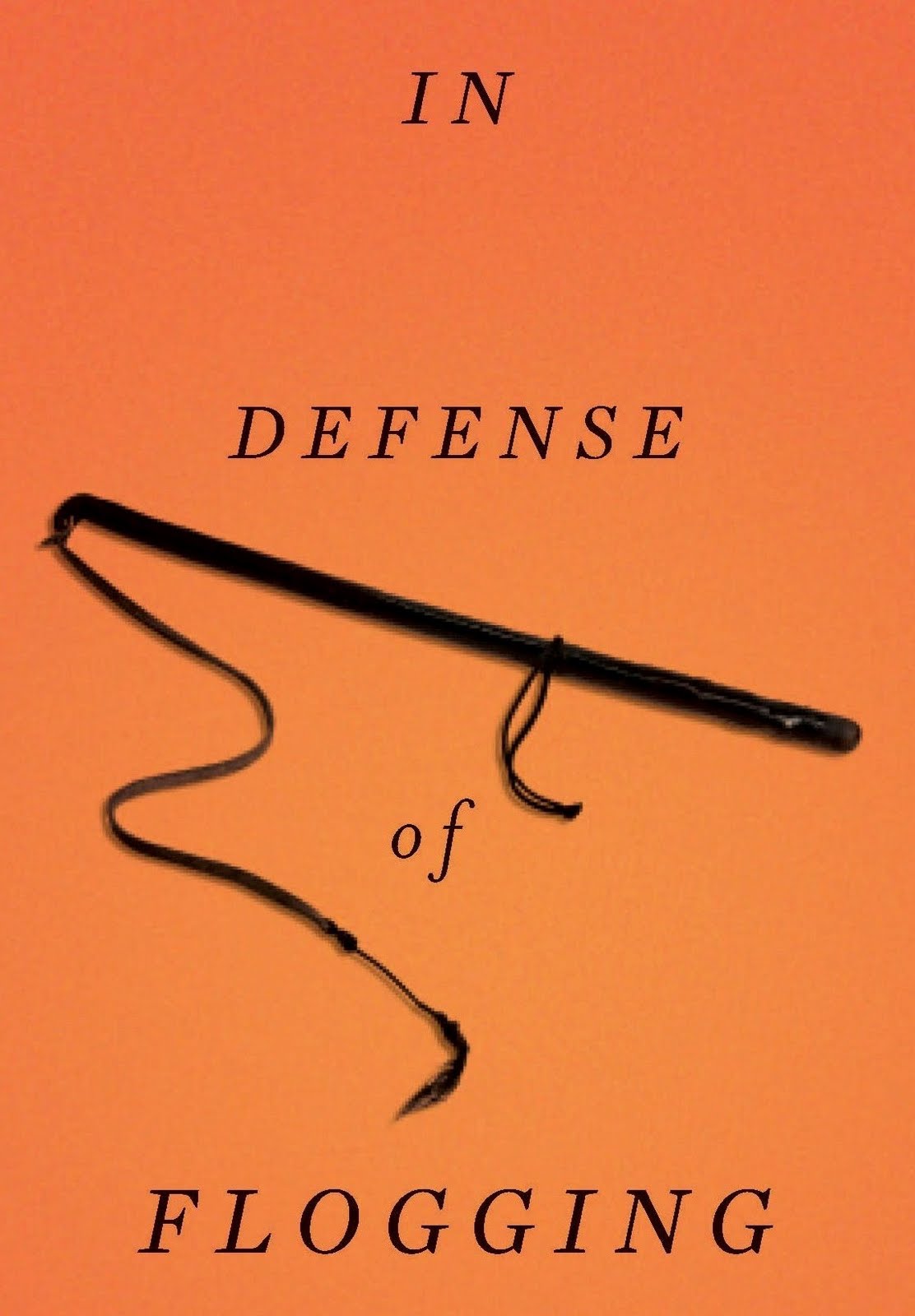
  • In Defense of Flogging

    In Defense of Flogging


    It’s in, hot, right off the presses!

    Amazon actually has nine copies of In Defense of Flogging in stock, for sale, ready to ship, to be in your grubby hands tomorrow!

    But I just bought eight of them. Still, that leaves one.

    The official release date is June 1. So your local bookstore should have them soon.