Copinthehood.com has moved to qualitypolicing.com

  • “I had to blame myself for a lot of things too”

    This is not the usual message I’d expect from a man whose armed son was just killed by police, provoking a bit of burning in Milwaukee:

    What are we gonna do now? Everyone playing their part in this city, blaming the white guy or whatever, and we know what they’re doing. Like, already I feel like they should have never OK’d guns in Wisconsin. They already know what our black youth was doing anyway. These young kids gotta realize this is all a game with them. Like they’re playing Monopoly. You young kids falling into their world, what they want you to do. Everything you do is programmed.

    I had to blame myself for a lot of things too because your hero is your dad and I played a very big part in my family’s role model for them. Being on the street, doing things of the street life: Entertaining, drug dealing and pimping and they’re looking at their dad like ‘he’s doing all these things.’ I got out of jail two months ago, but I’ve been going back and forth in jail and they see those things so I’d like to apologize to my kids because this is the role model they look up to.

    When they see the wrong role model, this is what you get. They got us killing each other and when they even OK’d them pistols and they OK’d a reason to kill us too. Now somebody got killed reaching for his wallet, but now they can say he got a gun on him and they reached for it. And that’s justifiable. When we allowed them to say guns is good and it’s legal, we can bear arms. This is not the wild, wild west y’all. But when you go down to 25th and center, you see guys with guns hanging out this long, that’s ridiculous, and they’re allowing them to do this and the police know half of them don’t have a license to carry a gun.

    I don’t know when we’re gonna start moving. I’ve gotta start with my kids and we gotta change our ways, to be better role models. And we gotta change ourselves. We’ve gotta talk to them, put some sense into them. They targeting us, but we know about it so there’s no reason to keep saying it’s their fault. You play a part in it. If you know there’s a reason, don’t give in to the hand, don’t be going around with big guns, don’t be going around shooting each other and letting them shoot y’all cause that’s just what they’re doing and they’re out to destroy us and we’re falling for it.

  • 40 shooting victims and 672 arrests? “That’s ridiculous!”

    CBS reports:

    At least 52 people were shot across [Chicago] over the weekend, including nine homicides.

    (“At least”? Has it got so bad that we can’t even keep track?)

    Chicago Police Supt. Eddie Johnson, talking about the 40 victims known to police, is “sick of it”:

    672 arrests? That’s ridiculous!

    There’s a certain segment of the community that is driving this violence. The police department is doing its job. We’re arresting these individuals. Where we’re missing the boat is we’re not holding them accountable.”

    2,639 people have been shot in Chicago this year. That’s an increase of more than 50 percent from last year. That really is ridiculous.

    And it’s even worse in Baltimore. Stephen Morgan, my Harvard squash mate — I love saying that because, put together, those might be the four snootiest words in the English language! (That said, in grad school Steve and I did play squash once or twice, and I’m pretty sure I won.) — anyway, Steve sent me these numbers for Baltimore:

    28 days beginning Monday 6/27/16

    Homicide 33

    Shooting 63

    Carjacking 32

    Street robbery 283

    28 days beginning Monday 6/29/15

    Homicide 38

    Shooting 84

    Carjacking 31

    Street robbery 327

    Prior five-year average of equivalent four weeks (from 2010 through 2014)

    Homicide 18.4

    Shooting 38.2

    Carjacking 13.6

    Street robbery 210.6

    If there was any doubt, murdres and shooting doubled after last year’s April riot. There’s a link to his updated report (and a few other things) here.

    But when I bring up increased crime, I feel like half the world is gas-lighting me. First there’s this inevitable rebuke: “Fear mongering! Crime isn’t up. It’s at all time low!”. There’s usually talk about the the “latest available data” as if time stopped in 2014. Yeah, back then crime was at a many-decades low. But now it’s not. Who you gonna believe?

    If history is any guide, liberals really should not concede crime fears to the Right. Yes, the public always thinks crime is getting worse. But now those fears just happen to reflect reality. So rather than say, “you were wrong for years” it behooves us to say, “OK, now you are right, and what are we going to do about it?”

    Politically, I don’t want to the only people responsive to rising crime to be Trump and the “law-and-order.” They scare me. But every time anybody, myself included, dares think about what has happened in the past two years that might impact crime, you get the inevitable “correlation isn’t causation” mantra. Makes me bang my head against the wall! Even Steve agrees. (And Steve, unlike me, is a quantitative stats guy.)

    Correlation actually can be indicative of causation. At the very least, it’s a clue. I mean, what else has changed so dramatically except police and crime? And some point, if you get enough correlation and have taken other variables into account (and reach an all too arbitrary “there’s less than a 1 in 20 chance it’s random”), well, that’s what qualitative social scientists call “proof.” And then if you don’t like the conclusion, you harp on measurement error or non-random missing data.

    Morgan writes (he always has sounded more academic than me. How does he do that?):

    I think it is undeniable that this is a downstream effect of the “unrest” last year, but there are still a lot of unanswered (and some probably unanswerable) questions on the particular mechanism that generated the effect.

    I’m more rash than Steve, quicker to point at the mechanism of decreased discretionary proactive policing as indicated by, you know, by cops telling me their do less discretionary proactive policing. (If you prefer your data more dry and processed, you could look at reduced arrest numbers.)

    Let’s play the counterfactual game. Pretend crime went gone down in Baltimore after April of last year but everything else stayed the same. Well, what then would be some possible reasons? People would be pointing to less proactive policing as part of the solution. They might say crime went down because of the indictment of cops. Perhaps this increased police “legitimacy.” Or maybe the presence of DOJ investigaters improved policing and lowered crime. Maybe City Council President Jack Young and State Sen. Catherine Pugh’s celebrated gang truce” saved lives. But none of that is true. Becuause violence doubled. We’ll never have definitive proof. There will always be “a lot of unanswered (and some probably unanswerable) questions on the particular mechanism that generated the effect.” But until somebody can show me something else that makes sense, I’m quite happy to Occam’s Razor this baby and focus on a massive decline in proactive and aggressive policing. It really is ridiculous.

  • Teach your children well

    Just came across this gem, that happened back when I was on the street. It’s community policing, with an Eastern District twist.

    While going around the block and stopped at an intersection (321 Post), two boys, 10-to-13 years old, come up near the window of my car, and one says to another: “give me the money.”

    “How much?”I ask.

    “$50”

    “How’d you get $50?” I asked.

    “$50,000!”

    “Whew, that’s a lot of money.”

    They come up to my window and one says, “lock me up!”

    “What have you done?”

    “Lock me up at take me to city hall!”

    “If we take you to city hall, what would you tell the mayor?” I’m thinking this is a great opportunity for ‘stop the violence’ or ‘we need more schools.’

    “Tell the mayor I’ll bomb his house and rape his wife!”

    How does one respond to this? It’s not easy to leave a cop speechless. I drove off.

  • On Felony Running

    [From pp.58-59 of Cop in the Hood]

    To meet the standards needed for a formal prosecution, one must follow the informal rules imposed by the state’s attorney. Rule number one is don’t take your eyes off the drugs. Drug charges against a suspect will not be prosecuted in Baltimore City if an officer fails to maintain constant sight of the drugs. A suspect fleeing from police will throw down drugs while running. An officer in foot pursuit must then choose between catching a suspect with no drugs and retrieving the drugs with no suspect. Officers generally will choose to follow the suspect over the drugs because— along with a personal desire to catch a fleeing suspect—arrests are a police statistic used to judge performance. Found drugs are not.

    After catching the suspect, the officer will return to retrieve the drugs and charge the suspect with possession, knowing full well that the charges will be dropped if the report is written honestly. But officers are rewarded for arrests, not convictions. If the drugs can’t be found–lost in weeds, scooped up by a bystander, or never there to begin with–the officer is in a bit of a bind, left with the noncrime of “felony running.” You can’t lock somebody up for drug possession without drugs. And after a chase, even loitering doesn’t apply. But the officer will find some crime, however minor If you run and get caught, you’re probably not sleeping in your own bed that night.

    [This is why Freddie Gray was arrested for a barely illegal knife].

  • On Clearing Corners and Drug Arrests

    [From pages 65, 83, 49, and 55 of Cop in the Hood]

    Clearing the corner is what separates those who have policed from those who haven’t. Some officers want to be feared; others, respected; still others, simply obeyed. An officer explained: “You don’t have to [hit anybody]. Show up to them. Tell them to leave the corner, and then take a walk. Come back, and if they’re still there, don’t ask questions, just call for additional units and a wagon. You can always lock them up for something. You just have to know your laws. There’s loitering, obstruction of a sidewalk, loitering in front of the liquor store, disruptive behavior.” Police assume that if the suspects are dirty, they will walk away rather than risk being stopped and frisked. You can always lock them up for something, but when a police officer pulls up on a known drug corner, legal options are limited.

    Because of these problems and the “victimless” nature of drug crimes, most drug arrests are at the initiative of police officers. On one occasion, while driving slowly through a busy drug market early one morning, I saw dozens of African American addicts milling about while a smaller group of young men and boys were waiting to sell. Another officer in our squad had just arrested a drug addict for loitering. I asked my partner, “What’s the point of arresting people for walking down the street?” He replied: “Because everybody walking down the street is a criminal. In Canton or Greektown [middle-class neighborhoods] people are actually going somewhere. How many people here aren’t dirty? [‘None.’] It’s drugs…. If all we can do is lock ’em up for loitering, so be it.”

    The decision to arrest or not arrest those involved in the drug trade becomes more a matter of personal choice and police officer discretion than of any formalized police response toward crime or public safety.

    Although it is legally questionable, police officers almost always have something they can use to lock up somebody, “just because.” New York City police use “disorderly conduct.” In Baltimore it is loitering. In high- drug areas, minor arrests are very common, but rarely prosecuted. Loitering arrests usually do not articulate the legally required “obstruction of passage.” But the point of loitering arrests is not to convict people of the misdemeanor. By any definition, loitering is abated by arrest. These lockups are used by police to assert authority or get criminals off the street.

    Police have diverse opinions about the drug problem. I asked my sergeant if it was more effective to arrest drug addicts or to remain on and patrol the street to temporarily disrupt drug markets. He surprised me by choosing the former:

    Arresting someone sends a better message. Locking up junkies makes a difference. This squad used to have more arrests than five of the districts. We used to go out every night and just make arrest runs as a squad. Start with six cars, like a train. Fill one up, then you have five cars. Continue until you’re out of cars. At 1 am, everybody on a drug corner is involved with drugs. We locked them up for loitering. Got lots of drugs, a few weapons, too. After a few weeks, everything was quiet. Eventually it got so that we had to poach from other districts. We ran out of people to arrest. You think the neighbors didn’t like that?

    [Note: This happened in the late 1990s, before O’Malley’s now-maligned “zero-tolerance” push.]

  • Use and Abuse of Terry

    There are some excerpts from Cop in the Hood that seem particularly relevant in light of the DOJ’s report on the Baltimore police. This is from pp.30-31.]

    The 1968 Supreme Court case Terry v. Ohio gives officers the right to frisk a suspect for weapons if they have reasonable suspicion that a suspect might be armed. A “Terry Frisk” is a limited pat-down of the outer clothing for weapons. This is distinct from and less than a “search” (for which probable cause is needed).

    While a limited pat-down of the outer clothing for weapons may seem benign, a frisk is very personal and intrusive. During any encounter, an officer can justify a frisk of a suspect by noting the drug trade in the area and the inherent link between drugs and violence. Legality depends on an officer’s perception of his or her own safety. And given the violence, officers in some neighborhoods have good reason to fear for their safety.

    The result of Terry v. Ohio is a huge legal loophole in which people in high-crime neighborhoods, usually young black men, are stopped and frisked far more often than people in other neighborhoods. Intended or not, constitutional rights depend on the neighborhood where you live. While race-blind in theory, the Terry Frisk (confusingly also known as a Terry Stop or Terry Search) gives police the legal right to stop and frisk most individuals in a violent, high-drug area.

    Technically a Terry Frisk may be used only to find weapons. But any contraband in plain view or “plain feel” is fair game, even if the found object was not the original goal. While reaching into someone’s pockets is technically and legally a search, one can easily feel drugs from outside a pocket while ostensibly frisking for weapons.

    In the police academy, trainees are instructed how to use the Terry Frisk to make drug lock ups. If drugs are found on a suspect during a frisk for weapons, officers should complete their search for weapons before addressing the issue of the suspected drugs. If a police officer were to stop a frisk for weapons upon finding drugs, it would be obvious–since drugs are not a direct threat to a police officer’s safety–that the intention of the search was not really officer safety. Once hands go in pockets, a legal frisk becomes an illegal search. The Terry Frisk explicitly does not give police the right to search or empty pockets. But on the street the line between a frisk and a search is not as clear-cut as the Supreme Court wants to believe. Necessary as the Terry Frisk is, in the war on drugs, officers on the street commonly exploit and abuse Terry v. Ohio.

  • Baton Question

    Baton Question

    (Nothing to to with the DOJ’s BPD report, just FYI)

    I received a call from a deputy down in Louisiana.

    He asked if I knew of any study looking at the effectiveness of various forms of baton. I do not. Does you? Leave a comment or, should you be deterred by that process, send me and email (my email address is toward the top of this page.)

    Does anybody know of anything that compares the old-fashion straight wooden baton versus the asp versus the PR-24? (Extra credit if it includes the espantoon.)

    I think the expandable baton took over much of policing because of little more than bad supervision (“I don’t carry my baton,” said too many cops), marketing, and a general cop of toys.

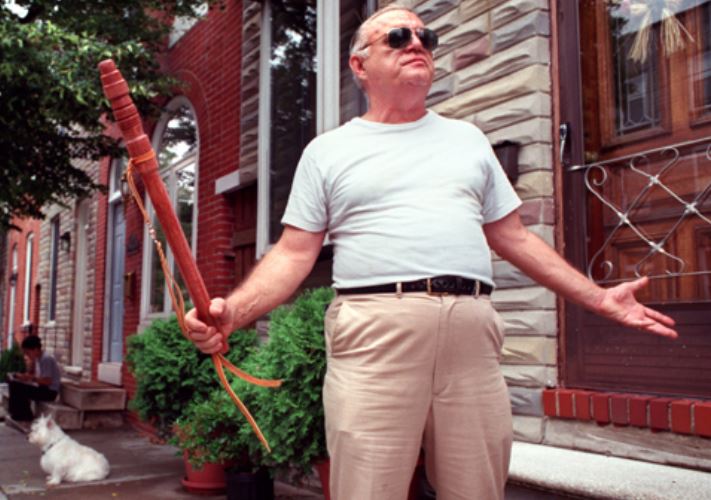
    No baton was better than a Joe “Nightstick Joe” Hlafka espantoon.

    I really wish I had one. One of my great regrets is not using an espantoon. I wasn’t good enough at using one.

  • The DOJ is wrong (4): On Diggs and Trespassing (dig?)

    Update: The links have changed (oops!) since these were first published. Here are links to all my August 2016 posts on the DOJ report on the BPD.
    1 https://copinthehood.com/initial-thoughts-on-doj-report-on-2/
    2 https://copinthehood.com/the-doj-is-wrong-1-2/
    3 https://copinthehood.com/the-dojs-war-on-broken-window-2/
    4 https://copinthehood.com/cant-you-take-joke-2/
    5 https://copinthehood.com/the-doj-is-wrong-2-n-word-2/
    6 https://copinthehood.com/the-doj-is-wrong-3-that-damn-kid-on-2/
    7 https://copinthehood.com/the-doj-is-wrong-4-on-diggs-dig-2/
    8 https://copinthehood.com/the-doj-is-right-1-2/
    9 https://copinthehood.com/the-doj-is-right-2-actual-department-is-2/
    10 https://copinthehood.com/the-doj-is-right-3-actual-department-is-2/
    11 https://copinthehood.com/the-doj-is-right-4-actual-department-is-2/

    [75 percent of this post was written by somebody else. As was 90 percent of the research. I double-checked, edited.]

    I think the goal of the DOJ report is not about constitutional policing in Baltimore. It’s about police not stopping people. Full stop. I mean, hell, even I have moral issues with “clearing corners” in a free society, but I’m telling you I never saw a corner I couldn’t clear legally and constitutionally. Unlike many of my more “progressive” academic colleagues, I see police as an essential part of our free society. And until we can think of a better way to disrupt violent crime, sometimes corners need to be cleared. Sometimes criminals hanging disrespecting neighbors and police need to spend the night in jail. And we can do that when they loiter under a posted “no trespassing” sign.

    Done strategically, it’s an essential part of preserving police authority. And I’m afraid that when police stop being proactive — like you see right now in Chicago and Baltimore — the dead bodies will continue to pile up. I do hope I’m wrong.

    The DOJ report cites a federal district court case (Diggs v. Housing Authority of City of Frederick Md. 1999) at the bottom of p.36. The DOJ says Diggs casts doubt on “the type of highly discretionary trespassing arrests that BPD utilizes.”

    This is totally BS.

    The BPD does nothing like that described in Diggs, which dealt with a very specific and complicated police enforcement scheme in public housing to hand out warning citations to people, maintain a “trespass log,” and only allowed pre-invited listed guests on the grounds of public housing.

    Diggs was even explicit that the trespassing they were talking was not the same as trespassing under a posted “no trespassing” sign:

    Maryland law, for example, permits a duly authorized agent of the housing authority to enforce the trespassing law by posting reasonably conspicuous signs.

    Did they not understand what they read? Or maybe they don’t care. An ideological objection to low-level proactive discretionary policing could be more important than the quality-of-life and lives of Batlimoreans. Consider that.

    Quibbling over a footnote may be kind of irrelevant when Baltimore cops do conduct a lot of unlawful Terry stops. But I’ll note that cops who actually bother to document their stops (and therefore can be audited by the DOJ) are almost certainly not the ones we need to worry about most.

    [If you don’t know Terry is, see thisand thisfor starters.]

    The pages on bullshit loitering and trespassing arrests (pp.36-38) pissed me off. Again, I’m not too mad, because let’s face it — lots of Baltimore cops arrest people for loitering when they aren’t actually impeding the free flow of pedestrian traffic, and they arrest people for trespassing when they haven’t warned them to move along.

    BUT, the trespass warning requirement has a YUGE exception, which is when there’s a fucking sign on the property that says “NO TRESPASSING.” That’s your warning! If you don’t belong there, you can go to jail. So why all the hate on the Lieutenant’s trespassing arrest template (p.38)? He’s trying to show his cops what a legit trespassing arrest looks like. Isn’t that what good supervisors are supposed to do? And if you’ve got black cops policing a black neighborhood, you know as hard as might be for some whites to understand, whites are pretty irrelevant to a lot day-to-day to policing in a minority white city and police department.

    The DOJ also ignored Jones v. State (MD App 2010) which clearly states that a sign can serve as a trespass notification:

    As noted above, notification of a person not to enter or cross private property is … not present in the trespass on posted property statute.

    But Jones goes so much further. It actually gets kind of crazy:

    In addition, the fact that appellant may well have had permission to enter … does not negate [an officers] probable cause to arrest appellant for trespass on posted property. … Consequently, although a police officer may ask a suspect about any right or permission to be on the subject property, there is no requirement to do so in order to establish probable cause for arrest for trespass on posted property.

    [Just FYI, I’ve omitted the parts about “wanton trespass” to focus on “trespass on posted property statute.” Also keep in mind, this is Maryland Law. Your laws may be different! Ask your doctor if these laws are right for you.]

    Think of how powerful and potentially unfair that last sentence is. You could be sitting on your friend’s stoop. But if he’s in the bathroom when I show up, legally and constitutionally I don’t even have to give you the common courtesy of waiting for him to come back before locking you up. (This is why we need cops who understand the law and also exercise discretion and common sense.)

    So it sounds like the DOJ is trying to outflank the courts here by asserting that all trespass and loitering laws are unconstitutional. And they have little problem just making things up to achieve their goal. Who wrote this report? What is the methodology? It’s all so opaque. And because nobody will challenge a “voluntary” consent decree,” the DOJ can say pretty say whatever they want. And leaving Baltimore aside for a moment, shouldn’t we be a bit more concerned about lack of integrity and transparency in the US Department of Justice?

    Here’s the thing, I do have problems with illegal stops and searches and arrests and Baltimore. It’s wrong. I wish it would stop. I’ve written about it. And if that were the point of this report, I’d be all for it.

    This report is something deeper and slightly nefarious. It questions the very right of police to stop, frisk, and search people at all. Even when it’s legal and constitutional.

    The difference between an unconstitutional extension of a Terry Frisk and a legal search can really be as simply as me going, “Can I search you?” And yet why some officers won’t utter these four fucking syllables before sticking their hands in somebody’s pocket I have no fucking clue. Not once was I refused a consent search. Not once. (And had somebody said no, I suspect I still could have searched incident to arrest.)

    So illegal searches do piss me off. Not so much for the semantic omission of four syllables, but because 90 percent of illegal stops and searches (at least in the Eastern where I policed) could be done legally and constitutionally if only cops weren’t lazy or dumb. There’s no excuse for police not to play by the rules because, despite what cops might even believe, the game is rigged in favor smart police. Or at least it used to be.
  • How do you define “reasonable suspicion” and “probable cause”?

    It’s not easy. Trust me. And I was cop, have a PhD, and teach criminal justice. United States v. Humphries, (4th Cir. 2004):

    The Supreme Court has repeatedly admonished that the standard for probable cause is not “finely tuned” or capable of “precise definition or quantification into percentages.”

    Well that’s not helpful. But yeah, it’s a bit unfair to overly fault cops for not meeting a definition you can’t define.

    But, uh, what is probable cause. I’m telling you there’s no answer. But a working definition I’ve used and cops will know (“reason to believe…”) is actually not that good because “reason to believe” implies more than 50/50 chance. It’s less than that! Dig this, from US v. Humphries (4th Cir. 2004):

    Similarly, we have stated (United States v. Jones, 1994) that the probable-cause standard does not require that the officer’s belief be more likely true than false.

    Well, damn. That was sort of news to me. (Which is why I’m posting this.)

    So less than 50 percent is clear. And “reasonable suspicion” is clearly (though only partially) defined as “less than probable cause.” So we’re talking a pretty low bar here. But I mention in terms of the low “hit rate” cited in the DOJ Report. What’s good enough? 10 percent? 25 percent? It depends. But if the hit rate gets anything close to this level, you can’t argue there’s prima fascia evidence of unconstitutional policing.

    And the argument that arrests are bad because charges are dropped? It’s absurd. Along with bureaucratic BS (prosecutors march to a much different drummer than cops), the standard for conviction is “beyond a reasonable doubt.” The standard for arrest is “probable cause” (which isn’t even “more likely true than false.” So of course good legal arrests will be dropped.

    On top of that, most low-level offenses are abated by arrest. You don’t actually prosecute people for loitering and trespassing on a stoop. A loitering arrest isn’t bad because it’s not prosecuted. It’s never prosecuted. And for such minor offenses, officer have pretty low motivation to write a good report, since it really just doesn’t matter.

    [In my intro classes, I just want students to know that “reasonable suspicion,” based on Terry, is the legal standard to justify a stop and/or frisk; probable cause, based on the 4th Amendment, is the legal standard needed for a search or arrest. And even this is a tough sell.]

    [Thanks to somebody else for all the research and some of the writing here]

  • Oh, yeah, Bratton resigned

    Hey, it’s been a busy few weeks in police events. Go read Lenny Levitton the abrupt resignation of NYPD’s Commissioner Bill Bratton.