Copinthehood.com has moved to qualitypolicing.com

  • Dorm Room Dealers

    Dorm Room Dealers

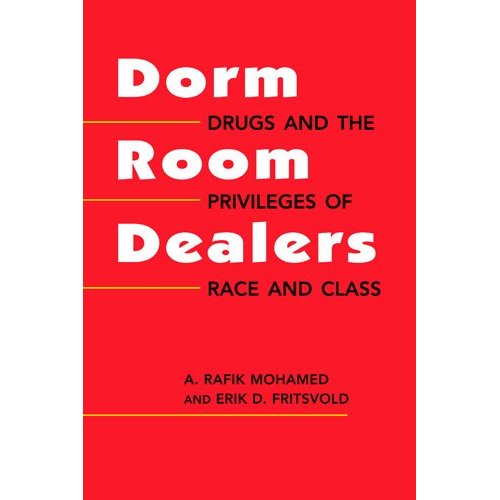
    There’s a great new academic book out by A. Rafik Mohamed and Erik D. Fritsvold: Dorm Room Dealers: Drugs and the privileges of race and class.

    Too many books (my own included) treat drug crimes like it’s some black thing that whites wouldn’t understand unless some kind-hearted interpreters explain to “us” those strange things “they” do.

    Well it ain’t like that. Most drug dealers are white. Most drug users are white. It just doesn’t make the news (or get police attention).

    And yet, you may be thinking… if most drug crimes are committed by white people, and whites are just as if not more likely than blacks to take and sell drugs, then why do I think of drug criminals as black and why are most people in prison for drug crimes black?

    As they say: Ah-hxaaaaaa!

    We don’t fight the war on drugs against rich college-educated white folks.

    Most prohibition violence in the drug trade happens in non-white neighborhoods. So there’s a reason we focus on crime more on drug crimes in some neighborhoods than others. To me it’s the publicdrug trade that is so brutal.

    But what about all those college drug dealers? Why do we never hear about them? Well this book answers that. I might write a proper book review later, but for now let me say this: I mean, I went to college. Anybody who has gone to college knows you can buy drugs in college. It’s like these college drug dealers have no fear of ever getting caught.

    Exactly.

    These dorm-room dealers sell drugs like they’re dorm-room posters. Everybody can see them. They have no fear. You see, the rules are different for them. College drug dealers get in the game, make some cash (or support their habit), and then graduate and get a job, maybe in daddy’s firm.

    Am I oversimplifying? Of course. You should buy the book. If for no other reason than it makes a great ethnographic counterpart to Cop in the Hood. Here’s how the other half deals drugs. There’s a good lesson there for all us all.
  • A Tale of Two Cities

    The Sun is starting a nice little feature where a reporter from London and Baltimore switch places.

  • Bratton and L.A.

    Everywhere Bill Bratton goes, crime seems to go down. Since 2002, homicides in L.A. decreased by more than 50%. And yet so many professors are unwilling to accept that good policing has a major impact on crime. In the academic world, Bratton still seems to get little credit and respect. Why is that?

    Here’s an article by Scott Gold, Catherine Saillant, and Joe Mozingoin in the L.A. Times about Bratton’s success.

    There’s a chance that Bratton will return to NYC. I hope so. Bratton is pro-cop and generally maintains good relations in high-crime communities. It’s a tough act to balance.

  • ‘Flying imams’ settlement

    Seems to me a request for a not-needed seat-belt extension alone is grounds for suspicion. Here’s an account in USA Today.

  • Police Bribes in Mexico?

    Strange question, but have any of you ever paid a bribe to a Mexican police officer in, say, the past 10 years? If so, when, where, why, and how much?

    There was an article in the New York Times the other day about Cancun police extorting people, in this case a Minnesota state senator. My wife, cookbook and travel writer extraordinaire, thinks this is yet another undeserved example of U.S. anti-Mexico propaganda.

    Mexico is a lot less third-world than many Americans think. Sure we wear rose-colored glasses, but our experiences in Mexico have been pretty rosy. I’ve sped through thousands of miles in southern Mexico and my wife has been stopped for driving the wrong way done a one-way street (it’s easier than you’d think) and been in a minor accident that was entirely her fault. And yet neither of us have ever been in a situation where we’ve been presented with any bribe possibility.

    We think it happens very rarely. If it does happen to you, don’t pay! Now of course there may be reasons you want to pay (like paying $10 is quicker and easier than going the legal route), but the Timesarticle says they coughed up $300 when the maximum fine was $50. And it is a crime to bribe police officers. Some rental car companies even offer a voucher to pay any traffic fines. Clever!

    It’s also interesting what happen after word got out of this state senator’s experience (especially compared to what might happen in the US). The police officers were fired, the mayor got involved, and the city of Cancun reimbursed the Americans for the amount of the bribe.

    Here’s the story in the Yucatan paper.

    For non-Spanish speakers (like me), here’s the gist: car rental agencies say they get an average of 50 tourist complaints a month about bribe attempts by cops in Cancun. Typical amounts are US$10 to $20. (Which, for the record, is cheaper than paying for the ticket, usually about US$50.)

    It also says that this is about double the rate of complaints last year. Which the car-rental group rep attributes to the economic crisis. Although what isn’t, these days?

  • Ghetto Reading List

    Ghetto Reading List

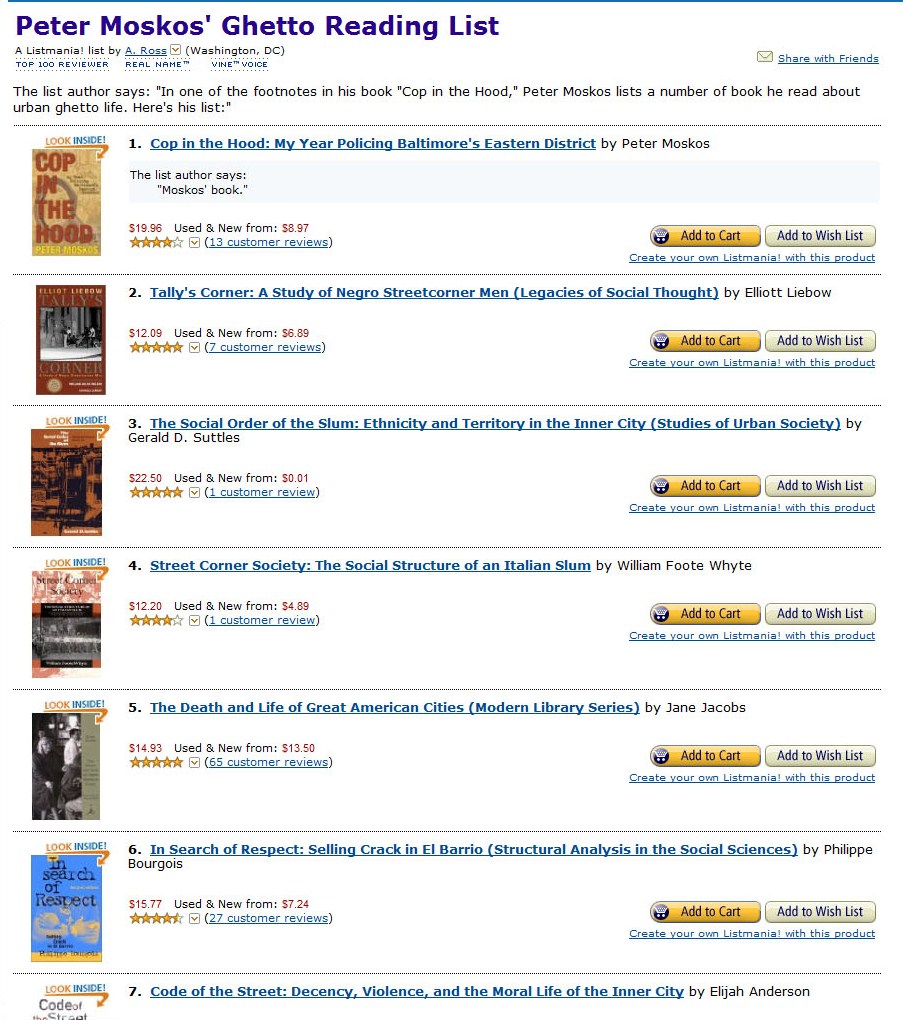
    In a footnote (p. 215) in Cop in the Hood, I list what I consider essential books in urban sociology (they’re not all about the “ghetto”).

    Somebody was nice enough to take the time to put this list on Amazon. It’s nice to see all these books in one place.

  • Get Ready to Ruuuuuummmmmble!

    NYPD cars are getting a low-frequency device to supplement their lights and siren.

    Why do I have the feeling I’m not going to like this.

    I think sirens should be quieter, not louder. We don’t need to escalate noise in the city. The problem isn’t that people don’t notice lights and sirens, it’s that they don’t care. I don’t see the Rumbler changing that.

  • Use of Force, eh?

    A reader sent me this link:

    Here’s the news story. Abbotsford, by the way, has been labeled “the Murder Capital of Canada” [insert scary music here]. Abbotford, the Murder Captial of Canada,” has a homicide rate of 4.7 per 100,000.

    Abbotford, the Murder Captial of Canada, has a homicide rate lower than the U.S. homicide rate.

    Think about that.

    As Yakov Smirnoff used to say: “What a country!”

    I have no problem with the force used in this video. In fact, I think it’s a very good use of force (and I’m not saying that just to provoke anonymous insults). Every bit of force is justified, in response to actions the suspect takes, and stops when the suspect complies.

    That guy on the ground had two things to do: 1) keep his head down, and 2) not move, especially his hands. Those are very fair requests. Mr. Brown Jacket complies and has no problem. Mr. Slow Learner keeps looking up and trying to move his hands to a place where 1) he could reach for a weapon or 2) get up. Neither is acceptable. The officer responds appropriately.

    To me, the greater issue (outside the war on drugs) is the limitations of the gun. Once you’re pointing a gun at somebody who doesn’t do want you want, you kind of lose your power. I mean, if you can’t shoot the guy, what can you do? So the gun, if you call its bluff, only serves to take the officer’s hands out of the equations. That’s not good. But as long as the gun is out (and yes, I’m assuming that officer has a good reasons to suspect the suspects may be armed), all you’ve got are your feet.

    There was one time I got out of my car and drew down on two people fighting in the middle of the Monument Street (I had reason to believe, falsely it turned out, that one had a gun). I ordered them to stop fighting. I will never forget as they both, in unison, turned to look down the barrel of my gun, then turned back to each other and re-starting slugging each other again. All I could do was put my gun away. By this time I could see they were not armed.

    I did end up macing one of them when the other, unilaterally, listened to my commands to stop fighting. At the request of their father, they both went to jail. Turned out they were brothers.

    Everyone would have been happier had I never been there.