Copinthehood.com has moved to qualitypolicing.com

  • Eastern District Commander Cleared

    Justin Fenton reportsin the Sun:

    A city police commander has been reinstated for active duty after being cleared of wrongdoing in a probe into text messages he exchanged with a community activist who was being sought on a warrant and later allegedly stabbed his wife to death.

    The Police Department intends to address “procedural issues” with how the warrant was handled. It did not go through normal channels; instead of sending it to a special domestic violence unit, Eastern District officers who knew Cleaven Williams tried to serve it themselves and gave him the chance to turn himself in.

    If you have the guy’s phone number and can get him to turn himself in, isn’t that worth a try? Seems like a better way to handle a warrant than busting down a door at 5am. And no, it’s not rare for community activists to have a direct line to the district commander.

  • The End of a Glorious Tradition?

    Now I haven’t witnessed this first hand, but it’s no great secret in the police world that every now and then somebody very troublesome may be picked up and dropped off far from home. Alas, this glorious police tradition may be on the way out, at least in Baltimore. Such is the usual fate in the light of media publicity.

    This gambit–I don’t know what it’s called, but there’s got to be some good slang. I propose “going on a field trip. This gambit has probably been on the decline for a long time, and certainly at least since the spread of cell phones. But the basic concept, a long lost late-night walk home, is a classic.

    Peter Hermann reports:

    And we still have to figure out why two city officers on a violent crime task force drove a teen-ager to a park in Howard County and left him there without shoes and his cell phone. … I’m hearing he was [a drug lookout and] warning friends the cops were coming.

    Regardless, cops can’t abduct citizens and leave them places…. If he’s really obstructing, then arrest him…. Both officers are under investigation. It boggles the mind.

    Not really. More mind boggling is how Hermann, a smart and savvy crime-beat reporter, could argue that arresting a lookout is a valid option. It’s hard to imagine a lookout even being chargedin CBIF (must less prosecuted). You think the state’s attorney will take an obstruction-of-justice case based on a report that says a guy shouted “hootie-hoo” every time po-po rolled by? Have you not heard of the 1st Amendment? Not to mention tourette syndrome.

    There’s nothing police can do. Does that justify abduction? Not usually. But under extenuating circumstances, I’m willing to tolerate it and laugh about it later. I’ve been there. It’s too easy to understand officers’ frustration.

    If abduction of lookouts isn’t the answer–and admittedly is probably isn’t–the only realistic alternative is to do nothing. Them’s the facts in the war on drugs.

  • Another gun prevents another crime

    This time in New York.

    The fallacy of gun-control (and I say this as a supporter of gun control) is that it never answers the question: how do you get the gun out of the hands of the criminal? Passing more feel-good laws is not the answer. Laws don’t make you safer. You need observanceof laws. And criminals are not partial to observing laws.

    That being said, anybody who thinks there is no possible good in any kind of law that restrict or regulates guns in any way is, well, crazy.

  • In the Weezee Heezee

    Can I just say I can’t believe that we have a president of the United States who dares to say, even in jest:, “In the Heezee. Waz’ up!” I love it.

    And if you think Obama is “unpresidential,” go back and look at Bush looking under the table [at 5:10 and 5:55] for non-existent weapons of mass destruction.

    Still think Iraq wasbehind 9/11? Would hearing George W. Bush say otherwise convince you? Would anything? [1:19: “What did Iraq have to do with [the bombing of the World Trade Center]? Nothing! … Nobody has ever suggested that the attacks of September 11 were ordered by Iraq.”]

  • Gun Prevents Crime

    Sometimes they do. Hey, I’m just trying to be fair and balanced. It’s one of those nasty character flaws of liberals like me–the desire to see all sides of a issue even if it doesn’t support their position. The story from WSBTV in College Park, Georgia:

    Bailey said he thought it was the end of his life and the lives of the 10 people inside his apartment for a birthday party after two masked men with guns burst in through a patio door.

    “They just came in and separated the men from the women and said, ‘Give me your wallets and cell phones,’”

    Bailey said the gunmen started counting bullets. “The other guy asked how many (bullets) he had. He said he had enough.” …

    That’s when one [college] student grabbed a gun out of a backpack and shot at the invader who was watching the men. The gunman ran out of the apartment.

    The student then ran to the room where the second gunman… was holding the women.

    “Apparently the guy was getting ready to rape his girlfriend. So he told the girls to get down and he started shooting. The guy jumped out of the window.” … [He was later] found dead near his apartment, only one building away.

    One female student was shot several times during the crossfire. She is expected to make a full recovery.

  • Drug Decriminalization in Portugal

    Drug Decriminalization in Portugal


    If you have an hour-plus to spare, listen to Glenn Greenwald talk about Portugal’s experience with drug decriminalization since 2001. Here’s a link to the video and also a downloadable audio podcast.

    Under Portugal’s new regime, people found guilty of possessing small amounts of drugs are sent to a panel consisting of a psychologist, social worker and legal adviser for appropriate treatment (which may be refused without criminal punishment), instead of jail.

    That’s from an article in Time. And here’s Greenwald writing in Salon.

    First the facts: drug use has declined. Repeat: decriminalization does not increase drug use.

    Greenwald addresses this and other points. For instance, the myth of American exceptionalism. This is tendency of some to discount any foreign case study simply because it’s not here. “The U.S. isn’t like the Netherlands.” “The U.S. isn’t like Portugal.” OK… But this argument looks pretty feeble as more and more countries try decriminalization successfully. The onus should now be on the naysayers to explain just exactly what differences in these countries make their experiences so inapplicable to us here in the U.S.

    Greenwald also addresses the logical difficulty many have in comprehending how decriminalization could possibly mean less drug use. Even though the facts consistently indicate that liberal drug policies reduce drug use, people just don’t believe it. So Greenwalk talks about why. Only with decriminalization can the government and even health-care workers effectively reach drug users. Only with ending the war on drugs does the government have the money to offer treatment and educate the public.

    So why decriminalization rather than legalization? Because of international treaties and pressure from the U.S. and other countries to keep up the war on drugs. In fact, in the Portuguese model, legalization was taken off the table from the very beginning. Given the political situation, it simply was not an option. The shame with not going all out and regulating the drug trade is that you are unlikely to get any decrease in prohibition-related violence.

    Peter Reuter provides a counterpoint of sorts about half-way through, arguing that decriminalization wasn’t so much a failure, but rather that it didn’t actually matter that much. But he concludes that the study is, “One more piece of evidence which helps strengthen the argument that decriminalization would have minimal adverse consequences and very substantial desirable consequences.”

    Greenwald says his main take-home point that can transform the drug-policy debate is that decriminalization won’t lead to an explosion of drug usage. “This shatters… the central myth that drives virtually even drug policy debate in this country.”

  • Tasing Naked Man

    A man at a concert, probably tripping, is naked. He ends of getting tased.

    I’m generally against the use of tasers. And I particularly oppose the use of tasers as a compliance device. Especially when the suspect is unarmed. Even more so when the suspect is unarmed, naked, and there are three burly officers involved.

    And yet, I think this taser situation was justified. Check out the video on Jennifer Lena’s blog. Be sure to scroll down and read Corey’s comments. He sums up my thoughts pretty well.

    Once you accept that the guy needs to comply–either by putting on clothes or handcuffs–what are the police supposed to do? They can’t just walk away.

  • Judge Rules L.A. Police Must Be Paid For Dressing Time

    I think all employees should be paid to put on work clothes, if it’s part of the job. Here’s the story in the L.A. Times. I wonder if I’m eligible for back pay from my time in Baltimore?

  • Maximum Enjoyment

    Maximum Enjoyment

    I just finished reading Maximum City by Suketu Mehta. Best book I’ve read in a while. Non-fiction book about the city of Bombay. Great arm-chair traveling. But some good deep insight, too (and a fair amount about the Mumbai police, too).

    I loved it.

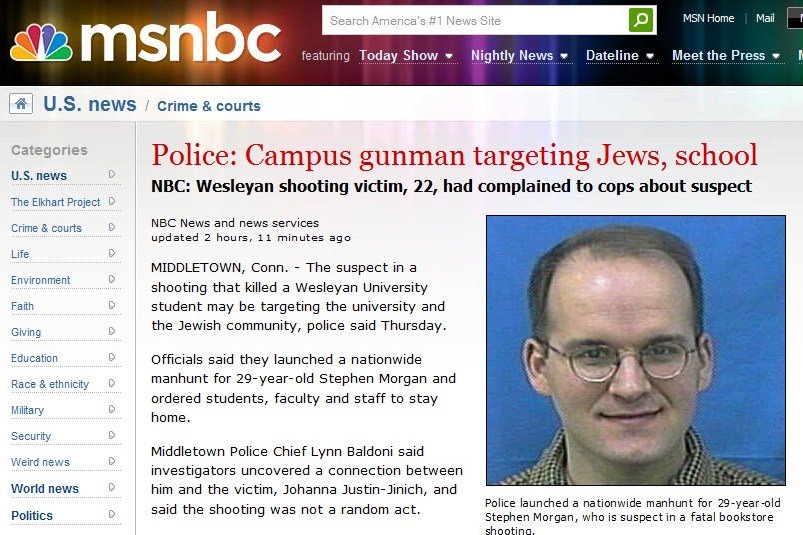
  • This Stephen Morgan is not a murderer!

    This Stephen Morgan is not a murderer!


    This mild-mannered Stephen Morgan lives a quiet professorial life in Ithaca with his wife and kids (at least that is what he tells me). This Stephen Morgan is a grad-school friend of mine and was nice enough to invite me to speak at Cornell University last month. Some of his best friends are Jews. And I saw no homicidal tendencies. And that’s even aftera long winter in Ithaca.

    Last night I read that a Stephen Morgan killed a Wesleyan University student. I sent my friend, Stephen Morgan, the story. He writes back with a story that feature his(my friend’s) picture. Then today I get this: “It’s worse: CNN broadcast the photo on air! The producer just called to say they will run a correction soon.” I should hope so!

    This is the killer:

    This is notthe killer:

    This Stephen Morgan isa killer.Please note that both have similarly receding hairlines, but the resemblances really ends there.

    If you run into a Stephen Morgan and you’re not sure which one you’re dealing with, try showing him this: This innocent Stephen Morgan will immediately start rambling on about advanced statistics. If you say “poissant regression” to the guilty Stephen Morgan, he might start talking about fish.

    Actually, what’s scary to me is that the guilty Stephen Morgan looks a lot like me when I was his age (29):

    I am not a killer, either!