Copinthehood.com has moved to qualitypolicing.com

  • New York City crime rate still falling

    The story in the Daily News:

    The city’s crime rate for the first three months of 2009 was the lowest in more than 40 years, defying fears that the sinking economy might send the city back into the bad old days of rampant murders and rough streets.

    Through the end of last month, overall crime dropped 13.5% from a year ago – down in every major category, including homicides, with 89, according to daily crime statistics from police. Last year, there were 116 homicides during the same period.

    Robberies were also down from 4,837 last year at this time to 4,131 this year, and grand larcenies dropped from 10,030 to 8,854.

    “I know there’s an anticipation … that crime would go up as a result of the economic turndown. We just haven’t experienced that,” Police Commissioner Raymond Kelly said Friday.
  • Fewer Police Deaths

    Fewer Police Deaths

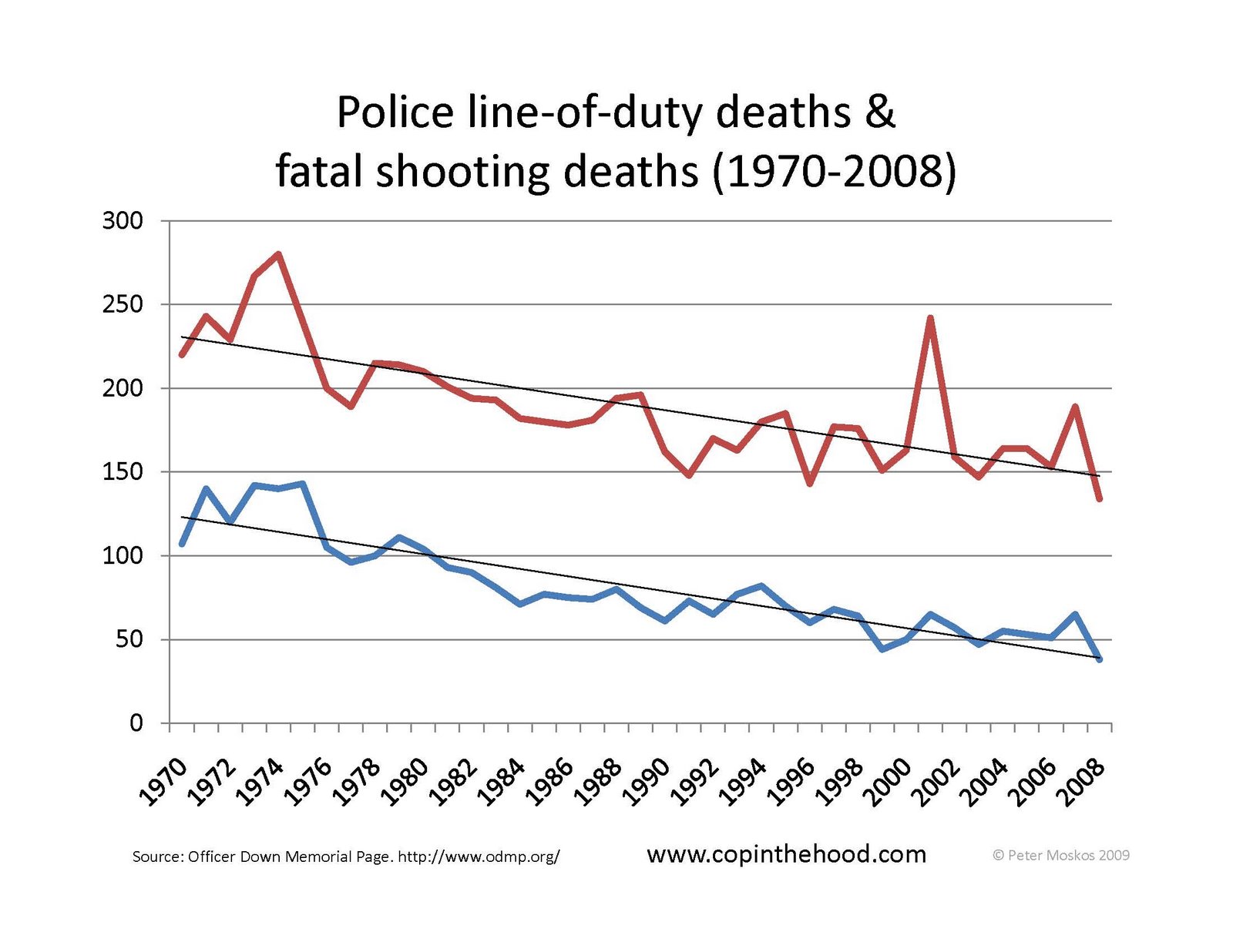
    It surprises a lot of people to find out that fewer and fewer police officers are killed on duty than in the past. I guess it counters the natural inclination to assume that the world is going to hell and violence is out of control and kids these days… have you seen what they’re wearing?

    The top red line is total police line-of-duty deaths. The bottom blue line represents cops shot and murdered on duty. I compiled these data for class. It’s much harder to get data on police-involved shootings.
    After being shot, car crashes comes in a close second. Nothing else comes close.

    Why are fewer police officers killed? Probably a combination (in no particular order) of better training, better emergency medical care, better equipment, and more restrictive shooting policies. Still, on average, a police officer is shot and killed almost every week in America.

    It’s interesting that shooting deaths don’t seem to correlate with overall trends in homicide. Because in general the best predictor of police and police-involved shootings is a high level of violence in the community.

    All the data comes from the Officer Down Memorial Page.

  • Prison Cigarettes

    Oh, Onion… how do you manage to keep being so funny?

    All joking aside, the price for a singlecigarette inside Rikers (last I heard) is $20. This black market was created, of course, after smoking was “banned.” Most of the supply comes from C.O.s. Hell, for hundreds of dollar profit per pack? I might, too.

  • Does Torture Work?

    Two questions:

    1) Does torture work?

    See FBI agent Ali Soufan’s column in the New York Times.

    2) Does it matter if it works?

  • $100 for taking out the trash

    $100 for taking out the trash

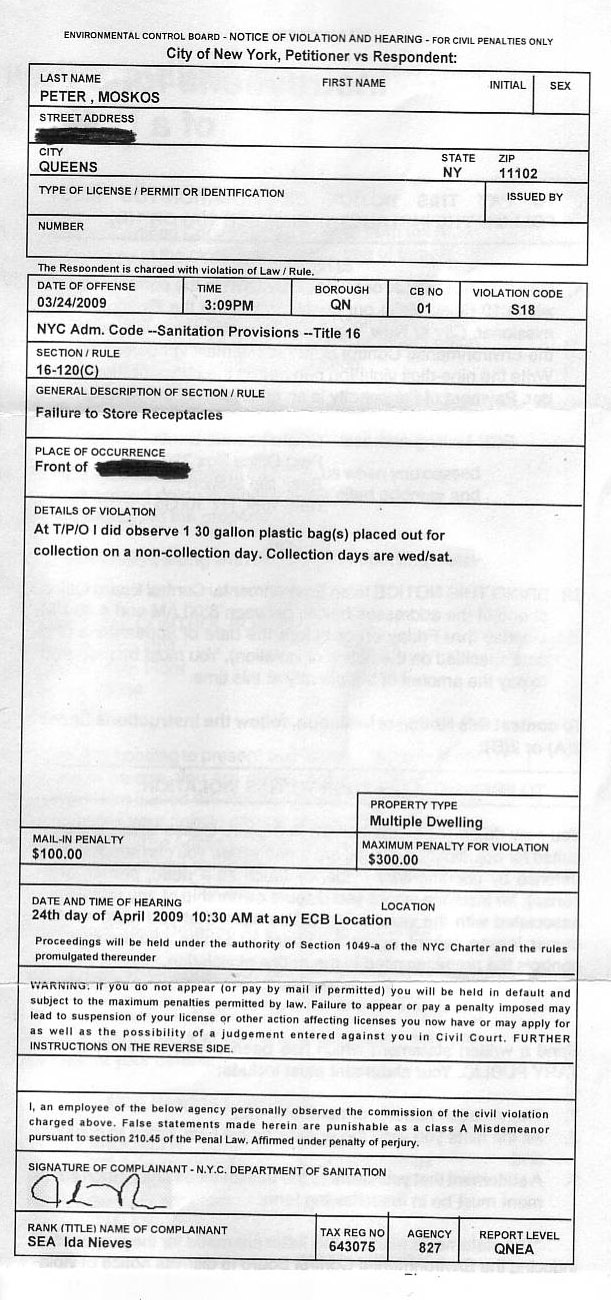
    I got fined $100 for putting my trash out too early. And not all the trash. Just the recyclable cans and bottles.

    I thought I was doing the can-pickers a favor by giving them a few more hours of daylight to pick out can and bottles for the 5-cent deposit. I got the ticket at 3:30pm. They shouldn’t go out before 5pm.

    $20 would have taught me a lesson. $100 is real money.

    And if I had known I was going to get fined, I would have put out all my trash to at least get my money’s worth!

  • A bunch of old potheads?

    Eight-term Iowa Republican Congressman Tom Latham is asked about LEAP, a group of former law enforcement agents who support drug legalization. He responds, “They’re probably a bunch of old potheads.”

    Don’t like the message? Disparage the messenger. That’s what they call an ad hominem attack. Maybe he should get to know us.

    Of well, you know what they say: any publicity is good publicity.

  • Arizona v. Gant

    The court just ruled that police can no longer search a car incident to arrest… assuming the car isn’t within reach of the arrested person and there is no reason to suspect that the car contains evidence related to the arrest.

    Since New York v. Belton(1981), police have assumed that they can search a car any time the driver is arrested. This relates to Chimel v. California (1969) saying a search incident to arrest is justified by officer safety or the interest in preserving evidence.

    In Arizona v. Gant (2009), a man was arrested for a suspended license and in custody in a police car. Police, because they could, searched his car (officer safety?) and found drugs. This is what has been overturned.

    The real-world implications of Grantwill be small. In my experience, most searches of cars happen not incident to arrest but technically to “inventory” belongings when the car is towed. Grant does not address that.

    But I’m always pleased whenever the courts extend fourth amendment freedoms of citizens. It doesn’t happen too often.

  • Drug Decriminalization in Portugal

    They say it’s a success. Here’s a report from the Cato Institute.

  • What if marijuana were legal?

    I haven’t listened yet, but I assume it’s good. From NPR.