I’m very interested in the concept of justice. Especially in situations where there really can’t be any.
So let’s just say that the police officer is put on trial and says, “I plead no contest. I didn’t mean to do it. But I did. All I remember was that there was a large crowd yelling and a man was struggling. Next thing I know I hear a gunshot and look down and discover it was my gun. I didn’t ever realize I was holding my gun. I feel terrible for the victim and his family. I’m sorry. I beg the court’s mercy.”
What should happen to the police officer? What isappropriate justice in a case like this?
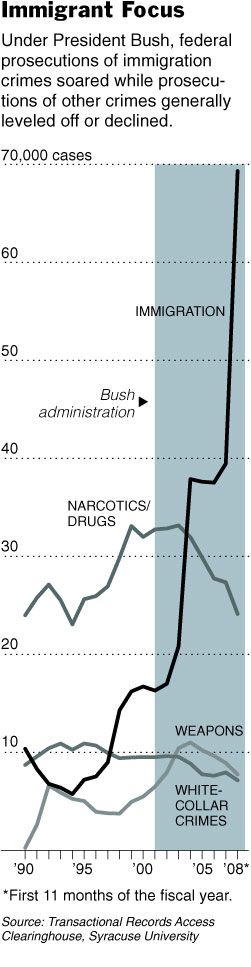
There’s a very interesting article in the New York Times today about how federal prosecution of immigration crimes is taking away from other prosecutions… like gun trafficking, organized crime, drug dealing, and white collar crime. That’s not good law enforcement.
A senior federal prosecutor who has worked on a wide variety of cases along the border said that the focus on relatively simple immigration prosecutions was eroding morale at United States attorney offices.
“A lot of the guys I work with did nothing but the most complex cases — taking down multigenerational crime families, international crime, drug trafficking syndicates — you know, big fish,” said the prosecutor, who did not want to be identified as criticizing the department he works for. “Now these folks are dealing with these improper entry and illegal reentry cases.” He added, “It’s demoralizing for them, and us.”
Read the whole store here. Click on the picture to the left to zoom.
“A long-awaited study of San Francisco’s installation of surveillance cameras in high-crime areas shows that the effort fails in its primary goal of reducing homicide and other violent crime, but succeeds in reducing such offenses as burglary, pickpocketing and purse-snatching.”
“The study found that the program, started by Mayor Gavin Newsom in 2005, is hampered by a lack of training and oversight, a failure to integrate footage with other police tactics, inadequate technology, and what may be fundamental weaknesses of cameras as devices to stop violent crime.”
In court, the officer’s actions will be judged by the standard of a “reasonable police officer.” It does not matter what the people shouting for the BART train felt. In fact, their shouting undoubtedly contributed to the general sense of danger the officer felt.
My guess… but I don’t know (let’s remember that none of us know; we weren’t there)… My guess is that the officer will be charged and criminally convicted of something like manslaughter that is based on negligence but not dependent on intent.
Is this a racial issue? Yes and no. No, police don’t go out saying let’s kill black people. In this situation, would white frat boys have been treated differently by police? Who can say for sure. It always depends on the situation. But it’s very likely.
Anybody who thinks that police behavior isn’t affected by race and class is crazy. In different neighborhoods, both the the public and the police act differently. Don’t think for a second that all police act like the police you know and see and deal with.
A few points on guns:
1) Police handguns (at least all the ones I know) do not have a safety.
2) Guns fire when the trigger is pulled. You may accidentally pull the trigger. But guns don’t “accidentally” fire. That’s important to remember. Your finger shouldn’t be on the trigger unless you’re taking aim and are seriously considering shooting. As a police officer, you are responsible for each discharge. Period.
3) In most jurisdictions, pulling a gun from the holster is not considered “use of force.” In my time on the street, I probably had my gun out of its holster every other shift. But I only pointed it at somebody two or three times. And I never pulled the trigger.
I was free to pull the gun out whenever I felt the need to. That was very often (say when searching a vacant building).
But when dealing with suspects, the gun is often just an intimidating bluff. If the suspect calls your bluff and nobody’s life is in immediate danger, you can’t shoot them. You have to holster up and pull out something you can actually use as a compliance device. In my case that was mace. And even that I only used once. (But I wasn’t on the street for long.)
Look, this shooting certainly looks terrible. Facts may come out that justify the officer’s action. But I doubt it.
A review written by me of The Thin Black Line: published in the Washington Post’s Book World.
It’s a collection of stories told by black law-enforcement officers. Not a great book, unfortunately. But the review is well worth reading:
THE THIN BLACK LINE: True Stories by Black Law Enforcement Officers Policing America’s Meanest Streets.
By Hugh Holton.
Reviewed by Peter Moskos.
The stories police officers tell each other often don’t amuse outsiders. While fellow cops laugh, an outsider is left thinking, “Is it funny that a man bleeds to death?” or “You took crutches away from a one-legged homeless man?” But police don’t tell these stories to entertain outsiders. A story is more than a way to bond over a beer after work; it’s an essential tool of the trade.
Stories provide sense to situations that lack it. Laughing at gore, the softness of human flesh and the misfortune of others isn’t necessarily a sign of an uncaring cop. Gallows humor is a way to compartmentalize, to maintain one’s sanity, to reserve empathy for situations in which emotion might be more productive.
Before I was a police officer, I loved the TV show “COPS.” But after a few nights in a police car, I realized that “COPS” wasn’t the real deal. The dialogue was stilted, on guard, seemingly self-censored for the more politically correct masses. The Thin Black Line, a collection of 28 oral histories of black law enforcement officers in U.S. cities from coast to coast, is similarly restrained. I’m certain these officers have great stories to tell. They just don’t tell them here.
A Sheriff in Alabama was jailed for “blatant” violation of past court agreements that prisoners be properly cared for. It seems he had been, legally mind you, profiting from the leftover money allocated for prisoners’ food (all of $1.75 per person per day!). Here’s the story in the Times.
Traffic tickets go up when local government revenue falls. Is that a surprise? Not really. Here’s the story in St. Louis Today. The study, by Thomas Garrett and Gary Wagner, quantifies it: “Controlling for other factors, a 1 percentage point drop in local government revenue leads to a roughly .32 percentage point increase in the number of traffic tickets in the following year, a statistically significant connection.”
I don’t quite understand when people complain about getting tickets. Whatever happened to “do the crime, do the time” (or pay the fine)? Especially when many of those complaining people are the same people who have no sympathy for poor (usually black) men who get arrested for minor drug crimes.
As long as poor black men are a gazillion times more likely to be arrested for drug possession than rich white men, I really wish that folks would stop bitching about how unfair traffic enforcement is. Yeah, it sure does suck when police decide to crack down on the illegal activity that you happen to think “isn’t so bad.”
The argument has been made that law enforcement should be random. I don’t think it should be. But if it were, every law breaker would have an equal chance of getting caught. To be honest, it’s not a bad goal.
Personally, I love traffic tickets. I wish even more were given out. And I wish the fines were higher. The city needs money and I don’t want it to come from me. Just follow the law, right? And… oh yeah, I don’t have a car.
The big police news of the week is probably the police-involved shooting of 22-year-old Oscar Grant (a black man) at a Bart Station in Oakland. Riotshave followed. I hate riots and those who justify them. Like there’s any justification to bust up a hair salon called “African Braids”.
And here’s to Oscar Grant’s mother, Wanda Johnson. She is quotedas saying: “I am begging the citizens not to use violent tactics, not to be angry…. You’re hurting people that have nothing to do with the situation. Please stop it, just please stop.” That’s a very noble thing to say after your son is killed.
At the time of the shooting, I was just across the bay in San Francisco. I actually heard a few gun shots in Noe Valley. But not these shots.
There are tons of You Tube clips about this shooting. Just search for “Bart Shooting.” This is probably the best report:
From what I’ve heard, this guy was unarmed. But it could very well be justified to shoot an unarmed man. I’ve also heard he was handcuffed. He wasn’t (best I can tell).
Like it or not, police will assume you might be armed until you prove otherwise. Especially on New Year’s Eve when you hear the constant crackle of gun fire.
If you’re pointing a gun at somebody and telling him to freeze and he’s fighting and then his hands are under him and then he doesn’t freeze and out from under his body come his hands holding something you think is a gun…. As the cop with the gun you either do nothing and get shot or shoot.
If police think you might be armed and you won’t follow orders… well, it’s on you. Sorry. It may not be right, but that’s just the way it is.
For the record, once I was brawling with and unable to controlan unarmed handcuffed man (lesson: never arrest anybody when you’re alone). Still I didn’t shoot him.
I’ve heard that perhaps the cop thought he was Tasing the guy. I don’t know. I’ve never held a Taser, but I don’t think you can mistake a Taser for a gun.
But really, this shooting looks terrible. From the officer’s reaction immediately after firing, it looks like he’s surprised and didn’t mean to fire. That makes it both a horrible mistake and a crime.
And whether or not the cop fucked up, and odds are he did, I hope all those schmucks yelling at the police from the train take a second to think about how they too contributed to this man’s death.
 There’s a very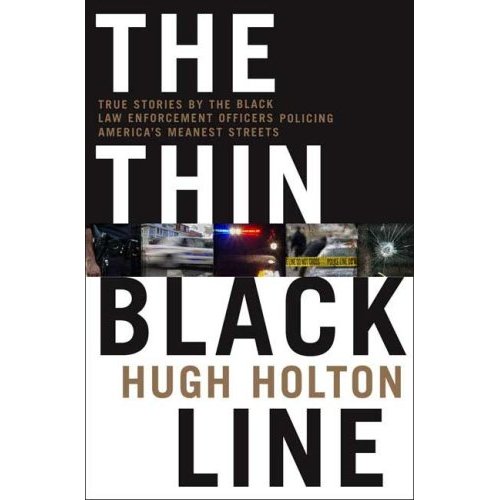
 A review written by me of