Copinthehood.com has moved to qualitypolicing.com

  • The “Gray Effect”

    Stephen Morgan, my grad-school colleague, released his Baltimore report (co-authored with Joel Pally) that looks at crime and arrests pre- and post-riot.

    [The Harvard sociology cohort of 1995 always turned to Morgan as the quant guy when we needed help with stats class, which was often. So rather than blame my own limitations and laziness, I prefer to entirely and falsely blame Steve for the fact that I still can’t really tell you what a poisson regression is and why you would want to use one.]

    I had some input in the drafts. One of my points was that the take-away would be an idiotic headlines like this one: “Study: There Has Been No ‘Ferguson Effect’ in Baltimore.”

    Citilab never talked to Morgan, which seems odd.

    Of course that headline isn’t the point of the study. I think the narrative focus of the study should have been centered around April 26, 2015 (the riot) and not early events half a country away (Ferguson). All policing is local. Buried halfway down that Citilab story is a mention of the “Gray Effect.” It is a better term. Perhaps because of the double meaning of gray, it can be applied elsewhere in a generic sense.

    I’m baffled by many people’s attempt to disaggregate a so-called “Ferguson Effect” from local police issues, since I’ve been arguing this is the same thing. But shorthand terms are only helpful if they have an accepted meaning. And clearly the Ferguson Effect does not. I’m not willing to waste time in a semantic debate or defend a term — the Ferguson Effect — that I never liked. So let’s call it the Gray Effect. My point is that police matter and that society influences policing, sometimes for the good and — as last year’s spike in homicides portends — sometimes for the bad. Call it what you will, the effect is real.

    Better reporting is done by Baynard Woods and NBC. From the latter:

    “I do think we provide some pretty compelling evidence that it is possible for the police to use discretion, to use alternatives to arrest, in a place like Baltimore without influencing the pattern of crime,” Morgan said.

    That is why Morgan says the eight months before Gray’s death could represent a “sweet spot.”

    The next part of Morgan’s analysis, the Gray period, was much less surprising.

    “Everything fell apart,” Morgan said.

    Crimes of all types, violent and non-violent, spiked, for an overall increase of more than 11 percent. [Ed note: In reported crime…. Homicides doubled, and there is good reason to believe more crime was non-reported. And decreasing arrests will also serve to reduce crime stats without a corresponding reduction in actual crime.] The drop in arrests became much more pronounced, from 19 percent to 30 percent, “consistent with the widely discussed conjecture that the Baltimore police pulled back from some routine policing in response to a perceived lack of support from the city’s leadership,” the researchers wrote.

    [Maybe it’s minor, but I’ll take credit for the subtle addition of “lack of support from the city’s leadership,” thank you very much. Correction: Steve, ruining my fun as only a quant guy can, says that phrase was in the earliest drafts and had nothing to do with me. –eye roll– ]

    From Woods in the Guardian:

    “One reasonable interpretation of these entangled effects is that the crime spike in the Gray period could be a Ferguson effect that would have remained dormant had it not been ignited by a localized Gray effect,” the report states. “However, the size and duration of the crime spike is almost certainly attributable to particular features of the unrest.

    The study found a decrease in crime in the period after the new police commissioner, Kevin Davis took office, which they dub the “Davis effect.” Davis replaced then-commissioner Anthony Batts, who was fired just after a Fraternal Order of Police report criticizing his handling of the riot came.

    The whole point of the Gray Effect (née Ferguson Effect) is that it is not necessarily centered around the events of Ferguson. Let’s the just accept that and move on. It is about media focus and changing political pressures of the past few years.

    The substantive issue is that anti-police movements and protests can affect policing and policing impacts criminals and crime. The events around the riots in Baltimore — specifically the failure of political leadership and the politically motivated prosecutions of police officer — were Baltimore’s Ferguson Gray Effect.

    Public events, media reporting, and political leadership all matter to police officers. And when this process is happening in many different cities, a shorthand label can be useful. When the factors combine to change policing in a negative way — when police are less proactive and more young black men are killed as a result — we need to recognize the facts and react accordingly.
  • Thoughts on Trump’s appeal

    From some facebook musings of mine:

    [Update: I’d also look at this by Scott Winship, which goes against my main theme, and is quite convincing.]

    You just hear the racism and xenophobia, but Trump’s main themes are actually about trade and jobs.

    Blue-collar white voters feel abandoned by both major political parties… because they have been abandoned. Shouldn’t working-class white men have the right to be heard and even say stupid things as much as, say, the Black Panther Party?

    This isn’t in defense of Trump. God, no. But don’t we have some responsibility to listen to and even have empathy for a large segment of fellow Americans? Instead, we mock and discount their experiences as false and unworthy.

    Not to discount the ugliness and horribleness of this all, but this isn’t just a racist backlash (though that’s certain a part of it); for the average Trump supporter it’s a “where did our jobs go?” backlash. They’ve been abandoned and mocked by mainstream America. There is no voice speaking for the blue-collar former union man or woman who is anything but “entitled.” I think we ignore that at our own peril.

    Don’t get me wrong. Trump is scary. He is a demagogue preaching dangerous racist proto-fascist bullshit. But asking why his supporters aren’t more vocal in opposition to hate is akin to those on the right saying, “Why don’t all Muslims denounce terrorism?” A) Many do, B) Why should they?

    [There’s a difference, of course, in that Muslims aren’t going to terrorist rallies while Trump is actively encouraging the hate. So it’s hardly a perfect comparison.]

    But my point is less about Trump, whom I loathe, then about tens of millions of blue-collar American who have been sold an economic woof ticket by both political parties for the past 35 years. They thought the system was on the level (if not biased in their favor). Well, it’s not.

    They played by the rules, only to find the game changed.

    And for decades nobody, certainly not either political party, listened or cared. They wanted somebody to follow. Trump stepped into that void. (It could have been Biden, or maybe Edwards, but it wasn’t.)

    And if we don’t have empathy for the Trump supporters who aren’t racist, what are we going to do? Deport them?

    Oh, I do think Trump supporters are being sold a bill of goods once again. But Trump is offering, I think, Protectionism. That is the appeal. Protectionism is now a four-letter word, but should it be? Trump is the first major political candidate (it pains me to write that) to speak against free trade since Ross Perot and the “great sucking sound.” That’s the key.

    So no, it’s not primarily about race. (Though I think it is more about race than Trump supporters are willing to admit.)

    Fuck fair trade and NAFTA. Fuck non-union wages in Mexico. I mean, thousands of Americans did actually lose their union jobs because of NAFTA. Was it good for America? I don’t know. It probably was good for me. But it sure as hell wasn’t good for Maytag factory workers in Illinois!

    So yeah, what you and I see as xenophobia? To an unemployed American worker, it’s his livelihood. His experience has been dismissed by both parties and most economists as irrelevant. (And economists do not have a great track record, it is worth mentioning.)

    The right wants to bust unions and Obama dismissed tens of millions of Americans as “clinging to their guns and religion.” That did great harm.

    Republicans want to reduce wages. Democrats want to help illegal immigrants. Liberals (myself included) want to help criminals reintegrate into society. And the racism that you and I hate? It barely registers if you love Trump and don’t watch MSNBC or listen to NPR. The racism is there, but it’s media spin. Trump hammers home this message: jobs jobs jobs. We’re ignoring that.

    The non-criminal white guy in the midwest who played by the rules and still lost his union factory job to NAFTA?! He’s not an immigrant; he’s not a minority; he’s not transgendered; he’s not a criminal. Who the hell speaks for him? Nobody but Donald effing Trump.

  • Why did New Yorkers stop shooting each other?

    In New York City not only has the number of homicides being going down, but the percentage of homicides committed with a gun has been decreasing.

    Put another way, there were about 309 people shot and killed in 2011 in NYC (for UCR reasons we’re talking incidents, so this is a bit of an undercount). In 2013: 188. That’s a huge decrease. (2014 saw 184.)

    If you look at all other city homicides (ie: non-gun), they’re down a little. But the decrease in NYC is all about fewer people shot. Did New Yorkers get together in 2011 and decide to stop shooting each other? I missed that meeting. Was it because of Occupy? Or because Occupy was broken up? Did anti-police protests somehow reduce gun violence? I doubt it. But something happened, and I don’t know what it is.

    Oddly, the NYPD didn’t take credit for this crime drop because it coincided with anti-police protests and the end of stop and frisk. Cops and Kelly and those on the right were certain — hoping even — that crime was going to skyrocket. They’ve been saying that since at least 2012. Well, it’s 2016.

    Here is some UCR homicide data from 2014 (if you hold your breath for 2015, you’ll turn blue and pass out):

    New York City: 56 percent of homicides are by gun, 26 percent by knife (“or cutting instrument”). Nationwide is 68% gun, 13% knife.

    A few other cities:

    Baltimore: 75% gun, 18% knife.

    Chicago: 87% gun, 7%knife.

    Los Angeles: 73% gun, 13% knife.

    Here’s the percentage of NYC homicides that were gun-related at various years (UCR data):

    1990: 74% of homicides by gun

    1997: 61%

    1998: 60%

    1999: 59%

    2000: 66%

    2002: 61%

    2005: 61%

    2009: 63%

    2010: 61%

    2011: 61%

    2012: 57%

    2013: 59%

    2014: 56%

    So maybe that’s not the issue. Honestly? A five-percent decrease since 1997 ain’t such a big deal. But my gut tells me a 5-percent slow but steady drop since 2011 does mean something.

    Of course it *is* related to gun control. But as any 2nd-Amendment-loving Trump-loving patriot will tell you (often in all caps) “CHICAGO HAS GUN CONTROL!!!!” And Chicago, if this is too subtle for you, has a lot of killings.

    So maybe, at least this is what I think, gun control isn’t about gun laws as much as actual prosecution and deterrence. New York is the only city where people believe — mostly correctly I might add — that illegal gun possession will bring you real time.

    What if it were that simple?

  • Things cops watch

    I don’t post a lot of these videos, but this one is revealing. I honestly didn’t know which way this was going to go. Indian River Country, Florida, December, 2015. 3AM. A man has just gone to the convenience store to buy cigarettes. He’s riding a scooter without tags (that’s southern for “license plate”).

    Stop the video right at 00:15. Don’t go a second further.

    The video:

    Ask yourself what you would do or do differently as the police officer. As a non-police officer, what would your reaction be if the cop aggressively brought this guy to the ground right there and then? Police brutality? White cop attacking unarmed black man? It’s easy to imagine the officer being criticized for excessive use of force.

    Most non-police will probably see a seemingly compliant black suspect asking a white officer, “What’s the problem, sir?… No, no, no, no, I don’t want no problem.” Just a minor traffic violation.

    Of course nobody knows if the suspect is armed or what he is thinking. And that’s the problem.

    The man’s son said:

    It’s crazy how it happened…. I don’t understand how it happened, from you going to the store on a scooter. What was the point of stopping him?… When I left him, he didn’t have no gun…. He doesn’t carry weapons at all. He doesn’t have any enemies. He doesn’t feel threatened by anyone.

    Who do you believe?

    Now watch the rest of the video.

    After being shot in the leg, the cop manages to shoot and hit the suspect twice. Impressive. The suspect was later found by a dog. Both men lived.

    Here are the warning signs (AKA things you should watch for as cop and not do if you’re not a cop):

    0:04: “Don’t go reaching into anything,” says the cop. Fair enough.

    0:05: Why does the suspect hold his hand up like he can tell the cop to stop? That’s not allowed. But as a cop I would probably let that slide. What can you do? But it’s a sign.

    0:09: The suspect gets off the hood, like he was a choice to disobey an officer’s order. I don’t know what I would have done, but I’ll tell what the cop should have done: take the guy down without hesitation. Or create space. But that’s easy to say in hindsight.

    It happened so fast. It often does. I’d like to think otherwise, but I probably would have been shot.

    My sergeant’s words come to mind: “Never arrest alone.” Words to live by.

  • Remain Calm!

    Apparently there’s still no need to worry.

    Here is what I think matters: 2015 will almost assuredly see (we don’t the numbers for sure yet) a double digit in increase in homicide. See this Washington Post piece for a clue.

    And yet, if you listen to Ames Grawert and James Cullen, there’s no need to worry:

    Rather than stoking unfounded fears of a new crime wave, always just beyond the horizon, we should take this opportunity to ask how we can expand on the public safety gains of the past 25 years.

    While there were 471 more murders in large cities in 2015 than 2014, more than half (260) of that increase occurred in just three cities: Baltimore, Washington and Chicago.

    My favorite ideological statistical shenanigans: if you ignore places where crime is up, crime isn’t up!

    America has not seen a double digit increase in homicide since 1971. (1986 and 1990 came close.) Since 1971 is my entire lifetime. So, yeah, we probably saw the biggest annual increase in murder in my lifetime and perhaps ever. Seems like something to worry about.

    But no. We who care about these dead people are just stoking public fear, as if police have anything to do with confronting murderers, and perhaps even preventing a few shootings.

    In Baltimore, mayoral candidates are talking about how best to reform police. Very little on how to prevent shootings. They should be talking about how to get back to how they were exactly one year ago, before police were seen as the problem and violent crime doubled.

    Just remember, no matter what happens, if it’s not ideologically expedient to worry about rising homicide, just repeat this mantra: Remain Calm. All is well.

    Related, at this is an interesting piece of the jigsaw puzzel. Homicides are down thirty-some percent in NYC this year, which seems to negate last year’s increase in NYC. At least here in New York, the sky is not falling.

    Mac Donald predicted in 2013 that if New York City ended its controversial stop-and-frisk program, crime would skyrocket back to pre-1990 levels.

    Well, stop-and-frisk formally ended in 2014, and the lights still haven’t gone out on Broadway. In fact, as the number of stops by police tapered off, so did the city’s murder rate, hitting a historic low the same year the program ended. Despite a small increase, the murder rate remained low in 2015, while shootings, major crime and arrests all fell in tandem.

    NYC is OK. But elsewhere, I’m not so sure.

    [Thanks to EyeRishPirate for bringing this to my attention.]

  • When the police reform issue is actually a “law reform” issue

    My once (and probably future) co-author Nick Selby has this piece in the Washington Post:

    But a closer look at some statistics shows that the problem is not necessarily an issue of racist cops, and that means fixing the criminal justice system isn’t just an issue of addressing racism in uniform.

    Some racial disparities in treatment by authorities actually appear to be the result of state laws intended to crack down on offenses like drunk driving and scofflaws that have, instead, had the effect of ensnaring poor people in a revolving door of debt, courts, collections firms and police.

    Suspended-license or no-license tickets are expensive. Why were so many blacks and Latinos driving on suspended or missing licenses?

    Poverty.

    But the way Texas tracks stops obscures the broader unfair effects of the law on poor people, and makes it look, instead, like police are the problem. In our subject city, less than 7 percent of the population is black, but in 2015, 11 percent of the people pulled over there were.

    That’s as far as Texas’ racial profiling laws want police chiefs to take their analysis.

    We wanted to compare the traffic stop data to the population of the entire area where drivers came from…. and we compared that model against the race and ethnicity of the drivers who got pulled over.

    Chiefs often do not conduct [more detailed] analyses (which are required to recognize these patterns) because they spend their scarce resources complying with well-intentioned but ill-informed and often underfunded racial reporting requirements.

  • RIP Ashley Guidon

    RIP Ashley Guidon

    On 26 Feb, 2016, on her very first shift and just 1 day after being sworn in, Ashley Guidon of the Prince William County (VA) Police Department was killed. R.I.P.

    In honor of Ashley, police are posting their rookie photo.

    Ashley and two other officers were shot while responding to a domestic-related call. The killed murdered his wife and shot the officers as they approached his home. The suspect was arrested and uninjured.

    Ashley is the 12th officer to be shot and killed this year. It is March 1st. Last year 39 officers where shot in killed.

    I lived to tell the tale. Here are my notes from April 16, 2000, my first day of field training:

    Not too nervous about starting, strangely enough. But there are not many jobs where your mortality come to mind before starting. I assume I will live, though I didn’t like the palm reading I got last night from J., A’s friend, telling me I wouldn’t live too long and would die in some sort of event.

    I was told at one of the first calls we were backing up, “Let me tell you something, junior, you don’t have to carry your stick to every call. You have to, well, prioritize. Big fight on the corner, bring the stick…” I still want to carry it with me all the time so it’s habit. Let’s see if I can resist the peer pressure. [Ed note: I did. I loved my stick stick. Still do, in fact. And I think because of that, I never had to hit anybody with it.]

    In Sector Three, they all had their sticks and hats. We [Sector 2 day work] had neither.

    My FTO [who was kind of a dick to me] wasn’t there. Went out with [C.S.].

    “If you go out looking for arrests, you’ll get complaints.”

    “Man, I think they should just build a fucking wall around the Eastern District and let them fight it out.”

    Q: Did you think that coming in here or is that me in three years?

    A: “I think a little differently than some. You get to murder and nobody sees anything. I think if I were shot, I’d like somebody to say something. If they don’t want to be policed, fuck ’em.”

    I do feel a lot safer having gone through the academy as opposed to just doing ride-alongs as a researcher. These streets aren’t Disneyland.

    Interesting twist of racial profiling: a lot of it happens in our district, but it’s only of white people. White folks looking for drugs (we assume) being told, “you got no business here. Get out of this neighborhood!”

    [C.S.] is a good example of some problems. He’s a bit burnt out, and knows he’s not accomplishing much at all. But he doesn’t think there is a solution.

    Two dumb looking white guys, but more in a dumpy intellectual rather than mutant way, were arrested for coke possession, driving without a license. Both Chris and I were asked, “do you want a summons?” No, I said.

    After work: ate with T., W., S., and W. [all from my academy class]

    S. said his gun was drawn and he really was hoping there was somebody behind the door they were searching: “I had my finger on the trigger, and I was just praying there was somebody there with a gun!” Why does he want to shoot people? I was talking with W. about it on the way home. W. said, “No, he wasn’t joking.”

    Soon after I left, S. transferred to a department in New Jersey. Last I heard, and I might be wrong, but I think he stuck a fork or something in an electrical socket and hurt himself.

  • My Book List

    Not that you asked, but here’s a list of (most of) the books I’ve read in the past two years. Seems like I average one every 20 days.

    The best or at least most memorable of the list? In no particular order: One Righteous Man; The Warmth of Other Suns; A Curious Man; Longitude; Jacksonland; The Faithful Executioner; The Fall of the Ottomans; Boom, Bust, Exodus; The Moor’s Account; History of the Jews; In the Kingdom of Ice; and The City & The City.

    It’s mostly history, I can’t help but notice, and a bit sociological. And just two fiction books (and one of those was historical).

    The Frozen Water Trade by Gavin Weightman

    The Great Siege: Malta 1565 by Ernle Bradford

    New York Burning: Liberty, Slavery, and Conspiracy in… by Jill Lepore

    The Beast Side: Living (and Dying) While Black in America by D. Watkins

    SPQR: A History of Ancient Rome by Mary Beard

    Washington: A History of Our National City by Tom Lewis

    Deep South: Four Seasons on Back Roads by Paul Theroux

    One Righteous Man: Samuel Battle and the Shattering of the… by Arthur Browne

    The Triple Package: How Three Unlikely Traits Explain the… by Amy Chua

    Americana: Dispatches from the New Frontier by Hampton Sides

    The Warmth of Other Suns: The Epic Story of America’s Great… by Isabel Wilkerson

    Genghis Khan: His Conquests, His Empire, His Legacy by Frank McLynn

    The Triumph of Seeds: How Grains, Nuts, Kernels, Pulses, and… by Thor Hanson

    The Faithful Executioner: Life and Death, Honor and Shame in… by Joel F. Harrington

    The Water Knife by Paolo Bacigalupi

    A Curious Man: The Strange and Brilliant Life of Robert… by Neal Thompson

    Longitude: The True Story of a Lone Genius Who Solved the… by Dava Sobel

    Astoria: John Jacob Astor and Thomas Jefferson’s Lost… by Peter Stark

    Carsick: John Waters Hitchhikes Across America by John Waters

    The Quartet: Orchestrating the Second American Revolution… by Joseph J. Ellis

    Jacksonland: President Andrew Jackson, Cherokee Chief John… by Steve Inskeep

    The Fall of the Ottomans: The Great War in the Middle East by Eugene Rogan

    Ghettoside: A True Story of Murder in America by Jill Leovy

    Boom, Bust, Exodus: The Rust Belt, the Maquilas, and a Tale… by Chad Broughton

    Odessa: Genius and Death in a City of Dreams by Charles King

    No Way Out: Precarious Living in the Shadow of Poverty and Drug Dealing by Waverly Duck

    The Moor’s Account: A Novel by Laila Lalami

    History of the Jews by Paul Johnson

    Ghost Soldiers: The Epic Account of World War II’s Greatest… by Hampton Sides

    In the Kingdom of Ice: The Grand and Terrible Polar Voyage… by Hampton Sides

    Bird by Bird: Some Instructions on Writing and Life by Anne Lamott

    The Global Pigeon (Fieldwork Encounters and Discoveries) by Colin Jerolmack

    The Jefferson Bible: The Life and Morals of Jesus of Nazareth Extracted Textually from the Gospels,

    Tempered Zeal: A Columbia Law Professor’s Year on the Streets With the New York City Police by H. Richard Uviller

    Ritual America: Secret Brotherhoods and Their Influence on American Society: A Visual Guide

    Pigeons: The Fascinating Saga of the World’s Most Revered and Reviled Bird by Andrew D. Blechman

    The City & The City by China Miéville

    Sister Bernadette’s Barking Dog: The Quirky History and Lost Art of Diagramming Sentences by Kitty Burns Florey

    American Homicide by Randolph Roth

  • Stop paperwork (2)

    Stop paperwork (2)

    An email from a Chicago Police Officer (emphasis added by me):

    I wanted to go through our new “investigatory stop report (ISR)” training before I replied. By now you realize we have an extremely long form to fill out every time we do a street stop. The form is ridiculous and redundant but fortunately the department has created a shorter form that will we start using on March 1st. I think they missed the point with the gripes about low street stops. The form sucks, is burdensome, and redundant, but it’s just paperwork.

    The issue is that there is still heavy oversight by the ACLU and many private attorneys and their quick access to all information on ISRs. So now, instead of just your sergeant deciding if you have articulated enough reasonable suspicion, each ISR has to be approved by a sergeant, the integrity unit, and then combed over by an endless amount of lawyers looking for the slightest hiccup in the report. Private attorneys have started contacted people stopped about two weeks after each incident, by phone and/or mail and asking them how the police treated them while they were stopped. This is really unsettling.

    All of this seems like a direct result from the McDonald shooting, even if it’s not. Although no one is talking about it (the media has moved on to other police issues from where we park to the “thin blue line” code of silence). Immediately after the dashboard camera video came out, most cops were defending the shooting even after seeing the video. I get it. I would not have shot, but I understand why Van Dyke did. A crazed maniac on PCP with a knife is certainly dangerous and it doesn’t morally bother me that he was shot. I do think it was a bad shooting, but not by much. Although, I come from a newer generation of policing with a different mindset I suppose.

    After the protests and eventually when the ISR system came out, everyone started to vilify Van Dyke as the cause of all this oversight whether or not they believed it was a good shoot or not. Those that believed it was a good shot, no longer say anything about it, if that makes any sense. Basically, no one is supporting Van Dyke anymore, at least not openly. Meanwhile, street stops are down an astronomical percent and homicides are at at 12-year high through February. On the 11th, the superintendent sent out an email to the department reminding them that it’s still okay to do street stops. No one took it seriously but the bosses have to do something to get numbers.

    The idea that every report is being read by people looking to sue police officers is not a way to encourage productive proactive discretionary police activity.

    The first two months of 2015 saw 51 homicides. 2016 has seen 101. That’s double, for those slow in math. If you don’t want to call this a “Ferguson Effect,” fine. I’ve never liked the term. But perhaps we can agree that if police feel they can’t do their job for fear of lawsuits and/or criminal prosecution and thus do their job differently and then crime goes up, something is going on?

    So if you don’t like “Ferguson Effect,” how about we call it the “when police feel they might get in trouble for doing their job, so police — mostly to satisfy critics on the left who seem not to care how many people die as long as police are not involved — get out of their car less, stop fewer people, interact with fewer criminals, and then murders skyrocket” effect?

    See part of the police job is to harass criminals. Maybe you can think of a better word than “harass,” but I use that work intentionally. Because policing isn’t all please-the-old-ladies-going-church. People don’t like to talk about it, but there is an actual repressive part of the job — legally and constitutionally repressive, but repressive all the same. When that doesn’t happen, criminals commit more crime.

    [What I also find interesting in that a change in police culture with regards to what constitutes a good shooting is happening in front of our very eyes in Chicago.]

    And here’s the email from the Acting Chief:

    Good Evening Everyone,

    I want to clarify concerns regarding the Investigatory Stop Report (ISR) and the Department’s Agreement with the American Civil Liberties Union of Illinois (ACLU). I have heard your concerns and I am working toward a solution.

    First, since January 1, 2016, Illinois Law requires all law enforcement agencies in Illinois to document investigatory stops and protective pat downs. We are not alone in this endeavor; the entire state is tasked with documenting investigatory stops and protective pat downs. Neither the law nor the Department’s Policy has changed as to when stops and pat-downs are appropriate; merely the documentation has changed.

    Second, Officers will not be disciplined for honest mistakes. I know that the Department ISR Policy has been in effect since January 1, 2016. The Department is working tirelessly to train everyone on the ISR policy and procedures. I know there is a learning curve and I appreciate your understanding as we make this transition.

    Third, I would like to clarify the agreement between the Chicago Police Department and the ACLU. The Department has not relinquished any control of our policies and procedures to the ACLU. The agreement does not provide the ACLU with any role whatsoever with respect to individual officers’ compliance with the Department’s policies. The Department alone is responsible for supervising compliance with policies and procedures. Rather, the Department’s agreement with the ACLU provides that a former federal judge, the Honorable Arlander Keys, will review CPD’s policies, practices, and data regarding investigatory stops and recommend any changes that are reasonable and necessary to comply with the law, and that the ACLU will have an opportunity to review and comment upon CPD’s policies, practices, and data.

    Fourth, our Department is working to reduce the burden on officers. Remember, completing an ISR is in the best interests of Officers based on the Illinois State Law. A properly completed ISR helps protect the officer by documenting the basis for the stop and any resulting pat-down. Additionally, the transparency of the agreement with the ACLU and the ISR create a trust and mutual respect between our agency and the communities we serve.

    Lastly, officer safety is one of my greatest concerns, and continues to be a valid basis for a protective pat down. Officers simply need to describe in the ISR why they believe their safety was at risk. To perform a stop, an officer must have reasonable articulable suspicion, based on the facts and circumstances, that a crime has been, is being or is about to be committed. And, before an officer conducts a protective pat-down, he or she must have reasonable articulable suspicion that a person stopped is armed and dangerous and therefore poses a threat to the officer’s safety or the safety of others. Neither of these requirements are new policies.

    I appreciate all of the hard work that each of you do on a daily basis. Additionally, thank you for your service and dedication to the people of Chicago. Take care and stay safe.

    Sincerely,

    John J. Escalante

    Interim Superintendent of Police

    Chicago Police Department

    Here’s the long form in question and my previous post on “stop paperwork.”

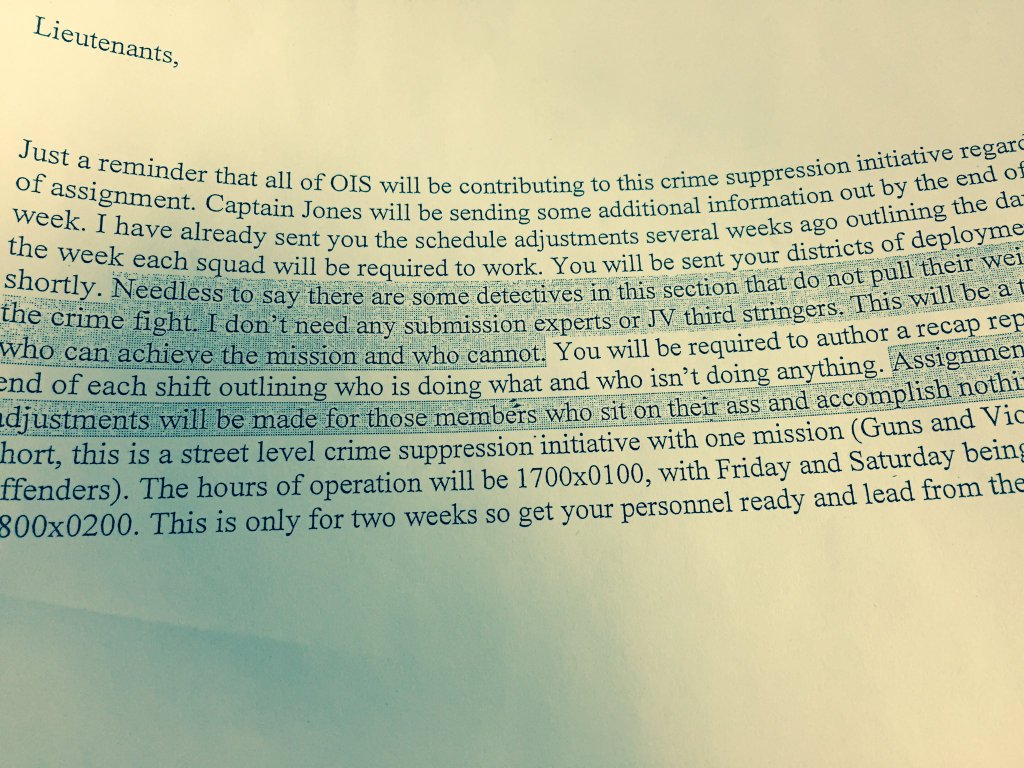
    Maybe Chicago could learn from the Baltimore way of motivating cops: pull your weight; and no “submission experts” or “JV third stringers” need apply!

  • There goes: “You get what you pay for!”

    Well Suffolk County certainly isn’t a good case study for my point that if you pay cops enough, you’ll avoid scandal. Though I’d still like to think that’s true, WTF?

    The former Chief of Police (how much did he make?) pled guilty:

    to federal charges stemming from accusations that he beat a suspect in custody, threatened to kill him and then coerced his fellow officers into covering up the misconduct.

    Two decades ago, as a sergeant, Mr. Burke had a sexual relationship with a prostitute, according to an internal affairs investigation that accused Mr. Burke of accidentally leaving his handgun with the woman, Newsday reported.

    With some 2,700 sworn officers and over 600 civilian members, the department is one of the largest in the region.

    Compared with those in other departments, officers in the Suffolk agency are well paid, making $125,000 in base pay. That is about $50,000 more than their counterparts in New York City, and it does not include overtime pay, which can be substantial, or the extra money officers receive for each year on the job.

    Detectives and sergeants have been known to earn more than $200,000 a year. The police unions on Long Island are so wealthy they have formed a “super PAC” to flood local elections with campaign donations