Copinthehood.com has moved to qualitypolicing.com

  • Bratton calls out Kelly for calling out Bratton! It’s an NYPD smackdown!

    Bratton calls out Kelly for calling out Bratton! It’s an NYPD smackdown!

    This Kelly vs Bratton feud has been simmering in the backgroundfor a little while.

    But then when Kelly accusedBratton of cooking the books(something Kelly should be familiar with, since book-cooking constantly flared up during his reign)? Well, I’ll just sit back and enjoy the fight.

    And here’s an insiders’ tip: the good money is on Bratton.

    The NYPD took Kelly seriously enough to release an official rebuttal. And hell, Kelly is the former NYPD commissioner. He should be taken seriously.

    Now I will admit my initial thought on Kelly’s accusations: it sure is odd this year that shootings are down and homicides are up. How does that happen? What are the odds? So could Kelly be on to something?!

    Turns out: No.

    In the far corner, the former champion, the man who must be in charge, Raymond Kelly. He’s the consummate micro manager, the marine, and the man would wouldn’t let cops administer a heroin antidote (not on his watch). Kelly completely closed the department to outside researchers, transparency be damned! But he kept crime down and avoided a big scandal. (Stop, question, and frisk was not a scandal so much as a strategy.)

    I don’t think Kelly did a bad job. Not at all. But I was happy to see him go. At some level I just don’t like him. Substantively his conservative micromanaging was insane. Everything transfer and shift of manpower had to go through him. His emphasis on stats led to a lot of problems.

    The fact that below I use week-old data copied from a PDF file is entirely Kelly’s fault. And the fact that he could be so closed, on idiotic principle, even with Mike “open data” Bloomberg as mayor? It was all amazing. Kelly ran the department like nobody has ever been allowed to run that department. For 12 years, he was the boss.

    Murders did drop from a low 587 to an amazingly low 334. The last two years of his reign saw a 35 percent reduction in killings(!). And nobody took credit for it. Kelly didn’t want to take credit for a crime drop at the exact moment it was coinciding with a massive drop in stops, since each and every one of those stops, so he said, was absolutely necessary to prevent a rise in homicides. And Kelly’s opponents sure didn’t want to give the big bad NYPD credit for anything at all. So we had the largest drop in homicides since the mid 1990s… and nobody noticed.

    Kelly ran the NYPD, something Bloomberg didn’t want to do. But Bratton is doing what De Blasio can’t do. De Blasio needs Bratton a lot more than Bloomberg needed Kelly, and also much more than Bratton needs de Blasio.

    So in this corner, the current champion, William Bratton. He’s a bit more polished, a bit more educated, some might even say… smarter. Bratton is also conservative, mind you, but in a more intellectual way. Bratton understands the politics of policing. Bratton is also more open to transparency and sharing data. The fact that the same limited NYPD Compstat data is available in 2015 in spreadsheet form? Well, that’s progress, I guess. (But there’s no reason he couldn’t have (Now can we please get open crime data like this.)

    I like Bratton because of his track record, his intelligence, and his support and understanding of Broken Windows policing. Also Bratton, unlike Kelly, understands why, other things being equal, it’s better if people don’t hate the police. Kelly really didn’t give a shit what people thought. He knew he was doing a good job. That was enough.

    I’ll give Kelly the benefit of the doubt and not doubt his motives. Kelly probably really believes what he’s saying. Unlike some former commissioners, at least Kelly is nota crook. Now that he’s not in charge, he knows things must be going to hell. Besides, people are constantly telling him things are going to hell.

    Kelly always surrounded himself with yes-men. He wasn’t a micromanager because he trusted others. And now you’ve got a bunch of old friends who remain loyal to him. Cops hate de Blasio and everything happening right now (the latter is a constant, by the way, no matter what is happening). And maybe there was actually a case of a shooting that was downgraded. It happens. So these old buddies get together with Kelly and, over a soda water, tell him all the bad that is happening. Kelly believes it to be God’s truth, since it’s coming from his people. His loyal people.

    So why did Kelly do this? Probably not just to sell books. Though maybe Kelly found out he enjoys talking to the press. Those with big egos tend to like seeing themselves on the tee-vee.

    But back to the issue at hand. How do you tell if shooting victims aren’t been counted?

    I thought I would look for smoke in the ratio of homicide to shooting victims. But to find out which of the NYC homicide victims were shot, you have to go the UCR data (the FBI’s Uniform Crime Report). So I did that. After a fun couple of hours on SPSS, I got the answer. For the past 15 years, about 60 percent of homicide victims are shot. It hasn’t changed much. No smoking gun.

    Between 1999 and 2013 (but excluding 2006 and 2008, for UCR data quality reasons. And keep in mind, if you run the numbers, the UCR undercounts homicides by about 5 percent because it looks at incidents. Like everybody else, I ignored this and assumed a constant error rate) approximately 60 percent of homicide victims were shot. But I already told you that. But it’s worth pointing out that this number remains pretty consistent over these years, which I was not expecting. And over these years, it turns out the odds of dying if you’re shot in NYC is about 15 percent (which is substantially lower than I thought it was. Much lower).

    In other words, in 2013 there were 334 people killed in NYC, about 195 of those were shot (188 incidents recorded by the UCR plus a few multiple homicides). There were 1,300 shooting victims, according to the NYPD, people with gunshot wounds.

    Now we, the UCR, doesn’t yet have gunshot deaths from 2014, much less 2015. (Though I’m sure the NYPD does, now about that openness…)

    We do have shooting victims and total homicides recording by the NYPD (the former is surprisingly difficult to tease from the UCR, which is yet another UCR problem).

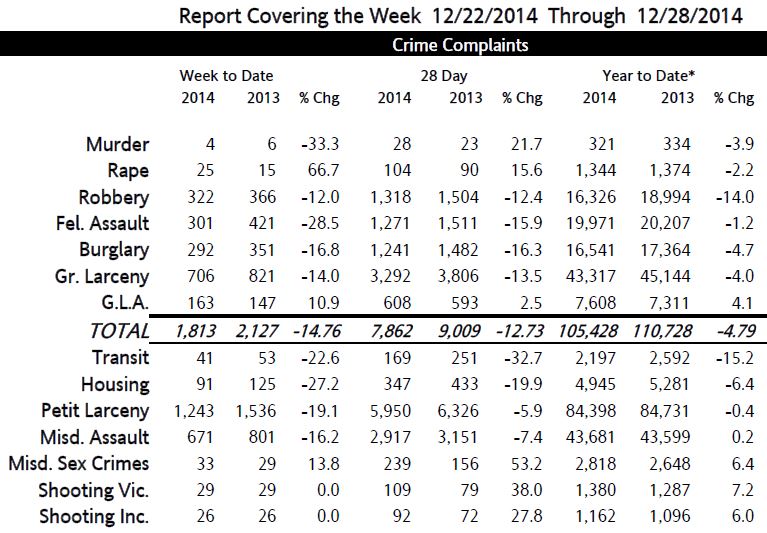
    If the number of shooting victims were being artificially reduced, one would expect the ratio of shooting victims to total homicides to be way down this year. And it is. But just a bit: to 3.9:1 from 4.2:1 in 2014. But it turns out that 2014 is the odd year, not this year. 4.2 is the highest that ratio has ever been. It was 3.9 also in 2012 and 2013. The average over the past 15 years in 3.4. The ratio is steadily increasing, probably due to better medical care. Maybe hospital closings affect this rate. Or maybe it’s just statistical variance (AKA: bad luck). But no, the numbers don’t look funny this year.

    Anybody still with me? One quick double-check: last year (2014) compared to the previous year (2013) the number of shootings should be down and homicides up (the opposite of this year). And yes, indeed, that is the case.

    Look at the “year to date” columns for the two years and the rows “homicide” and “shooting vic.”


    I’m betting on Bratton.

    Update: Gothamist jumps into the ring with a folding chair! And Bratton hits againin the Daily News. And the Inspector General, that’s the new oversight department under the Department of Investigations that is still in search of institutional meaning, stays mum.)
  • Did anybody say “crime wave!”?

    No. (Update: Actually, turns out a more people did than I thought. See the comments.)

    But lot’s of people are refuting the claim, nevertheless.

    Fivethirtyeight.com says:

    Scare Headlines Exaggerated The U.S. Crime Wave: If you’ve read reports of a U.S. crime wave this year and wondered how many cities it was really affecting, you’re not alone.

    Which headlines are these?

    In the Washington Post Radley Balko says:

    At various times over the past 12 months, we heard dire predictions of a “nationwide crime wave”

    Have we?

    According to Law Enforcement Leaders: “Some cities have seen a rise in murder, but these are isolated incidents — not a new crime wave — which local leaders are taking steps to address.” Glad we set the record straight.

    Mother Jones reassures us: “No ‘Crime Wave’”. They link to much cited Brennan Center report(much cited among lefties trying to say “everything is fine!” with regards to crime):

    One year’s increase does not necessarily portend a coming wave of violent crime.

    Indeed.

    Ultimately, all the links about “crime wave” seem to go back to this one friggin’ May headline for Heather Mac Donald piece in the Wall Street Journal. One. And Mac Donald never even said there was a “crime wave.” She never uses the phrase. It’s only in the headline.

    [Headlines are weird things. They do become how a story is known. But do not judge an article (or the author) by a headline. Authors do not write the headlines; headline editors write headlines. Authors have no say in them. And sometimes — and I speak from experience — the headline does not begin to capture the point of your piece. Other times they get it right.]

    This all came to mind because I was tweeted with my man, Andrew Papachristos, and the subject of “moral panic” came up with regards to the “crime wave”:

    Who is all this “they” hyping a “moral panic,” I wondered.

    So I googled “‘crime wave’ 2015” and found only people saying, “don’t believe the hype about the crime wave!” It’s a classic straw man argument, making up an false position in order to refute it.

    Best I can tell, the New York Times, the Washington Post, The Marshall Project, the Brennan Center, Mother Jones, NPR, even Fox News… they’ve all smugly refuted the “crime wave” claimed by nobody.

    But in the meantime, let us ask why is crime sharply up in some cities and murders roughly 10 percent higher than 2014. That seems to be the touchy subject many are trying to avoid. Why? Some ideas in my previous post.

  • “The enduring commitment of antipolice progressives to the ‘root causes’ theory of crime”

    This op-ed by Heather Mac Donald is the one I wanted to write. But I didn’t. And she did.

    The point, one could say rather simply, is that police matter as a force for crime prevention. That simple concept is why I decided to study policing and then became a cop.

    In the mid 1990s I got into this gig because an entire academic field said that the crime drop couldn’t happen. Crime wouldn’t go down until we improved “root causes” and fixed a racist society. By the time I entered graduate school in 1995, it was clear that crime was going down. Something was up. And it wasn’t employment and equal opportunity.

    This link to Mac Donald’s op-ed is behind the Wall Street Journal paywall. To read it all, try googling the headline “Trying to Hide the Rise of Violent Crime” and click through. Excerpts:

    An 11% one-year increase in any crime category is massive; an equivalent decrease in homicides would be greeted with high-fives by politicians and police chiefs. Yet the media have tried to repackage that 11% homicide increase as trivial.

    Several strategies are employed to play down the jump in homicides. The simplest is to hide the actual figure. An Atlantic magazine article in November, “Debunking the Ferguson Effect,” reports: “Based on their data, the Brennan Center projects that homicides will rise slightly overall from 2014 to 2015.”

    A second strategy for brushing off the homicide surge is to contextualize it over a long period. Because homicides haven’t returned to their appalling early 1990s or early 2000s levels, the current crime increase is insignificant.

    The most desperate tactic for discounting the homicide increase is to disaggregate the average. … The “numbers make clear that violent crime is up in some major U.S. cities and down in others.”

    If there weren’t variation across the members of a set, no average would be needed. [Zing! Nice one. I always appreciate a snarky line about stats.]

    To the Brennan Center and its cheerleaders, the nation’s law-enforcement officials are in the grip of a delusion that prevents them from seeing the halcyon crime picture before their eyes.

    FBI Director James Comey noted “a chill wind blowing through American law enforcement over the last year,” and called it “deeply disturbing.”

    Obama … accused Mr. Comey of “cherry-picking data” and ignoring “the facts” on crime in pursuit of a “political agenda.”

    Critics of the Ferguson-effect analysis ignore or deny the animosity that the police now face in urban areas.

    The St. Louis area includes Ferguson…. The Justice Department later determined that the officer’s use of force was justified, but the damage to the social fabric had already been done…. The media and many politicians decry as racist law-enforcement tools like pedestrian stops and broken-windows policing—the proven method of stopping major crimes by going after minor ones.

    Consider that background. Here’s the point I’ve been trying to make:

    The puzzle is why these progressives are so intent on denying that such depolicing is occurring and that it is affecting public safety.

    The answer lies in the enduring commitment of antipolice progressives to the “root causes” theory of crime. The Brennan Center study closes by hypothesizing that lower incomes, higher poverty rates, falling populations and high unemployment are driving the rising murder rates…. But those aspects of urban life haven’t dramatically worsened over the past year and a half.

    To acknowledge the Ferguson effect would be tantamount to acknowledging that police matter, especially when the family and other informal social controls break down.

    Many of those who are driving the “there is no Ferguson effect” bandwagon still believe that police are largely irrelevant to crime prevention and, rather than having anything to do with crime prevention, serve primarily as agents of racial oppression. That sentiment lies just under the surface of anti-police protests.

    It’s not just about “Justice For [fill in the blank of latest person shot by cops].” It’s about an ideology that still won’t accept that aggressive order-maintenance policing did any good. The “root cause” brigade never accepted that crime could decrease independent of structural changes. That’s what I mean when I talk about an ideological opposition to Broken Windows.

    So the next time you hear somebody say “crime isn’t up” or “there is no Ferguson effect” or “Michael Brown had his hands up” consider that they’re not just mistaken about one detail, however important. Instead, consider that they have a fundamentally different ideological view of who police are and what they can do.

  • The “Freddie Gray Era”

    Justin Fenton on solving homicides in the Sun:

    A couple of decades ago — the last time the city saw so much killing — Baltimore’s homicide unit closed more than 70 percent of its cases. Veterans talk of returning to the office from a crime scene to find a fistful of tips waiting for them. [Former Commissioner Thomas Frazier broke up that homicide squad to increase diversity in its ranks. He accomplished his goal; the homicide clearance rate plummeted.]

    But the widening gulf between police and the community since then has made witness cooperation a rarity.

    Forensic science has advanced, and surveillance cameras have grown common in the city. But detectives say witnesses remain the most important element in successfully bringing charges against a suspect.

    The challenges are not exclusive to Baltimore, but are being felt here more acutely. Among similar-sized cities in 2014, the average for cases closed — through arrest or other means, such as the death of the suspect — was 56 percent.

    In Baltimore, it was 45 percent. This year, it has fallen to 31 percent.

    Detectives say they have suspects in as many as three-quarters of cases, but in many instances they lack the evidence to move forward or can’t convince prosecutors, who in recent years have wielded more authority over detectives’ ability to charge.

    You want cause and effect between politicians’ rhetoric, a narrative that says police can’t be trusted, and less trust in police? There you go. And prosecutors are spending their precious resources putting six cops on trial. It’s all just the perfect shit storm. And as a result people are literally getting away with murder. There is no justice and indeed, no peace.

  • “Law enforcement is instilled”

    Marilyn Mosby, Baltimore State’s Attorney, keep emphasizing that she comes from a family of cops:

    To the rank-and-file officers of the Baltimore City Police Department, please know that these accusations of these six officers are not an indictment on the entire force. I come from five generations of law enforcement. My father was an officer. My mother was an officer. Several of my aunts and uncles.

    (I was never understood why she said “five generations” when she meant two.)

    But five relatives who are cops is kind of rare. Impressive, even. What are the odds?

    Well it turns out at least four of these “generations,” including both of Mosby’s parents, were bad cops. What are those odds?!

    Her mom repeatedly tested dirty for coke and was suspended multiple times. She had a her gun taken away and nine disciplinary actions and drug rehab. Yowzas. But at least she didn’t get fired. Mosby’s dad, also a Boston cop, was fired in 1991 after being acquitted by a jury for assault and robbery. He got his job back on what cops would call “a technicality.”

    Her uncles? Two of her mom’s brothers, both cops, were also fired, one in 1991 and the other in 2001. A third uncle successfully sued the Massachusetts state police for discrimination. On the plus side there’s no evidence that her grandfather, a founder of the Massachusetts Association of Minority Law Enforcement Officers in 1968, did anything illegal as a cop.

    Hey, it’s bad enough to have criminals parents, but it’s worse to have criminal parents who are cops. But it happens, I suppose. Not the kid’s fault. But to use these disgraceful cops as a badge of honor and distinction while prosecuting good cops? That’s disgraceful.

    Mosby says, “I come from five generations of police officers, so law enforcement is instilled.”

    God only knows what these clowns instilled in her.

    [This is not new news, but first I’ve heard of it. I think I was in Greece when this news broke in July.]

    July 2016 update:

  • Whose fault is this?

    A good piece of journalism in the Sun:

    In Baltimore, where there are an estimated 19,000 heroin users, including 9,500 chronic users, annual spending on the drug is estimated at least at $165 million.

    When the brothers of one local kingpin were kidnapped, he came up with $500,000 for ransom. When investigators searched a stash house and home of another dealer, they found $464,283 and $74,980, respectively.

    But as in the legitimate economy, such wealth is largely limited to those at the top levels of the heroin trade. At the bottom, the so-called “corner boys” who sell on the street can be making as little as minimum wage.

    There seems to be an unending supply of mostly young men willing to do this entry-level work, however low-paying, illegal, and dangerous. Among them was Freddie Gray, the 25-year-old whose death in police custody in April triggered protests and rioting in Baltimore and led to criminal charges against six police officers.

    It is an all-too-familiar cycle in Baltimore: Those with little education and thus few job prospects find their way to the lowest rungs of the drug trade, touting on the corner or serving as lookouts. At some point, they are arrested and end up with a criminal record that makes them even less attractive to the legitimate economy. And so they return to drug dealing, often in the neighborhoods they live in.

    “They’re basically unemployable.”

    And yet they’re eminently arrestable. Not that that does any good.

  • Choose your own adventure! The sick prisoner.

    You’re a police officer in the big city. This was your life’s dream. You like to help people. Once on the job, you realize it wasn’t all you hoped, but you still do the best you can.

    You have a prisoner in the back in your vehicle. It was a minor offense. But the law is the law.

    You’re driving to booking when the prisoner starts to act like he’s sick. He moans and says he’s not well.

    What do you do?

    Ignore him. You’re almost at booking. Besides, he’s probably faking it. If you keep driving, turn to page 8.

    You took this job to help people. Sure he might be faking it, but what if he really needs help? If you stop immediately to check on his well being, turn to page 26.

    Don’t ask any questions. The man is in need of aid. You’re only trained as a medical first responder. Best to see a real doctor. If you change course, put on the lights and siren, and head straight to the hospital, turn to page 4.

    (You know the rules: no pressing the “back” button!)

  • Courage, not fear

    I still can’t believe this guy got shot down by a cop playing whack-a-mole with his service weapon. The D.A. said:

    The evidence in this case shows the shooting to be accidental, and possibly negligent, but not criminally so. “This shooting is not justified, but also not criminal.”

    I don’t know if I buy the stutter-step no-double-tap explanation. But at least the legal concept is sound. Something can be wrong and not criminal.

    In fact, the only charges are against the paralyzed victim with the dead wife. [Update: Charges were dropped. He died.] This seems kind of mean. And there are no national politicians weighing in. Just a small local protest. Al Sharpton must be previously engaged. (As is often the case, this unnecessary shooting happened in California.)

    Officer Feaster claims he didn’t know he shot Thomas:

    No, no. … I don’t think I shot him. I wasn’t even pointing at him but the gun did go off.

    Did go off“? What are you saying? It just blew?

    Let’s leave aside whether Feaster is the world’s best shot or the world’s worst cop. Perhaps it doesn’t matter. The question I have, the question any reasonable police officer might have, is why the hell did he draw his gun in the place. What made this cop so afraid that he felt the need to approach a crashed presumed drunk driver with his gun drawn and shot the man trying to get out of the wreck? The guy was going to run? What use is your gun in that case? A car just flipped. What exactly was the threat?

    In the same vein, a reasonable police officer wonders, as did Levar Jones complying with orders, why he got shot. Why did cops feel that innocent Jonathan Ayers was a lethal threat while driving away? Why is a man not carrying a gun a lethal threat when he drops his hand?

    Why did all these police officers see non-existent threats? Why were they so damn afraid? (I’m tempted to add “…these days,” but maybe it’s always been this way. I don’t know.)

    In the face of danger you need to act but not overreact. You need courage, not fear. There’s a line I always liked in Birds Without Wings:

    His courage was not the foolish kind of a young and silly man. It was the courage of a man who looks danger in the face, and forces himself not to flinch.

    Hell, a little fear can be a good thing; you don’t want to be blasé in the face of danger. It starts in the police academy. “Stay alert, stay alive!” It’s a good lesson. Even “make a hole” isn’t so bad when it’s put in the context of situational awareness. But too much fear becomes paranoia. And that’s not conducive to good policing (or a happy life).

    Here are some of the videos cops watch in the police academy. Some I saw myself. Others are more recent. They’re all on YouTube (which didn’t even exist when I was a cop). I guarantee you that every last one one of these has been watched in some police academy somewhere. Every cop I know knows 1) Dinkheller.

    And 2) here’s that woman cop getting her ass kicked trying to arrest some big guy. His daughter is there. The cop kind of came back, but never recovered.

    Go on. Watch them. Watch them all. It won’t take but 10 or 15 minutes. I’ve cued them all up to the key moment. It’s a parade of snuff films (though many of the cops do live, somehow). Can you watch all of these and not perceive threats and car stops a bit differently?

    3) Here’s a man who wouldn’t stay in his car.

    4) Here’s a routine traffic stop.

    5) Here’s another routine traffic stop.

    6) And other routine car stop.

    7) This was a routine car stop but the guy drove away.

    8) Here’s a guy in cuffs and a girl. What could possible go wrong?

    9) Three cops. One suspect. Everything under control?

    10) This guy isn’t wearing a shirt and doesn’t seem hostile.

    11) This guy is naked and unarmed. There are three cops, two of them with tasers. The guy is still a threat.

    12) And sometimes this happens. Things can go from 0 to 100 really quickly.

    13) This guy does a little jig. He must be just be an odd character.

    14) And everything seems OK here. Except for that shot cop.

    15) This is what happens when you don’t put suspects on the ground.

    16) We all know that when it comes to an armed man, it’s easier to act than react.

    17) And people who have done time can be especially dangerous.

    18) Out-of-shape fathers with their 16-year-old sons? Could always be cop killers.

    And to cops these aren’t just abstract videos. There are people I know, friends, some taught in the academy, who were shot and lucky to live. Others, the pictures on the walls, weren’t so lucky.

    Certainly cops need some of this. Some people are willing, even eager, to kill police. You can’t go on the job as a pacifist. But at some point fear isn’t healthy. It isn’t good for the job. It can even make the job less safe.

    And I worked in a dangerous post. It made me less afraid. You face danger a few times, and you learn to respect it. Cops in the Eastern don’t squeal every time somebody steps on a leaf. But you don’t shoot at everything that moves.

    But what if your work in some place without much danger? How do you stay awake, much less alert? (In my squad we could be alert and asleep!) And then, during some “routine” traffic stop or domestic — blam — something goes off script. Maybe you, the young cop who took the warrior mindset to heart, get a flashback to one of those videos in the academy where the cop got ambushed. And you think: “This is exactly how that cop got killed.”

    [Cue trippy flashback music and echo]

    “This officer hesitated [tated] and it cost him his life [life, ife, f…]”

    “Better to be judged by 12 [elve] than carried by six [six, ix, x…].”

    So you misidentify a threat, overact, and pull the trigger. You’ve screwed up because you’ve gone through life in a constant state of “Condition Yellow” because you didn’t want to slip into unaware “Condition White” in which:

    You may very well die — unless you are lucky. I prefer to not depend on luck.

    Some insist you cannot go through life using this system without becoming a hair-trigger paranoid person who is dangerous to ones self and others. I believe well-adjusted police officers can run through the color code dozens of times every day and be no worse for wear. Most experienced police officers who learn the color code realize they have been taking these steps on their own all along.

    Maybe. For some. For me even. (This is why cops don’t sit with their back toward the door.) But even if constant hypervigilance doesn’t make you paranoid, it is very tiring. Exhausting, even. I don’t miss it. And stress affects some people more than others. NYPD officers are much more likely to commit suicide with their service weapon than be killed by a criminal. Why?

    I don’t know the answer. I don’t like the “warrior” or “guardian” dichotomy. I would certainly put the emphasis on the latter, but you need a bit of both. You can’t let the warrior mindset take your soul.

    Seth Stoughton writes in the Harvard Law Review:

    Officers learn to be afraid. That isn’t the word used in law enforcement circles, of course. Vigilant, attentive, cautious, alert, or observant are the terms that appear most often in police publications. But make no mistake, officers don’t learn to be vigilant, attentive, cautious, alert, and observant just because it’s fun. They do so because they are afraid. Fear is ubiquitous in law enforcement.

    And to those who say police need to abandon this warrior mindset for guardian mindset. Well, they’ve got an answer for that, too. And it’s not crazy. What do you do when it’s time to fight?

    At some basic level policing does involve confronting and fighting criminals intent on hurting you or others. I always notice that when people talk about police reform or improving community relations, the word “criminal” will never come up. It’s as if the entire job of policing is nothing more than dancing with kids and smiling at church-going ladies in fancy hats.

    See, just as the public needs to have a more realistic perspective about the “epidemic” of police killing innocent people (happens, but not too much), police need to get a realistic grip about being shot on the job (happens, including to friends of mine, but still less than cops think). Nationwide police get shot and killed about 3 times every month. That’s an annual homicide rate (cops getting killed per 100,000 officers) of under 5, which just happens to be almost identical to the national homicide rate. Of course keep in mind cops are on-duty only a fraction of the time, so cops on the job have a homicide rate 5 times higher than the national average. But hell, it’s still safer to be a cop than to live in Baltimore.

    Stay alert. Stay alive. But for God’s sake stop being so damn afraid all the time.

    [In memory of the police officers killed in the above videos: Kyle Wayne Dinkheller, Jonathan Richard Schmidt, Edward Scott Richardson, Billy Colón-Crespo, Ramón Manuel Ramirez-Castro, Darrell Edward Lunsford, Sr., Thomas William Evans, and Robert Brandon Paudert. They gave their all.]

  • Perhaps the worst police-involved shooting ever

    I don’t say that lightly. There have been some bad ones.

    Click on this link or you can jump to about 0:50 sec on this:

    Andrew Thomas, the victim, a drunk driver, is paralyzed. He is white. So is Paradise, California.

    1:35: “I got a male in the car refusing to get out.”

    Maybe, you think, just maybe, it’s because you just shot the mother f*cker for no reason?!

    And yet I hadn’t even heard of this shooting until a Baltimore cop just brought it to my attention tonight. We were talking about Baltimore cops actually do their job pretty well, all things considered. A Baltimore cop would never do this; we can’t imagine this happening in Baltimore. Apparently the officer in this shooting won’t face charges.

    And yet in Baltimore six cops are being tried for failure to seat belt and bring prompt medical care? Has the world gone mad?

    It’s not just that white people don’t care about black lives. Honestly, most white people don’t care about white lives, either.

    [Update: he died]

    [Further update: The officer was found guilty of involuntary manslaughter and sentenced to 6 months in jail.]

  • Cause 911 is cheaper than a shrink

    Here’s a report with some numbers on the problem of untreated mental illness and police response.

    Bottom line, according to these numbers:

    About two percent of Americans have untreated severe mental illness.

    Those two percent of people account for 10 percent of police responses, 20 percent of those behind bars, and 25 percent of fatal police encounters.

    I was going to joke how it’s easier to blame the police than treat mental illness. But I don’t even know if that’s true. We just choose to treat mental illness with police and incarceration. That’s messed up.

    [Thanks to a reader]