Copinthehood.com has moved to qualitypolicing.com

  • Meanwhile, in Brazil

    Meanwhile, in Brazil

    In New York City, police have killed 281 people over the past 10 years. Meanwhile, a friend just gave me this a fun tidbit, in Rio de Janeiro (which is smaller than NYC) over the past ten years police have killed 8,466 people! That’s crazy. That means that every day police kill 2.3 people in that city. Just think of the normalized bureaucracy that must surround that. The only other place that might come close is Jamaica. And maybe parts of India. I don’t know.

    79 percent of those killed in Rio are black, however they define it.

    De acordo com relatório lançado em agostodeste ano pela Anistia Internacional, 8.466 pessoas foram mortas pela Polícia Militar do Rio de Janeiro nos últimos dez anos. Dessas mortes, 99,5% envolviam homens, dos quais 79% eram negros e 75% tinham de 15 a 29 anos.

  • Fox Lake cop killled himself in “carefully staged suicide”

    When I was on Bill O’Reilly, he used Lt. Joe Gliniewicz’s death as a lead-in to asking: “Do you believe that the black lives matter crew and other radicals are igniting violence against police officers?” I didn’t. The next day I pointed out that Black Lives Matters doesn’t have a strong foothold in Fox Lake, Illinois, which is less than 1 percent African American. That works out to all of 80 black people.

    Well, it turn out the cop wasn’t even murdered. A police investigation revealed he killed himself in a “carefully staged suicide.” Normally I’d have a bit more sympathy for this guy, but it also turns out that he was stealing and laundering money for the past 7 years (something in the “5 figures”). He stole some of the money from a police youth training program he helped run. What a prick. He had 30 years on. He could have just retired. Classy.

  • “Fruit and other food in season… seems to have been completely overlooked”!

    “Fruit and other food in season… seems to have been completely overlooked”!

    The good ol’ days…

    I love spending time in John Jay College’s great Lloyd Sealy Library browsing NYPD annual police reports from 100 years ago. Even older ones are available to the public online.

    In 1912 the total force was 10,371 plus 268 civilian.

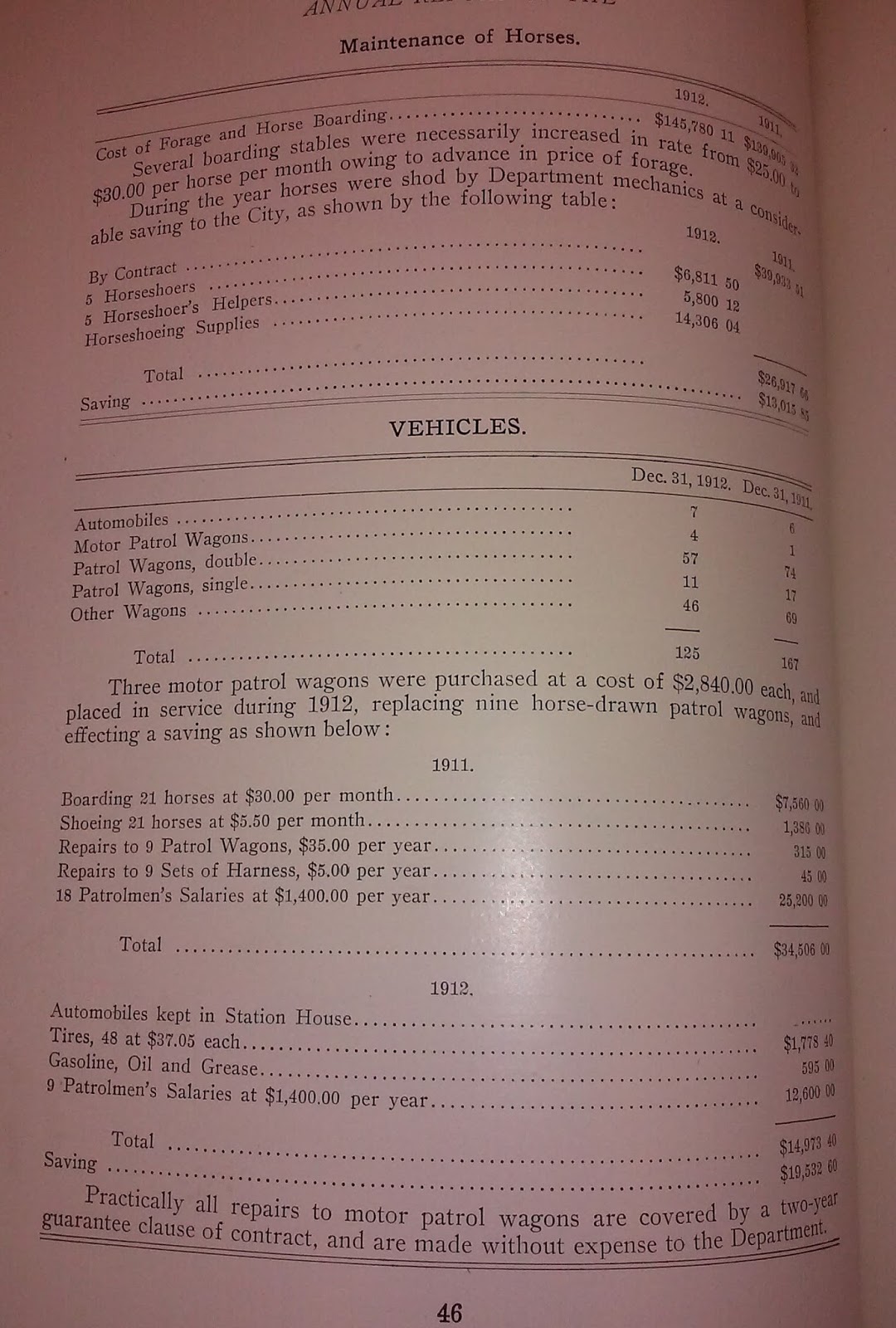
    Three motor patrol wagons were installed during the year 1912 [making 4]. It is proposed to immediately purchase ten additional wagons of the same type. Each of these vehicles replaces three horse-drawn wagons. The savings in salaries of the drivers alone pay for the original cost of the vehicle [$2,840] in about six months.

    There were the 25 motorcycles, 55 bicycles, and 679 horses (139 patrol wagon, 483 saddle service).

    Crime and arrests: 300 homicides, 107,227 misdemeanor arrests (60,493 for intoxication and/or disorderly conduct), and 18,780 felony arrests (242 for cocaine, 2 for opium).

    Pay was to be not less than $1,000 for a patrolmen. Pension was requested to be 2% per year after 25 years of service.

    In 1919 NYC had 5.6 million people and 10,000 cops, the ratio of which was considered a big low compared to other cities.

    In 1925, 453 children 16 and under were killed by cars and trolleys. That’s a lot! By 1948 this number was brought down to 82. In 2015 there were 250 people of all ages killed by traffic. I guess the 1920s was the first time in human history when kids weren’t supposed to play in the streets.
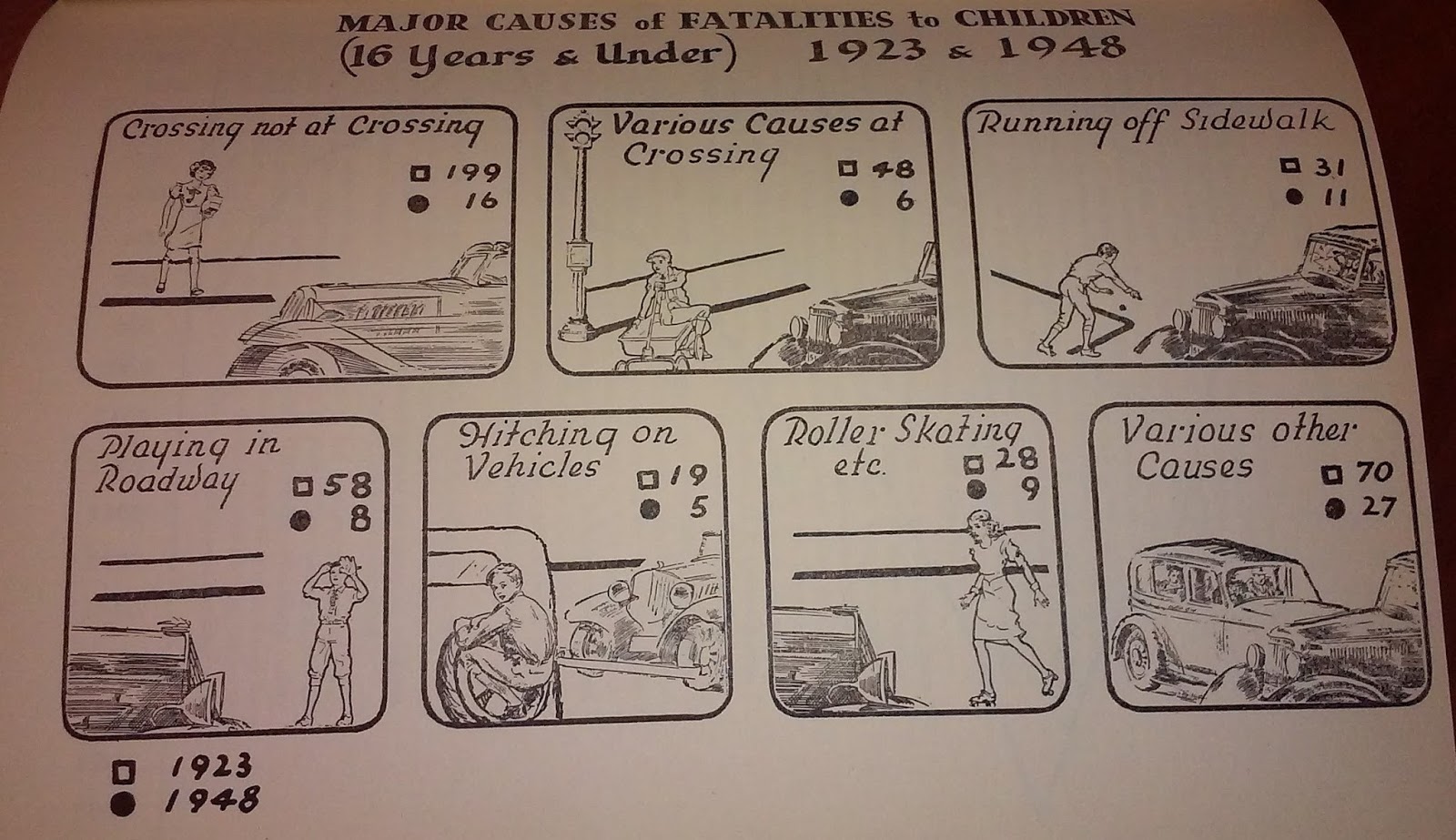
    I love the category of “roller skating, etc.”

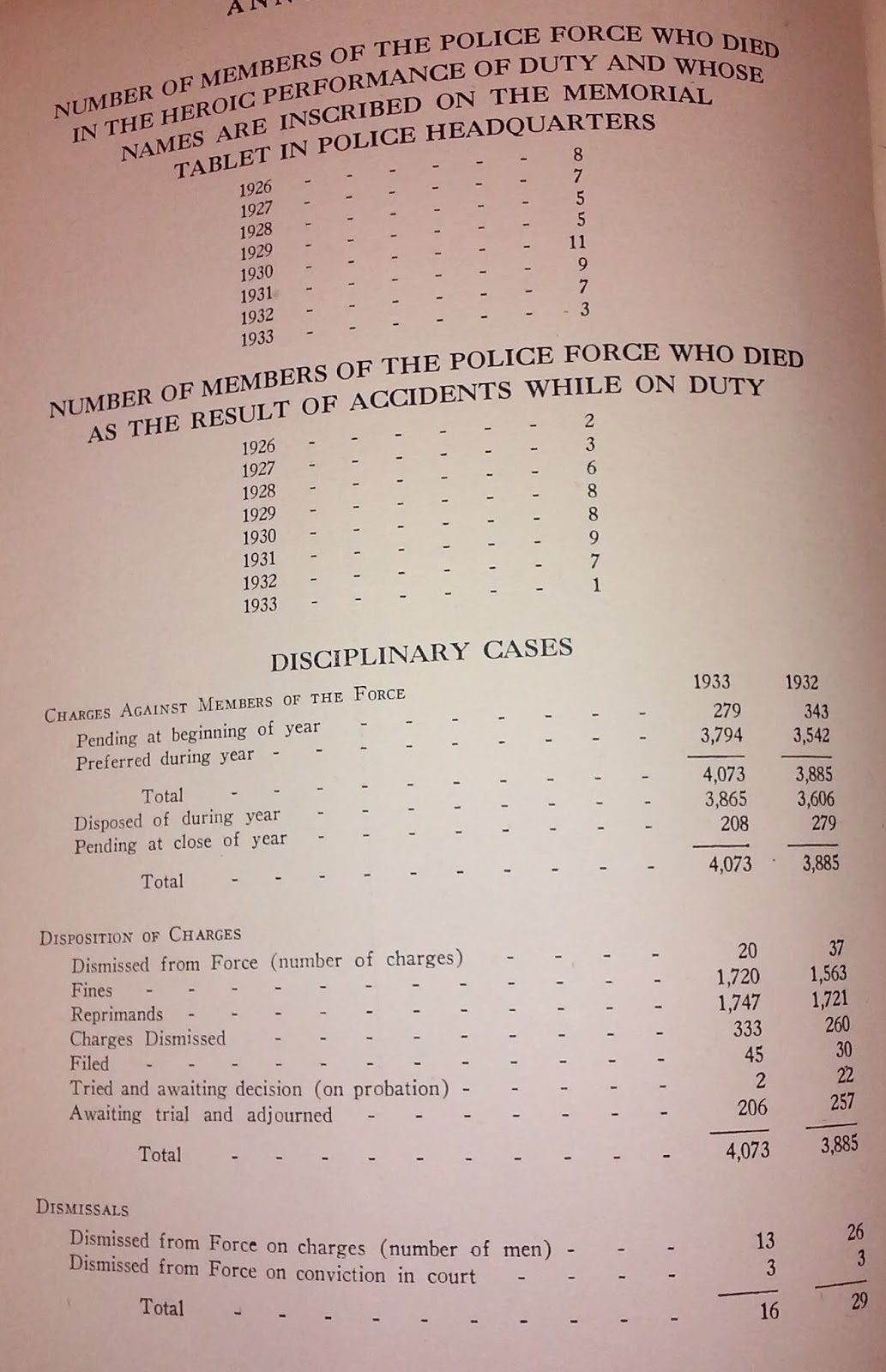
    From 1926 to 1933, an average of 7 officer a year “died in the heroic performance of duty.” An additional 5.5 died “as the result of accidents while on duty.” There were just under 19,000 uniformed personnel.

    In 1933, at the end of prohibition, there were 431 murders: 6 homicides from bootleggers’ dispute (down from 16 in 1932), 3 narcotic disputes, 3 slot machine disputes, and 2 prostitution disputes. 997 traffic fatalities. Total arrests 460,484.

    There were 12 motorcycles with side cars, armored. 64 2-passenger radio equipped coupes were purchased. There were 240 2 passengers, radio equipped “runabouts.” 123 had no radio. Keep in mind there were one-way radios! “Standard equipment, seven tube super-heterodyne radio receivers have been installed in four hundred Department automobiles.” Radio Motor patrol made 2,162 arrests.

    Under the great Mayor LaGuardia, police re-entered the social welfare game:

    The Unemployment Relief Bureau was established to function in connection with the work of obtaining aid and relief for the unemployed.

    Members of the Force were assigned to investigate applications for the relief cases of distress, visit owners of property whose tenants were in arrears in payment of rent with a view of obtaining monetary relief from the Mayor’s Official Committee.

    Food checks were issued to families requiring assistance.

    The nature of relief rendered through the Mayor’s Official Committee was as follows:

    A) monetary assistance

    B) distribution of food tickets

    C) Distribution of fuel

    D) distribution of clothing

    E) Securing positions for unemployed

    F) cases referred to other agencies.

    1,780,600 lbs of coal distributed. 16,334 articles of clothing, 220,000 food tickets (redeemed at authorized stores) worth $684,814, $70,799 in cash.

    31,094 (!) pistol licenses were issued (bringing in $286.50). 74 tear gas permits (?!) issued along with 418 religious permits (30 were disapproved). Other permits that the Pistol License Bureau could issue were: “auctioneers, bail bond agents, candidates for admission to the Bar, Hotel runners’ license, loud speaker permits, masque ball permits, massage operators, massage institute license, miscellaneous investigations, piston license, religious permits, tear gas permits, various investigations for the Department of License.”

    By 1939 homicides in the city dropped to 291 (78 shooting, 96 cutting, 85 assault). There were still 326 motorcycles and 375 horses in service.

    In 1948 there were 315 murders. 93 were shootings and 59 were categorized as “marital or passion.”

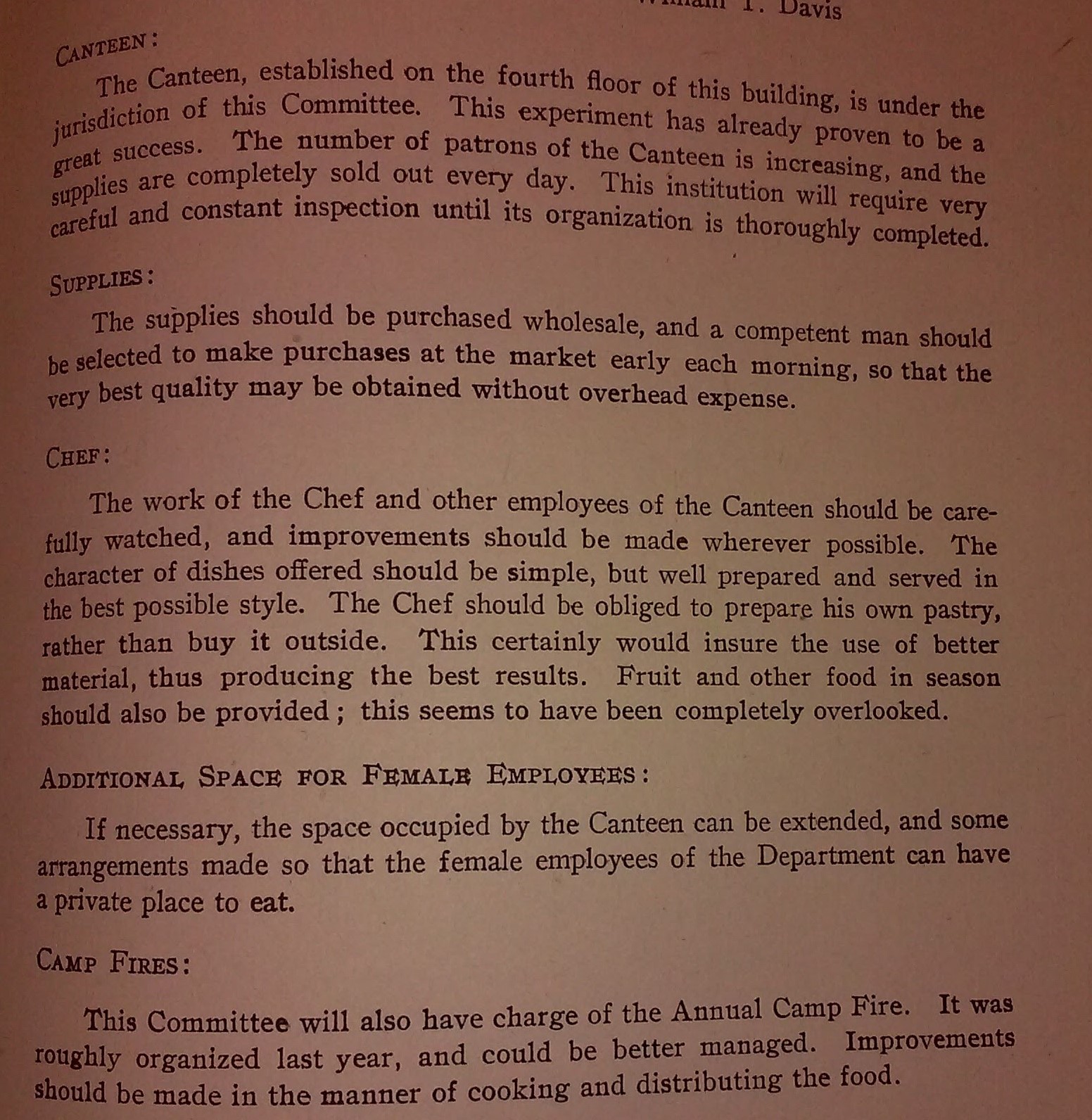
    My favorite part goes comes from the 1913 report and the complaint about the lack of “fruit and other food in season” at the canteen, something “that seems to have been completely overlooked”! Well, I say, the Chef does need to up his game!
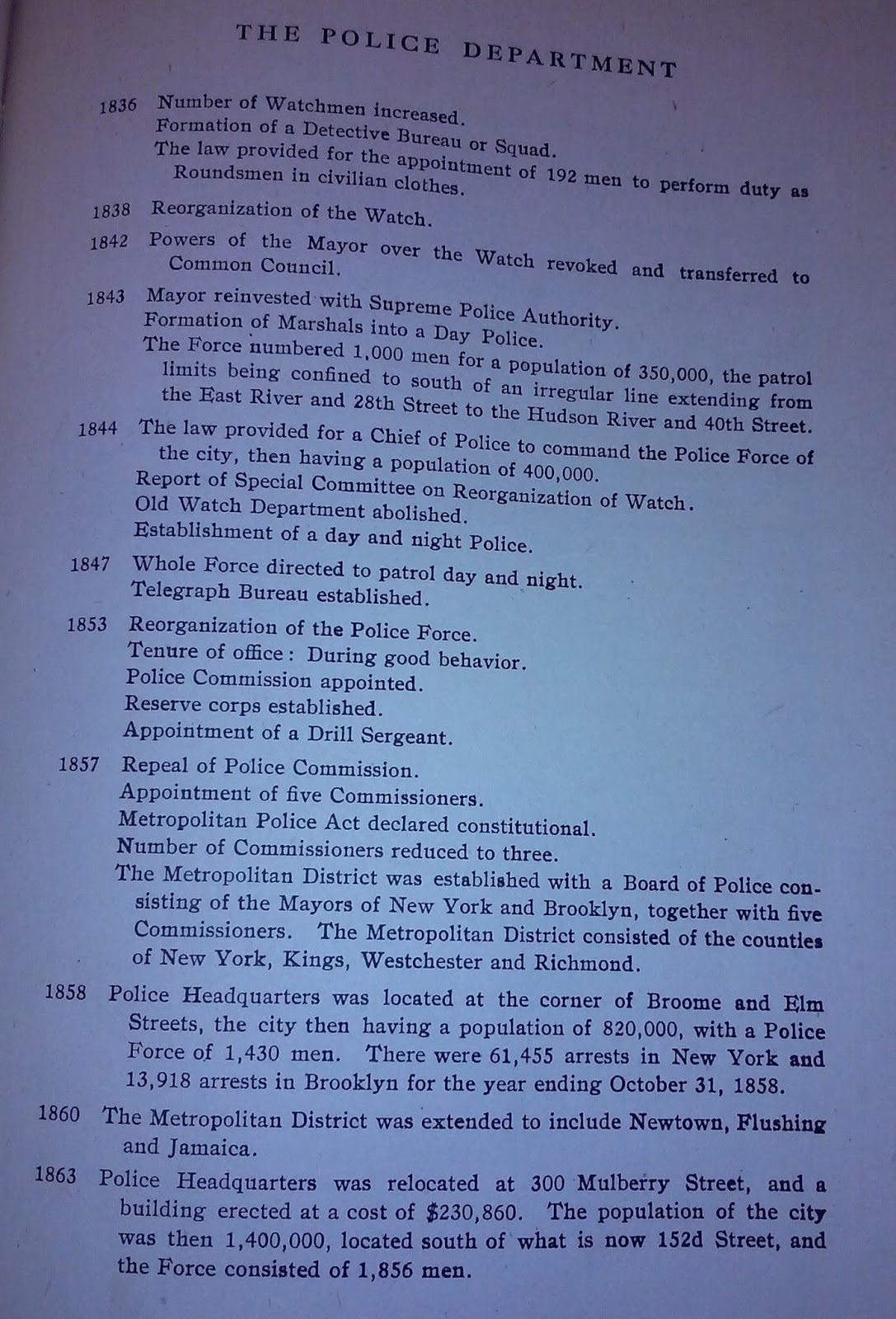
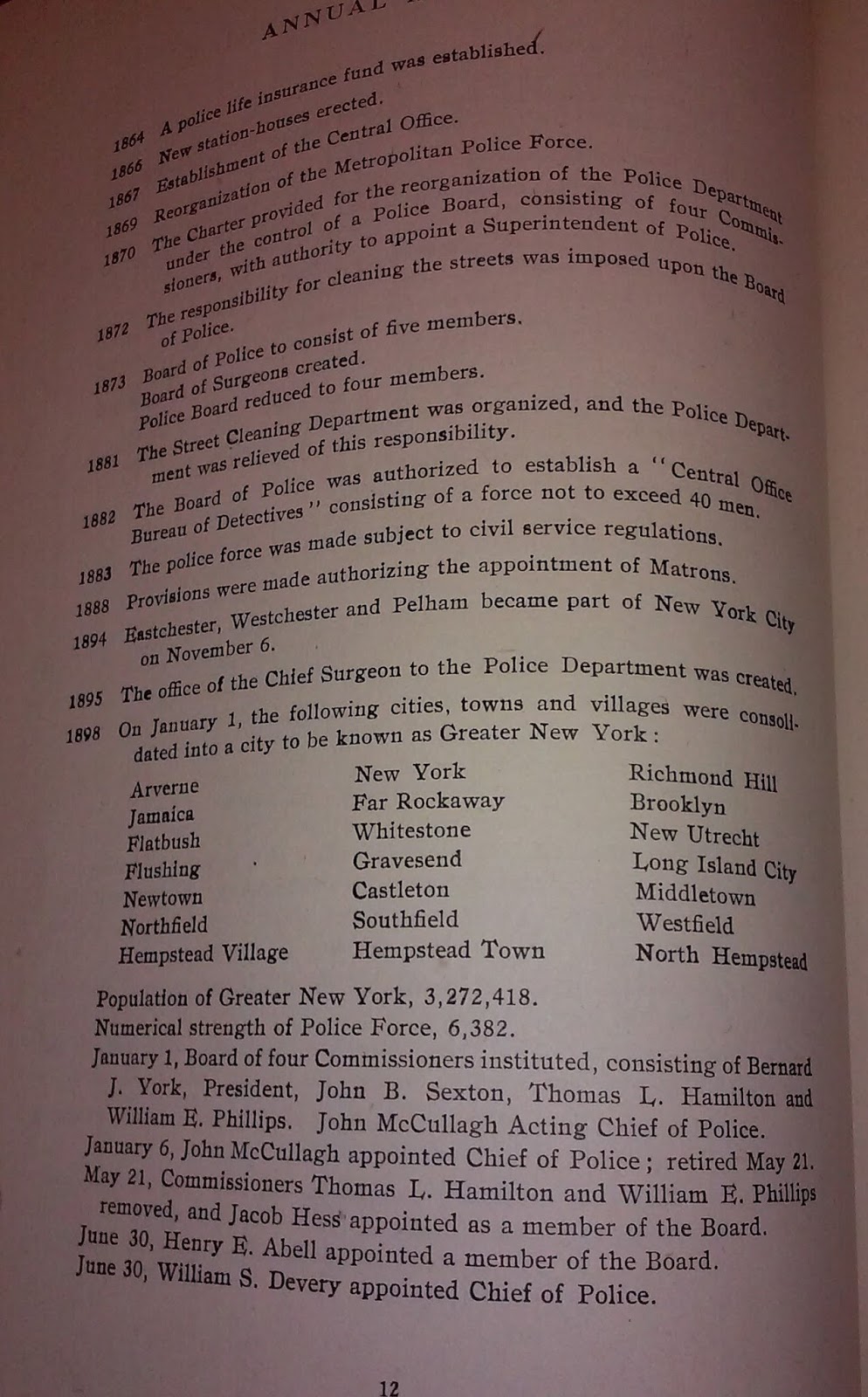
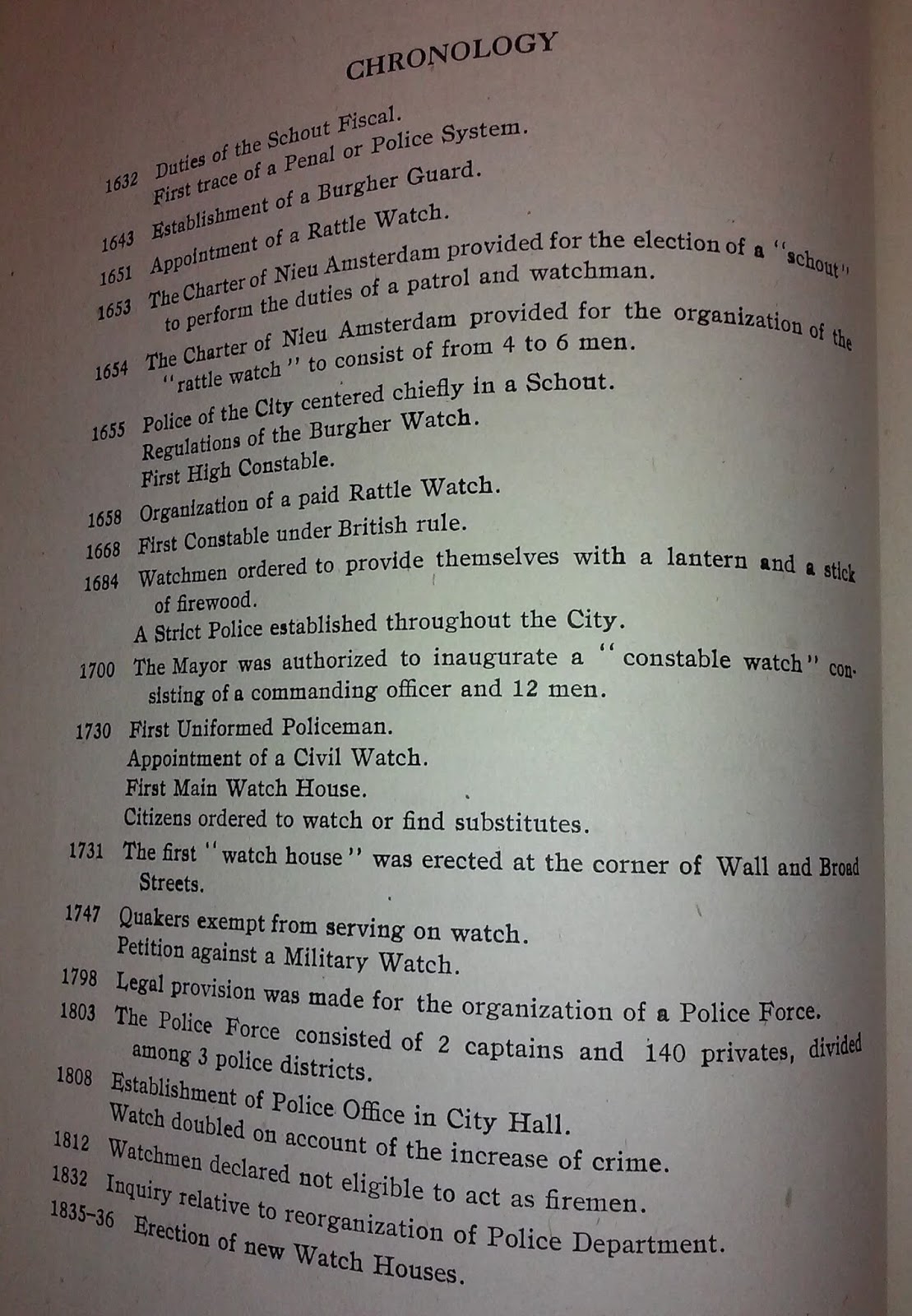
    And here’s the official chronology of the NYPD, up to 1900:


  • Terry v. Ohio

    For such a Landmark Case, I was curious how Terry v Ohio (1968) was reported at the time. I was thinking it would have been hard to see its potential implications at the time (though William Douglas did so in his dissent).

    Indeed, on June 11, 1968 the New York Times said:

    Held, 8 to 1, that the police may constitutionally stop and frisk suspicious persons, even if the officers do not have probable cause to make an arrest.

    That’s it.

    In July 1974, the Times gave Terry six paragraphs in a long obituary on Earl Warren:

    One notable exception to this [“‘anti police’ pattern”] came in 1968, when a political backlash was building up against the Court’s restrictions on the police, and even some liberals were beginning to wonder if the Court had not been too rigid in ruling out all evidence obtained in violation of the Supreme Court’s procedural rules.

    He then declared, with obvious reluctance, that weapons sized by “frisking” could be used in evidence — a decision that civil libertarians lamented as a serious breach in the Fourth Amendment’s shield against unreasonable searches and seizures.

    One way to see the growing influence of Terry is to look at the increase in citations over time. Using ProQuest’s newspaper search, there were only 3 references to “Terry v Ohio” in the entire decade of the 1970s. This grew to 7 in the 1980s, 11 from 1990 to 1999, 36 in the 2000s, and 56 in the 6 years since 2010.

    It’s interesting to me, listening to the oral argument (for the first time as I didn’t know you could do that!) that a big part of the debate circles around the idea of whether Terry was “arrested” at the moment he was stopped and not free to leave. The answer now seems obvious, but this is where “stop” — the idea of “temporary detaining” — got put in “stop and frisk.”

    Brennen asks:

    It’s certainly not an arrest in the sense of taking him to the station house and booking him for a crime; but, if he’s detained, isn’t it in the nature of an arrest?

    Lawyer Payne:

    The first seizure of the person was at the time that he ordered them into the store.

    Brennan, Jr.:

    You mean when he took Terry and swung him around there was no seizure of the person?

    Payne:

    I think there was a temporary detaining, or interference with his person.

    Brennan, Jr.:

    Well, he had his hands on him and he switched him around.

    Surely — there was no seizure of the person?

    Black:

    What is the difference between seizure and arrest?

    You know, a seizure — you don’t seize a man — I mean, you may seize him because you seize something tangible, but that’s not what you are talking about in a seizure in the Fourth Amendment.

    I thought it was an arrest?

    Payne:

    …and some may term that as a seizure of the person himself; but I would not term that it as a seizure of the person himself unless he has the intention of taking that person into custody, even though he may lay hands on him at that particular time.

    Payne won the day.

    [As a refresher course, Terry was extended to allow drugs based on “plain feel” if “immediately obvious” in Minnesota v. Dickerson (1993). (People v. Diaz says this does not apply in New York State.)]

  • The truth will set you free

    Another case where body cams help police officers avoid false accusations of brutality from a viral video.

  • Cops on Comey

    I love thoughtful cops. Especially those who can write. He emailed me this and agreed to let me repost it, anonymously. I wish him well and am happy to see people like this still becoming police officers.

    I’m a police recruit with a B.A. in the social sciences, and I read your blog a lot. Granted I am just a recruit and don’t know anything at all, but I thought I’d send you some thoughts about your posts on Comey and his remarks.

    I do not care at all about “scrutiny.” I work for a large, liberal city. We all have dash cameras and are required to tape every call. Body cameras are coming shortly and everybody knows it, and I’m fully in favor of it. I don’t care one bit if citizens film. We’ve talked about it in the academy, and it’s part of our training.

    What I do care about a lot more is the possibility of being the next Darren Wilson. Everybody in the academy watches every viral video and reads about every controversial police incident that happens in this country. Everybody knows about Ferguson. In Ferguson, a cop defended himself while trying to detain a robbery suspect. The Grand Jury agreed with it and the DoJ’s own investigation proved it via forensics and witness interviews. And that cop lives every day of his life in hiding. Wilson has no job, no job prospects, a wife and kid he can’t support, half the country thinks he’s a murderer, and every news article about him states he is “the white police officer who shot unarmed black teen Michael Brown.” His life is over.

    So people are idiots if they think cops don’t stand out there, see a black guy with some good warrants or who matches the description of a suspect, and think “this stop could cost me everything if he fights and dies – is it worth the risk?” To me, being fresh and new, I say it is. But I definitely understand it when the old guys sit around and say it isn’t. Your data from Baltimore shows this quite clearly.

    I think most cops recognize scrutiny is important and valid. But they also feel like this is a profession and we are entitled to some professional respect. Nobody tells nurses how to give medicine, or plumbers how to fix piping, but everybody feels the need to referee police use of force even if the extent of their expertise is watching NCIS reruns.

    So while police need to be responsive to public opinion, the public also needs to defer at some point to people with technical expertise on use of force. Certain things cannot bend. If someone tries for my gun, I will kill or maim them until they quit, even if they’re 18 and I originally stopped them for jaywalking. If the public refuses to accept that, police will pull back because the only other choices are to get fired or get hurt.

  • “Most people really do not return to prison”

    This goes against common accepted wisdom, which refers to a recidivism rate (ending up behind bars again within three years) of about two-thirds .

    Here’s another good piece by Leon Neyfakh in Slate, an interview with William Rhodes.

    The basic gist is this. Some people recidivate a lot while others do not at all. So if you look at everybody released from prison this year, indeed, two-thirds will be back (75 percent in five years). But if you look at individual people who have been to prison, most never come back! That’s the interesting part, conceptually.

    Here’s the bottom line:

    Two of every three offenders (68 percent) never return to prison. Another 20 percent return just once. The NCRP data are not definitive but it appears that most of these one-time returns are for violating the technical conditions governing community supervision rather than for new crimes. Importantly, only one in ten offenders (11 percent) returns to prison multiple times.

  • Bar the doors! Board the windows!

    Bar the doors! Board the windows!

    Halloween is coming! 6,000 inmates are about to be released from prison. Most got about 2 years cut from a 10 year drug sentence.

    Think of it: 6,000 roving marauders. Pirates! Barbarians!! Thugs!!! They’ll be Shanghaiing our youth, raping our maidens, and pillaging our homes! At least that’s what I’m learning from some on the Right. (See me on Bill O’Reilly.)

    Don’t believe the hype.

    6,000 is less than the number released from prison every goddamned week in the US.

    You know what will happen when, during one week, that number of released prisoners goes from 12,000 to 18,000?

    Absolutely nothing.

    Update: I just heard on public radio that close to 2,000 of those 6,000 are going to be immediately deported to Mexico (Nothing like investing half a billion dollars on incarcerating people before kicking them out of the country). So the actually weekly increase of people getting out of prison will go from about 12,000 to 14,000.

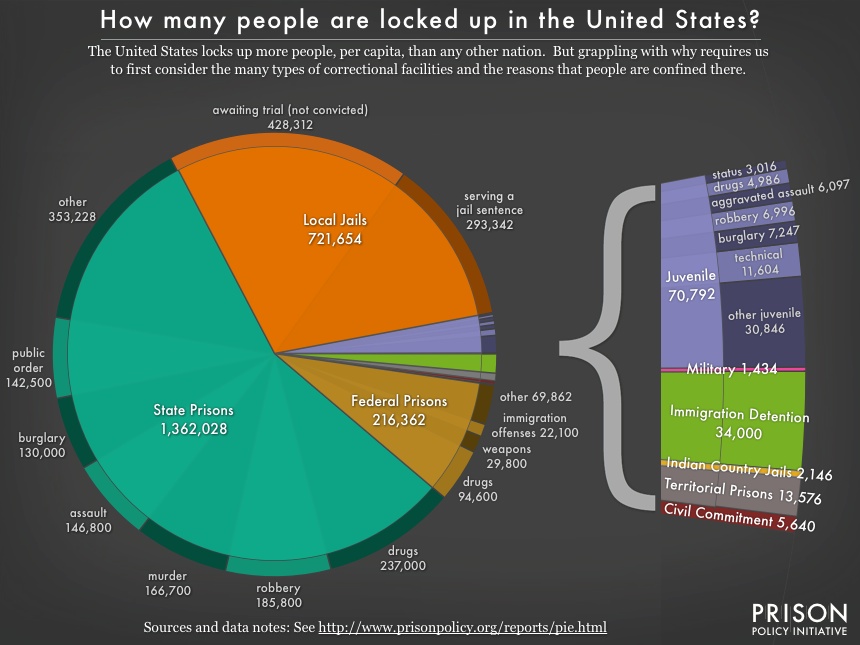
    Only semi-related: Here’s a nice pie chart from PPI. It’s rare to see things broken down by why you’re there, and include immigrants and juveniles:

  • Killed by police, Washington Post analysis

    Washington Post reporters are doing what journalists are supposed to do. They’re looking at those killed by police (like the Guardian, but a bit more fairly).

    815 have been shot dead by police this year as of right now (the Guardian, just FYI, pushes that number to 948. That’s a 15 increase based on people that really shouldn’t be counted because it includes things like suicide and non-police custody).

    Of the 815, 31 are labeled “undetermined” in terms of “threat level” and thus questionable as to their justification. Of those 10 each were white, black, and hispanic. But even among those 30, 11 had a deadly weapon.

    76 of the 815 were “unarmed” (28 of 76 black). 29 of those 76 “unarmed” are labeled “attack in progress.” 39 “other.” 8 “undetermined.”

    Overall, 203 are determined to be mentally ill. That’s one in four. And 40 percent of all whites. “Just” 15 percent of blacks are considered mentally ill. I assume there are labeling errors here. I suspect more mentally ill blacks are not labeled as mentally ill when killed by police. But hell if I know. Regardless, that difference jumps out at me.

    Of the total number, 390 were white, 208 were black, 134 hispanic. 32 were women.

    I keep harping on the state differences. And for good reason. The top ten states by rate (from the Guardian) of police-involved homicides (from the Post) have about 20 of the US population and 298 (36 percent) of police-involved homicides. The rate of police-involved killings in the ten worst states, (extrapolated from 10 to 12 months) about 5.4 per 100,000, is greater than the overall level of homicide in the United States. Period.

    Damn.

    Meanwhile the best ten states (police in these states are least likely to kill people) have nearly the same population as the ten worst states just and 67 (8 percent) police-involved homicides. That’s an annual rate of about 1.2 per 100,000.

    That’s a big difference.

    The states where police kill the most are OK, NM, WY, AK, AZ, LA, WV, NV, CA, and CO.

    The states with the least lethal cops are VT, ME, RI, CT, NY, ND, PA, MA, IL, and IA.

    Is gun control a factor? Maybe. The top 10 average rank is 15 according to the Brady Campaign’s rank of gun control. The bottom ten rank 31. But I suspect that is mutual causation or correlation without causation. Gun culture in general more than gun control in particular. There are outliers galore: California ranks 1 on gun control and cops killed 150 people; meanwhile Vermont (1/60th the size of California, mind you) ranks 44 on gun control, but police have killed nobody.

    The biggest divider I can see is simply East/West. You can draw a sharp line between the top 10 and bottom 10 with the Mississippi and Missouri Rivers.