Copinthehood.com has moved to qualitypolicing.com

  • After a 200-percent decrease in basic math skills…

    As promised, here is how to determine basic percentages. Too many of my college students don’t understand basic percentages. Clearly GTF has the same problem. So here is how it works — in words — with no math symbols. I’m totally serious. It’s never too late to learn. And not knowing how to relate “doubled” and “100% increase” is the mathematically equivalent of being functionally illiterate.

    To say how many times something increased, simply divide the second number by the first: There were 10 arrests; now there are 30. 30 divided by 10 is 3. Arrests tripled.

    To figure out a percent increase or decrease, subtract the first (earlier) number from the second (later) number and then divide the result by the first number (multiply by 100 — move the decimal place over two to the right — to get a percentage).

    30 minus 10 is 20; 20 divided by 10 is 2; 2 times 100 is 200. So 30 arrests is a 200 percent increase compared to 10. A 100 percent increase would be the same as saying something doubled.

    Going the other way, from 30 to 10 arrests would be one-third as many arrests or a two-thirds decrease or a decrease of 67 percent.

    And nothing, not even math skills, can decrease more than 100 percent.

    Next I’m going to talk about rates.

  • This is the DEA’s Brain on Okra

    This is the DEA’s Brain on Okra

    marijuana

    I wonder if an end-the-drug war voter is just an law-and-order conservative whose backyard okra garden was raided by local cops after being spotted from a helicopter funded by the Drug Enforcement Agency Domestic Cannabis Eradication/Suppression Program?

    Barstow County, Georgia, resident Dwayne Perry may be a recent convert: “I do the right thing and they come to my house, strapped with weapons. It ain’t right…. The more I thought it. What could have happened? Anything could have happened.” Indeed.

    Now I don’t know Mr Perry’s politics, but seeing how he is a white man in a conservative Georgia county (Republicans out number Democrats 8:1) I’m assuming he didn’t cast his ballot for any progressive candidate wanting to end the drug war. I wonder if Mr. Perry will see a connection between the so-called “law-and-order” politicians he votes for and the police who mistook him for the enemy? [More likely, as my wife pointed out, he will just blame Obama.]

    But my point does not actually concern Mr. Perry, okra aficionado. It’s almost pointless to keep highlighting absurdities in the war on drugs because if you’re not convinced by now, it’s doubtful one more anecdote will persuade you. Even if this anecdote, you do understand, concerns a helicopter being used to spy on an innocent American which was then followed by a police raid on the backyard garden of an innocent American because the drug warriors incorrectly though okra was marijuana (a relatively benign drug that is partially legal in 23 states and the District of Columbia).

    okra

    Regardless, it is worth reading Christopher Ingraham’s informative Washington Post post about this raid. Did you know that close to 98 percent of all the domestically eradicated marijuana is “ditchweed”? I didn’t! And “ditchweed” — I’m not making this up — is a technical Department of Justice term for wild non-tended marijuana that contains little if any THC. They’d be more productive pulling up kudzu!

    Anyway, I clicked through to the Georgia Department of Public Safety Governor’s Task Force/Drug Suppression (GTF) webpage, because that’s the type of thorough bathrobe-wearing research you can expect of me. I always like to know what our hard-working taxpayer-sucking drug warriors are up to:

    2012 Operational goals were exceeded with an increase over 2011 in plants eradicated, arrests, weapons seized and asset seizures…. GTF initiated and developed intelligence for grow operations throughout the state. The intelligence was then forwarded to local agencies. Subsequent investigations resulted in numerous arrests and seizures. The 2012 statistics indicate the degree of success in achieving primary operational goals.

    Those numbers aren’t easy to read, but let me highlight a few lines:

    2011 Outdoor Grow Plants Seized: 18,710 Plants

    My actual calculator! You probably use a phone.

    2012 Outdoor Grow Plants: 67,634 Plants

    72% increase

    2011 Indoor Grows Located: 20

    2012 Indoor Grows Located: 24

    16% increase

    2011 Asset Seizures: $812,248

    2012 Asset Seizures: $3,952,307

    79% increase

    Notice anything? The math doesn’t make sense. And it’s not that they’re trying the old DEA trick of making shit up to make them look good. I think they’re just dumb. While a couple of computations are actually correct, the grade overall, based on 2.5 correct out of 8, would still be an F.

    Now look, we all make mistakes. I make typos all the time, and it’s easy to punch a wrong number into a calculator. But thinking a 387 percent increase is less than 100 percent is absurd. You can pretty much mentally check “more or less than double” in your head. And a more astute practitioner of basic math skills might just know that 20 to 24 is a nice round 20% increase (and not 16%). After that even I need to break out my calculator. So I did:

    Now I don’t know if bad math is a direct cause and effect related to the Georgia legislature cutting $8.4 billion from public schools, but the math skills of Georgia’s drug warriors are just as bad as their botany identification.

    Regardless, asset forfeiture increased nearly four-fold from 2011 to 2012, presumably because the warriors have a helicopter. They can look in your backyard and, if they find drugs, take your property. These cops weren’t hoping to dig up Mr. Perry’s weeds. They wanted to seize his whole damn house!

    (In my next post I’ll tell you how to figure out percentages. For real.)

  • Paperwork

    The ninth in a series from Sgt. Adam Plantinga’s excellent 400 Things Cops Know: Street-Smart Lessons from a Veteran Patrolman:

    Most critical incidents you’re involved in take anywhere from a few seconds to a few minutes to resolve themselves. The paperwork that follows takes hours. You’ve got the incident report, the clearance report, the inventory forms, the DA sheets, the arrest report, the prisoner statement, and supplemental reports for all witness interviews. Then the reports are signed by the lieutenant, copied, stapled and routed. But not all reports are copied in the same quantities or colors. The liaison office receives an extra clearance report. The incident report requires a pink copy that stays at the district and the clearance report, which was originally green, needs white copies that are sent to the DA with the green original routed to Central Records. The arrest report needs six copies, one for the booker, one for the captain, three for the county jail, and two for the DA. Some copies are one-sided. Some are two. Some are collated. Some are stamped. You stare at the Xerox machine dully and try to remember these clerical vagaries while at the same time thinking about how Baretta never had to do any of this crap.

  • Why Hassaum McFarlan Matters (or what liberals don’t understand)

    Why Hassaum McFarlan Matters (or what liberals don’t understand)

    Imagine you’re a New York City Police Officer. You take pride in your job and serving the city. You work hard. You play by the rules. You also feel you don’t get enough respect for what you do. And that disrespect comes right from the top.

    De Blasio gets elected mayor. You believe, perhaps correctly, that the mayor neither understands nor appreciates what you do. Suddenly police bugaboo Al Sharpton becomes a trusted aide. Whatever you think of the reality of Sharpton, the symbolism of giving him a major say in police policy is painful to most police officers. The New York Timessays: “Mr. Sharpton… is now a highly influential figure at City Hall.”

    Anyway, you do like your job. You love the people you work with. But anti-police liberals — those who have no understanding of your job and seem to criticize everything you do or don’t do — piss you off.

    If you’re a cop, you’re not getting rich. You get by on $45,000 to $70,000 (perhaps $10,000 more with overtime). NYPD Captains (a rank above sergeant and lieutenant) make less than Noerdlinger. Captains can have hundreds of disgruntled officers and 100,000 concerned citizens to manage and keep satisfied. And these are people you can neither fire nor deport. On top of that, you’ve also got the top brass breathing down your neck, busting your chops at compstat. The chief of patrol makes about $200,000, I think (correct me if I’m wrong). For what it’s worth, my salary as an associate professor (10 years on the job) is about $85,000.

    And do keep in mind this is a city where apartments rent for $2,000 to $3,000 and the average (median) home sells for over $1,000,000. It’s not a cheap place to live. But this really isn’t mostly about money. It’s about job professionalism and integrity. It’s about messages from the top.

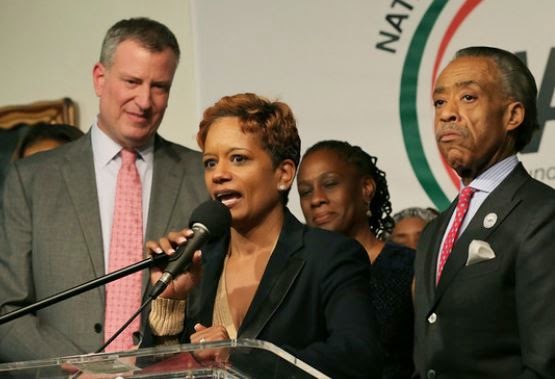
    The mayor hires Rachel Noerdlinger to serve as chief of staff to his wife, Chirlane McCray. You even noticed that one because Noerdlinger was formerly Sharpton’s spokesperson. But it became news recently when Noerdlinger became the story became of her boyfriend .

    Noerdlinger lives in Jersey (she got a waiver for that). Noerdlinger also gets paid $170,000. That would pay for two college professor, two police officers, or 1.5 sanitation workers (you can pick whichever you think is most needed).

    Here’s the first part of the problem. Noerdlinger’s live-in boyfriend, Hassaun McFarlan, was convicted of manslaughter as a teenager and does not like cops, to put it mildly. He also doesn’t seem to speak well of women, either. From the Times: “The mayor has defended Ms. Noerdlinger, saying she should not be judged by the behavior of a companion.” OK. Fair enough. Maybe we shouldn’t judge. But sometimes you need to: “two of McFarlan’s five arrests on charges ranging from driving on a suspended license to drug trafficking took place while he was dating Rachel Noerdlinger.”

    Let’s get real. This isn’t a civil service or union job. This isn’t a question of free speech. This is a question of bad judgement by a woman in a powerful discretionary patronage job. Standards should be higher, not lower. Messages from the top do matter. What if McFarlan wrote about Jews like he wrote about cops? What if McFarlan stereotyped women like he actually did stereotype, er, women? (Actually, that he’s getting a pass on that is kind of surprising). If it were almost anybody but cops complaining, Noerdlinger would be out. There were be platitudes about the tapestry of New York City. You’d hear about there being no place for hate in this beautiful diverse city. Now you may have no problem with all this being considered no big deal by the administration, but please understand why cops do.

    I would argue that a trusted aide should be trusted to have, if nothing else, good judgement, it’s not just a question of what her boyfriend said or said. It’s also that Noerdlinger herself didn’t mention her living arrangement, as required in the hiring process:

    She had failed to disclose on a background questionnaire that she lived with a boyfriend, Hassaun McFarlan, who had an extensive criminal record. False or misleading statements on such a form can result in termination or prosecution.

    …Still, it remained unclear why Ms. Noerdlinger had chosen to inform the mayor’s aides of her living arrangement, but not officials at the city’s Department of Investigation, which conducts formal reviews of high-ranking City Hall appointees.

    But apparently the administration sees no problem here Nordlinger didn’t “intend to deceive” the mayor about her domestic status. Or do honesty and ethical inquiries not apply at the top (is that a silly question to even ask)? You can be damned sure a cop in controversy would be thrown under a bus for such a violation. And perhaps rightfully so.

    Patrick Lynch, PBA president, quite rightly said:

    The standards that apply to hiring police officers should apply equally to hiring high ranking, influential staff members. If it is found that she committed a lie of omission during the investigation, then she should be fired.

    If you want to read more, you could read this and this.
  • “Those drug-dealing kids need to get off my lawn!”

    So many controversial police incidents, where police are accused of being prejudiced or racist — and here I’m thinking of the grandfather “kidnapping” his black granddaughter in the previous post, or police shooting the guy in Walmart, or the black guy in Minneapolis being hassled while waiting for his daughter, or just “swatting” in general. These incidents often happen because citizens are stupid or racist or prejudiced. And then the call police. And then the police officers get put in this horrible situation where they have to investigate the sometimes irrational suspicions of an idiot citizen. Usually it’s not a matter of life or death. But there are lot of calls for youths selling drugs when they’re just loitering. There are a lot of calls for an armed person, when the person is not armed.

    I don’t know how to avoid these problems, but they are related to the whole problem of the 911 system and reactive policing in general. Police can and do make mistakes, but based on police officer training and experience, police are much better judges of crime and danger than the average schmuck with a cell phone. And yet the information from the average schmuck with a cell phone — then filtered through an underpaid 911 operator and then passed on to an under-appreciated police dispatcher — is how most police-public interactions start. For the average citizen, it’s too easy, too anonymous, and too without consequence to dial 911. One would think there has to be a better way. Any ideas?

  • Stop making sh*t up!

    Here are a few cases were cameras have backed up the police version.

    One case I’d like to highlight is the Reverend Bill Godair who claimed a North Carolina officer was aggressive in a traffic stop. The good reverend said, “I refuse to sit back and not do anything, not say anything until Ferguson, Missouri becomes a reality here in Salisbury.” And: “My wife was in my vehicle when this incident occurred and was scared by his actions. We honestly thought that I would be arrested.” There was even a little press conference and everything! From PoliceOne: “The head of the NAACP chapter has called for Chief Collins to step down or face protests over the excessive force claims.”

    But my point isn’t that the police version is always the truth (though it usually is). I’d prefer, if you don’t like cops, to imagine what you would think if you heard this accusation against police and there were no camera present. And if you are a cop, why would you not want a camera to document what happened? As my colleague John DeCarlo likes to point out, “the police are the only ones out there without a camera!”

    The reason I like this little example much is because of just how unremarkable the traffic stop was. It most cases something actually does happen, and you have to sort out what happened. But this was a traffic stop. No voices were raised. A ticket was issued.

    But while we’re at it, this incident in Celina, Texas is interesting because you see two very different perspectivesfrom two very different cameras. In one shot, the cop looks bad, tackling a compliant suspect for no apparent reason. In the other (which starts at 1:40), you see the guy bolting before the cop tackles him. Job well done, officer!

    And there’s also a guy in Austin who blogged about “babysitting while white” (he was with his black granddaughter):

    The officers got out with Tasers drawn demanding I raise my hands and step away from the child. […] I complied, and they roughly cuffed me, jerking my arms up behind me needlessly. Nine police cars plus the deputy constable all showing up to investigate the heinous crime of baby-sitting while white.”

    Except that is not happened. There were no Tasers. There was frantic call about the girl being kidnapped. The guy was detained for 13 minutes before being let go.

    Said Police Chief Acevedo (quite boldly and accurately, along with pointing out that most kidnappers are not strangers but relatives): “Had that been a real legitimate kidnapping. And we would have responded with one or two officers in a nonchalant manner. The same exact critics that are criticizing us now would be saying that the Austin Police Department does not care about an African America little girl being kidnapped from the Millennium Center.”

    [thanks to Sgt B for the initial link]

  • Everywhere signs

    The eighth in a series from Sgt. Adam Plantinga’s excellent 400 Things Cops Know: Street-Smart Lessons from a Veteran Patrolman:

    Police stations are papered in signs. Some offer guidance, like the one that says: In the absence of detailed instruction, please do the right thing. Others suggest a certain approach to life like the large No Sniveling placard. There are signs for district BBQs. Someone always seems to be selling a gun or a boat. Cops advertise their side jobs out to other cops—services in home remodeling, mortgage services, and party planning. The police assembly bears a large communicable disease chart to remind you what’s out there, a chart which includes tuberculosis and antibiotic-resistant staph infections as well as more exotic maladies, like Lyme Disease, pinworms, and whooping cough. The chart kindly reminds you that Hepatitis can last up to seven days outside the body. There are so many contagious diseases that can be passed from prisoner to officer that it makes you wonder why anyone in law enforcement bothers to come into work at all.

    My favorite sign, as I’ve said before, was the one that said: “Unlike the citizens of the Eastern District, you are required to work for your government check.”

  • Utah shooting of unarmed man justified

    Dillon Taylor was another unarmed white boy shot and killed by police. In (mostly) conservative circles, Dillon Taylor was compared to Michael Brown of Ferguson, Missouri. In some liberal circles, people believe police only shoot and kill black people. But Taylor, who is white, got almost no press (and I think the officer who shot him was hispanic). Michael Brown was black (and shot by a white officer). There were protests about both shootings (no looting in Utah), but unless you make an effort to follow these things, you’ve probably never heard of Taylor.

    Comparing Taylor and Brown, one person wrote:

    But they are alike in this important way: Neither young man deserved to die that day. Neither Michael Brown nor Dillon Taylor was convicted of a crime related to their activities on their last days, and even if they were, it wouldn’t be a capital crime. And this doesn’t appear to be an uncommon mistake.

    Well leaving aside what “common” means, a police officer does not shoot you because of the crime you did or did not commit. You are justifiably shot because a reasonable police officer believes you to be an imminent and potentially lethal threat

    To be clear, Taylor was not armed (nor was Brown). But Taylor sure doesn’t act like like he’s no threat. Taylor was — and acted like — an armed criminal. Still, knowing only that Taylor did not have a gun when he was shot, anti-police folk went out and filled in their ignorance with their ideology. The inevitable conclusion: police are to blame.

    But comparing the homicide of Taylor and Brown, there is one important difference: the officer who shot Taylor was wearing a body camera! As is usually the case, the video shows exactly what police claimed to have happened. We’ll never for sure what happened in the moments before Brown was shot: Here’s the Taylor shooting:

    The shooting was declared justified. This is maybe not the best shooting, as Taylor was eventually raising his shirt, presumably to show he wasn’t armed. I also can’t see Taylor’s right hand, which could change things. But at some point it seems to me that Taylor is doing the old “life your shirt to show you’re not armed” thing. So it does seem unfortunate to shoot a guy when he finally does comply with “getting his hands out.” But there was a period of non-compliance. And then there sure was a quick move from a concealing waistband. And had Taylor been armed, and I think a reasonable officer had good reason to believe Taylor was armed, then yes, this is a justified shooting.

    There are certain things you have to take on the job: dumb people; dirty people; violent people. But a depressed criminal idiot (perhaps with a death wish), playing “I might have a gun on me” is not one of them. Still, though I’m willing to give the officer on scene the benefit of the doubt, well, like I said, it’s not the best shooting. But yes, I think it is justified.

    Many people don’t realize how many idiots police deal with. As a police officer, more than once I was approached by a kid (always on a bike) who would quickly reach into his waistband and act like he was pulling a gun to shoot me. Honestly, driving toward them, I never had time to react. Also, they were young teenagers. And unarmed. Still, it’s the kind of dumb move that can get you killed.

    And yet when I’ve told seemingly smart people (who are far removed from ghetto policing) that this happened a few times, they stare at me in disbelief. They simply can’t believe that anybody, much less a unarmed young black male, would do something so potentially lethally stupid as pretend to pull a gun out and shoot a cop. And yet that attitude was routine enough that I didn’t even deem it worth mentioning it in my book. It was just some real life FATS training, I suppose.

    It was more common, it might be worth pointing out in this post, for young men to routinely (and without any prompting from me) raise their t-shirts to show they were not armed. That move would baffle ride-alongs.

    [For what it’s worth, I strongly suspect that police who work in violent areas — and though those officers will be involved in more shootings overall — those same officers will shoot fewer unarmed people because those officers are acculturated to a certain level of danger. Those cops who work the tough beat have more experience and less fear. I have no idea how to test this killer hypothesis.]

  • Sometimes it’s just a job

    The seventh in a series from Sgt. Adam Plantinga’s excellent 400 Things Cops Know: Street-Smart Lessons from a Veteran Patrolman:

    This job can turn sour for a variety of reasons. Maybe you got hurt in your last fight with a suspect. Maybe you have enough pending citizen complaints that it seems your solid, aggressive police work is actually being punished; you wonder if being a proactive officer is even worth the hassle. Perhaps a sergeant is breathing down your neck or your squad partner is good for nothing. Whatever the reason, you can adopt a lousy attitude rather quickly.

    You start to show up at assignments not because you want to make anything better, but because you have to. Then you do just enough at that assignment not to get written up or fired. You look at citizens with a growing Us versus Them disgust, resentful of a community quick to criticize the police for being heavy-handed, but at the same time not exactly lining up themselves to take a job where there is a reasonable chance of getting shot at and an excellent chance of working weekends and holidays.

    You will order zippers on your uniform shirts in addition to the buttons not because you want zippers, but because it will cost the city a few extra dollars per shirt so screw ’em. Or when the district captain comes into roll call and asks people to come up with ideas to stop auto thefts in the area, you might grumble, “I’ll take the assignments dispatch gives me, but you can’t order me to have an idea.” Or when you and your co-workers aren’t getting the off-days you request, you’ll band together and call in sick, the fabled “blue flu,” leaving the citizens short on protection, and leaving your fellow officers, who did choose to come in, short on backup.

    These attitudes are most prevalent among veteran officers. As a newer cop, you look at them and wonder if you’re seeing your future.

    At the same time, despite the challenges that come with the job, it’s good to keep in mind that this is the profession you chose. Not much point in bellyaching about it. During tough economic times when workers are being laid off across the country, you have a position that will not be outsourced any time soon. You are in an industry where business is always booming. Until the crime-fighting robot is perfected, you have plenty of job security.

  • When police-involved shootings aren’t about race

    There’s still the strange belief among some people that police only do bad things to black folk. When I was on Chris Hayes the other night, some commentators thought the initial stop was racially biased. Chris himself questioned whether a white person would have been stopped for a seat-belt violation. I find that crazy talk. There was so much bad going on in that shooting that to be distracted by the initial stop seems to miss the greater point. I know the vast majority of cops don’t give a damn about your race. And the idea that white people don’t get stopped for seat-belt violations is also demonstrably false. (If you want to download and read a large and rather academic pdf report from the National Highway Traffic Safety Administration on the matter, knock yourself out.)

    Bad things do not only happen to black people. Most bad shootings don’t become issues till there’s unrest and/or Al Sharpton raises a fuss. And sometimes, a fuss should be raised. (And the last time the Rev tried to help some poor white guy who claimed he was brutalized by police, well, Sharpton sure picked the wrong white guy.)

    I’ve written a few times times about police killing white people, first on this blog in 2008. And then in 2009 there was the horrible police f*ck-up that resulted in police shooting and killing Rev. Jonathan Ayers. This was never big news. (In fact, to my dismay, my limited account of Ayer’s death seems to be the most extensive on record.)

    I’m not saying race never matters, but cops are not shooting black people because they’re black. Cops are not stopping black drivers for seat-belt violations because they’re black (though police may be searching your car for drugsafter that stop because you’re black). To believe that race is the issue in policing ignores and won’t solve the problem of people of all races who are wrongfully shot (or tased, or maced) by police. The issues have less to with race than with bad training and police officers making bad split-second decisions.

    So here’s a black cop shooting Bobby Dean Canipe, an unarmed white person (and a 70-year-old disabled vet at that).

    Clearly in hindsight this is not a good shooting. It’s a traffic stop and an old guy with a cane. And yet when Canipe gets out of his pick-up truck, on the highway, and I see a long hard object turn toward my face — and keep in mind I’m watching a youtube video and I *know* it’s not going to be a gun — I felt my ass pucker.

    Would a reasonable officer have feared for his or life in that situation? Yeah, potentially, probably, I think so.

    Sure it would have been great if the cop had known it was a cane. It also would have been great if the guy hadn’t gotten out of his truck and reached for his cane.

    A mistake. But I think a reasonable one. I’d let the cop off.

    [Hat tip to a commenter for bring this shooting to my attention.)