Copinthehood.com has moved to qualitypolicing.com

  • There are good people, too.

    The sixth in a series from Sgt. Adam Plantinga’s excellent 400 Things Cops Know: Street-Smart Lessons from a Veteran Patrolman:

    There are good people in the neighborhood. They work hard. They try to raise their kids right. They’ll even help you push if your squad car gets stuck in a snow bank. You see them out there, tending to their lawns, cleaning the broken bottles off the sidewalk in front of their house, shaking their heads as a car with chrome rims drives by, the bass turned up so loud it rattles the stemware in their kitchen.

    Some of them have lived in the same house for 20, 30, 40 years and now look around and don’t recognize the street they grew up on or the people that live there. The block has taken a turn for the worse and they’re talking about moving. They don’t want to move, mind you. But maybe they’d rather live in a place where they can watch their grandkids play without having to worry about stray bullets or vicious dogs. Maybe they want to look out the window and see kids racing each other on bikes instead of some teen in an oversized I Got That Snow T-shirt doing a hand-to-hand drug deal. You can’t blame them for wanting out. You don’t live there. You wouldn’t make it. Sure, you patrol those streets and alleys but at the end of your shift, you go home. That makes you merely a tourist. Not a guide, but a guest.
  • Cops and fitness

    The fifth in a series from Sgt. Adam Plantinga’s excellent 400 Things Cops Know: Street-Smart Lessons from a Veteran Patrolman:

    There are uniformed cops on the street who are grossly overweight. Their prominent bellies make their equipment belt hang so low it seems inaccessible to them and they can’t chase a suspect more than a block without collapsing. To them, a five-foot tall fence they need to scale might as well be five hundred feet.

    In my current department, it is said that we have an officer who once dropped his gun and was too fat to bend down and pick it up so he just waited until a concerned citizen came along who retrieved his firearm for him. How can this be? Chalk it up to years of less than salubrious living, cumulative stress, drive-through Chicken Fingers, and indifference.

    There are incentives for staying in shape on some police departments in terms of extra off-time awarded, but there are certainly no penalties, so once you’re out of the academy, you technically never have to exercise another day in your life. Is it fair to the general public that they are protected by such gelatinous first responders? No, it’s not. But police unions tend to have a lot of juice, and they would never go for a system that penalized overweight

    But even given that, you know that some of the more rotund officers are among the best investigators. A detective with 20 confidential informants who can pick up the phone after a fresh homicide and get a line on the murderer in ten minutes is worth a dozen Cross Fit uniformed officers, even if he is packing 75 extra pounds and wheezes frequently.

    But if you are someone who regularly responds to hot calls, some basic level of fitness is necessary. If you throw one punch and then are immediately ready for a water break, it’s time for some soul-searching. You have to ask yourself, if you were in physical peril and called the police, would you want an officer like you to be the first one on scene? If your answer is a resounding no, it’s time to get off the street and into police administration, investigations, or maybe retail.

  • S.C. State Trooper arrested for bad shooting

    Here’s me on Chris Hayes last night talking about the shooting of Levar Jones.

    And yeah, that’s my bolo tie. You got a problem with a little New Mexico sunshine on TV? Didn’t think so.

    Update: The officer pled guilty

  • Youth: The future (prison) leaders of tomorrow

    The fourth in a series from Adam Plantinga’s excellent 400 Things Cops Know: Street-Smart Lessons from a Veteran Patrolman:

    As a cop, it’s easy to get discouraged about the state of today’s youth. You don’t see much of the honors student bound for Dartmouth, because she doesn’t do anything that would cause her to come into contact with you. You mostly see the teen hustler wearing a jacket with dollar signs written on it gearing up to break The Ten Commandments but good. You patrol neighborhoods where toddlers chew absently on cigarette butts from the ground and 2-year-olds with matted hair and jam-smeared faces play unsupervised in the street. You see fifth graders with girls’ names tattooed on their arms. You talk to teenagers whose dad is locked up and whose mom is strung out on dope. The kid’s breakfast is a bag of chips and his lunch is a butter sandwich—which is exactly what it sounds like—and his friends are all just like him and some of them are carrying guns. Does it really come as a shock that these young people tend to fall out on the lawless end? They’re just little criminals waiting to become big criminals. The shock would be if they turned out halfway normal. You marvel at the few that make it. It’s the equivalent of muscling their way out of quicksand.

  • On Fighting

    The third in a series from Adam Plantinga’s 400 Things Cops Know: Street-Smart Lessons from a Veteran Patrolman:

    People give off plenty of indicators that they’re looking to fight. Some precursors are obvious, like the clenched fists and the readjustment of the feet into an attack stance. Others are more subtle, like the lowering of the chin to instinctively protect their neck, or the rigid setting of the jaw or brow. Some people dry their hands on their pants to prep themselves for an assault. Many of these indicators are reflexive. People don’t even know they’re doing them. They’re tells, like poker players have. So it helps to pay attention to these signs and signals because if you see them coming from the guy you’re about to arrest, take your baton out and call for backup, because he’s not going quietly. He’s going to make you work for it.

  • “Will police have more free time once pot becomes legal?”

    Good question! And it’s answered by Ted Hesson in his good article in Fusion.net.

    Spoiler alert: No.

    Second spoiler: I’m quoted.

    Third spoiler: I curse (yet again).

  • We Got Another Kingpin! (14)

    It’s been a few months, and actually “we” didn’t get him. But he was gotten all the same.

    From the BBC: “Mexican police have found the body of Aquiles Gomez, who was thought to be one of the main leaders of the Knights Templar drug cartel.”

    We win! (for the fourteenth time and counting…)

    As I wrote back in 2011:

    Ah, the illusive search for “Mr. Kingpin.” If only we could nab him, the whole criminal enterprise would tumble. Witness how we’re all safe from terrorism after the killing of Osama bin Laden. And notice how the drug war in Mexico has been won…

  • CRIME (not) SKYROCKETING

    The real headline of course, the one you don’t see very often, is that crime is down.

    So says the BJS. Though I’m skeptical of the NCVS, since it reported a 40 percent increase in the previous two years, which, quite frankly, as I wrote, I do not believe. (The UCR showed an every-so-slight drop during the same time). So this “drop” in crime may be a bit of a statistical correction.

    Still, “crime isn’t up” is always nice news, since people always assume the world is always going to hell in a handcart (which seems like an awfully slow and old-fashioned way to get somewhere, these days).

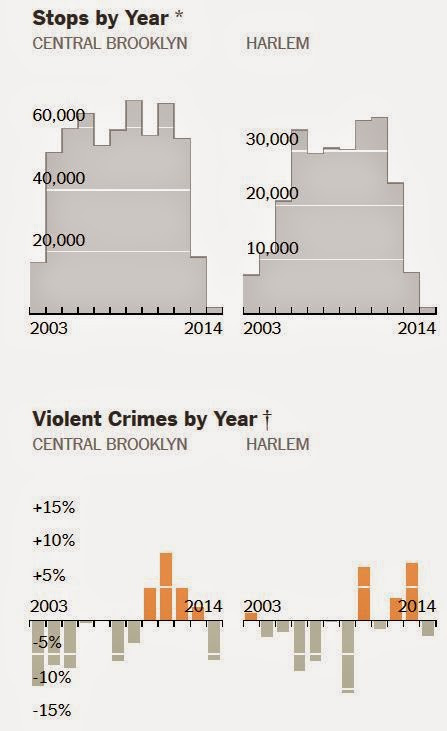
    Meanwhile, in New York City, despite the claims, or should I say desire, nay, let’s go all out and say despite the knowledge, dreams, and aspirations of police unions and many police officers, crime in New York is basically steady.

    Yes, shootings are up 6 to 7 percent. Homicides are down. Other crimes are basically steady. (Now PBA and SBA, please stop, as you’ve so often done in the past, trying to harm the city that most of you don’t live in).

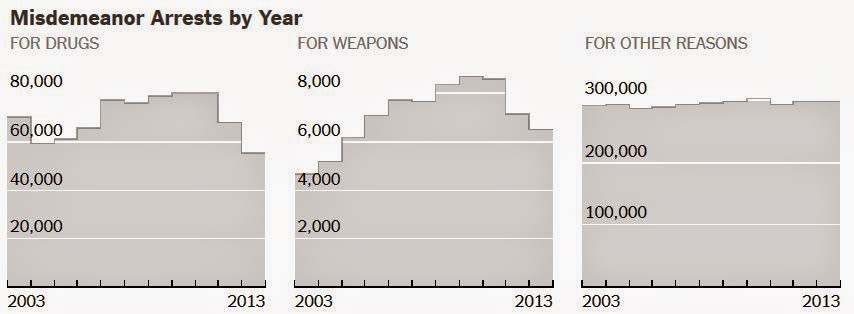
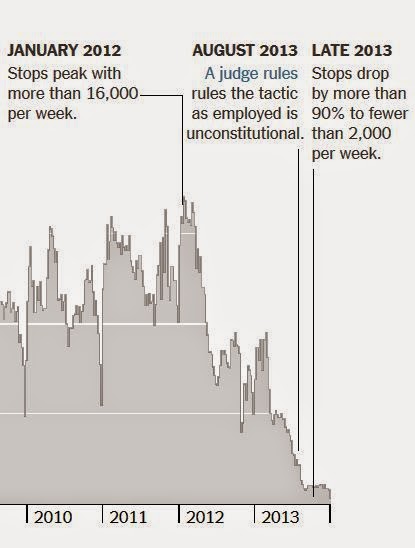
    Oh, how it must pain conservative ideologues to see that even without strong conservative leadership, crime isn’t going through the roof. Now let’s not forget that in the 1990s liberals knew that crime couldn’t go down. It did. Now conservatives have been certain for about two years now that crime would go up. But it hasn’t. At least not dramatically and definitively. (And we’re now through the second summer after the demise of stop and frisk, which was what I was waiting for.)

    Imagine this: the city is still safe even with a commie mayor, Al Sharpton as police adviser, extra and probably unneeded police oversight, unfair accusations of murder when criminals die resisting arrest, and unnecessary stop and frisks all-but stopped.

    See it’s not about ideology. It’s about hard work. It’s about an intelligent police department and intelligent police officers using discretion and doing their job. I know haters (on both sides) are gonna hate, but instead of seeing impending doom, why not take credit for a job well done?

  • On Gunshot Wounds

    The second in a series from Adam Plantinga’s 400 Things Cops Know: Street-Smart Lessons from a Veteran Patrolman:

    The seriousness of a gunshot wound depends on a host of factors, including the type and caliber of round, the distance the bullet travels, and if anything is present to slow the bullet down (a wall, a door, another person) before the moment of impact. But it’s a given that anything into the spine is a disaster and close contact handgun rounds to the face can leave the victim’s molars spilled out on the ground, or can blast off half of their skull, leaving a conical section of bone and skin that resembles the head of a unicorn. Other than that, anything goes.

    Bullets rarely maintain a straight path. They loop and spin and sometimes follow the curve of the body. A shot into the arm can be “through and through” or it can ricochet off the elbow bone and explode the heart. A bullet entering the lower torso can rip through the intestines and cause lifelong complications or end up lodged in soft tissue without any lasting damage. Many gunshot victims in the latter category are released from the hospital the same day they entered, as it is often medically safer to leave the bullet right where it is. A shot in the buttocks can be a painful but ultimately colorful tale for the shooting victim to share with others, or it can result in an artery being pierced, causing the victim to bleed to death, something one of my sergeants witnessed years ago and to this day still cannot quite believe.

    I spoke with a man once who had recently attempted suicide by shooting himself just behind the left ear. The bullet caromed off the front of his skull, and exited out the top of his head, leaving him dazed but very much alive. I could still see the corresponding C-shaped scar on his scalp. I once investigated a shooting where a round entered through a woman’s back, shattered the shoulder blade, and came to rest perched on top of her right clavicle, jutting out like a marble without breaking the surface of the skin. As a police officer, you look at bullet wounds with both respect and wonder because you know that for a gunshot victim, the difference between life and death can be the narrowest of margins.