Copinthehood.com has moved to qualitypolicing.com

  • “Write your own damn book!”

    “Write your own damn book!”

    Occasionally, really surprisingly rarely, some crusty old cop takes an instant dislike to me because I write and teach about policing even though I wasn’t a cop for long. I’ve never pretended to have as much experience as somebody with 20 years on the job, but I still find something pathetic when a police officer refuses to read what I have written — which, more often than not, is on his side — on some B.S. matter of principle. (Usually that principle being he’s a dumbass).
    The other week I got into a argument with a cop at a bar I like going to. The bartender asked him if he had read my op-ed in the paper. The cop said it didn’t matter because I was never real police (of course didn’t use those Baltimore words, but that was his gist). Generally I like talking to cops; usually we get along just fine. But after trying to hear him out and conceding much of his basic mistrust (there is a lot about policing I don’t know), I mentioned that perhaps he should judge me on what I actually do, say, and write rather than call me a dick for what he thinks I might be writing.

    But logic wasn’t working. Oh well. I don’t need him to like me or read my book. Now I know I can’t win a whose-d*ck-is-bigger argument based on my time on the job (two years). But given where I policed, given a few too many damaged and dead friends, I don’t take kindly to people asserting I was never there. So after telling him to go f*ck himself, I went on the offensive and questioned his policing credentials (and, while I was at it, his military credentials as well, since by his own ignorant logic, he had only served in Iraq for less than two years).

    I also know he’s never policed in a neighborhood as violent as where I policed, because such neighborhood don’t exist in New York (perhaps the 75 in the late 1980s came close.) I know he’s never patrolled alone. So I asked him how many drug corners he’s single-handedly cleared? Perhaps I laughed when he doubted the number of arrests I had made. In the end, though my memory is a bit hazy, perhaps I alluded to him and his partner stroking each other off while other cops are out there doing real police work. See, I don’t really care what you think about me, my writing, or what I know. But to say I never policed? Go f*ck yourself.

    Anyway, it was all drunk stupid macho swinging-d*ck shit. Nobody got hurt. But here’s what it all comes down to: if you think you know so much more about policing than I do, write your own goddman book!

    Well, every now and then, somebody does.

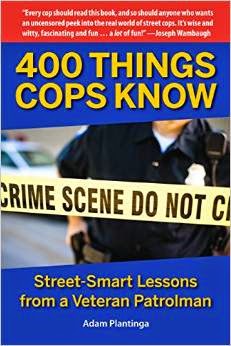
    A short while back I got sent a promo copy of 400 Things Cops Know: Street-Smart Lessons from a Veteran Patrolman. I put it on the back burner. There actually are a fair number of “I was a cop and this is what the job is really like” books. A few are good. Most aren’t. Some cops write better than others. Some police act too macho while others are not macho enough. But I wish cops would write more. At least more than police reports and texts to their lovers.

    When I finally got to reading 400 Things Cops Know, I couldn’t believe how good it was. I teach a lot of students who want to become police officers, and I can’t think of any other single book that would so well prepare them for what the job is actually like.

    Plantinga, a sergeant in San Francisco, seems to have both a pretty level head (though who knows? I’ve never met the guy) and he can write. He was an actual real English major (and a currently employed one, it’s worth point out). Evidently, he can write fiction and non fiction. This is non fiction. These are anecdotes. Good ones. It’s not heavy on the theory (which some will see as good), but it’s a nice combination of this happened and these are my thoughts on those matters. Plantinga is both perceptive and able to articulate the, er, totality of the circumstances. Now I don’t agree with him 100 percent of the time. But I do most of the time. Besides, what the hell do I know?

    Anyway, with permission from Plantinga, I’m going to publish a few excerpts from his book. They’re well suited to blog form. In fact in 2008, when I started this blog, I myself published a little pithy series of “Officer Pete Says“.

    So here’s what I’m thinking: I’ll print one of these every few days. It gives me material to keep copinthehood.com active, and you’ll tell your friends about this great new policing book. I want to help get the word out and help Plantinga sell a few copies.

    So this is my first excerpt from Adam Plantina’s 400 Things Cops Know (Quill Driver Book). Available for less than $12 from Amazon. This is my numbering order, not his, but let’s call this #1:

    The job will change you. It changes everyone, for better and worse. You will become far more alert to your surroundings. You will keep your gun hand free even when off-duty. You will become hyper-aware when taking money out of ATMs, day or night. You’ll look inside convenience stores and banks before you enter to make sure you aren’t walking in on a hold-up in progress.

    If you didn’t curse before you became a cop, you probably will once you have six months in on this campaign. You will curse like a dockworker. You will also become angrier. More disillusioned. Far more skeptical about the inherent goodness of humankind. The constant exposure to toxic social conditions and dealing with people at their hopeless worst solders an extra layer onto your skin. You see too much darkness and it becomes part of you in ways you may not fully understand. Some describe this condition as compassion fatigue, the main symptom being a vague sense of loathing for human frailty and for one’s self. Maybe this extra layer is good. It keeps you from being emotionally invested and affords you the detachment you need to be an objective investigator. It acts like a suit of armor against the elements. But part of you may want to be, well, illusioned again. Part of you wishes that guy you used to be, the one in the police academy with the fresh haircut and the extra-shiny shoes wasn’t such a stranger to you now. You know that for the most part, it’s good that guy is gone. He meant well, but he wasn’t an effective street cop. He was too hesitant, too trusting. He’s been replaced and you don’t expect him back.

    But once in a while, you sort of miss him.
  • Good use of Taser

    NYPD subdue armed mentally disturbed man. Nobody seriously hurt.

    That’s the headline you should read every now and then. But you rarely do.

    I’m not a big fan of the Taser, but this seems to me exactly what it is designed for.

    What’s odd, at least to me, is that here is a perfect use of the Taser. A crazy gets zapped. Nobody gets seriously hurt. And yet at least one media source seems to imply something bad happened.

    Also, does the NYPD really respond to 100,000 EDPs a year? Seems awfully high to me. And what the hell does, “routinely result in injuries or death” mean. I seriously doubt there the NYPD responds to 275 EPD calls per day. But if that is the case, and people are “routinely” injured, does “routinely” mean say, half the time? So there are 6 EDPs injured by the NYPD every hour? Now that would be a real story… except it’s not true. I’m not quite certain what the story here is, except for a job well done by the NYPD.

    Anyway, “cops do good job” indeed isn’t much of a headline. Nor is “violent crazy man committed to hospital, everybody goes home” a great lede. Still, it seems appropriate to give the police credit when it is due. I mean this is what Tasers are for.

    [hat tip to Sgt B]

  • The 21-Foot Myth

    It’s long been “known” among police that anybody with a knife or edged weapon within 21 feet is a lethal threat. This so-called “rule” has long been a big pet-peeve of mine.

    This anybody-within-21-feet-is-a-threat mentality does result in a lot of crazy people getting shot. And don’t get me wrong, I have no problem with police shooting and killing people coming at them with knives. But the idea that anybody within 21 feet could be carrying an edged-weapon and is thus potentially a lethal threat? Get real. Even if the “21-foot-rule” were true, what are you supposed to do with this knowledge? You’re a cop. Of course you’re going to be dealing with people at a normal talking distance of a few feet.

    The first problem with the 21-foot “rule” is that it assumes the officer doesn’t perceive a threat. The scenario starts with a holstered weapon. Well if you don’t perceive a threat that exists, that’s a separate problem. But it doesn’t mean you’re justified in keeping everybody at a 21-foot distance. The second obvious problem with the “rule” is that it assumes that the man with the blade is a trained skilled stealth ninja (or at least an academy instructor-san much better than you, young academy grasshopper trainee, at hand-to-hand combat).

    The relevant question is how close should you let a man with a knife get to you when you are in the drawn and ready position. Based on nothing but my gut experience (I’m sure somebody has better-formed answer), I would probably start shooting at about 6 feet. Maybe 10 feet if they’re advancing in more a threatening manner. But of course it all depends on the situation: what kind of person? What kind of knife? How is the person holding the blade? (Blade facing back, arm-down, fist clenched means the guy may know how to use it.)

    For small knives that don’t make particularly good weapons (like a dinner knife or something without a bolster/finger guard), I’d be more than willing to take my chances defending myself and whacking the guy with my trusty 29-inch wooden straight baton (a far better offensive and defensive weapon than the now much more common expandable metal asp). And I’d be more willing to try and disarm the guy if I could come up from behind while the person with the blade is distracted by the other six officers on scene who are drawn down on him).

    [And of course a man with a knife is exactly what the Taser is designed for, even if it is emasculatingly and shamefully used far more often for routine non-threatening non-compliance situations. Also, you should not mace a guy holding a knife, because then you have an angry blind guy with a knife.]

    Here’s the thing: most people police face with knifes are not well trained in “edged-weapon combat.” They are A) crazy or B) cutting up their loved one. Sometimes both. But police rarely if ever face a trained evil ninja out to assassinate a police officer caught unaware (honestly, there are far easier ways to assassinate a police officer, if you so choose). So basically you have this whole police paranoia based on a situation that never happens.

    I checked Officer Down and, since 2000, could find just four officers on patrol killed by an assailant with a bladed weapon: one domestic, one EP (aka: EDP or mental case), and two fatal fights after a foot pursuit. As you might guess, not one of these assailants was an a trained stealth ninja.

    Best I can ascertain, only one officer in the past 14 years (Sault Ste. Marie Detective John Weir) could have been saved, maybe, I don’t know, by keeping greater distance and being quicker to shoot. The other officers, rest in piece, died doing the job they had to do.

    So why has the 21-foot rule persisted for decades despite little basis in fact or police reality? I don’t know. I’d love to hear what you think. Could it be just another example of the conservative warrior mentality so pervasive (and usually counterproductive) in policing? Think of this: the instructor teaching hand-to-hand combat in the academy is the most aggressive threat-perceiving police officer out there perhaps (just hypothetical, er, based on my experience) having been pulled off the street and into the academy where he can’t shoot another sue-the-city person (all of them technically justified, but still…).

    So you get a perpetuating cycle where the paranoid cop too-quick to elevate a threat-level ends up teaching and scaring the next generation of police officers to adopt his code-red us-versus-them ideological world-view in which one must assume the worst about even seemingly non-threatening citizens.

    Here’s a good recent piece by Ron Martinelli which more scientifically analyzes and partially debunks the 21-foot rule, and inspired this post. If you’re still with me, it’s also worth clicking-through to the first link on this page.

    Update: Based on a useful comment to this post, I also should have included blunt weapons and not just knives. Doing so brings the total number of police officers killed in the past 15 years with any relevance to the 21-foot-rule up to three police officers. It’s also worth mentioning that I’m not looking at officers just injured. But we don’t have those figures. And one can assume some relationship between fatal and non-fatal injuries.

    So let’s put the 21-foot-rule in perspective. In this same time period since 2000, as many officers (3) have been killed by a moving trains.

    Six officers have been killed by animals: one by cow, one by spider, and one by bee; the other three from horses (interestingly, none by dog, the only animal often at the receiving end of a 21-foot mindset).

    If one were truly interested in saving police lives rather than simply building police paranoia and mistrust of the public, we should look at the 515 law enforcement officers killed traffic fatalities. How many of these would have been prevented by officers wearing seat belts? And yet the same officer who won’t wear his seatbelt because he claims it gets caught on his equipment (which, speaking from experience, is bullshit) will be quick to spout the absurdity that his life is endangered by anybody within 21 feet, in optimal conditions.

    Also, it’s come to my attention that the 21-foot-rule has now been upped to 30 feet.

  • “Excited Delirium” is not a real medical condition

    Best I can figure, it was invented (or at least inspired by) the Taser corporation (correct me if I’m wrong here).

    But it’s not a real cause of death. That being said, it’s usually used to get cops off the hood when someone dies after being Tased.

    But now some high guy dies and the police officer might (but probably will not) get in trouble? If there’s any crime here, it sure wasn’t committed by the police.

    The story from the New York Times.

    And I’ve never heard of this pseudo bullshit medical condition being used in a situation that wasn’t Taser related. Again, correct me if I’m wrong.

    And since when did the NYC M.E. buy into the concept of “Excited Delirium”?

  • “Unarmed” man not shot by police

    One of the things that keeps coming out of the Ferguson shooting is that Michael Brown was “unarmed.” As if “unarmed” people cannot be a threat to cop.

    That’s bullshit.

    Now I’m not talking about whether Michael Brown was or was not a threat. I do not know. But the fact that he was “unarmed” does not mean he wasn’t a threat.

    This is a video (from 5 months ago) of an “unarmed” man on the whom I think the police officer should have shot. But the cop didn’t. I guess the officer didn’t feel his life was in danger. Kudos to him. Seriously. But I think his life was in imminent danger. And I think I would have shot the guy.

    Just based on the description of the video (and the fact that the train isn’t leaving and a police officer is involved), let’s assume guy threatened to shoot subway passengers. A cop responded. The guy attacks the cop. That’s where the video starts.

    The cop tries to retreat. Then the cop maces him at 0:15. There’s a nice deflection at 0:17. (Shazam! Jujitsu shit.) The asp comes out at 0:21. [Wack.] Little if any effect. The guy keeps coming at the police officer. Notice how few seconds have passed.

    The grappling continues. The guy keeps coming. What would you do?

    Now when you can use lethal force is not cut and dried. It’s up to the police officer. And I can’t read this police officer’s mind. But he didn’t use lethal force. That was the choice he made. Maybe he never felt his life was in danger.

    But I’m telling you I think I would shot guy point-blank at 0:45.

    Would this have been a “good” (ie: justified) shooting. Abso-fucking-lootly.

    I’ve been in fights. And I haven’t shot anybody. For whatever reason (backup, for instance) I never felt my life was in danger. I won’t say this cop should have shot the guy. He felt he didn’t need to. And he turned out to be right. But had he shot him, I would defend that shooting (as would the law).

    But what if there’s no video? What if the cop does shoot? What if, as would happen, some “eyewitness” on the subway says “the guy had his hands in the air [which, actually, he kind of did]. And he was surrendering when the cops shot him for no reason!” Then what do you assume?

    Because when cops hear of a cop shooting an “armed person,” they assume something like this happened. Cop know, based on everything they have done and seen, that police do not shoot people for no reason. Cops think: there but for the grace of God, go I.

    Also note there is a train of people, not one of whom helps the cop. (Or you could say it’s good nobody helped the other guy, who was asking for help).

    So this subway cop showed amazing (and perhaps even unwise) restraint in use of force. But yes, in hindsight, it’s clearly better that nobody got shot.

    So did this officer receive any kudos for his bravery or his restraint? I don’t know. Should he? Yes. Did he? I doubt it.

  • Bad cops

    OK, my cop friends: please tell me what I’m missing here or how any of this (from February) is defensible. It’s so rare I can watch a video and not understand or at least empathize with the police.

    These Bloomfield, New Jersey cops are going to end up in jail right? And is the salary range really $57K starting up to $100,000. 

    Here’s an update from July. I don’t know the latest.

  • Race and justifiable police homicides (VII): hispanics

    Fact 7: What about hispanics? Hard to tell because many police departments don’t keep track. Half of all homicides (justifiable police homicides) have no “ethic origin” listed. When it is listed, 1/3 of those killed are hispanic, which strikes me as very high. Overall, including all the missing data, hispanics come out at 16 percent. So the real number of hispanics killed is somewhere between 16 and 33 percent. The census lists 17 percent of Americans as hispanic (which includes all races).

    That’s all I got for now. If you can think of any other question I can answer with the data I have, leave a comment, and I’ll do my best.

  • Race and justifiable police homicides (VI): black police shoot white people, too

    Fact 6: Black police officers do kill white people. This really isn’t surprising, but I mention it because I’ve seen a few people on twitter doubt this fact. Black officers (about 1 in 7 of all police) kill about 27 blacks and 9.4 whites per year. White police (of whom there are many more) kill an average of 81 blacks and 200 whites each year (both for the past 15 years).

    Like the previous fact, this doesn’t mean much without greater context. But it’s worth pointing out that there aren’t too many black officers working in high-crime white neighborhoods.

    The next and last fact concerns hispanics. Spoiler: the data isn’t good enough.

  • Race and justifiable police homicides (V): black police

    Fact 5: Black officers are disproportionately more likely than white police to kill black people. But this should come as little surprise since black officers are much more likely to work in black areas and in cities where there are more blacks. Again, given the bad data, take all this with a huge grain of salt, but according to the data we do have (UCR justified police-involved homicides 1998-2012), 73 percent of those killed by black police are black (which is kind of amazing). For white police officers, 28 percent of those killed are black.

    Put a different way, if you are black and shot by police, the odds are about 1 in 5 you’ll be shot by a black cop. If you’re white and shot by police, there’s less than a 1 in 20 chance your police-officer shooter will be black.

    In these 15 years, 547 black police officers killed 402 blacks and 141 whites. 4,388 white police killed 1,213 blacks and 2,998 whites.

    Also, the officer’s race is “unknown” 10 percent of the time. (n = 535)

    Next question: Do black police shoot and kill white people?

    Update: Additional data were added to this post in January, 2015.

  • Race and justifiable police homicides (IV): On the increase

    Race and justifiable police homicides (IV): On the increase

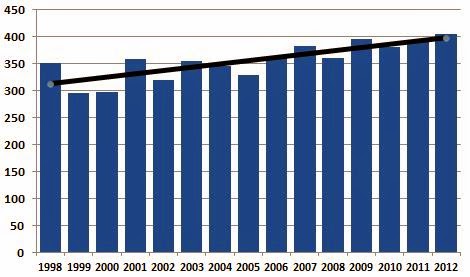
    Fact 4: Police-involved killings are going up. This one surprised me. Because police-involved shootings are generally correlated with overall homicides. But homicides are more or less steady right now, and down 10,000 since 1998 (14,000 in 1998, 13,000 in 2012).

    The trend is about five more killings a year, for the past 15 years. Keep in mind this is based on flawed data. So it could be indicative or something, or maybe it’s not.

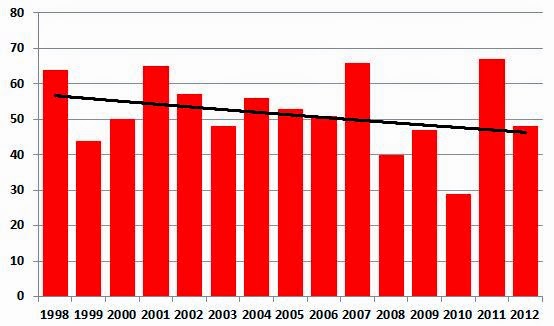
    Meanwhile the trend is for fewer officers to get shot and killed. (If you go back further, like to the 1970s when more than 100 officers were shot and killed each year, the trend is way down.)

    So cops may just be quicker on the draw. Or perhaps too quick on the draw. Or some combination of the two.

    The next post examines if black police are more or less likely to kill people. What do you think?

    As a side note, justifiable killings by civilians have been increasing at an even greater rate over the past 15 years. From 191 in 1998 to 309 in 2012. I would assume (but do not know) that “stand your ground” laws have something to do with this. Also, (surprising to me) the race relationship of those killings have become even more intra-racial (and the greatest increase is seen in justified killings by black).

    [Data on police fatal shootings comes from the Officer Down Memorial Page.]