Copinthehood.com has moved to qualitypolicing.com

  • Race and justifiable police homicides (III): one a day

    [Update: Using better data, the number is more like three a day.]

    Fact 3: UCR data on justified police-homicides are notorious incomplete. These numbers are an undercount. But given the data we have, as reported (or not) to the DOJ by local police departments, police kill at least one person a day (426 in 2012, to be exact, 30 percent were black, 63 percent were white). Again, how you want to use or misuse that statistic is up to you. And you need to take it with a large grain of salt. Either at least one person a day needs to be shot to protect somebody from getting killed or seriously hurt. Well, either that or police are cold blooded murderers who fill a one-body-a-day quota in the murder department. I’m more partial to the former explanation…

    But it might be worth mentioning that the combined total for deaths from police shootings in Japan and Britain was… zero. Germany had eight.

    Now ask yourself this: are police-involved killings in the US going up or down. That’s tomorrow’s fact.

    And now, for the nerdy set, some numbers:

    In 2012, police killed a total of 426 people. Of those:

    white men: 267

    black men: 128

    white women: 6

    black women: 4

    “Asian or Pacific Islanders”: 9

    “American Indian or Alaskan Native”: 5

    The rates of justifiable police homicide, are roughly (per 100,000):

    black: 0.33

    Indian/Native American: 0.17

    white: 0.12

    Asian: 0.06

    To put these numbers in some perspective, there were 13,063 total homicides in 2012.

    white men: 4,332

    black men: 5,745

    white women: 1,651

    black women: 858

    Asian men: 160

    Asian women: 82

    Native/Indian men: 72

    Native/Indian women: 22

    The 2012 US homicide rates (per 100,000, and again, roughly):

    black: 16.5

    white: 2.7

    Asian: 1.6

    Indian/Native: 3.2

    One other interesting tidbit, if you’re still with me, is if one looks only at murders in which the killer is known to be a “stranger” (which is just 15 percent of all homicides… and this does not include the larger category of “relationship not determined”). Then the numbers plummet:

    white men: 912

    black men: 812

    white women: 112

    black women: 90

    Asian men: 45

    Asian women: 9

    Native/Indian men: 15

    Native/Indian women: 1

    I mention this because fear and public policy is built so much around the concept of people (I’ll say it: white women) being killed at home or in a robbery by some stranger (I’ll say it again: a black man). And yet there were just 32 such victims in 2012. And 2012 was a high year. 2011 saw just 25 white women killed by black strangers.

    The odds of being killed by a stranger, especially if you’re a woman, are almost infinitesimally small. Though to be fair, they’re still greater than the chance of being killed by lighting or attacked by a shark.

    [Rates are based on these population numbers (which are not cut and dried): white 224 million; black 40 million; Asian 15 million; Native/Indian 3 million. Homicides from the 2012 UCR homicide supplement.]
  • Race and justifiable police homicides (II): white and black

    Fact 2: Blacks are more likely than whites to be shot and killed by police, but probably less so than you’d suspect. 34 percent of those killed by police are African American. But put another way, 62 percent of those killed by police are white. (Actual numbers provided in next post.)

    What you want to make of these data probably depends on your ideological persuasion. While the percentage of blacks killed by police (1/3) is disproportionately high compared to the percentage of Americans who are black (about 13%), one-third is low compared to other indicators of violence, such as the percentage of homicide victims and offenders who are African American (about 50 percent, give or take).

    Since police-involved shootings correlate with gun violence in the population — and many black communities receive a disproportionate amount of police attention — one might expect the percentage of those killed by police to be closer to (or more than) 50 percent.

    Based on the data, it does not seem that police are particularly trigger-happy around blacks compared to whites. (Though once could still argue that police are too trigger-happy overall.)

    And keep in mind I make mistakes. If something seems fishy about my facts, let me know and I can double check.

    Question for tomorrow’s fact (#3): how many people (per year or per day) do police kill in the US?

    [The source for all police-involved homicides is self-compiled UCR homicide supplements from 1998 to 2012. I’ve selected the value of 81 (“felon killed by police”) for V29 (“Offender 1: circumstance”). I know that not all police departments report to the UCR, so the real numbers may be a bit more. But most police departments — certainly all the big ones — do report to the UCR. And the UCR covers “93.4 percent of the total population as established by the Bureau of Census.” The coverage for justifiable homicides, however, is less complete.]

  • Race and justifiable police homicides (I): Over time

    Back in 2008 I posted about what I called the “Al Sharpton effect”: cops shooting white people doesn’t generally make the news. That post has gotten a lot of hits recently (roughly 2,000 page views a day, when normally my whole blog gets about 700).

    So I’ve re-crunched these numbers, both to make them more current and to look at the past 15 years, from 1998 to 2012. This is fact 1 of 7 (give or take).

    Fact 1: The racial percentage of those killed by police hasn’t changed. In other words, police are not more (or less) likely to shoot and kill blacks than they were 15 years ago. (In more academic terms, there is no correlation between year and race, from 1998 to 2012, selecting for whites and blacks).

    Before I post the next fact, ask yourself this: what percentage of those killed by police do you think are black?

    I ask because because it’s good to know if your “facts” are actually based on reality And if the actual facts don’t coincide with what you think is true, then you need to reconsider your opinions based on lies. Too many people don’t do that.

  • Is the silence deafening?

    That’s because I’m out of town, in New Mexico (“not really new and not really Mexico”), and only have my phone to type on.

    I’ll be back home and posting in about two weeks.

  • How to arrest a very large man who doesn’t want to go

    Telling officers what not to do doesn’t tell them what they should do. And it’s never going to look pretty. That doesn’t make it wrong.

    Here’s my op-ed in today’s New York Daily News:

    If you’re a cop, how do you cuff a 6-foot-tall, 350-pound man who doesn’t want to go to jail?

    Most arrests happen without a problem. Police order a guy to put his hands behind his back. The cuffs click or zip, and that’s that. But sometimes people make it clear that they don’t want to go. Then what?

    Read the whole thing here.

  • I stand corrected

    I stand corrected

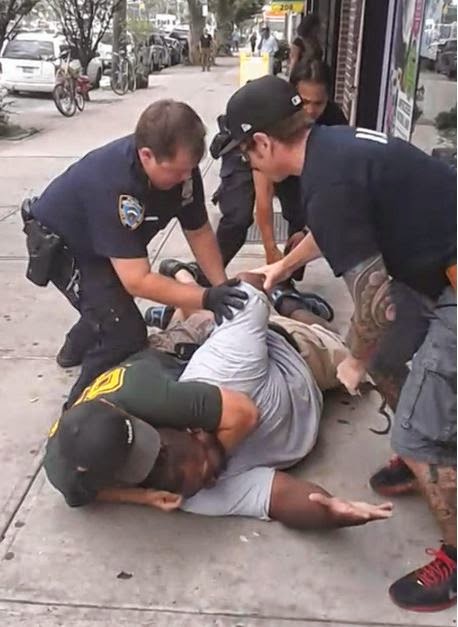
    The medical examiner’s office says Eric Garner was murdered. To wit: “compression of neck (chokehold), compression of chest and prone positioning during physical restraint by police.”

    Asthma, heart disease, diabetes, and obesity were contributing factors.

    His death has been ruled a homicide, and presumably we’re going to be in for a Staten Island trial with Daniel Pantaleo and perhaps other police officers as defendants.

    Update October 2014: This is a picture that shows a choke hold. I hadn’t seen it before. Garner was not taken down with a choke hold. But this, once he was down, clearly shows a choke hold.

  • Gun Rights

    This recent decision in DC saying there is right to carryis actually bigger news than you’d think. Why? Because up till now you did not have that right.

    This decision asserts constitutional rights beyond what the Supreme Court has ever ruled. The Court said that the government cannot prevent you from having a gun in your home for protections. But that’s it. Now this was a huge decision because, for the first time ever, the Court, in Heller and McDonald, ruled that the 2nd Amendment indeed does give an individual a right to bear arms.

    This wasn’t the intention of the Founding Fathers and has never been the case in US history, but what is good for the (liberal) goose is good for the (conservative) gander. I have no problem with the Court expanding our rights (or more correctly: limited the rights of the government). The 9th Amendment says this explicitly (though this Amendment, for reasons I do not understand, is rarely invoked in Court opinions).

    Still, given those Supreme Court decision, the government could regulate ammo, the kinds of gun, and everything about guns in public. But even with those restrictions, Heller and McDonald were landmark cases that re-interpreted and expanded the 2nd Amendment. But all they said is that regulations could not prevent, again, you from having a handgun in your home for protection. That’s it. But it was huge.

    But now a lower court has said you, my fellow American, have a constitutional right to carry a gun in public. That is a huge expansion of the the core rights of the 2nd Amendment. We’ll see if it stands.

  • Looking up to police officers

    I just learned that cops in Greece have to be at least 5’7″ (170 cm) tall. Male and female. That’s crazy. Hell, I’m just barely over the cutoff.

    …which is the highest minimum in Europe, along with Malta, Romania and Serbia. At 152cm, Belgium has the lowest height requirement. Female applicants in Greece must also be 170cm tall, making them the highest in Europe.

  • Is Selling Untaxed Cigarettes Now A Capital Offense?

    So asks W. James Antle III in the Daily Caller. The answer is no, even with death of Eric Garner. But it is an arrestable offense. And that’s a problem for police. It should be a problem for society. But people love passing stupid laws and then getting upset with police for enforcing them.

  • How to change occupational culture

    New York City just paid $2.75 million to settle a lawsuit from a prisoner who killed in Rikers. As a taxpayer, I worry about a million here and a million there. Pretty soon, as they say, we’re talking about real money. To the tune of $100 million each yearfor New York City. And indeed it does not grow on trees.

    Everybody who has ever been a jail — guard, police officer, prisoner, lawyer — knows some bad stuff happens in there. If you want to find brutality, stop looking at police and start looking at C.O.s. (Of course, it’s a lot easier to film police than to film what goes on in jails and prisons.)

    But those big settlements don’t cost the agencies where it happened one penny. The Department of Corrections or NYPD budget doesn’t pay for the lawsuits they brought about. The city pays. It’s a lot easier to be irresponsible when somebody else picks up the tab. It’s like you’re playing baseball and break a neighbor’s window. You’ll probably break fewer windows if you have to pay for the replacement. But as long as mom and dad pick up the tab, play on.

    If some or all of that money came from the agencies that were responsible, I guarantee you those agencies would find a way to change the behavior and working culture that leads to lawsuits. Instead, the culture stays the same, and every now and then an officer gets thrown under the bus.

    [Update: Jim Dwyer has a July 22 story with a similar themein the NYT.]