Copinthehood.com has moved to qualitypolicing.com

  • Rich folk don’t “fare well” behind bars

    A du Pont family heir plead guilty to raping his 3-year-old daughter in 2008.

    From The Daily News:

    Superior Judge Jan Jurden sentenced Richards to eight years in prison, but suspended the time for probation that requires monthly visits with a case officer. “Defendant will not fare well in [a prison] setting,” Jurden wrote in her sentencing order.

    Well that’s very sweet. Money does have its privileges. But as much as I’d love to go off on trust-fund babies, a large part of me says this judge did exactly the right thing: not send this guy to prison. Why? Because he will be killed in prison. The problem is that the state cannot protect its prisoners from being murdered. How could you, as a judge, knowing sentence someone to prison knowing they will be killed? Now were he killed, I wouldn’t shed a tear, but still… if we as society want this guy to be executed, then we as society should have the balls to kill the guy. Legally. By the book. But to gleefully put a guy in locked cage knowing that convicts will do our murderous dirty work for us? For shame.

    [The definition of “rape” has come to mean too things; here’s the definition of 4th degree rape in Delaware.]

    [hat tip to Jay Ackroyd]

  • ABQ Police Protests

    “Check it out, esse…. shit’s going dowwwn.” (That’s an Albuqueque accent, just FYI, as dictated to me by my Albuquerquean wife).

    There are some anti-police protests in the Duke City.

    A police-involved shooting of James Boyd, caught on police video, sparked the protests.

    If you’re right wing, watch this version:

    If you’re left wing, watch this version (if you’re in the middle, watch the right-wing version because it provides more dialogue.):

    It’s also good to watch both versions and see the political convergence of right and left come together in the face of what is a pretty morally indefensible police-involved killing.

    Perhaps how this is how police are now trained, but I hope not. I do not like what I see.

    These are not effective tactics (though it worries me that the officers seem well trained). This shooting also demonstrates why we should not provide police with military weapons willy nilly. The police use almost every toy at their disposal. What’s the point of having less-lethal weaponry if you never get to use it? The desire to use less-lethal weaponry — flash grenade, dog, “bean bag”  — contributes to a bad death. When police shoot a guy with a knife (or two), I’m generally pretty sympathetic to police. But not in this case. I know the 15-foot rule, but this guy wasn’t about to go billy-goat ninja on the side of a mountain.

    First of all, and I know we didn’t see the first few hours, but this guy was complying. At least until police fired a less-lethal round near here. But regardless, one the guy is down, you can go up to the guy with a night stick and wack him if he moves. You don’t need to fire three less-lethal rounds at his ass and sick the dog on him. Sure, he might be playing possum, but I think you can assume he won’t be fighting at 100%, if you know what I mean. You’ve already shot him and you’ve got lethal cover.

    There’s something particularly morbid about shooting a dying guy with a bean bag and letting a dog bite him because he failed to comply… after you done shot him.

    I’ve written about this “hands-off” movement in police training, and I do not like it. When did cops become such wimps?

    I’m also not at all clear why police fired a flash grenade at a complying individual. In all seriousness, could somebody please explain to me what is the S.O.P. now in training and the use of flash grenades? Is compliance no longer enough to prevent use of force?

    Since 2010, ABQ police officers have been involved in 37 shootings, 23 of them fatal. By comparison, the NYPD has been involved in perhaps about 70 shootings since 2010. But, just to remind you, New York City has far more than 10 times the population of fair Albuquerque. In terms of police-involved shootings, Albuquerque is roughly on par with Baltimore, but Baltimore has much more crime.

    I think this was a bad shooting.

    But what really worries me is that perhaps the officers performed exactly as trained. If so, we need to change police training (and not make scapegoats of the officers).

  • Like David Hasselhoff, but in Australia. And with a whip.

    Like David Hasselhoff, but in Australia. And with a whip.

    Not too long ago I was kindly very politely by a woman at the Australian Police Journal to restate my argument in defense of flogging. This goes back to my Festival of Dangerous Ideas talk last November. I am generally happy to oblige anything with “police” in the name, even if they don’t pay. So I dusted something off and thought that was that.

    Well perhaps I, er, mis-underestimated the APJ. S allow me to plug them:

    The Australian Police Journal (APJ) is Australasia’s pre-eminent non-fiction publication about policing.

    The APJ is published quarterly on behalf of all the Police Commissioners of Australia in order to educate and inform police and interested members of the community, in policing and related topics – both contemporary and historical. From its humble beginning in 1946, the journal now has over 25,000 subscribers throughout Australia, New Zealand, the Pacific Region and beyond.

    The APJ is administered by a not-for-profit company representing all the Australian police services. Its articles are written by police and related professionals, and have a direct relevance to Australian policing.

    Admittedly, that description is a bit dry, but that’s actually just the kind of publication I love publishing in.

    Anyway, it turns out that more than just flatfoot cops read the APJ. And it turns out my flogging story was their cover story. After the APJ article appeared, it was picked up by the mainstream Australian media. In the past few weeks, me or my argument against prisons and In Defense of Flogginghas appeared down under here, here, here, here, here, here, and here. G’day, mate! (Best of all, because of the 15-hour time difference, even the morning-drive radio interview was at a civilized 3pm.)

    And of Friday I’ll be on “The Project.” (Pronounced down-under with a long-O and, as my friend put it, “It’s like the Jon Stewart of Australia, but more serious.” Though actually my friend used the words, “…not as funny,” but let’s not quibble about his comedic taste.) Here was my first appearance on the Prooooject (though last time I checked you couldn’t view from the US).

    Anyway, all this is to say it’s nice the flogging is still alive in Oz. Better yet that they’re actually talking about alternatives to incarceration that are politically more feasible. I don’t know if this will sell books or improve the criminal justice system in Australia… but a man can dream. Regardless, it’s a bit odd to be a very minor academic celebrity in a land that is 10,000 miles away.

  • It just don’t make sense…

    Angel Rojas came to the US four years ago from the Dominican Republic with his wife, Maria Lopez and their two kids, now 12 and 8. Rojas was on a break between two jobs, riding the bus home to, (from the New York Times):

    …hug his children and grab a quick bite. When three young adults stepped aboard the bus, he most likely thought nothing of it.

    Several rows back, the police say, a 14-year-old boy, a member of a street gang called the Stack Money Goons, had a visceral reaction. At least one of the three young adults belonged to a warring crew; there was a shared flash of recognition, and then, the police say, the 14-year-old pulled out a .357 revolver and fired one shot inside the bus.

    The bullet missed the intended target but struck Mr. Rojas in the back of the head. Mr. Rojas had no time to react; there were few if any words exchanged, and police officials said a video of the encounter showed Mr. Rojas’s head simply slumping forward after sustaining the mortal wound.

    After Kathon fired the shot aboard the bus, he and the three young adults ran off the bus; five more shots were fired outside…. None of those bullets struck anyone; the police recovered the revolver, and all six rounds had been fired.

    The age of this killer made me think of the youngest armed kids I arrested, I searched my notes and found it on Christmas Day, December 25, 2000:

    Busy night at work. Merry Christmas. People getting their last minute Christmas robbing in. And lot’s more Christmas Fussing.

    A guy was robbed by 2 kids at Monument and Port. The kids were caught under a car at Patterson Park. 13 years old and really young looking. About 4 feet tall. I found the knife at Montford and Patterson Park. A small cheap steak knife. Turns out both of these kids have quite a record, going back about 2 years. Selling coke. Attempt 1st degree sex offense. 2nd degree sex offense.

    Back in New York, says the Times:

    One young man would not answer questions and pointed at the windows of the housing project beside him, to indicate crew members might be watching. “One thing I’m going to tell you, those little kids, they ain’t to be messed with,” he said.

    Well… those gun-toting kids are to be messed with. And the police are those who are paid to do the messing.

    Police have to deal with these kids, not just after they kill an innocent person, but before, when they’re hanging on the corner acting tough, and maybe not carrying a gun. But faced with a potentially armed person, no matter the age, police do not put on kids’ gloves.

    Some 14-year-old kids carry gun and use them to kill people on the bus. Keep that in mind next time you blame police for harassing kids. Had young Kathon been shot and killed by the cops before his murder, the Times would print a picture of cute 13-years-old Kathon “graduating” from 8th grade. Kathon’s mother would be found, crying, saying how her lil’ angel may have been involved in a little trouble, but he was a good kid. Sure a gun was recovered, but a “witness” would come forward saying Kathon wasn’t armed: “Police just shot the kid for no reason!” You, dear liberal reader, would think the truth was somewhere in between and blame the police. It doesn’t make sense.

  • Reducing 911 calls

    A reduction in 911 calls in unheard of. The number of people calling for police goes up and up (because the system would have one believe there is an unlimited supply of cops). Right now about half your police department is dedicated to being ready to answer your call for service. And being ready (“in service”) too often means sitting around doing nothing.

    That’s why this, coming out of Nashville, is interesting:

    But in the struggle to run an efficient 911 system, Nashville officials have seen recent success. A 13-month streak of declining 911 calls allowed 2013 to wrap with the fewest since 2009. That helped responders spend more time on real emergencies.

    But if calls are simply diverted to 311, the actual gains may be minimal. The public needs a way to reach and talk to an actual police officer (and not just the police agency in general).

  • “Never again”

    This is truly amazing. I cannot believe this is not an Onion video.

    WKRN, Nashville News, Nashville Weather and Sports

    “As the buses left, the only way to get those students back to school was to walk.” It too nearly 15 minutes.

    One student noted with disdain: “It was sunny and windy. It was not fun.”

    (This walk of 0.7 miles, just happened to be the same distance as the walk from the subway at 57th & 7th to my school.)

    [hat tip to Streetsblog]

  • This is (not) only a test

    I’m going to present a scenario. I want you decide who if anybody is right. And who if anybody should be criminally charged. But you have make a decision before you hear about the race of the people involved. Just imagine that everybody is white.

    A guy lives in northwest Albuquerque. He may may not have been wondering around his neighborhood armed (I’m going to guess he was, but I don’t know. I wasn’t there). No matter, at some point somebody is this suburban-looking neighborhood sees an armed man near her house and gets worried.

    The man of the house gets involved. He’s got a permit to carry. So he gets in his SUV and goes looking for the suspicious man with a gun. He brought along his 15-year-old son for the hunt, as you do.

    He approaches a house, slowly, armed. In the driveway of this house is the guy lives there. He’s an Iraqi veteran. So this guy in his driveway sees a suspicious SUV approach and gets scared. He shoots… and misses. The man in the SUV returns fire. The man in his driveway is hit: “He dies from loss of blood, only a few feet from his own back door, dying in his own garage on his own property.”

    Do you charge the killer? Was the veteran who fired first defending his castle from an armed invader? Or was the man who killed a hero, killing a crazy armed man?

    Was a crime committed? After all, a guy was killed standing on his own property.

    Now what if I told you the guy killed was white and on his own property and the killer was a black. What if I told told you the killer was charged with homicide. Not hard to imagine. But what if I told you no charges were filed against the killer of the Iraqi veteran killed defending his home? Would you be outraged?

    [pause to think now]

    But what if I told you that the guy killed was black and the shooter was a white veteran? Would that change anything? Seriously… would it?

    Try and play with the race and veteran status. But the question is: is it fair to charge the killer with the killing?

    The answer in the comments.

    Not according to this story (also the source of the above quote).

    Another story with some more details.

    Hell, there’s even helicopter footage.

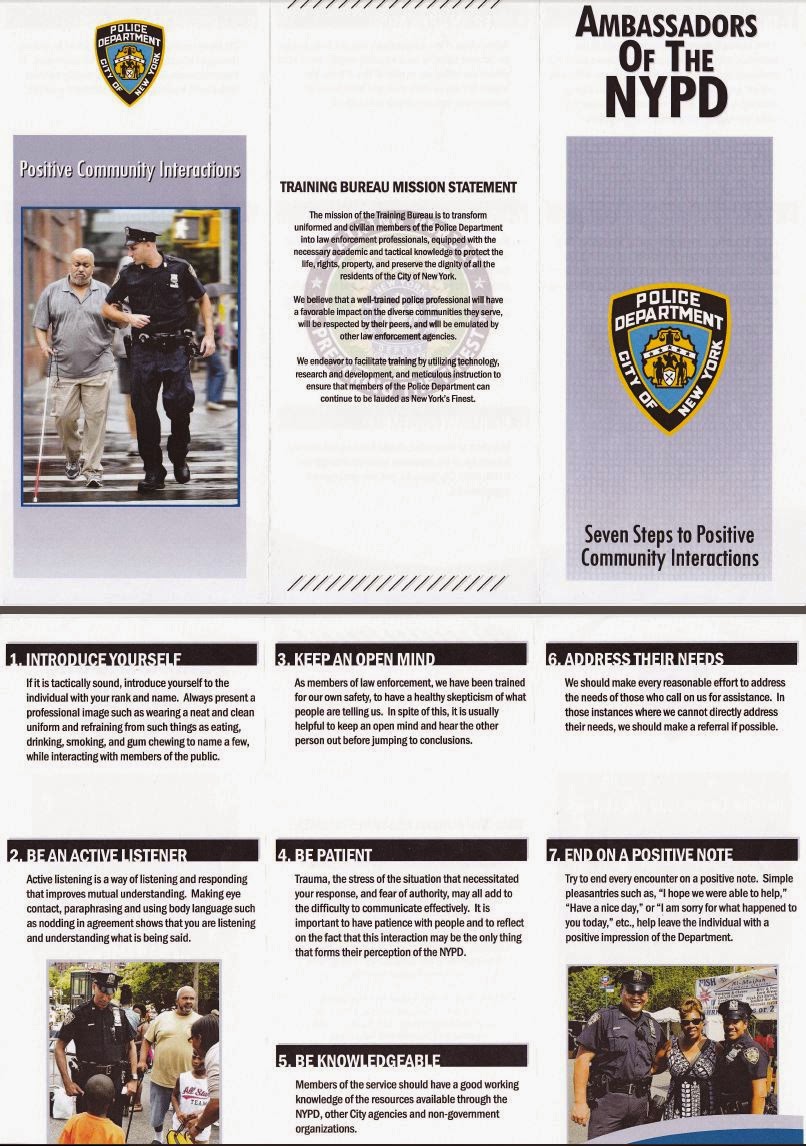
  • “Ambassadors of the NYPD”

    “Ambassadors of the NYPD”

    “OK, academy class, pay attention. Today we are going to learn the ‘seven steps to positive community interactions.’ OK? And, um, even though Number Seven says ‘end on a positive note’ — stop snickering in the back — you should not say ‘have a nice day’ after cuffing somebody.”

  • Officer Down

    Yesterday an Eastern District sergeant, Keith McNeill, was shot and very seriously wounded. My thoughts go out to him, his family, and all those who know and work with him.

  • “The true lives of low-level drug dealers”

    Erin Rose wrote a great piece in Salon about your average run-of-the drug dealer. It’s not like Breaking Bad (though it is in Albuquerque). It’s not like Baltimore’s Eastern District. Most drug dealers are not violent. Most drug dealers are not black.

    Some highlights (but it’s worth reading in its entirety):

    Rico works a full-time job and only deals as much as he can reasonably use or hide. He lives in the the same small house he’s lived in for 12 years, in a down-and-out part of Albuquerque that recently began to “yuppify,” as he puts it.

    “I’m not trying to be some rich guy. I’m just trying to get money to enjoy myself. Real-world jobs don’t allow people to do that. I think that’s why a lot of people sell drugs,” Rico says.

    His “real-world job” pays a few bucks more than minimum wage.

    These men don’t belong to cartels or gangs. They’ve never murdered or physically hurt anyone while selling drugs. They don’t keep guns. With the exception of Shorts, they’ve never been arrested. Each of the dealers I spoke with said that they began selling drugs when they realized that there was no way their jobs would allow them to do what they wanted to do.

    Selander sees it as a larger societal problem. “Try to raise a family working at McDonald’s or Wal-Mart. Try to buy a house.”

    While dealing is not significantly more lucrative — economic researchers report that independent drug dealers make, on average, $20,000-to-$30,000 a year – being self-employed offers these men a freedom unavailable to them at a normal job. Working at McDonald’s or Wal-Mart puts them at the mercy of a system that will ruthlessly replace them should they break any of its rules. Drug dealing, they say, allows them to set their own priorities and schedules.

    “I’m not lazy,” he continues. “They call it hustling for a reason!” He cackles. “But I ain’t dumb enough to wear myself out making someone else money.”

    Shorts sold meth for a short time, he told me, but complains that the people he sold to were unable to wait, and liable to do something crazy. He prefers to deal only with professionals — and, he says, the professionals do cocaine.

    “I like to sell to the lawyers, the doctors, you know, people who have something to lose.”

    “Everybody does drugs, but it’s the poor who go to jail for it, ” another dealer, named Cruz, told me.

    Cruz had grown up broke. At one point, he, his mom and his brother were living on $9,800 a year. “We tried to go through the bank. No financial institutions would lend to us, because we didn’t have repossess-able assets.”

    Without the money Cruz made selling drugs, he never could have opened his legal, and so far successful, business. Once he had the money he needed, he stopped selling blow. When I asked him why, he told me, “If you don’t get addicted to the drugs, you get addicted to the money.”