Copinthehood.com has moved to qualitypolicing.com

  • David Durk thought I was crazy…

    …at least at first.

    David Durk died last month. And I didn’t even know it. That really would have pissed him off.

    (My excuse for missing the obits was that I was en-route to a conference in Chicago. Here’s one. And another. And a third.)

    Let me take you back a bit. In October, 2009, there was this strange voice mail on my school office phone. Some gruff guy with no phones manners said, quite awkwardly: “Call me I want to talk about your book!”

    Hmmmm… No, thank you.

    But I did save the message because it was so strange.

    A month later a similar message comes over the phone. But now I’m sitting in front of my computer. He did actually spell his name, David Durk, D.U.R.K., so I punched it into google. The David Durk? I called him back the next day.

    He proceeded to talk my ear off for a good 40 minutes. He hadn’t read my book, but he had heard something I said that pissed him off, which seemingly wasn’t very hard top do. He thought I was crazy because I said something like, “the culture of police today isn’t corrupt.” What can I say? I call ’em like I see ’em. I didn’t know what else to tell him (nor did I ever get the chance to say much). But I did offer to send David Durk a copy of Cop in the Hood. And I did.

    A short time passes and he call me again saying, “I just finished reading the last footnote! Great stuff.” That blurb from him has been on the right column of this blog for a while now. I’m rather proud of it. We got along better after he read my book. I like to think he respected my integrity. Or maybe he just had a soft spot for a college-educated cop. I don’t know if I got in more than 50 words, edge-wise. Evidently, I later learned, I was not the first to experience this Durkian balance of conversation.

    But I considered it an honor to listen to David Durk ramble on. I mean, he’s David Durk for Christ’s sake, and my time isn’t that precious. But I never did invite him to speak to my classes or the school, which (before his health issues became more serious) he was keen to do. We never met. I didn’t really want to. We talked a few more times on the phone. These conversations each lasted about an hour. But over the phone, when push came to shove, I could simply hang up.

    What David Durk told me, again and again, was that the world was corrupt, policing was corrupt, and he was forced out to retire on an officer’s pension rather than the lieutenant’s pension he deserved. I couldn’t argue with any of that, because he would never give me the chance.

    By many accounts, David Durk was a difficult personality. He struck me as not at peace with himself or the world. Mind you, had he achieved some zen-like state of nirvana, he never would have accomplished what he did. I mean, David Durk — along with Frank Serpico — changed the friggin’ culture of modern police! I can’t think of any other two individual with so much positive impact on policing in the 20th century.

    Perhaps the most importantly change is that today (going back at least twenty years) an honest person can become an honest cop and lead a crime-free work-life for 20 years. No “pad”; no stealing from places already burglarized; no shaking down drug dealers; no shooting criminals just to teach them a lesson (not that Durk was opposed to a robbery squad that did just that, just FYI). It’s not that none of this ever happens, it’s that there’s no longer institutionalized criminal corruption in rank-and-file policing. We have Durk and Serpico to thank for that.

    But something odd happens when you quit policing. In the following years you assume nothing has changed. I know policing changed a lot from 1990 to 2001. And I suspect it’s changed as much if not more between 2001 and 2012. But not in my mind, which will forever be a bit stuck in a bit of a time-warp from 2001.

    David Durk lived his life thinking policing hadn’t changed much over the years. This was unfortunate. For a man not known for his humility, Durk couldn’t appreciate what he himself had done do make policing less corrupt. He told me things were just as corrupt in 2012 as they were in 1985, or even 1970. “But it ain’t so, David,” I would tell him, “It just isn’t.” For Durk, the world was never clean enough. The man tired me out. But I’m happy he found the time to do so.

    Rest in peace.
  • Gun Rights? “Your Side Won”

    Gun Rights? “Your Side Won”

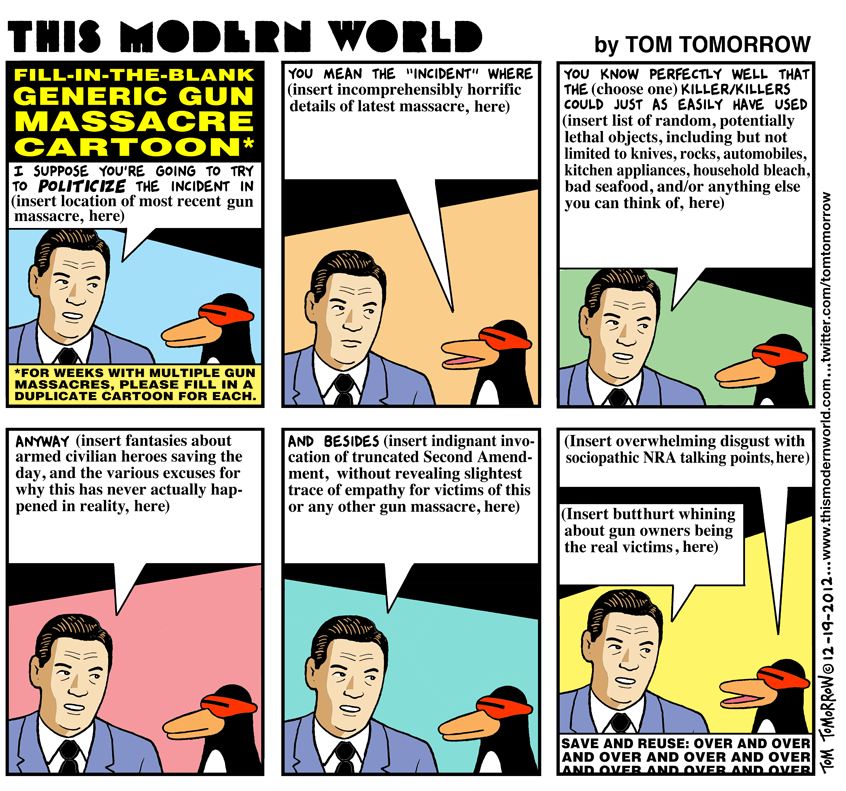
    I’ve said it before: “Barring some seismic realignment in this country, the gun control debate is all but settled–and your side won. The occasional horrific civilian massacre is just the price the rest of us have to pay.”

    And then there’s this gem of a cartoon.

  • Breaking the Taboo

    The documentary is out: Breaking the Taboo. Directed by Cosmo Feilding Mellen and Fernando Grostein Andrade, it stars Jimmy Carter, Bill Clinton, Morgan Freeman, leaders of Brazil, Mexico, Switzerland, Colombia, and an additional cast of dozens (including me):

    My favorite parts? Other than the guy who appears before Bill Clinton at 17:15, it would be the former President of Brazil, Fernando Cardoso, who says, “When I was in office in Brazil of course I was aware of the situation of drugs. But I was convinced that true repression to be possible to stop the production of drugs. But I was wrong at the time.” And then there’s Jorge Casteneda,Mexico’s Secretary of Foreign Affairs (2000-2003): “The war has created the situation. The situation did not create the war.”

    Rarely has the history of the drug war and the logic of ending the war on drugs been explained so well (or entertainingly).

    [Update: Here’s Richard Branson’s take. And the Netflix link]

  • Cop Does Good, paper reports

    An all too rare reporting of a cop doing a good deed.

    Of course the cynic in me worries that he will get in trouble for 1) being off post, 2) shopping while on duty, and 3) accepting a police discount. That’s they way cops think because that’s the way the departments can f*ck you, when they want to. Only the good press might save him.

    Why do we let police work in a system where they can get in trouble for buying shoes for a barefoot homeless guy?

    [Update: The homeless guy was found barefoot again by the New York Times. He said the shoes were in a safe place because they were worth a lot of money.]

  • Incarceration numbers down

    A BJS reportreports the number of state and federal prisoners decreased last year by 17,264. This has been called a small step in the right direction (since there’s no reason the US should lead the world in incarceration rate and numbers).

    But what I haven’t heard, and it seems relevant, is that this decrease can wholly be accounted for by the Supreme Court ordered reduction of prison overpopulation. This has resulted in a 25,000 inmate decreasein the California prison system. And it means that prisoner population in the non-court-ordered rest of the country actually increased by some 7,000. (Local jail numbers are down 30,000 nationwide, or 45,000 if one excludes California.)

    So while I’m happy to see a reduction in unnecessary incarceration. This isn’t actually a step in the right direction. Because a step implies some sort of trend, where the next step will be in the same direction. California prisons still have another 7,000 prisoners to rehouse. Meanwhile, back in the other 49 states, we’re still walking in the wrong direction.

    [The California jail population increased 15,000. By my math, that means that 10,000 California prisoners are now on the street, without any huge increase in crime. The cost savings of not incarcerating 10,000 California prisoners is roughly $472,000,000.]

  • Law Enforcement Againt the Drug War

    SafeKeepersis a video series profiling law enforcement officials
    who’ve been on the front lines of the drug war and mass incarceration.

    (in partnership with LEAP)

  • The Law and Order Database

    Why TV isn’t reality. And done in such a charming nerdy way.

  • Now Hiring: John Jay College Dept. of Law & Police Science

    “Did you say tenured-track professor in New York City!?”

    Why, yes I did.

    My department at John Jay College of Criminal Justice (Law, Police Science, and Criminal Justice Administration) is hiring 3 (count ’em, three) tenure-track assistant-professor lines. Two are police-related; one a more general criminal-justice (or it might be the other way around, but that doesn’t really matter).

    You can read the job postings here (for police) and here (for criminal justice).

    You need a PhD or have to be on track to get one in the spring.

    Related, I and some of my colleagues will be at the ASC conference in Chicago this week (I’ll be there Wed-Sat). We’re looking for a few good men and women. Come find us and we can all tell each other nice things about ourselves.

  • Legal Marijuana

    My friend, Neill Franklin of LEAP, spells it out (and does so far better than I could have).