Tag: 911 is a joke

  • To call 911 or not to call 911?

    To call 911 or not to call 911?

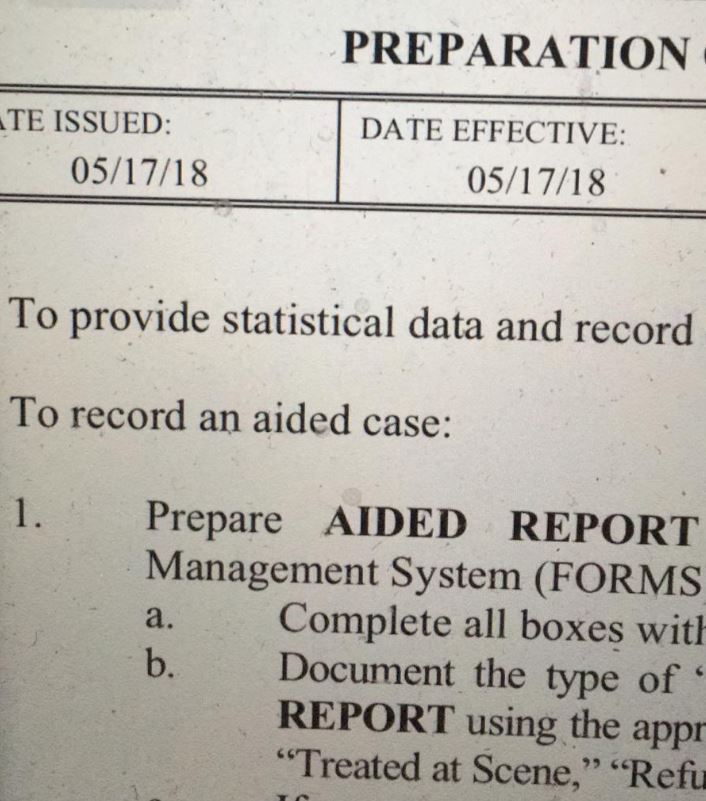
    May 17 of last year the NYPD issued an obscure order concerning “aided reports” — that’s when a cop responds to a 911 call for a sick person waiting for an ambulance (a “bus,” as they say here) — requiring the officer to enter the person’s information into their phone. This looks all technical and boring.
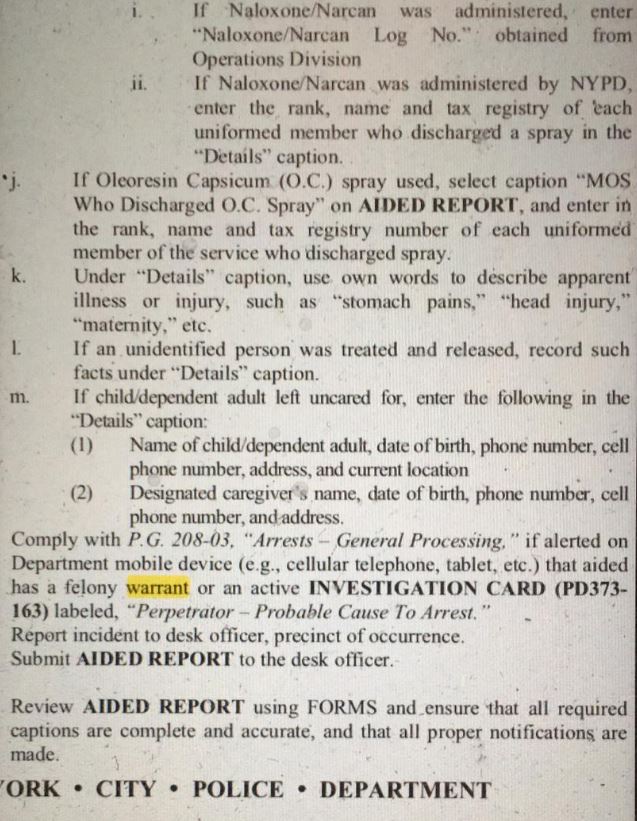
    When you put the “aided card” into the phone, it automatically goes
    and queries the warrant system. This means that if Uncle Pedro has a
    heart attack and he or you is wanted, cops will take you away
    (after medical treatment, but still). Thanks, technology! That’ll teach
    you to call 911!

    Say your Uncle Pedro has chest pains. Or is ODing. Should you call 911? Of course! Right? But what if you don’t know if he’s wanted? What if you don’t know if you’re wanted? Should you still call 911? You know cops might also respond because, well, why not? Maybe cops can do some good
    before the ambulance arrives. (Though generally, as a former cop, when it comes to medical care, are you serious?)
    Or keep the peace. But should you be debating all this before deciding to call 911? While you’re discussing the pros and cons, Uncle Pedro just stopped breathing. 

    The NYPD has spent time and dollars trying to build relations with all communities. We want people to call for help. The goal has always been to bring people into the system, not make them afraid of it. The Neighborhood Coordination Officer (NCO) philosophy is just the latest serious effort. All this will be for naught if people are afraid to call 911 or 311 even for non-police matters.

    We don’t need people thinking EMS are the bad guys. And we for sure don’t need people fighting unarmed EMTs because they’re worried that they the EMTs and paramedics are going to call the police and get them arrested. That’s not good public policy.

    Cops do not have discretion when somebody comes back wanted. A
    warrant is a warrant. And arguably for good reason. A judge hath spoken.
    But there are wanted people out there, and an entire undocumented
    population, for instance, whom we still want to call 911 when A) there’s
    a fire, B) they witness a crime C) they victims of a crime, and D) when
    they need medical care. Needless to say, this is not an inclusive list.

    Perhaps for minor violations, when you know the person’s name and addresses, just give the guy something like a “must appear notice,” like the one he never got because it was mailed to his address from three years ago. Then bounce it to a detective for follow up. A surprisingly large percentage of people who have warrants simply do not know they are wanted. Give them 60 days or something. Why is the only part of the criminal justice system that moves quickly the one in which somebody wanted is taken in?

    It’s in everybody’s best interests to have people turn themselves in at a more convenient time. This can be the difference between staying employed or being fired. Most warrants are not over urgent matters. And often staying employed can make all the difference in the world.

    Could it become common in NYC hospitals (and not the hospitals serving rich white people) for police to run the names of visitors and patients while they are waiting around? For some, their injury or presence might constitute grounds for a probation or parole violation. This is exactly what Alice Goffman said was happening in Philadelphia. (It’s not clear it actually was happening, but people thought it was, and that’s bad enough.)

    New York City has an estimated undocumented population (aka illegal immigrant) population of 560,000. Even in a sanctuary city, people — more than half a million New Yorkers — are afraid. Currently NYPD doesn’t share this information with ICE. But that could change overnight. Recently I had an immigrant student whose boyfriend was hit by a car. He was hurt. The driver stopped, but the boyfriend didn’t want to exchange information. A guy hit by a car through no fault of his own was afraid to get the driver’s information or go to the hospital. This is not good.

    What problem is this solution supposed to fix? “We want the cops to put an aided card into the phone on the scene and it to automatically query the warrant system.” It is bad policy to routinely run warrant checks on people seeking medical care.

    I know it’s not in the public’s interest to have wanted people running around. It’s one thing for police to run somebody because they have suspicion. It’s another to do so because they called for help. It’s not in the public’s interest to have people afraid to seek medical care or see EMTs and paramedics and the FDNY as part of law enforcement. Let’s base a policy decision based on evidence rather than, “hey, cops now have smart phones linked to the warrant system!”

    One interesting (at least to me) thing I learned in talking to somebody about this, cops in New York did not routinely run (check for warrants) every time they 250d (stopped) somebody. In Baltimore, we ran basically everybody we stopped. This is a big difference in police behavior, and I’ve never heard anybody discuss or even be aware of this. But even in Baltimore we didn’t routinely run people on medical calls. In part we didn’t want to know. Because if the person is wanted and going to the hospital, guess who gets to babysit the patient until they’re released? Not a good use of patrol resources. And the next shift will really hate you, too.

    Maybe we ran more people in Baltimore than they did in NYC because more people were wanted. But it probably had more to do with an unrelated technological issue. One radio channel in Baltimore covers one district (aka precinct) with 1 dispatcher for 15 (often fewer) patrol units. One radio channel in New York covers multiple precincts and has perhaps 10(?) times as many officers. It takes precious air time to run a 10-29 (Balto code for, check warrants). And air time in New York is more precious. Many stops, even car stops, weren’t called in. That’s not safe or good policy. Something as simple as how many units are on one radio channel, can change police culture more than any formal debate or informed policy. Maybe it shouldn’t be that way.

    And if it is good policy to check people in medical crisis for warrants, and I don’t think it is, they hey, why not go all-out and front-end it to the 911 and 311 operators. Let them be part of the system, too. At least it would be honest. “Thank for calling 911. This call is being recorded and you are being checked for any felony warrants. Now, what is your emergency?”

  • When to call (and not call) 911

    Interesting study by some prominent (and good) sociologists about the drop-off in 911 calls after there was publicity about a man severely beaten by off-duty Milwaukee cops in 2004. Calls dropped by about 17 percent for about a year.

    But that’s just a segue to this, which comes from a community listserve in Durham, NC. A friend of mine who lives there sent it to me. And I reprint it here with permission of the author, Durham Sergeant Dale Gunter. He’s got a bit of whimsy about him (a good quality in a sane cop) and seems to be in the news a fair amount, in a good kind of way way. Also, this a question I still get asked a lot.

    There seems to be some confusion and hesitation about when to call 911. Lots of people have emailed me recently to ask when or what constitutes a 911 call versus a non-emergency call. So in order to clear it all up and because I know you’re all wondering, I’m gonna give you the skinny on the whole deal. This is exciting stuff folks, so put a pillow on the floor just in case you fall off the edge of your seat.

    Here we go: if you see something HAPPENING that you think needs Police attention NOW (or for that matter, anything that falls under “Emergency Services” such as Police, Fire or EMS) then 911 is appropriate. The basic idea is to ask yourself if what you’re seeing is “In-Progress.” If it is in progress — call 911.

    Now — if the situation is clearly NOT an emergency or the incident is not currently in progress, then dialing the Non-Emergency line is appropriate [The Durham number is given here, but yours might be 311]. That’s why it’s called the Non-Emergency line — nifty huh?

    Examples of 911 calls can include:

    • Car wrecks
    • Any medical emergency
    • A break-in to your home (and you don’t know if anyone is inside)
    • A break-in to your home while YOU’RE inside!
    • Seeing someone stealing, about to steal, or break-in to something
    • Fights (doesn’t apply to animals, does apply to Kung-Fu)
    • Bad guy with a gun
    • Any sighting of Chuck Norris (cause someone is about to get hurt)
    • Gunshots
    • Suspicious activity (make sure to tell 911 exactly what’s suspicious about what you see)
    • Your house is on fire
    • My house is on fire
    • Anybody’s house is on fire
    • Fire in general
    • If you’ve fallen and can’t get up
    • If I’ve fallen and I can’t get up!
    • On second thought, a Chuck Norris sighting? Nothing we can do. Best not to intervene. It is, after all, Chuck Norris.

    Now this is not even a drop in the bucket. So don’t limit yourself to any list out there, because there are so many situations that can and would apply. Use good judgment and if you still have doubt, call 911. You can’t go wrong — we’ll figure it out when we get there.

    Now, for the non-emergency stuff. the Non-Emergency number for the Durham Police is [yours might be 311, if you live in a city].

    Basically, anything that you might need the police for, but it’s not a “ShaZaaam!” moment. It’s NOT in progress, and it doesn’t endanger life or property. It’s more of a “Well, the police should probably know what’s going on here, but there’s no rush.”

    Some examples of non-emergencies are:

    • A dent to your car in the parking lot.
    • A stolen mower, weed wacker, whack-a-mole game, wilted weeping willow, or other property (something that might have gotten stolen out of your shed for example) and the bad guy is long gone
    • A minor crime that occurred days ago or even hours ago
    • A car break-in (not in progress)
    • Identity fraud (not in progress)
    • Police advice

    When not to call us at all

    • When your order at Mickey-D’s is not really “Your way.”
    • When you forget your anniversary — again — and you were married Christmas day, her birthday, or Halloween (You’re on your own fellas).
    • Cat in a tree (it will come down eventually. after all, who’s ever seen a cat skeleton in a tree?)
    • Dog in a tree — call me directly. Gotta see that.
    • Clowns — your discretion — they creep me out too.
    • Aliens — when aliens from Mars, in possession of an Illudium PU 36 Explosive Space Modulator, lands in the city park and start vaporizing people into cosmic dust — it may be an emergency, but trust me — I ain’t coming.
    • Just to say “Hi Police!”
    • When Victor finds out Adam is secretly conspiring against Ashley to make her think she’s losing her mind and to make her think she’s pregnant, but we all know she’s really not, except for Victor, who can’t see the truth because he hates Jack, and Jack is worrying about Gloria scheming as usual and Jack and Victor are worrying about that crazy Mary Jane and kitty cat. Mary Jane wants to kill Jack and Victor and stuff the new cat, or marry Jack, depends on the moment. Now, Mary Jane ought to think about calling 911 for that spider bite, that might be appropriate, and she could if she hadn’t have stomped on the cell phone. Not that I watch Y&R, it’s just what I hear, honest, you know, word on the street and all.
    • To find out the weather or road conditions. Instead, just watch Don “Big Weather” Schwenneker on WTVD. If Big Weather says “TarNader is a comin,” grab Dorothy and the dog and get in the cellar, cause a TarNader is a comin!
    • You want directions
    • Lost cell phones (No need to report it to anyone but your insurance company. Also, how did you call?)
    • Lost wallet
    • Lost dogs
    • Lost cats
    • Lost love
    • Lost keys
    • Lost re-runs
    • Los Alamos
    • Las Vegas. What happens in Vegas — stays in Vegas — unless you put it on Facebook, Instagram or Snapchat.

    Now, if you have something that comes up and are confused or wonder about or have ANY DOUBT at all, repeat after me: Call 911 — you can’t go wrong.

  • Is this what the Ferguson Effect looks like?

    Take this fightat North Avenue Beach in Chicago. Seems like mostly a bunch of stupid frat bro’s, one wearing an SAE tank top. (“These people” also have problems.)

    Why does does this have to do with the Ferguson (or “Viral Video”) Effect? Well, if you’re looking for an example of how fear or negative publicity can impact policing and create disorder and crime, this is a good example.

    I mean, unless you’re in Chicago, you probably haven’t seen this video because there are no police to be seen. I hate to think this is future of policing. But in terms of limited bad policing, lack of police really does completely solve the problem.

    But there should have been police here. I used to bike by here quite frequently as a kid. There was always a phalanx of cops hanging around the beach areas, flirting and keeping order. Had there been, maybe the fight never would have happened. Maybe it never would have gotten out of hand. Or maybe a half-dozen cops would have entered the fray and physically restored order — fists, pepper spray, maybe a billy club — and a few idiots would be led off in cuffs. But then we would have criticism of police excessive force — maybe a lawsuit by the ACLU, definite discourtesy, somebody would say police were the instigator, “stop” paperwork would not have been filled out — and the focus wouldn’t be on the idiots fighting but on the nature of the police response. But what if there is no police response and nobody calls 911? Problem solved, at least from a viral police video perspective. Like it never happened:

    CPD says they did have officers in the area, but did not get any reports of fights on the beach. No arrests were made.

    Crime even goes down (at least by the official stats). That’s what happens when you don’t have proactive policing. See, officially, this never happened. No arrests were made. (Though later reports do say a few arrests were made along with a few going to the hospital.) Luckily, nobody had a gun and started shooting.

    And, best of all, nobody can fault the police.

    If you want police, just call 911. An officer will be with you shortly. Crime is up. Boy, is it up in Chicago. But of course, say some, we really have no idea why. No clue. Meanwhile… Chicago police are understaffed. Recruitment is down. Chicago police fear lawsuits from the ACLU. Paperwork requirements tell cops never to “stop” people unless absolutely necessary. Chicago police officers don’t want to be in the next viral video. Police are not being proactive. Chaos ensues.

    But really, who can say for sure?

  • “Queens Man Accused of Making Over 30 False Calls to 911”

    This doesn’t happen enough(the prosecution, not the BS calls to 911):

    In all, the authorities said, more than 30 calls were made over a month, none for actual emergencies. On Friday, prosecutors in Queens said that they had all been traced to one man.

    He told the fire marshal investigating the case that he made the calls. “My uncle is verbally abusive to me,” he told the investigator, referring to a relative with whom he lives, “and the sound of sirens calms him down.”

    The man, Kenneth Campbell, 47, of the Briarwood neighborhood, has been charged with five counts of making a terroristic threat and more than two dozen counts of false reporting of an incident, prosecutors said.

  • Butt dials 30% of mobile calls to 911 in S.F.

    The BBC:

    When the researchers [in San Francisco] sat by the call handlers and noted down what was happening – they found 30% of calls coming in from mobiles were accidental butt-dials, also known as pocket-dials.

    As well as being time-consuming taking the call, the impact of butt-dials doesn’t stop there.

    Each one requires further attention – after all, the 911 handler doesn’t know if it was a mistake, or someone trying to call for help but unable to talk at that point.

    And so, all butt-dials are followed up. In the sample period, it took an average of one minute and 14 seconds to get back to people and determine the call was a mistake.

    In a survey of handlers at the San Francisco 911 centre, 80% said chasing these calls back was a time-consuming part of their already overstretched day.

    About 39% said it was the single biggest “pain point” they had in the job.

  • 311 is a Joke

    When 311 is introduced for non-emergency calls, there’s always talk about how the new 311 system will ease pressure on the 911 system. That never happens (but “hope springs eternal…”).

    I can’t actually find the 911 numbers, but I know there are more 911 calls now than in 2003, when 311 was introduced here in NYC. (I know because 911 calls always go up).

    But what’s amazing is how much 311 calls have gone up. Whether this is good or bad is debatable. But it’s certainly noteworthy and does cost money.

    The 311 system in NYC went live in March 2003. There were 8,383 calls a day average: “As many as 32,023 callers a day”! (Plus $25 million in start up costs plus $27 million-a-year operation.)

    Six year later (2010) the system was taking 68,000 calls a day (more than twice as much as the maximum load when the system was introduced).

    In 2014, New Yorkers used the 311 system 28 million times! (16% higher than 2011) I had to do the math, but that’s 77,000 times a day.

    311 call volume will increase. As will 911 call volume. It is written. And maybe increased call volume can increase forever — or maybe it’s a good thing — but let’s not fool ourselves into thinking anything will decrease 911 calls but going back on the promise of unlimited free supply of police services

    And kind of related — and certainly amusing — in 2012 38% of 911 calls in NYC (not 311) were inadvertent. 10.4 million 911 calls in 2010. Of those, 4 million were “butt calls.” I have to assume that these were not handed to patrol officers. But when I was a cop in 2000 (cell phones were just up and coming), 6% of all calls were “911 no voice.” And we had to respond to all of them.

  • “Those drug-dealing kids need to get off my lawn!”

    So many controversial police incidents, where police are accused of being prejudiced or racist — and here I’m thinking of the grandfather “kidnapping” his black granddaughter in the previous post, or police shooting the guy in Walmart, or the black guy in Minneapolis being hassled while waiting for his daughter, or just “swatting” in general. These incidents often happen because citizens are stupid or racist or prejudiced. And then the call police. And then the police officers get put in this horrible situation where they have to investigate the sometimes irrational suspicions of an idiot citizen. Usually it’s not a matter of life or death. But there are lot of calls for youths selling drugs when they’re just loitering. There are a lot of calls for an armed person, when the person is not armed.

    I don’t know how to avoid these problems, but they are related to the whole problem of the 911 system and reactive policing in general. Police can and do make mistakes, but based on police officer training and experience, police are much better judges of crime and danger than the average schmuck with a cell phone. And yet the information from the average schmuck with a cell phone — then filtered through an underpaid 911 operator and then passed on to an under-appreciated police dispatcher — is how most police-public interactions start. For the average citizen, it’s too easy, too anonymous, and too without consequence to dial 911. One would think there has to be a better way. Any ideas?

  • Reducing 911 calls

    A reduction in 911 calls in unheard of. The number of people calling for police goes up and up (because the system would have one believe there is an unlimited supply of cops). Right now about half your police department is dedicated to being ready to answer your call for service. And being ready (“in service”) too often means sitting around doing nothing.

    That’s why this, coming out of Nashville, is interesting:

    But in the struggle to run an efficient 911 system, Nashville officials have seen recent success. A 13-month streak of declining 911 calls allowed 2013 to wrap with the fewest since 2009. That helped responders spend more time on real emergencies.

    But if calls are simply diverted to 311, the actual gains may be minimal. The public needs a way to reach and talk to an actual police officer (and not just the police agency in general).

  • While I’m out…

    Check out this lengthy piece (and well worth reading the whole thing) by David Simon about murders, stats, the BPD, the state’s attorney’s office, and the need for main-stream media. (And thanks to an anonymous comment for cluing me in.)

    The Stat:

    In 2011, the Baltimore Police Department charged 70 defendants with murder or manslaughter.

    Yet in 2010, the department charged 130 defendants with such crimes.

    What is happening?

    Are Baltimore’s killers showing more cunning, are murders becoming
    harder to solve?  No indication of that from any quarter.  Did the
    homicide unit lose a ton of veteran talent?  Nope.  Not between 2010 and
    2011 at any rate.  No, the dramatic collapse of the department’s
    investigative response to murder is the result of a quiet, backroom
    policy change that has created a bureaucratic disincentive to charge
    people in homicides.

    Also, and unrelated, McCarthy in Chicago says police don’t have to answer stupid 911 calls for service anymore. It might seem minor, but this could have a huge impact on policing (as Chapter Six of Cop in the Hood — “911 is a Joke” — describes in breath-taking page-turning detail). McCarthy is talking about “beat integrity” and says he’s willing to face the political flack for fewer police responses. He also wants to give powers of where police go to police bosses (instead of giving all the power to the dispatcher). This is all good. (Maybe in Baltimore they’ll actually bring a box back to put call in!) From the Sun-Times:

    McCarthy replied that the change was
    already under way, with the goal of creating, what he called “beat
    integrity.” That means leaving police officers to patrol their assigned
    beats, instead of chasing their tails by running from one 911 call to
    another at the behest of dispatchers. …

    “Previously, the dispatcher would direct
    the resources, while the sergeants in the field would basically just be
    receiving them. [Now], sergeants in the field are in charge of
    dispatching resources if they don’t like the way [dispatch] is doing it. …

    [Dispatch] has also abandoned what McCarthy called the “clean screen concept” at the 911 center.

    “They would dispatch a car from one end
    of the district to the other end of a district to simply get the job off
    the screen. That’s the clean screen concept,” he said.

    “What we’re now doing is maintaining
    beat integrity. … If a job comes in in a neighboring beat and it’s not
    an emergency call for service, that job will actually get stacked until
    that beat is available to handle it. That’s what beat integrity is all
    about. Same officers in the same beat every single day. Those officers
    are not only accountable for what’s happening on the beat, they also
    know who the good kids are from the bad kids. They’re not stopping
    everybody. They’re stopping the right people because they know who they
    are.”

    McCarthy said a more dramatic change is
    coming soon, when the Chicago Police Department determines “which jobs
    we’re not gonna respond to” anymore.

    “That’s a call that I’m going to make — and there’s going to be some wrankling about that,” he said.

    “We don’t need to respond to calls for
    service because, ‘My children are fighting over the remote control.’ We
    don’t need to respond to calls for service because, ‘My son won’t eat
    his dinner.’ Unfortunately, believe it or not, those are calls we
    actually respond to today.”

     And the political flack will come when one of the my children are fighting over the remote calls turns into a homicide. But you can’t dedicate half the police department to every idiot who can pick up a phone.

  • 911 is a very costly joke!

    There’s a much delayed and controversial report listing the flaws of New York’s “new and improved” 911 phone system. There are many flaws I won’t get into here, but I would like to point out just the cost. The project has cost $2 billion. The entire annual budget of the NYPD is about $4.5 billion (NYPD and NYFD is about $6.1 billion). It’s bad enough that half the average police department is, in effect, sitting in a car waiting for the phone to ring. It’s even worse when the system costs as much as the officer.