Tag: books

  • My Book List

    Not that you asked, but here’s a list of (most of) the books I’ve read in the past two years. Seems like I average one every 20 days.

    The best or at least most memorable of the list? In no particular order: One Righteous Man; The Warmth of Other Suns; A Curious Man; Longitude; Jacksonland; The Faithful Executioner; The Fall of the Ottomans; Boom, Bust, Exodus; The Moor’s Account; History of the Jews; In the Kingdom of Ice; and The City & The City.

    It’s mostly history, I can’t help but notice, and a bit sociological. And just two fiction books (and one of those was historical).

    The Frozen Water Trade by Gavin Weightman

    The Great Siege: Malta 1565 by Ernle Bradford

    New York Burning: Liberty, Slavery, and Conspiracy in… by Jill Lepore

    The Beast Side: Living (and Dying) While Black in America by D. Watkins

    SPQR: A History of Ancient Rome by Mary Beard

    Washington: A History of Our National City by Tom Lewis

    Deep South: Four Seasons on Back Roads by Paul Theroux

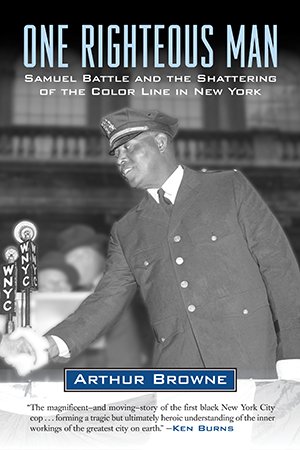
    One Righteous Man: Samuel Battle and the Shattering of the… by Arthur Browne

    The Triple Package: How Three Unlikely Traits Explain the… by Amy Chua

    Americana: Dispatches from the New Frontier by Hampton Sides

    The Warmth of Other Suns: The Epic Story of America’s Great… by Isabel Wilkerson

    Genghis Khan: His Conquests, His Empire, His Legacy by Frank McLynn

    The Triumph of Seeds: How Grains, Nuts, Kernels, Pulses, and… by Thor Hanson

    The Faithful Executioner: Life and Death, Honor and Shame in… by Joel F. Harrington

    The Water Knife by Paolo Bacigalupi

    A Curious Man: The Strange and Brilliant Life of Robert… by Neal Thompson

    Longitude: The True Story of a Lone Genius Who Solved the… by Dava Sobel

    Astoria: John Jacob Astor and Thomas Jefferson’s Lost… by Peter Stark

    Carsick: John Waters Hitchhikes Across America by John Waters

    The Quartet: Orchestrating the Second American Revolution… by Joseph J. Ellis

    Jacksonland: President Andrew Jackson, Cherokee Chief John… by Steve Inskeep

    The Fall of the Ottomans: The Great War in the Middle East by Eugene Rogan

    Ghettoside: A True Story of Murder in America by Jill Leovy

    Boom, Bust, Exodus: The Rust Belt, the Maquilas, and a Tale… by Chad Broughton

    Odessa: Genius and Death in a City of Dreams by Charles King

    No Way Out: Precarious Living in the Shadow of Poverty and Drug Dealing by Waverly Duck

    The Moor’s Account: A Novel by Laila Lalami

    History of the Jews by Paul Johnson

    Ghost Soldiers: The Epic Account of World War II’s Greatest… by Hampton Sides

    In the Kingdom of Ice: The Grand and Terrible Polar Voyage… by Hampton Sides

    Bird by Bird: Some Instructions on Writing and Life by Anne Lamott

    The Global Pigeon (Fieldwork Encounters and Discoveries) by Colin Jerolmack

    The Jefferson Bible: The Life and Morals of Jesus of Nazareth Extracted Textually from the Gospels,

    Tempered Zeal: A Columbia Law Professor’s Year on the Streets With the New York City Police by H. Richard Uviller

    Ritual America: Secret Brotherhoods and Their Influence on American Society: A Visual Guide

    Pigeons: The Fascinating Saga of the World’s Most Revered and Reviled Bird by Andrew D. Blechman

    The City & The City by China Miéville

    Sister Bernadette’s Barking Dog: The Quirky History and Lost Art of Diagramming Sentences by Kitty Burns Florey

    American Homicide by Randolph Roth
  • One Righteous Man

    One Righteous Man

    I read pretty quickly. I’m always looking for new non-fiction. Particularly history. I’ve found Darkblue714 on twitter has never failed me with good book recommendations. He reminded me to read The Warmth of Other Suns: The Epic Story of America’s Great Migration. Being a best seller in 1994, I don’t know how that bestseller managed to escape my classes in graduate school. [Turns out it came out in 2010, which explains why I didn’t read it in graduate school.] Anyway, if you don’t know what “The Great Migration” is, well, shame on you. But leaving that aside. It’s a great book.

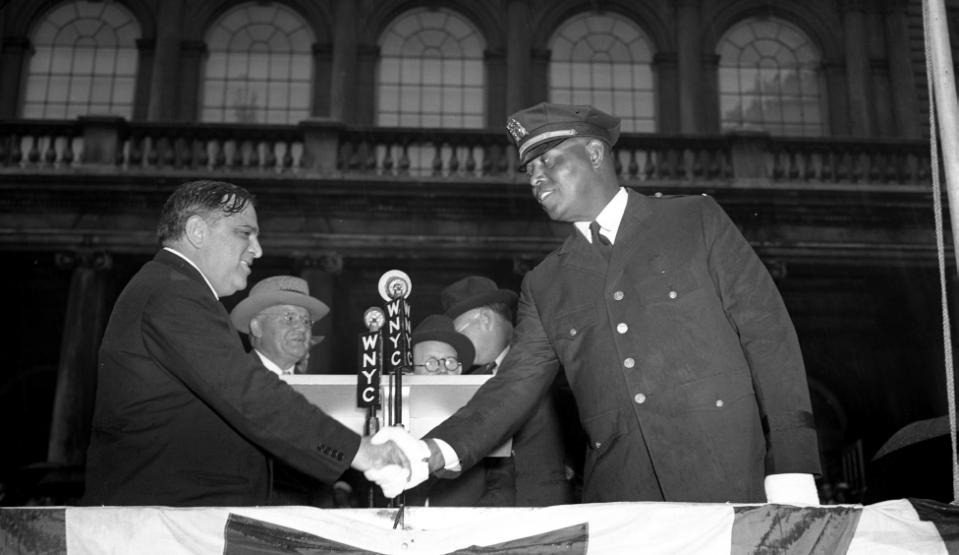
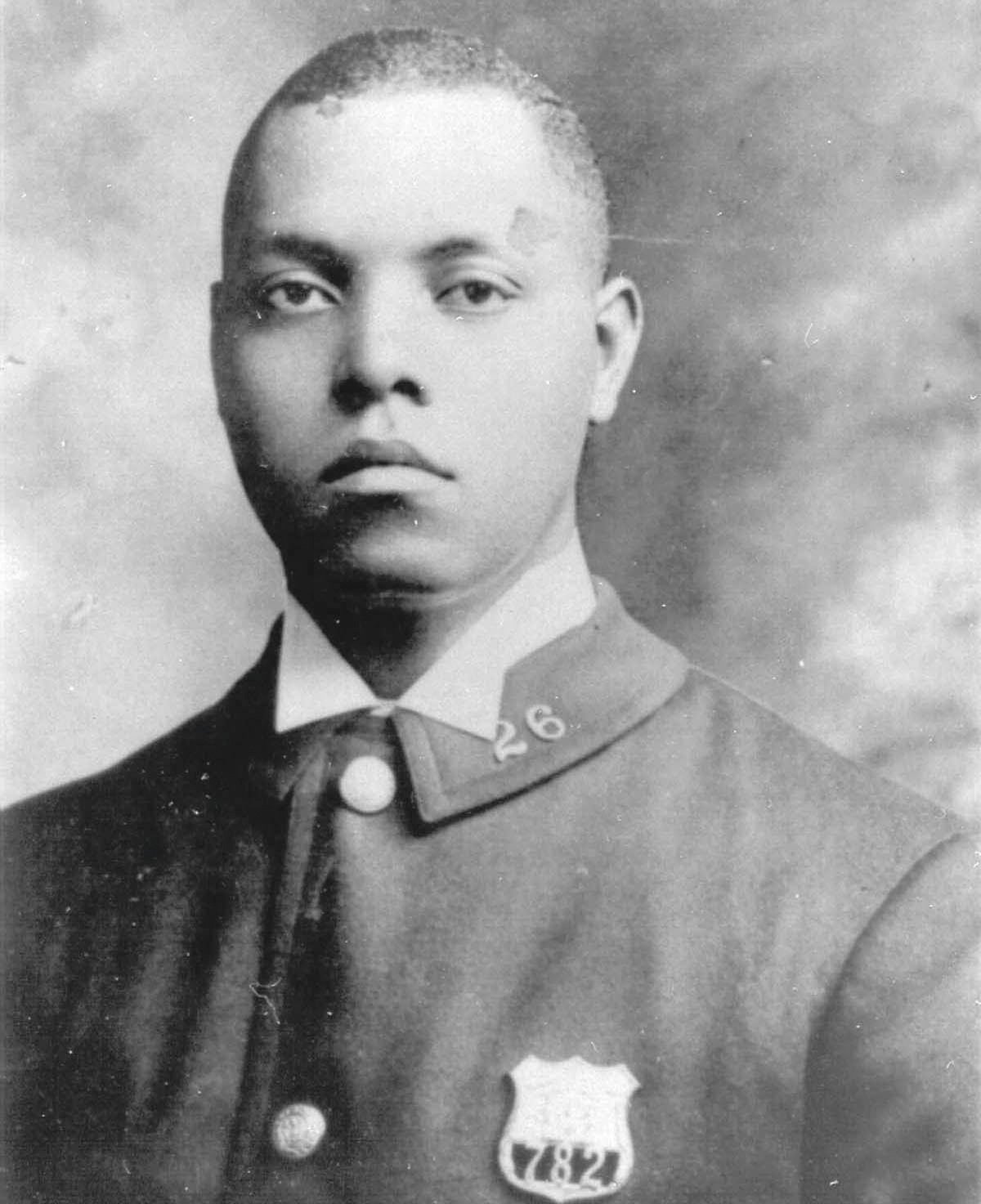
    Darkblue’s next recommendation was One Righteous Man: Samuel Battle and the Shattering of the Color Line in New York. This is new book. And it’s great history for anybody interested in police history, the NYPD, black history, American history, New York history, or for anybody who enjoys a good biography of a fascination man. You think you got it tough? Imagine being the first black cop in New York City. (Though Brooklyn had a few before Consolidation). Battle knew everybody who was anybody. The entirety of black America (and much of white America) passed through his watch. All the politicians, musicians, stars, and political leaders come to him. Talk about some weight on your shoulders. It’s an amazing story.

    That white guy? He’s LaGuardia. If you don’t know who he is… well, he’s more than a crappy airport and great community college near my house.

  • “Write your own damn book!”

    “Write your own damn book!”

    Occasionally, really surprisingly rarely, some crusty old cop takes an instant dislike to me because I write and teach about policing even though I wasn’t a cop for long. I’ve never pretended to have as much experience as somebody with 20 years on the job, but I still find something pathetic when a police officer refuses to read what I have written — which, more often than not, is on his side — on some B.S. matter of principle. (Usually that principle being he’s a dumbass).

    The other week I got into a argument with a cop at a bar I like going to. The bartender asked him if he had read my op-ed in the paper. The cop said it didn’t matter because I was never real police (of course didn’t use those Baltimore words, but that was his gist). Generally I like talking to cops; usually we get along just fine. But after trying to hear him out and conceding much of his basic mistrust (there is a lot about policing I don’t know), I mentioned that perhaps he should judge me on what I actually do, say, and write rather than call me a dick for what he thinks I might be writing.
    But logic wasn’t working. Oh well. I don’t need him to like me or read my book. Now I know I can’t win a whose-d*ck-is-bigger argument based on my time on the job (two years). But given where I policed, given a few too many damaged and dead friends, I don’t take kindly to people asserting I was never there. So after telling him to go f*ck himself, I went on the offensive and questioned his policing credentials (and, while I was at it, his military credentials as well, since by his own ignorant logic, he had only served in Iraq for less than two years).

    I also know he’s never policed in a neighborhood as violent as where I policed, because such neighborhood don’t exist in New York (perhaps the 75 in the late 1980s came close.) I know he’s never patrolled alone. So I asked him how many drug corners he’s single-handedly cleared? Perhaps I laughed when he doubted the number of arrests I had made. In the end, though my memory is a bit hazy, perhaps I alluded to him and his partner stroking each other off while other cops are out there doing real police work. See, I don’t really care what you think about me, my writing, or what I know. But to say I never policed? Go f*ck yourself.

    Anyway, it was all drunk stupid macho swinging-d*ck shit. Nobody got hurt. But here’s what it all comes down to: if you think you know so much more about policing than I do, write your own goddman book!

    Well, every now and then, somebody does.

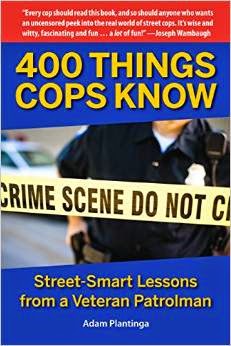
    A short while back I got sent a promo copy of 400 Things Cops Know: Street-Smart Lessons from a Veteran Patrolman. I put it on the back burner. There actually are a fair number of “I was a cop and this is what the job is really like” books. A few are good. Most aren’t. Some cops write better than others. Some police act too macho while others are not macho enough. But I wish cops would write more. At least more than police reports and texts to their lovers.

    When I finally got to reading 400 Things Cops Know, I couldn’t believe how good it was. I teach a lot of students who want to become police officers, and I can’t think of any other single book that would so well prepare them for what the job is actually like.

    Plantinga, a sergeant in San Francisco, seems to have both a pretty level head (though who knows? I’ve never met the guy) and he can write. He was an actual real English major (and a currently employed one, it’s worth point out). Evidently, he can write fiction and non fiction. This is non fiction. These are anecdotes. Good ones. It’s not heavy on the theory (which some will see as good), but it’s a nice combination of this happened and these are my thoughts on those matters. Plantinga is both perceptive and able to articulate the, er, totality of the circumstances. Now I don’t agree with him 100 percent of the time. But I do most of the time. Besides, what the hell do I know?

    Anyway, with permission from Plantinga, I’m going to publish a few excerpts from his book. They’re well suited to blog form. In fact in 2008, when I started this blog, I myself published a little pithy series of “Officer Pete Says“.

    So here’s what I’m thinking: I’ll print one of these every few days. It gives me material to keep copinthehood.com active, and you’ll tell your friends about this great new policing book. I want to help get the word out and help Plantinga sell a few copies.

    So this is my first excerpt from Adam Plantina’s 400 Things Cops Know (Quill Driver Book). Available for less than $12 from Amazon. This is my numbering order, not his, but let’s call this #1:

    The job will change you. It changes everyone, for better and worse. You will become far more alert to your surroundings. You will keep your gun hand free even when off-duty. You will become hyper-aware when taking money out of ATMs, day or night. You’ll look inside convenience stores and banks before you enter to make sure you aren’t walking in on a hold-up in progress.

    If you didn’t curse before you became a cop, you probably will once you have six months in on this campaign. You will curse like a dockworker. You will also become angrier. More disillusioned. Far more skeptical about the inherent goodness of humankind. The constant exposure to toxic social conditions and dealing with people at their hopeless worst solders an extra layer onto your skin. You see too much darkness and it becomes part of you in ways you may not fully understand. Some describe this condition as compassion fatigue, the main symptom being a vague sense of loathing for human frailty and for one’s self. Maybe this extra layer is good. It keeps you from being emotionally invested and affords you the detachment you need to be an objective investigator. It acts like a suit of armor against the elements. But part of you may want to be, well, illusioned again. Part of you wishes that guy you used to be, the one in the police academy with the fresh haircut and the extra-shiny shoes wasn’t such a stranger to you now. You know that for the most part, it’s good that guy is gone. He meant well, but he wasn’t an effective street cop. He was too hesitant, too trusting. He’s been replaced and you don’t expect him back.

    But once in a while, you sort of miss him.

  • Gun Guys, by Dan Baum

    Gun Guys, by Dan Baum

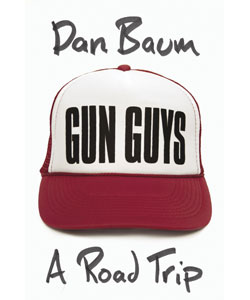
    I finished reading Gun Guys, and it’s very good.

    Here’s Dan Baum talking about his book on the BBC. And here he a more in-depth interview with Dan Baum on KMO’s C-Realm Podcast (which just happens to have been recorded in my basement). [Update: and here is Baum in the New York Times.]

    Baum makes the point that nothing productive with gun policy unless anti-gun people actually listen to gun guys. And he presents his case from a “liberal Jewish gun-loving” perspective. This book isn’t a defense of the NRA, since the NRA represent but a small minority of gun owners (something like 4 million of 100 million gun owners). But rather an attack on the gut-level reaction so many liberals have against gun, without considering (or worse, mindlessly dismissing) the thoughts, feelings, and needs of hundreds of million of non-criminal gun owners.

    A take-away point is that guns are here, like them or not. We can pass all the pointless laws we want, but if we want a safer and less violent America, we need to have an engaging, serious, and rational conversation about guns. Gun Guys does that. How does it make sense to advocate restricting something when the people advocating such restrictions have no idea what they’re talking about? For instance, if the goal is fewer guns, how does it make sense to push for laws that result in a boom in gun sales?

    I do think Baum places a bit too much of the onus on people who don’t like guns. It doesn’t seem to much to ask for a less violent America. Even an America with fewer guns (not that those two are necessarily related–the past two decades have seen less restrictive gun laws, more guns, and a reduction in violence). But to say something isn’t politically feasible is different than saying something isn’t a good and even noble goal.

    Baum stretches credibility a bit when he makes the analogy that hating gun owners is akin to being racist or anti-semitic. But he’s right in that such mindless hatred is often based in ignorance and fear of people the hater makes no effort to get to know. But what about the mindless and ignorant fear of gun owners who think their guns are going to be taken away or feel an irrational need to protect themselves from some criminal class of people? From my perspective, too much of “gun rights” is linked to “state’s rights” and “protecting a way of life” and fear of some “them” taking over America. Until there is serious discussion about repealing the 2nd Amendment, why such paranoia about an assault on freedom? I mean, I love the 1st Amendment, but I’m not shouting objectionable things in the street to protect my 1st Amendment rights. Why? Because they’re not in jeopardy!

    There’s also the point (not in the book) that guns are not freedom. Guns protect freedom. We should be worried about our freedoms being taken away (warrantless searches, mass incarceration, indefinite detention without due process, Presidential-ordered assassinations of US citizens). Having guns without freedom is, to paraphrase Bill Maher, like being in a titty-bar filled with bouncers but no strippers!

    Regardless, Baum makes the essential point that simply hating guns and people who own them is counterproductive from any anti-gun or anti-violence perspective. Most guns are not the problem. Most gun owners are not the problem. And until gun-control people get that through their thick liberal heads, nothing productive will ever happen. Certainly this book is a great starting point to any rational discussion on guns and gun policy. It’s also a good read.

    At its core (and in its title), Gun Guys is a road trip. Who doesn’t like a road trip? Baum takes the reader on an adventure while he talks to as many gun owners and stops in as many gun shops and gun shows as possible. Entertaining and educational! What more could one ask for?

    Now buy his book and read it. You’ll be happy you did.

  • What I’m Reading: Gun Guys

    What I’m Reading: Gun Guys

    Gun Guysby Dan Baum. So far so good. Especially if you don’t understand gun guys. Or if you are a gun guy but don’t like the NRA.

    I’ve written about Baumbefore. Truth be told, I know the guy. Truth be told, sometimes when he’s in town he lets himself into my house and eats my food. But none of that would have happened if he weren’t a good writer.

  • Eliot, by Michael A. Wood Jr.

    Eliot, by Michael A. Wood Jr.

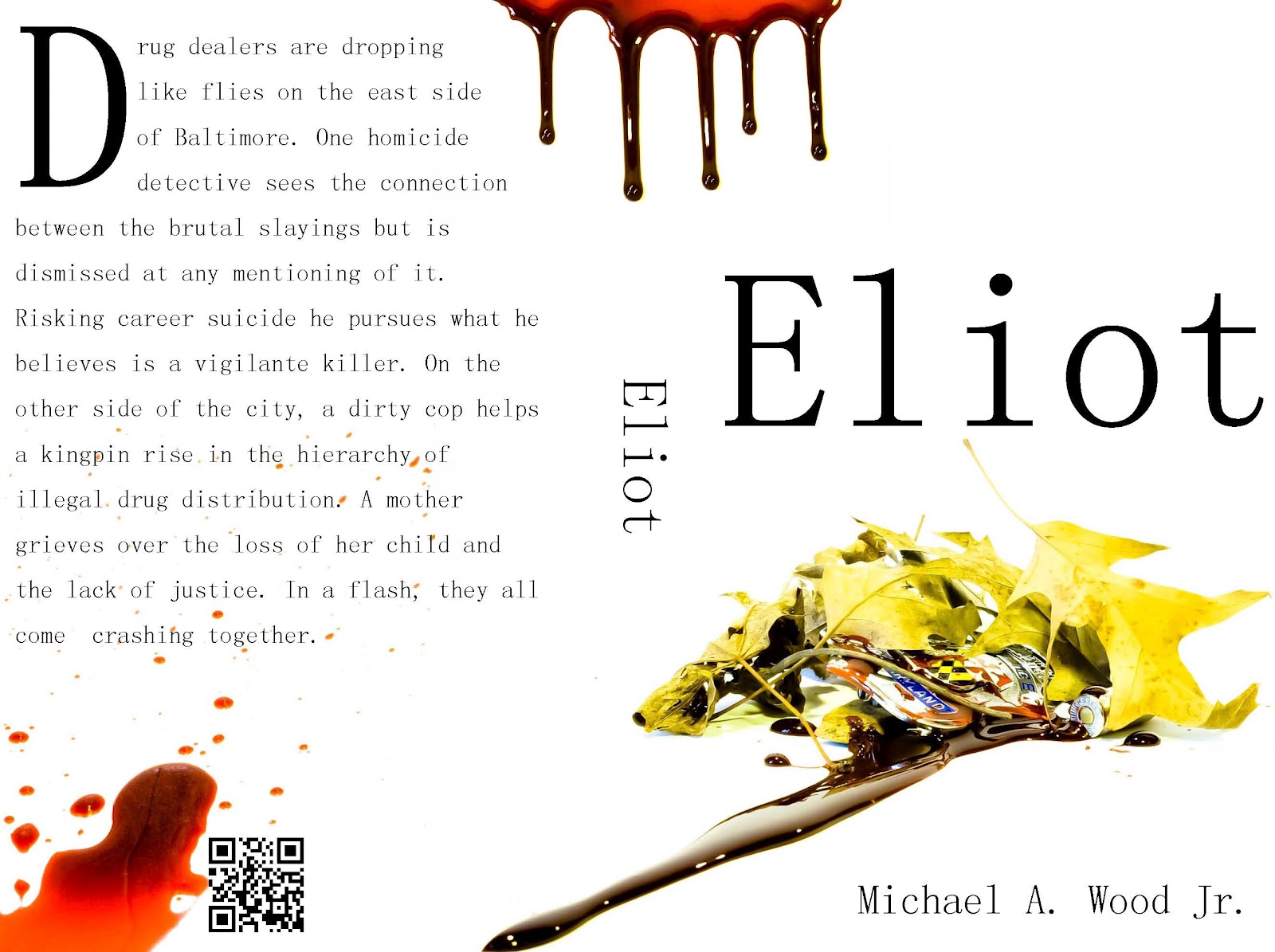
    Need some good summer reading? Why not Eliot? It’s fiction set very firmly in Baltimore’s Eastern District. I know those streets well (even if the cameras are new to me). (and I love that he gives a shout out to Larry, the world’s best dispatcher.)

    I don’t want to spoil anything, but I will say I enjoyed taking the turns around my old stomping grounds. And Michael swears there’s no connection, but I could swear I went to the academy with the homicide detective. Here’s the cover and you can read the back of the book:

    You can get more info and buy a copy on Michael Wood’s website. [Update: you can’t, and don’t] While you’re there, if you’re a cop, check out his promotion guide. I can’t personally vouch for the promotion guide (I’m not up for Sergeant or Lieutenant) but I do have a copy and think it gives you the straight dope on what you need to know.

    I can vouch for Eliot: good crime fiction.

    Next on my list is Cop Stories: The Few, The Proud, The Ugly by Dick Ellwood. Ellwood’s career goes back to 1965, so I look forward to what is now a bit of history.

    And previously I wrote about Badges, Bullets, & Bars by Danny Shanahan.

    Who would have though so many books would come out the ranks of the BPD?

    And let’s not forget Michael East’s Beyond Hope. East isn’t a Baltimore Cop, but he did write a very good book.

    Update: Turns out Michael Wood Jr. is an narcissistic SOB who confessed to crimes but tried to play it off as being a “whistle blower.” And then he he stole money from veterans. http://www.copinthehood.com/2018/09/15/michael-wood-jr-took-money-from-veterans-2/ The other books I stand by, though. And writing this years later, I particularly remember Michael East’s book. Outstanding.

  • Summer Reading (1): My Father’s Name

    Summer Reading (1): My Father’s Name

    The end of the semester means I get caught up on some of my reading. I finished The Autobiography of Ben Frankin (good stuff) and David Foster Wallace’s “A Supposedly Fun Thing I’ll Never Do Again.” (The footnote on the necessity of formal wear would have been very useful to read before we crossed the Atlantic on the QM2 last September).

    But more relevant to this blog, I read Lawrence P. Jackson’s excellent My Father’s Name: A Black Virginia Family after the Civil War. This is a historical ethnography about a man who decides to trace his family’s Virginia roots back to ante-bellum days. Jackson tells us that blacks in America generally only have have
    their accounts recorded for posterity if they were very good, very bad
    (criminal records), or sold in slavery (and not always then). Jackson’s
    family seems just about average for the time and place, which makes his
    ability to delve into the past and bring it to life all the more impressive.

    It doesn’t help that Jackson is a common name. It also doesn’t help that Lawrence Jackson, an introverted academic, doesn’t actually seem to be very good at talking to people. But Jackson is great in the library and the county records office. And he can write. Before you know it, you’re tasting the red dust of unpaved roads and hoping the good guys win the war. My Father’s Name is a bit detective novel, a bit Roots, a bit Fox Butterfield’s All God’s Children (but without the homicides), a bit Ta-Nehisi Coates (they’re both self-reflective and perceptive men from Baltimore), and all with a pleasant meandering pace of Twain’s Life on the Mississippi.

    Jackson also writes with what I can only describe of a pleasant undercurrent of anger. This is not unjustified blind rage but rather controlled anger which is the inevitable result of unearthing the horrors of chattel slavery not in some abstract historical sense, but in the very real way of how it defined your kin and our country and continues to do so in the present day.

  • Procedural versus substantive justice

    There’s a great review of William Stuntz’s book, The Collapse of American Criminal Justice (which I have but have not read). Stuntz was conservative, just FYI. The review is by Leon Neyfakh in the Boston Globe. Stuntz’s point is that procedural justice is not the same is real justice. And the trend towards the former, encouraged by liberals, has actually screwed everything up. It’s quite convincing, at least in summary form. Neyfakh explains it well, particularly how well intentioned layers have helped screw everything up, with their misguided faith in the magic of procedure:

    At the heart of the book is Stuntz’s surprising argument about how we reached this point: that well-intentioned Supreme Court rulings meant to protect defendants from unfair and discriminatory police practices combined with the harsh laws passed in response to the crime wave of the 1960s and ’70s to produce a system that is merciless, destructive, and above all, unjust.

    Stuntz described it as a chain reaction, set off by the fact that the court had focused all its efforts on procedure, and had failed to impose any substantive limits on what legislators could criminalize and the punishments they could impose.

    In effect, those rights that the Warren Court gave defendants have become bargaining chips, to be traded away by defense attorneys in exchange for shorter sentences.

    The practical result, Stuntz writes, is that the criminal justice system is now anything but local, and mostly indifferent to the people whose lives are most directly affected by it. Poor minorities who live in the urban neighborhoods with the most crime are living under laws passed to please middle-class voters who live elsewhere, and processed by a system built to force a guilty plea rather than determine whether they actually deserve to go to prison.

    “It is the lawyer’s conceit to believe, on some level, that if you can get the procedure to be perfect, that will ensure that the results will be perfect,” said Joseph Hoffmann, a professor at the Indiana University Maurer School of Law, who has known Stuntz since the two of them clerked together on the Supreme Court. “It’s the way most lawyers look at the world….They would say procedural justice is how you get to substantive justice.”

    Alas, the real world doesn’t work that way.

  • “Up With Chris Hayes” book sales bump?

    “Up With Chris Hayes” book sales bump?

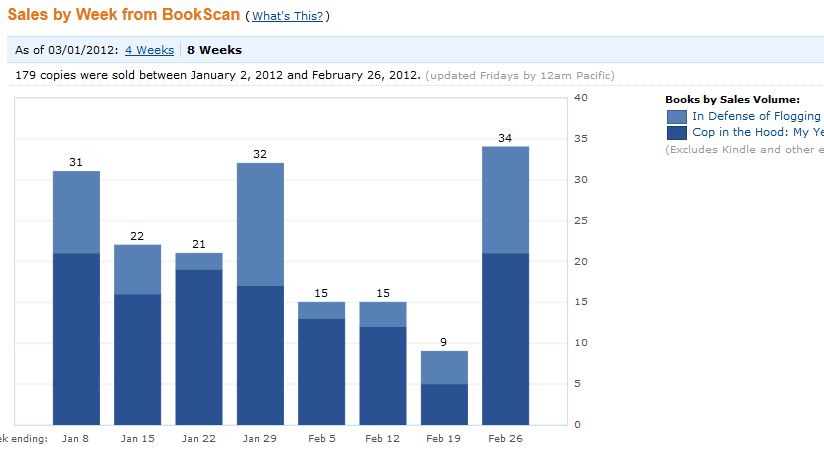
    You might wonder (I certainly do): Does being on national TV for half an hour and having your book plugged in front of hundreds of thousands of viewers actually help book sales?

    Not really. Now my sales did triple for that week. Yes they did… but we’re still only talking an additional 25 copies sold. Nationwide. For both my books.


    These are absolute numbers (and no, the scale isn’t “thousands”), and it probably represents about half the number of total sales.

    At this feverish pace Floggingwould sell about 500 copies a year. Keep it up and in about 22 years I’ll have earned back my decent ($22,000) advance and would start getting royalties. Bookmark 2034 for a big party.

    The good news is that Cop in the Hood is still selling pretty well, especially considering it’s been out for a few years. This is due to professors (very smart professors, I might add) assigning the book in their classes. (#3Cheers4Indoctrination)

    My meager advance ($3,150, if one subtracts the indexing fee) from the estimable Princeton University Press was paid off pretty quickly. So now I get about a buck for each copy sold. It comes out to about $1,000 a year. This money is my favorite kind: free money. But no, books do not let me quit my day job (luckily I like my day job) or live the high life (I can always buy a few six-packs of the High Life).

    Give or take (off the top of my head), I think I’ve earned about $15,000 from Cop in the Hood. Nice for an academic book. Not so nice if you consider it took, on and off, from start to finish, nine years to research and write. Of course during that time I did work as a cop, get a PhD, and then the nice job I have now. So I can’t complain. And as a professor, publishing serves purposes other than money, such as getting tenure, promotion, and respect in the field.

    What I would like to do is tip my cap to writers who actually manage, against all odds, to earn a learning. As full-time job, it’s tough, low-paid work without health insurance. (On the plus side, you can wear your bathrobe all day.)

    As to my day job, the taxpayers of New York State pay me (an eighth-year tenured professor) $74,133 a year. That will go up just a bit with my recent promotion to associate professor. I tell you this not to gloat (I’d have to make a lot more if I wanted to gloat) or to thank the taxpayers (though I do), but because I believe it’s good to be open about income. I’ve explained this rational before. Knowledge is power. And workers need more of both.

    Besides, if releasing your tax returns is good enough for Mitt, it’s good enough for me! If I can read my tax returns correctly (my wife does those, around here), we paid an income tax rate (federal, state, and local) of 20 percent (gross income) or 25 percent (taxable income).

    In 2010, Mitt Romney was unemployed, but he did manage to make my annual salary each and every 30 hours of the year. His tax rate was 14 percent. Now that’s the American way.

    I’d prefer him to pay more rather than me pay less.

  • The Choirboys

    This may not be news to anybody who was old enough to read in 1975, but Joseph Wambaugh writes a good police story. I just finished reading The Choirboys, 38 years after it was written. It’s about a bunch of police in Los Angeles: “They were just policemen. Rather ordinary young guys, I thought”

    It the book “true”? I don’t know. I imagine most of it is, at the very least, as they say, “Inspired by a true story.” As they also say: “You can’t make this sh*t up.” It’s also about a bygone era in policing, when cops drunk on duty, screwed any whore who came along, and earned their keep by staking out public bathrooms to bust “fags.” While the book is certainly dated, a lot of it still rings true. Some things never change.

    In the officers’ stories and camaraderie, there’s something very heartwarming about the fraternity: the sheer pointless of “torpedoing” another officer (the German officer, naturally), the bad sex jokes, the idiotic criminals. Somehow–despite the alcoholism, adultery, suicide, and generally self-destructive behavior–it kind of makes me miss the job.