Tag: books

  • A Dog That Barks

    A Dog That Barks

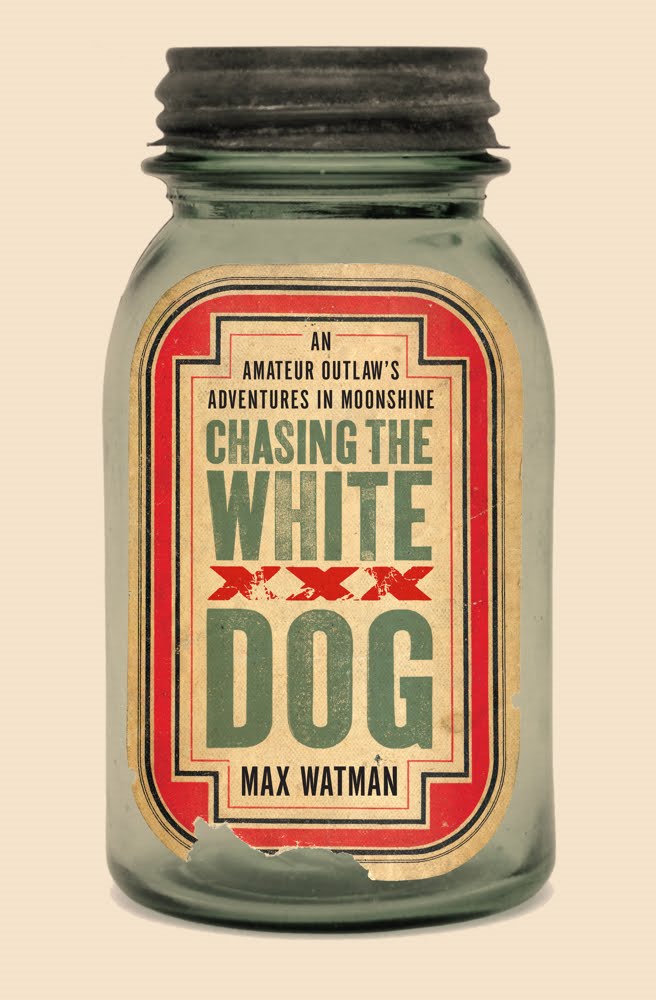
    White dog… that’s moonshine, hootch, likker. Who hasn’t dreamed of distilling up a little batch in their basement (What? Is it just me?). It’s also generally illegal. Max Watman, I nice guy I met once (what’s how I learned about his book) has written a gem, Chasing the White Dog: An Amateur Outlaw’s Adventures in Moonshine.I’m enjoying more than any other book I’ve read in a while. Well written, informative, and with a very lively and personal style. I’m about 55 pages from the end, but I wanted to post his guide to “How to Be a Criminal,” scattered throughout the book, based on people who failed (interestingly and tellingly, the fourth commandment of crack, never get high on your own supply, does not make the list):

    Item 1: Do not, while on probation or having recently come to the attention of the law, engage in large-scale felonies with strangers.

    Item 2: Surprisingly, drugs and crime don’t mix. Stoners will forget what they have to remember, crackheads are unreliable, meth heads are crazy. Even drunks–they’ll either get pulled over for driving drunk or they’ll get in a fight.

    Item 3: Do not write down the keys to the code. If you can’t count to ten, think of another code.

    Item 4: Read up on the law you are breaking.

    Item 5: It’s important to understand that criminal justice attends no only to the crime committed but to every ancillary activity involved in the perpetration, and especially perpetuation and concealment, of illegal activity, and that those acts, because they suggest intent, because they are part of a scheme, often carry heavier sentences than what we would normally think of as the illegal act. If you view it in a forgiving light, the law could be seen to forgive reckless impulse (“I was lonely and drink and I picked up this hooker”) and punish a pattern of concealment and manipulation (“I set up this bank account so that I could withdraw cash without my wife noticing and pay for hookers”).

    Item 6: Do not hire as underlings people whose next strike will be their third.

    Item 7: Buy equipment at tiny mom-and-op hardware stores with no computer systems and no video.

    You can buy the book here.

  • New Orleans Police after the flood

    Dan Baum wrote an excellent, award winning, best selling book about New Orleans, Nine Lives: Death and Life in New Orleans. He first spent time there as a reporter and writer for the New Yorkerin the days after Hurricane Katrina and the subsequent devastating flood.

    A few years ago I cold-called (or email) Dan after my wife realized that we were going to be in New Orleans with them and, more impressively, Dan and his wife just happen to be our doppelgangers. Dan and I shared a love for 1) writing books about ending the drug war, 2) food, 3) bicycles, and 4) literate women who edit extremely well. (Our mutual fondness for hats and hat stores is just, as they say down there, lagniappe.)

    Dan is no dummy (though I’d never say that to his face). At our very first dinner, while discussion corporal punished in schools, Dan coined the title for my upcoming book, In Defense of Flogging.

    Dan is also a very good writer. (He also loves guns and I look forward to his next book about America and guns.)

    In the days after we met, Dan and his wife were kind enough to waste some time with us, so we [queue montage music] biked around, got a food tour of the city, danced in a second line, ate too much, drank just right, and heard some great music.

    So naturally I’m very curious about Dan’s thoughts on the famously f*cked New Orleans Police Department. But honestly, except for the police officers in his book, I had no idea what we thought about any of the many issues plaguing the NOPD. The officer who left? The officers who staying? The behavior during the flood? I couldn’t get a straight answer! And it wasn’t for lack of trying.

    My queries were generally returned with what can only be described as minor apoplectic fits. There was this one: “didn’t I ask you not to get me started about the NOPD during katrina? didn’t I?” And then this one, “This is total, unreconstructed bullshit, and the kind of toxic rumor that made the disaster immeasurably worse when it was going on. Christ almighty.”

    But stubborn I am. So I sent him the latest on the police killing and cover-up of unarmed civilians on the Danziger bridge and politely wrote, “If you could be so kind to help me out, would you mind calmly and briefly (15 sentences or less) telling me your thoughts on police behavior during and after the flood, and the criminal proceedings that have followed.” Perhaps Dan is a sucker for uncharacteristic formality, but it worked. And that he did not stick to the length limit is but our gain.

    I decided early in my Katrina reporting to believe nothing I didn’t see with my own eyes. New Orleans, as I constantly told the New Yorker’s fact-checkers, is not a fact-rich environment, and the bullshit that flies around that city is beyond belief.

    What I saw of the police during the storm were heroic officers operating with no leadership or resources whatsoever. The cops I was with were protecting and serving under incredibly trying conditions, and doing so with professionalism and compassion. That they were cut adrift from any command or support was obvious; Eddie Compass (and Ray Nagin) were not only criminally incompetent, they made everything immeasurably worse by all their talk about babies being raped in the Superdome and roving bands of marauders.

    I also saw no violence or predation whatsoever. Everyplace I was, people were taking care of each other with unbelievable tenderness. Even the gold-toothed young men in the Convention Center were bringing water to the old folks, protecting a play area for the toddlers, and so on. I never once saw a black man with a gun who was not in uniform. My editor kept asking me about the violence — because he was listening to the reporters who were repeating the wild-ass assertions of the city’s so-called leadership — and I kept saying, “there is none.” I saw looting, but what I saw was people going into supermarkets and drug stores to take what they needed. Invariably, the liquor shelves were completely intact. The French Quarter is full of stores full of valuable art and antiques and no burglar cages over the windows. They were untouched. (Yes, smash-and-grab artists tend to go after electronics, but still, a lot of very valuable stuff was left unmolested.)

    I say all this because for the NOPD to say, “we had to do what we did because the city was in chaos” is patent bullshit and disgraces the majority of officers, who did their jobs without any support at all. There was no chaos. The structure of government disappeared, and the people behaved themselves admirably. The police abuses are prime examples of what Rebecca Solnit, in her excellent book, “A Paradise Built in Hell,” calls “elite panic.” Officials, cops especially, are terrified of mass chaos and therefore react to it whether it exists or not. On some level, it creeps them out that the people really don’t need them at all. Left alone, they behave just fine.

    We now are learning about some of the things bad cops did. And it’s certainly true that a small number of civilians did bad things during Katrina. But the vast majority, cop and civilian alike, behaved exactly as we would hope they would.

  • Tooting Other People’s Horns

    Two of the best police books out there are little read. Too little read.

    And top-quality and much more action packed than my book.

    I’ve written about both these books before, but it can’t hurt writing about them again.

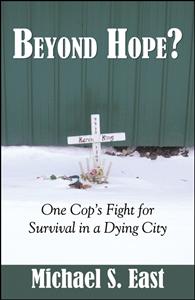
    Beyond Hope? by Michael East is about policing in Saginaw, Michigan. Unless you live in Saginaw, you probably won’t find it in book stores, but you can buy it here. Beyond Hope? is one of those few books written by an active police officer under his real name. But East doesn’t pull any punches.

    The other is another book about the Eastern District. But his experience was very different from mine. Badges, Bullets, & Bars by Danny Shanahan.

    They’re both great books. I haven’t met either of the authors. But both know more about policing than I do. And they write well. What more could you ask for?

  • Amazon Mysteries and How Much I Make From My Book (II)

    I like Amazon.com. I buy a lot of stuff from them. I don’t have a good local independent bookstore. Plus Amazon brings stuff right to my door. For free. But Amazon is a strange a mysterious place.

    Authors have no website to logon to and check out how many copies they’ve sold. So I got a good feeling I’m not the only author who checks out Amazon’s mysterious “sales rank” to see how things are going (right now I’m at #13,100 — down 2,000 since the first draft of this post). But Amazon doesn’t tell you how many copies you’ve sold, just how your book is selling in relation to every other book they sell. So ultimately it’s very frustrating because it doesn’t tell you anything concrete.

    For instance, my wife’s bookhad a serious jump in “sales rank” last week. And the book isn’t even out yet! Was this the start of good things to come? Well… maybe… until we found out my mom bought 15 copies though Amazon, thus single-handedly cornering the Forking Fantastic market.

    Here’s an author’s dirty secret: unless you write pulp fiction or the New Testament (or a great cookbook), your book won’t sell much. My book, considered a decent success, has sold about 6,500 copies through June. From that I’ve made (including my advance) about $13,000 since I signed a contract in 2005. I’m not complaining, but it’s not like I can quit my day job and live on $3,250 a year.

    [Just FYI, since I believe people should talk more about how much money they make, I make 10% from paperback sales. But that comes from the price the press sells the book wholesale, and not the price you buy book. So if you really want to help me, buy 1,000 copies straight from the publisher!]

    Cop in the Hood was selling for $12.20 on Amazon (what a bargain!!!). That was a nice low price. Then about one month ago Amazon stopped discounting my book and jacked the price up to $16.91, a full four cents off the cover price. So I asked my press to ask Amazon why and they basically said, “mind your own business.”

    I couldn’t help but think my book, as a required reading, probably sells more at the start of the school semester (always be suspicious of professors who assign their own book). So they jacked up the price.

    Well now that the semester is underway and students have mostly bought their books, Amazon has resumed their full discount.

    I guess that’s their business.

    At least by next semester there will be lots of used copies out their for students to buy.

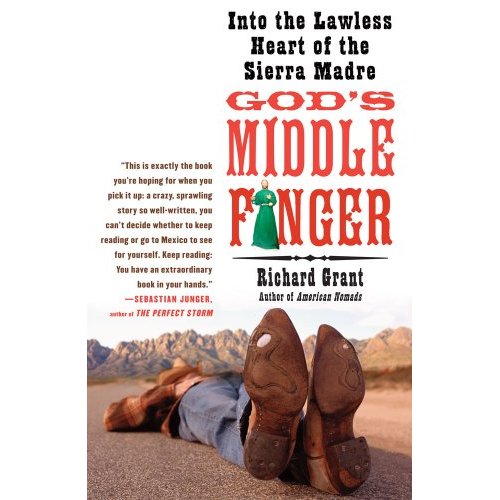
  • God’s Middle Finger

    God’s Middle Finger

    One of the nice thing about school being out and traveling a bit is it gives me more time to read books for fun. My favorite genre is probably the travelogue. Mark Twain, P.J. O’Rourke, Paul Theroux? I love them all. And I’ll even define travelogue broadly to include historical fiction, like my favorite books by Louis de Bernières. Even New Jack by Ted Conover is a travelogue of sorts, since it took me to Sing Sing, a place I’ve never been. Hmmm, I guess by this logic Cop in the Hoodcould be called a travelogue. But I don’t think it is. But I do like my book.

    In the past month, along David Sedaris’s When You Are Engulfed In Flames, I’ve been able to read Gerald Brennan’s South From Granada, which is a very good anthropological-like account of 1920s life in a Spanish village. But perhaps you might only care about life in Yegan if you happen to be hiking through the Spanish Alpujarras.

    Chris Stewart writes about the same region in present times in a much more light-hearted and readable way. I read the third of his trilogy, The Almond Blossom Appreciation Society. Good stuff. And I’ve told myself, somewhat unconvincingly, that I’ll buy and read the first two.

    In a different genre, I was not Swayed by Sway. It does not succeed at being the Malcolm Gladwell book it wants to be. Some of Swaywas interesting, but I don’t need a rehash of one dumb psych experiment after another to tell me that economic rational-choice theory doesn’t have all life’s answers. I wanted more discussion and relevance to the real-world.

    So maybe I should stick with travelogues. For some reason I think the British are the best at this genre. Maybe it’s the old colonialist in them. Maybe they’re don’t mind being culturally chauvinistic. They’re certainly less concerned with style killing political correctness. Perhaps these attitudes are no way to rule an empire, but it makes for good reading.

    Most travelogues either start happy and end happy (“what a wonderful trip with great people and food!”), start unhappy and end unhappy (“oh, my woeful journey into the heart of darkness… and I would kill for a good cup of tea!”), or start unhappy and end happy (“I just couldn’t be happy until I learned to let go of my neurotic hang-ups and be at one with these wonderful if somewhat simple people!”).

    It’s the rare travelogue that starts happy and ends unhappy. And this brings me to the best book I’ve read since Maximum City: Richard Grant’s God’s Middle Finger: Into the Lawless Heart of the Sierra Madre.


    Talk about unhappy! This book ends–and I don’t think I’m spoiling anything because the book starts with a sort of flash forward so you know where it’s going, but skip the next paragraph if you don’t want to read the last line in the book:

    I never wanted to set foot in the Sierra Madre again. The mean drunken hillbillies who lived up there could all feud themselves into extinction and burn in hell. I was out of courage, out of patience, out of compassion. They were sons of their whoring mothers, who had been fornicating with dogs.

    The first line of the book is, “So this is what it feels like to be hunted.” Why does this man, Richard Grant, travel into the lawless, wild, and narco-controlled Mexican Sierra Madre mountains? Well, for some of the same reasons that many sociologists enjoy research and some of the reasons I enjoyed policing:

    We drank four or five gourds each and got nicely buzzed there on the rim of Sinforosa Canyon and it occurred to me that this was more or less the moment I had been looking for when I set out on this journey. Here I was in the heart of the Sierra Madre, about as far from consumer capitalism and the comfortably familiar as I could get, drinking tesguinowith a wizened old Tarahumara and feeling that edgy, excited pleasure in being alive that follows a bad scare. It was an uncomfortable realization. To put it another way, here I was getting my kicks and curing my ennui in a place full of poverty and suffering, environmental and cultural destruction, widows and orphans from a slow-motion massacre. I tried to persuade myself that I was going to write something that would make a difference and help these people, but my capacity for self-delusion refused to stretch in that direction.

    God’s Middle Fingerneeds no rationalization to read, but I could justify my time reading because I wanted to learn about drug production in Mexico. It’s not a pretty picture. And it closely resembles the destructive prohibition-caused drug culture I saw as a cop in Baltimore’s Eastern District.

    Why did drug cultivation increase the murder rate? “Because drugs give people money to buy gun, alcohol, and cocaine,” said Isidro.

    He didn’t think that statement required any elaboration but I asked him to elaborate anyway. “People get more aggressive and paranoid. They kill more easily and then the dead man’s family has to avenge the killings.

    I was reading a fascinating book with a similar thesis. Its title translates asThe Sierra Tarahumara, A Wounded Land, The Culture of Violence in the Drug-Producing Zones. Its author, a professor in Jaurez called Carlos Mario Alvarado Licon, based his ideas on prison interviews conducted with convicted murderers from the Sierra. He found that they were nearly all model prisoners, with no prior criminal record, and no remorse or regret for what they had done. … They told of their crimes “serenely” and were convinced they had done the right thing.

    In the Sierra homicide is no dishonor. Killing is a part of life, a circumstantial action, generally vengeance for another killing. However, on occasion it is a symbol of pride, when vengeance was done and the law taken into one’s own hands…. Homicide is a form of maintaining the social order where the official authority is absent, unjust or corrupt, and particularly where it fails to punish aggression or offense to the family.


    When Isidro’s father was killed, his mother implored him to take vengeance. “It was very hard, but I decided not to because if I avenged my father, I would end up losing my brothers and maybe my uncles. It wouldn’t bring back my father and would bring more sorrow into my family. My mother didn’t understand. She never really forgave me.”

    Don’t go thinking that drug decriminalization in Mexico for personal possession is going solve this. The problem isn’t possession. It’s wholesale prohibition of drug production, distribution, and sales.
  • The state of sociology

    I’m sure that just like me, you all are browsing the latest issue of Sociological Forum, the quarterly publication of the Eastern Sociological Society.

    Hmmm, here’s an article called “Anomie Among European Adolescents: Conceptual and Empirical Clarification of a Multilevel Sociological Concept.” The “results lend strong support to the theoretical construct of anomie as exteriority and constraint.”

    O-kay… I’ll think I’ll skip that one. Actually, I usually skip most of the articles in sociology journals. So does the rest of the world.

    But in this issues there’s a series of short pieces relating to Sudhir Venkatesh’s Gang Leader For a Day, probably the best selling sociology book in decades. But Venkatesh has gotten some flack from the Ivory Tower because the book exposes weaknesses in ethnographic methodology and is, well, a memoir.

    I’ve mentioned Venkatesh a fair amount about on this blog because our research and writing has a fair amount in common (not in sales, alas). I think we need more intellectuals like Venkatesh.

    The point of writing is to be read (though Venkatesh points out that 90% of those interviewing him about his book haven’t read his book). The point of sociology is to understand (and hopefully improve) the world around us. Venkatesh succeeds because he is interesting, insightful, and writes in a language we can all understand. There’s no crime in that.

    In the Gang Leaderexchange in Sociological Forum, one author asks, “What does America want of sociology?” Venkatesh answers quite frankly: “I don’t think America cares about sociology. And, unless we change our conventions, our writing, and our relationship to the public, I’m not sure they should.”

    I wonder what the fancy sociological term is for, “Oh, snap!”

  • Police Corruption

    Police Corruption

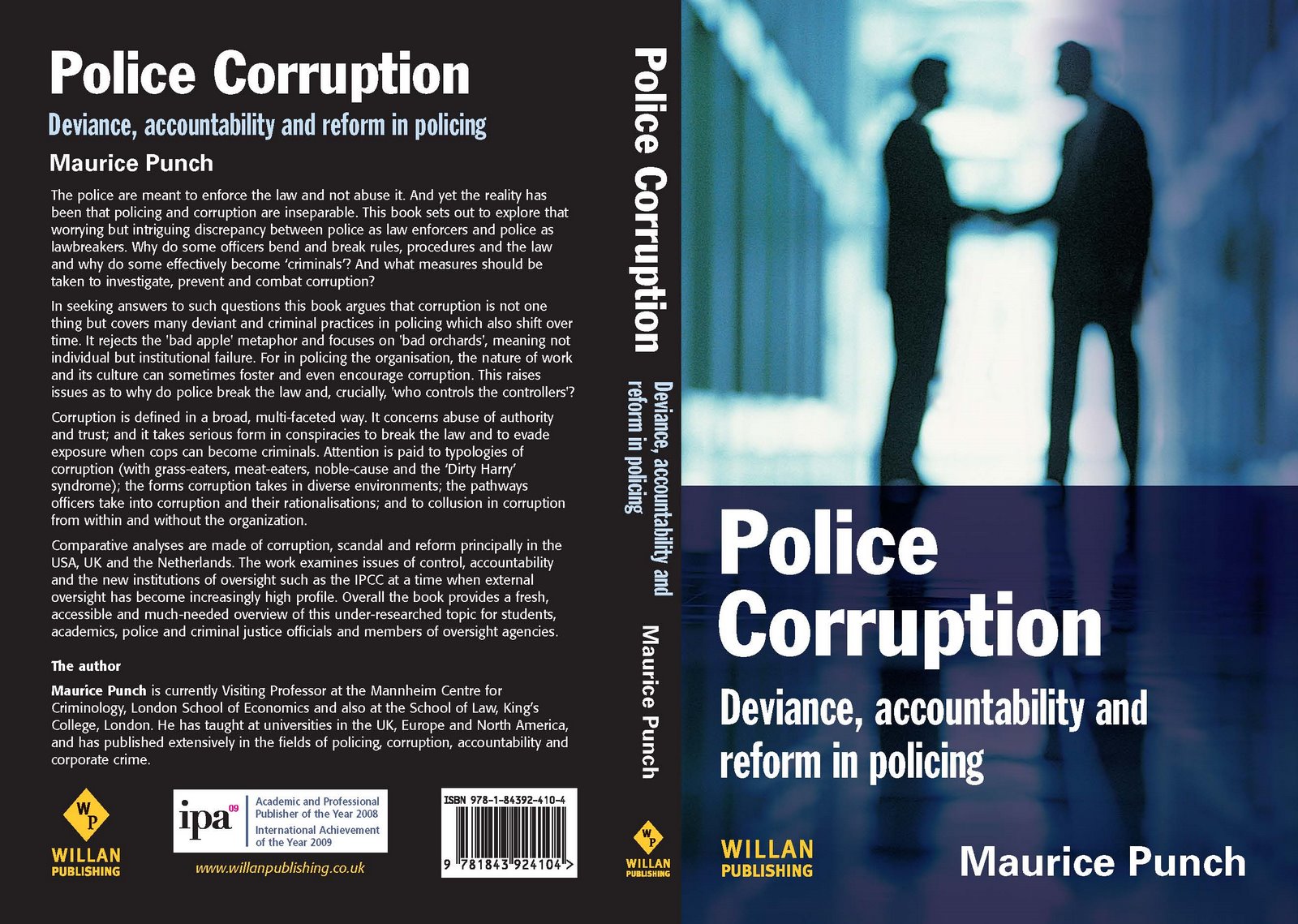
    Maurice Punch has written another excellent book on policing: Police Corruption: deviance, accountability and reform in policing.

    More than anybody else, Maurice Punch inspired my policing career (well, maybe Punch and John Van Maanen share top prize). Punch’s wonderful and classic study of the Amsterdam Police, Policing the Inner City inspired me into the whole police business, especially my research in Amsterdam.
    Not only can Punch write, but we was always very helpful to me and willing to meet with me whenever I was in Amsterdam. Our semi-annual meetings were always the highlight of my trip to Amsterdam (and Amsterdam has some pretty tough competition when it comes to highlights). And Punch was helpful to me when I was just a young egg-head whipper-snapper with no research or writing or real work to my name. Without a doubt, were it not for Maurice Punch, I would not be where I am today as a professor, former police officer, or published author.

    Now if all this sounds like shameless promotion for a friend… well it is. But I’d also be promoting this book even I didn’t know Maurice. It’s an excellent book and really does delve, smartly and with respect, into the complicated world of police corruption.

    Punch’s short Zero-Tolerance Policing is also a gem that highlights the impact and transition of broken-windows policing in the U.S. to zero-tolerance policing in the U.K. and the Netherlands.

    Come to think of it, I think I still owe Maurice a review of Zero Tolerance Policing. Luckily for me, not only is Punch very smart and a good writer… he’s very forgiving.

  • Court Dress Code

    My friend used to joke that the local criminals would come to court “dressed in their best sweat pants.”

    I was reading a David Sedaris book, When You Are Engulfed in Flames, on my flight back from Chicago and came across this passage:

    There were plenty of things that should have concerned me–the blood-spatter evidence, the trajectory of the bullets–but all I could concentrate on was the defendant’s mother, who’d come to court wearing cutoff jeans and aGhostbustersT-shirt. It couldn’t have been easy for her, but still you had to wonder: whatwouldshe consider a dress-up occasion?

  • Beyond Hope?

    Beyond Hope?

    The glorious genre of Cop Lit has many notable contributors. The writing ranges from the driest academic tome to the cheesiest pulp fiction. There a pretty extensive list of police books at police-writers.com. A lot of them are crap. But many are good.

    Two of the best older police books are Jonathan Rubinstein’s City Police and Joe Poss and Joe Poss and Henry Schlesinger’s Brooklyn Bounce. The former was an academic who went native (nobody knows whatever happened to Rubinstein–rumor was he retired and ran a liquor store in Philadelphia). Poss and Schlesinger are doing just fine, living in NYC.

    Bad Cop and Badges, Bullets & Bars are two more good police books.

    (And of course there’s my book, soon to come out in paperback with a brand new chapter.)

    Now add veteran police officer Michael East’s Beyond Hope? to the list. It’s good. Very good.

    The best police books, whether academic or pop, have a few things in common: a confidence in the writing, a good voice, an awareness of one’s surroundings, humility in knowing one’s limitations, the ability to link the personal observation to greater truths, courage to face uncomfortable truths, and the ability to tell a good yarn. In other words, a good police book needs many of the same qualities of a good police officer. But most cops don’t write good books.

    Michael East has written a good book. Beyond Hope? is his story policing Saginaw, Michigan. I’ve never been to Saginaw, but it sounds grim. Kind of like a smaller, poorer, f**ked-up Baltimore.

    Beyond Hope? is finally for sale. I was able to read an advanced copy so that’s how I know it’s good. Buy it today! If you like cop stories (and if you’re reading this you do) or have a thing for cities in decline, this is a book for you.

  • Maximum Enjoyment

    Maximum Enjoyment

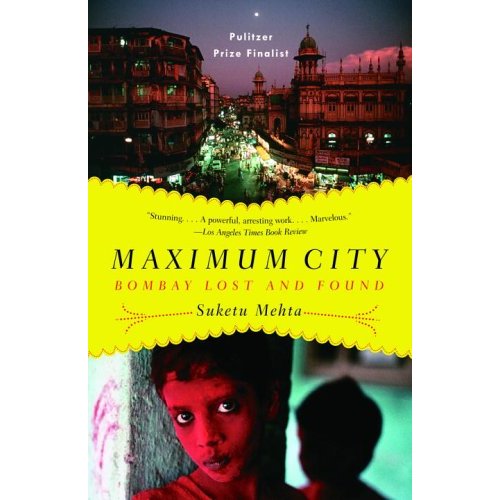
    I just finished reading Maximum City by Suketu Mehta. Best book I’ve read in a while. Non-fiction book about the city of Bombay. Great arm-chair traveling. But some good deep insight, too (and a fair amount about the Mumbai police, too).

    I loved it.