Tag: broken windows

  • NYPD: “Broken Windows Is Not Broken”

    NYPD: “Broken Windows Is Not Broken”

    The NYPD released its response to the “quality-of-life policing is bad” report issued by the NYC Dept of Investigation. Guess what? Quality-of-life policing is good! (The original report, the one this responds to, is titled, and I’m not joking: “The New York City Department Of Investigation’s Office Of The Inspector General For The New York City Police Department Releases A Report And Analyses On The NYPD’s Quality-Of-Life Enforcement.”)

    Here’s what I wrote about the DOI’s report. I was bit gentle. Well Bratton and his people sure as hell are not. From Azi Paybarah in Politico describes it like this:

    Bratton, who is scheduled to step down Sept. 15, said the June 22 report from the Department of Investigation’s Inspector General for the NYPD is of “no value at all” and that the office does not have experts on staff capable of analyzing NYPD work.

    The report has an “incomplete understanding of how quality-of-life policing works and mischaracterizes Broken Windows as zero-tolerance, which it is not, and never has been,” Bratton said during an hour-long press conference at police headquarters. “Police go where people call. The vast majority of quality-of-life calls come from some of the poorer neighborhoods in our city.”

    Bratton also cast doubt on the ability of the OIG-NYPD to analyze police work.

    “I’m not sure of the quality of the researchers at the OIG,” he said. “I think we made it quite clear that if you want to delve into these types of areas, you’re going to need experts, not amateurs. Otherwise, you’re going to get the rebuttal that you’re seeing here this morning where we have a lot of experts within the NYPD [and] access to experts who are objective reviewers of the issue [that] the IG just, apparently, does not have, based on the poor quality of this report.

    Here’s the first footnote from the NYPD’s report, which actually is a very good point:

    The OIG report contains numerous modifiers and disclaimers that seem to contradict its own conclusions in many places. On the one hand, it strives to support the conclusion that there is no positive correlation between what it defines as quality-of-life enforcement and decreasing felony crime, but, on the other hand, it acknowledges that this conclusion cannot be reasonably drawn. It is as if the report’s authors wish to insulate themselves from possible criticisms by preemptively mentioning these criticisms in their report without allowing any of the criticisms to alter their conclusions. Taken together the disclaiming statements in the report form a virtual rebuttal to the report itself.

    See, the report said it wasn’t a critque of Broken Windows, but we all knew it was. And that is exactly how the media summerizedthe report.

    The NYPD response is a thorough report. I’ll highlight parts that illustrate Broken Windows. (I’m assuming you’re not going to read the whole report).

    From page 10:

    The Broken Windows Theory does not assert that 20 more misdemeanor arrests, for instance, will result in one or two fewer felony crimes. Rather, the concept holds that a general atmosphere of order and a general sense of police presence resulting from the enforcement of lesser crimes, will reduce the opportunity for more serious crime with generally positive results.

    Page 11:

    Misdemeanor arrests and summonses should not be used as simple surrogates for quality-of-life policing which has many other dimensions. Police officers can effectively respond to reports or concerns regarding quality-of-life conditions without arrests or summonses simply by dispersing groups, warning people to cease disorderly activity, establishing standards of behavior, and assisting with social service interventions.

    Page 12:

    Enforcing quality-of-life standards, without actually using misdemeanor arrests and summonses, still relies on the ability to invoke these sanctions. Telling people to move along when they know an officer can arrest or summons them is far more effective than it would be if they believe the officer cannot. Police officers require the fundamental authority to manage street situations and the option to move swiftly to criminal sanctions when necessary.

    Page 15:

    There actually is a strong statistical link between minor and felony criminals. The populations that commit both types of crime overlap to a significant degree. About half of all misdemeanor arrestees in New York City in recent years have had prior felony arrests, and nearly three quarters of felony arrestees have had prior misdemeanor arrests. [Ed note: This is surprisingly low. I would have guessed something closer to 90 percent.]

    Page 16:

    From the Broken Windows perspective, street management is a critical element in controlling street violence. It is an observable phenomenon that drunken, carousing groups may become involved in violence as an evening wears on. Summary enforcement, or police intervention prior to the violence, is one way of controlling it.

    Page 18:

    Quality-of-life enforcement should not be confused with reasonable-suspicion stops. Reasonable-suspicion stops are based on a significantly lower standard of reasonable suspicion, whereas misdemeanor arrests and summons issuance each require probable cause, the same standard required for felony arrests. The NYPD uses quality-of-life policing as a way of countering more serious crimes, but it does not make misdemeanor arrests and issue summonses without meeting the probable cause standard.

    Page 19:

    The OIG report largely ignores calls for service as a reason why quality-of-life enforcement may be pursued more intensively in one precinct than in another. As the NYPD has shown in its own report on quality-of-life policing “Broken Windows and Quality-of-Life Policing in New York City,” racial disparities in enforcement of minor laws in New York City can be largely explained by calls for service that have pulled officers to particular locations and particular offenders.

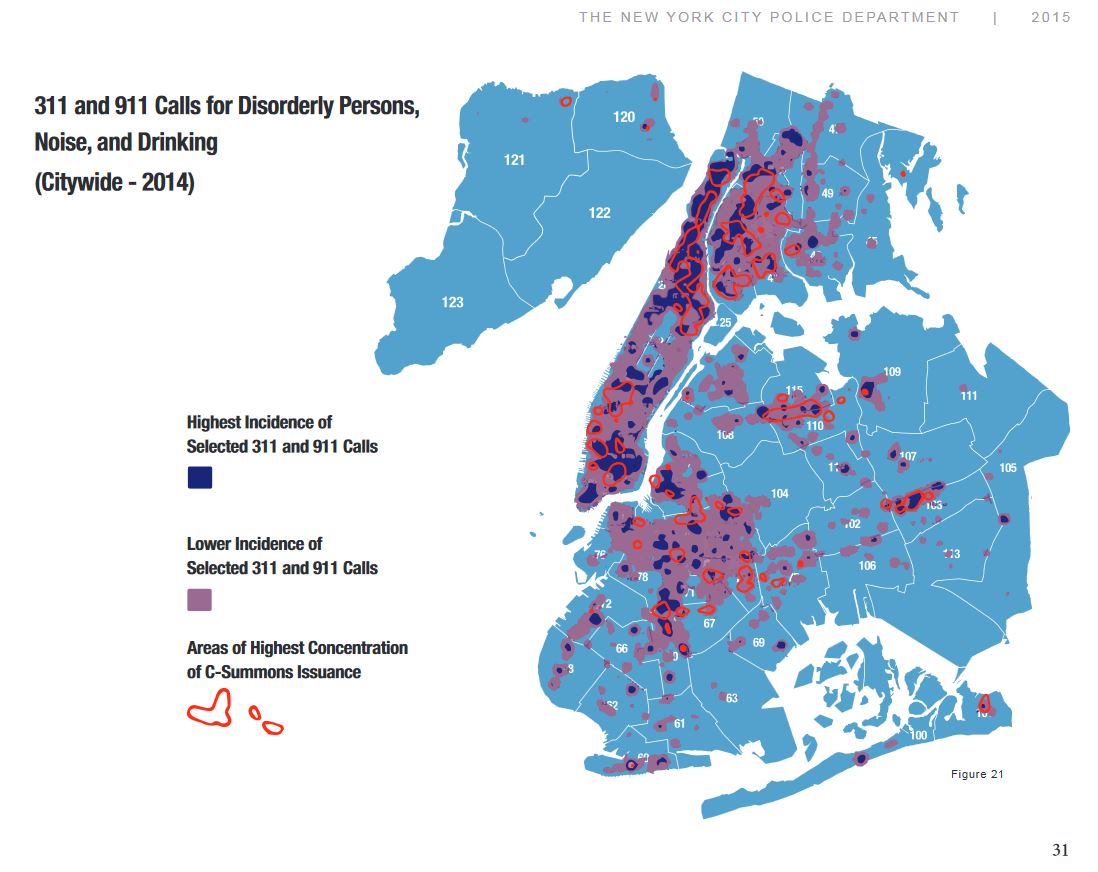
    It’s worth pausing here. This is important. Quality-of-life enforcement — which does affect minorities disproportionately — is in response to minority citizens’ calls for service. Here’s a page from that linked-to report.

    Quality of life enforcement happens because residents want it to happen. And residents in black and hispanic neighborhoods call police for quality-of-life issues most of all.

    In the name of racially non-disproportionate policing, should police ignore these calls for service? Not according to the poll data of New York blacks and hispanics (page 21). Similarly there’s a 2015 Gallup poll that showed 38 percent of blacks (nationwide, compared to just 18 percent of whites) want more police presence; just 10 percent of blacks want less police presence. Blacks want more policing more than whites want more policing. You wouldn’t sense that from the current cops-are-the-problem. Now of course more policing and better policing are not mutually exclusive, but it comes down to this: you can’t have community policing if you ignore the quality-of-life issues the community cares about.

  • The DOJ’s War on Broken Windows?

    Update: The links have changed (oops!) since these were first published. Here are links to all my August 2016 posts on the DOJ report on the BPD.
    1 https://copinthehood.com/initial-thoughts-on-doj-report-on-2/
    2 https://copinthehood.com/the-doj-is-wrong-1-2/
    3 https://copinthehood.com/the-dojs-war-on-broken-window-2/
    4 https://copinthehood.com/cant-you-take-joke-2/
    5 https://copinthehood.com/the-doj-is-wrong-2-n-word-2/
    6 https://copinthehood.com/the-doj-is-wrong-3-that-damn-kid-on-2/
    7 https://copinthehood.com/the-doj-is-wrong-4-on-diggs-dig-2/
    8 https://copinthehood.com/the-doj-is-right-1-2/
    9 https://copinthehood.com/the-doj-is-right-2-actual-department-is-2/
    10 https://copinthehood.com/the-doj-is-right-3-actual-department-is-2/
    11 https://copinthehood.com/the-doj-is-right-4-actual-department-is-2/

    This flew in over the transom:

    As someone who also works in a department with a consent decree in place, I found the DoJ’s report on Baltimore very interesting.

    It seems like a lot of what the DoJ objects to is not actually a constitutional violation, but rather a public policy decision to have “zero tolerance” policing. The words “zero tolerance” are used a lot (phrase used 32 times). There is much written about loitering (word comes up 35 times) stops and arrests.

    My jurisdiction has no loitering law, and no major problem with open air drug dealing in residential areas. Trespassing arrests are a rarity, to the point that citizens and business owners have become very angry with our lack of action at times. Technically, if someone (myself or a property owner or a posted notice) says that trespassing is prohibited, and someone trespasses after receiving verbal notice, they can be stopped and arrested. A property owner says “I told that guy to leave and he didn’t” – boom, we have PC. In practice, we almost never do this, because our supervisors and prosecutors don’t want us to and because we all know the DoJ is watching and dislikes this kind of police work.

    The DoJ’s objections to enforcement of these laws is written in such a way that the strict enforcement of these laws is then juxtaposed with extreme examples where officers probably violated Terry. In any significantly large department, if you look long enough, you will find Terry violations, including some pretty stupid ones. And there are some damn stupid ones in this report. But it’s not clear to me that loitering and trespassing arrests as a crime prevention strategy are inherently unconstitutional. Trespassing and loitering laws can be strictly enforced in a legal way, if you have supervisors and training that adequately address what is needed to establish probable cause and reasonable suspicion (which BPD may indeed lack).

    But it does seem to me that what the DoJ actually objects to is the policing strategy of low level pedestrian stops and enforcement. The DoJ’s message here is pretty clear: broken-windows policing is over, and if you do it, we will come at you for every Terry violation and make it out to be a pattern and practice brought about by a public policy decision to emphasize low level enforcement. “Broken Windows” policing might be a good or bad public policy, but it seems like an innovation for the DoJ to now claim it is inherently unconstitutional.

  • “The people ride in a hole in the ground”: Subway Broken Windows

    One point of Broken Windows policing is that it requires police discretion and intelligence. Yes, rules are important so police act without the bounds of the law, but just because something is against the rules doesn’t mean it’s a Broken Window worthy of police attention.

    Similarly, just because something is a Broken Window wouldn’t necessary mean it’s against the law. (Though I can’t think of a single example… Actually maybe topless women in Times Square? Not that I personally mind or think breasts are a Broken Window, but apparently others do).

    When Bill Bratton was on the cover of Time Magazine in 1996 (for which he was later fired), he was called, correctly, “A leading advocate of community policing.” When dealing with quality-of-life issues as a police officer, it’s not just about blind rule enforcement. It’s about selective rule enforcement based order maintenance and public fear. The law focuses only on the criminal individual. Broken Windows policing gives consideration to the reasonable community standards.

    Thankfully (over significant objections from the ACLU and others who wanted to let the live and beg in the subway system), the courts ruled in 1990that begging on the subways is not constitutionally protected free. (Nor should it be, damnit, because it’s a closed and confined space, and people have a right to be left alone, especially when they can’t get away.) In 1997 the court upheld a ban on the unauthorized sale of goods, even political materials.

    Yesterday on the subway, in very short order, I saw three illustrative examples. In ascending order of disorder:

    1) Is this guy a Broken Window?

    Not in my mind. I have a soft spot for Mexican singers on the train. I really do.

    I’m a strong believer that people riding the train have a right to be left alone. The subway is for commuting. It is not a free and open public space. And though this guy was violating the rules, I don’t think he’s a Broken Window. Reasonable people can differ. But as a cop, I’m using my discretion and not citing him.

    But it is illegalto play any instrument or “sound production device” on the subway. [I can’t believe phonographs are expressly prohibited! (Or that I once violated the phonograph rule….]

    [Here’s the unedited two-minute version. He gets added props for playing the whole song rather than hustling through a verse to move to a new car every stop. And another nice thing about musicians like this is they keep away the straight-up obnoxious beggars. I’ve never seen them on the same train. Bad for business. Who would give something to Joe-Junkie demanding our attention when this guy is singing, telling us not to cry?]

    2) Are these musicians on the platform a Broken Window?

    At first I was thinking that was an officially issued (and auditioned for) spot for subway musicians. Yes, if it’s MTA approved(and quality controlled) it’s legit. But it’s not:

    Notwithstanding any other provision of this section, the use on subway platforms of amplification devices of any kind, electronic or otherwise, is prohibited.

    That makes sense. A good rule of thumb is that it’s OK if you can walk away from it. It’s not that they’re bad musicians, but what if I don’t want to hear them? Broken Window? Probably not. But I could go either way.

    3) What about these guys?

    The “showtime” style dancers bother me and a lot of people. Not that these two seem like bad kids (unlike other whom I have seen start fights for people unwilling to move). I call Broken Window. But why? What’s the difference? It’s not just that they’re young and more “urban” (I love using that code word in a completely urban environment). But as a police officer (and believer in Broken Windows) you have to articulate the differences. For starters:

    A) Amplified sound.

    B) Dancers move. Musicians don’t.

    C) There are two people rather than one. These two were not particularly threatening, there is something potentially dangerous about swinging around in small confined spaces. The law generally only recognizes individual action, but the public and police are and should be sensitive to group behavior.

    D) I don’t want anybody’s ass in my face.

    E) I have to pay attention else so I don’t receive an errant (or intentional) kick.

    F) This is known and generally(not universally) disliked behavior in New York City.

    Maybe there are a few others you can come up with.

    And as a practical matter I’d be willing to give up Mexican singers to get rid of showtime dancers. And the city has tried some creative non-puntative methods. But part of the point of Broken Windows is you do selectively enforce rules based on non-discriminatory community standards. But you have to be able to articulate differences between acceptable and unacceptable behavior.

    And keep in mind all three of those examples were from just one subway ride yesterday.

    4) And then there’s this guy. This tweet and this videois actually what started this whole post. This is a Broken Window that needs immediate action.

    This doesn’t happen often in New York, but it does happen.

    [This guy is clearly having some mental episode. And I suspect drugs are involved — both drugs he shouldn’t be taking but is along with drugs he should be taking but isn’t. He needs help. But along with his long-term needs, there is the short-term matter of everybody else on that subway. People should not be expected to tolerate this behavior as just a normal part of a commute in which you ride in a hole in the ground. And the passivity you see is less acceptance than self-preservation.]

    Yes, of course it would be great if there were a mental health crisis team at the ready. But in the short term, if there were a cop on this train, he or she better not walk away saying, “Broken Windows is racist and quality-of-life enforcement is not my business.”

    That said, I actually had a tough time figuring out what crime this guy was actually committing. There’s no begging or “sound production device.” But that is why you need police discretion and a catch-all like disorderly conduct: “in any manner which may cause or tend to cause annoyance, alarm or inconvenience to a reasonable person or create a breach of the peace.”

    This man needs to be taken off the train at the next stop and committed, hopefully through deescalation and voluntary compliance, but by force if necessary. (And no, I’m not willing to stop the whole transit system to wait for a response team. Tens of thousands of commuters have rights, too.) But I could imagine people criticizing a cop for having to use force on this poor unarmed man…. But if you’re the cop? What do you do. It’s not so easy.

  • Attacking Broken Windows Again

    There’s a report out by the newfangled NYC Department of Investigation Office of the Inspector General for the NYPD (you know, OIG-NYPD, for short): “An Analysis of Quality of Life Summonses, Quality of Life Misdemeanor Arrests, and Felony Crime in New York City, 2010-2015.”

    The report is surprisingly good, in terms of data analysis and presentation. (I love, for instance, how somebody cared and took the time to explain how the data in the charts should be read.) Though it seems strangely political that one of the first things the office does is produce a report to be spun as “Broken Windows Doesn’t Work” (Despite evidenceto the contrary). From the OIG report:

    Issuing summonses and making misdemeanor arrests are not cost free. The cost is paid in police time, in an increase in the number of people brought into the criminal justice system and, at times, in a fraying of the relationship between the police and the communities they serve.

    The report limits itself (sort of) to:

    what, if any, data-driven evidence links quality-of-life enforcement–defined narrowly for purposes of this Report as quality-of-life criminal summonses and quality-of-life misdemeanor arrests–to a reduction in felony crimes.

    From 2010 to 2015, it doesn’t find any. Both misdemeanor enforcement and crime went down. Ergo, Broken Windows must be broken.

    But no Broken Windows advocate thinks there’s a one-to-one correlation between misdemeanor summonses and lower crime! Both can go up. Or (in the ideal Broken Windows world) both can go down.

    In the six years before 2010 (the starting year for the report) misdemeanor arrest in NYC went up substantially (190,346 to 245,400) and murders went down (570 to 471). Of course when arrests are up and crime is down, the anti-Broken Windows klatch says correlation doesn’t mean causation (even though sometimes it actually does). But of course when the data works for them, correlation “proves” Broken Windows doesn’t work.

    But perhaps, to give police a bit too much benefit of the doubt, the NYPD simply reassessed what needed to be done. Some would call this problem-solving policing. And the NYPD actually has a pretty good track record of this over the past 25 years. Tactics change. Times change. Reassessment is a key to problem solving. As old problems go away and new problem appear, police don’t need to keep making the same quality-of-life arrests.

    But I mentioned “too much benefit of the doubt” because police were and are wedded to the idea that all arrests are good, and more arrests are better. This is wrong. And the recent reduction in small-scale enforcement happened not because police under Bloomberg and Kelly wanted to reassess their strategies but because the department was dragged kicking-and-screaming by lawsuits into the political reality of a lower-crime New York City.

    This OIG report does a great job in linking police enforcement to violent crime.

    Higher quality-of-life enforcement rates in precincts with higher proportions of residents who are Hispanic or living in [public housing] may be related to violent crime rates in those precincts. (p. 44)

    You think? We need minor arrests and citations, especially when they’re given to major criminals.

    What’s interesting is that when one takes violent crime into account:

    White residents receive higher[!] rates of quality-of-life enforcement, and precincts with higher proportions of residents who are black or males aged 15-20 receive lower[!] rates of quality-of-life enforcement than would be anticipated given these precincts’ violent crime rates.

    Whoa.

    This goes against type. It could mean (à la Ghettoside), that given the crime rate, communities with high-crime are actually under-policed. Or it could mean there is no connection at all between violence and police enforcement, and police just happen to be harassing blacks in high-crime areas. (And these position are not necessarily mutually exclusive.)

    Anyway, I applaud the report for at least considering violent crime as a relevant factor. Because it is. Such politically-incorrect honesty is shockingly rare. But more importantly — though I think there is a link between good Broken Windows policing and a reduction in serious crime — quality-of-life issues deserve police attention for their own sake. Even if the Broken Windows theory (unattended disorder leads to more disorders and serious crime) can’t be proved, we still need Broken Windows policing because order maintenance and quality-of-life issues matter for their own sake.

    The major problem with this report is that it doesn’t take 911 and 311 calls for service into account. This is a serious omission. Police get called to deal with “minor” issue because neighbors don’t think they’re so minor. Police have little control over whom they interact with. As Bratton put it in 2014:

    “The idea that we can engage in policing that’s racially proportionate is absurd,” he told reporters after a panel discussion in Manhattan about Broken Windows.

    Quality-of-life enforcement, he said, is driven primarily by complaints made to the city’s 311 hotline, meaning police action is in response to citizen complaints.

    “We go where the calls come from, we go where the help is needed, we go where the victims are, and that’s the reality,” Bratton said. “If those numbers are racially disparate, or disproportionate, well, that’s the reality.”

    Assuming calls for service are concentrated in high-crime minority areas (because they are), what are police supposed to do? Wait for some white people to walk by engaging the public?

    The other half of the story, the bad half, is that quality-of-life crackdowns come from nervous and insecure precinct commanders. Very few people call 911 to ask cops to stop and arrest people for nickel-bags of weed. But it happened 83,000 times in 2010. That’s non-intelligence-driven policing. Too often commanders face Compstat pressure and need to “do something” to keep the brass off their back. Quality-of-life policing can and must be part of real policing, and not just a way to generate numbers or revenue.

    The 71 in Crown Heights, for instance, went crazy giving tickets to bicyclists. People were not complaining about bikes without bells. But a commander wanted “numbers,” and “numbers” he got. This wasn’t real policing, much less quality-of-life enforcement or Broken Windows policing. But the data in the report can’t distinguish between good misdemeanor enforcement (Broken Windows) and bullshit misdemeanor enforcement (Zero Tolerance).

    Or take this example I wrote about in 2009:

    Police know the difference between “good” and “bullshit” stats. One ranking NYPD officer told me he neither asks for nor approves of bullshit citations from those under him. He gave an example of a public park closed at night: “If the park were used by people to party—smoking and drinking–we would encourage citations. But if people were just using the park as a shortcut coming home from work, I wouldn’t want officers citing those people. That’s an excellent use of discretion.” He’s right, and an officer under him acknowledged his superior’s ideals. But he added, “I’d love it if I always had enough good C’s [criminal citations], but I need numbers. And if I don’t have enough stats and CompStat is coming up, I don’t care if they’re bullshit. I’ll take whatever the f*ck I can get!” In a world where “better stats” and “more stats” are synonymous, the tail has long since started to wag the dog.

    Broken Windows is not Zero-Tolerance enforcement. Key to Broken Windows is proactive order-maintenance policing that targets quality-of-life issues and public fear. Neighborhoods with more violence fear should be targeted more heavily for selective misdemeanor enforcement.

    With less policing, crime and violence rise. (The former especially in neighborhoods with more criminals and the latter especially in neighborhoods with public drug dealing.) Shamefully, many in the police-are-the-problem camp refuse to accept any cause and effect between less policing and more crime, particularly in cities such as Baltimore and Chicago beset with passionate but unfocused calls for “police reform.”

    Hopefully we’ll see police as part of the solution and demand proactive, smart, quality-of-life policing responding to citizens’ fear in high-crime areas. But then police will focus disproportionately on blacks and hispanics in high-crime neighborhoods.

    Or we can continue down the wrong roadand see police as part of the problem. As murders increase nationally, we shouldn’t be debating the crime rise and quibbling semantics over the “Ferguson Effect” and “Broken Windows.”

    If we restrict policing and police discretion in order to return to the failed call-and-response police model of the 1980s and early 1990s, police will still focus disproportionately on blacks and hispanics in high-crime neighborhoods. But less with the citation book and more with the crime-scene tape.

  • Broken Windows case study

    Here’s how Broken Windows works in real life. A “subway swiper” — a minor crime — causes disorder, and then swiper gets into a fight and is murdered.

    Herbert Burgess, the Metrocard swiper — “58 prior arrests and sent to prison in 1993 for 18 years after confessing to fatally strangling his roommate” — was stabbed and killed:

    Neighborhood residents said Mr. Burgess was a familiar presence in the subway station, where he subtly approached people and asked them to give him a dollar or two in exchange for a swipe of his MetroCard. (Selling swipes is illegal in New York City.) Many people described him as disheveled.

    From the Daily News:

    Burgess saw Velazquez’s daughter trying to add money onto her MetroCard at a machine.

    He offered to swipe her through the turnstile for $1.

    She refused and tried again to add cash at the machine, which scammers have been known to disable to force straphangers to buy from them.

    Burgess grabbed the cash out of her hand and taunted her, sources said. As he walked off, she accused him of robbing her, followed him to street level and called 911 to report him.

    She then called her dad, Velazquez, 48, sources said.

    Burgess tried to return the cash but she refused and said it was too late, sources said. An irate Burgess dropped the money and punched her in the face.

    Velazquez showed up and the daughter pointed to Burgess, sources said.

    Velazquez chased Burgess back into the station and grabbed him just as Burgess was about to jump the turnstile.

    Velazquez stabbed the victim in the back but Burgess still made it over the turnstile and onto a downtown No. 2 train, according to cops.

    Burgess made it just one stop before medics rushed him to Mount Sinai St. Luke’s Hospital, where he died.

    Not entirely surprisingly:

    Police released a mug shot of Velazquez from a 2013 Harlem arrest for weapon possession and asked for the public’s help tracking him down Thursday.

    He has 12 prior arrests, mostly on drug charges, police said. He has one weapons possession arrest.

    And yet another non-gun murder in New York City.

  • Stop paperwork

    In Chicago, as in New York City, police officers have been instructed to fill out a new an extremely burdensome form every time they stop somebody. This would be great if eliminating police stops were a worthy goal.

    In Chicago, as reported in the Sun-Times:

    Interim Chicago Police Supt. John Escalante said Tuesday he hopes to counter a severe downturn in street stops by responding to cops’ complaints about the “burdensome” reports they’ve been filling out since the beginning of the year.

    Escalante told the Chicago Sun-Times that officers will start using a new, streamlined form on March 1.

    Street stops plummeted 79 percent in January compared with the same period of 2015. Meanwhile, murders and other crimes have skyrocketed this year in Chicago, which many cops have attributed to the slowdown in street stops.

    The city and the ACLU agreed last week on the streamlined form.

    Meanwhile, in New York, stops are down and reported crime this year to date is basically steady. Homicides are down 25 percent. Shootings down 30 percent.

    Subway crime is reported up. Or so I hear. I’m not certain because I can’t find any actual data on subway crime.

    I did see this video of a guy been egged on to assault a Chinese food delivery guy. The delivery man decided to fight back, got in a few punches (hee), and lived to tell about it. But what’s interesting is that this took place in the lobby of public housing, exactly where cops are patrolling less aggressively since they were accused of harassing poor innocent tenants hanging out in lobbies. While this is just one incident, it is exactly why police do need to patrol lobbies of public housing. And no, it’s not just a matter of people who don’t live there. It’s about maintaining order.

    According to one resident of public housing I spoke to, things are getting slightly worse in terms of people up to no blocking the way of people coming and going. But “it’s not nearly as bad as it used to be [years ago]. But it’s swinging in that direction.”

    Next post on this.

  • “It’s Showtime NYC”

    Interesting conceptreported in the New York Times to get subway dancers out of the subway. An arrest based approach wasn’t working (not the first time you’ve heard that):

    Arrests alone — though drastically increasing — were not solving the problem, Mr. Bassin said. He said many of the dancers interviewed in the planning stages of the new effort viewed being arrested as part of the cost of doing business. The statistics appear to bear that out: A quarter of those arrested in 2015 for dancing on the subway had previously been arrested for the dancing

    I should mention I know Mr. Bassin, a lawyer in the mayor’s office. This is a very Broken Windows approach:

    Ian Bassin, approached the Police Department with an idea for addressing the problem — which results in regular complaints from passengers — by providing an alternative to the criminal justice system.

    And I like that even de Blasio is getting better at understanding Broken Windows:

    “Broken windows doesn’t mean simply arresting our way out of every minor infraction,” Mr. de Blasio said in a statement. “It means focusing on quality of life while providing pathways for all New Yorkers to reach their full potential.”

    One reason I like this program is it does not limit police discretion. It’s still up to the officer. But now cops can actually help solve the problem (and most people, myself included, think it is a problem) rather than just choose between basically no enforcement and arresting a kid for dancing on the subway:

    Though officers may still pursue arrests or issue summonses for soliciting on trains, they have been urged to consider the alternative approach: handing out the cards with information about the dance initiative.

    Every transit officer now carries the small, brightly colored square cards. Roughly 200 have been handed out to dance groups since officers began the effort in May.

    “It’s very refreshing for us and our officers to have another alternative when we’re out there,” said Joseph Fox, the chief of the Police Department’s Transit Bureau. “What this program has given us is something in between warning and admonish, and enforcement.”

    As a result, Chief Fox said, arrests of dancers are down, 185 through late August, compared with 264 over the same period in 2014. (There were 153 arrests of dancers in all of 2013.)

    Also of note:

    Chief Fox said he and Mr. Bassin looked into the backgrounds of the men who were arrested or given summonses for dancing on the trains and found that, while a large number had had some contact with the criminal justice system, it was mostly for minor offenses such as fare beating. A smaller fraction, roughly 25 percent, had been previously arrested for a serious crime like robbery, burglary or felony assault.

    The jury is still out on whether the program is working. And success can be judged a few way: fewer complaints on the subway, fewer conflicts on the subway (I’ve seen a dancer punch a guy for not moving out of the way on a busy train), more people being able to enjoy the right to get home without illegal distractions, fewer people entering the criminal justice system, and potentially more dance potential. Some of the guys do have serious skillz, but they’re probably not going to be “found” on the subway. They might be in a city-sponsored public performance space.

    Now if only they could make a city-sponsored public performance space for all the subway beggars…

  • “Broken Windows” fights crime, when used wisely

    Clarence Page, as usual, provides a rational, reasonable, and correct analysison the crime rise and Broken Windows.

  • Shootings up in NYC

    Shootings are up 20 percent this year. Bratton is blaming marijuana. I doubt it. But maybe. I’m certainly willing to consider the idea. Most liberals, I find, never ever consider the idea that their advocacy might have unintended consequences, like more young black men getting murdered.

    That said, Bratton pointed to drug dealers getting killed. That was illegal last year and remains illegal this year. So I’m not certain how not arrested people for small scale marijuana possession really changes anything. (For public safety or Broken Windows, that is. It certain matters for the guy getting arrested or not.) If the increase is as Bratton describes it, these killings seem more like old-fashioned Prohibition killings than decriminalization killings.

    But… it could be that criminals are more brazen in response to less aggressive policing. And maybe some robber smoking a joint last year would have gotten stopped by the po-po. But not so in 2015. I’m not saying that is the reason. But it’s possible.

    Here’s the story in the Times. Worth reading if you’re into this kind of thing.

  • George Kelling on Broken Windows

    In the LA Times:

    Q: Do people confuse and conflate broken windows with “zero-tolerance policing” or “stop, question and frisk” practices?

    A: Yes. The other day I read that a Delaware police chief said his department was going to do broken windows with steroids. I find that pretty scary because that smacks of zealotry.

    Broken windows is a tactic, an essential part of community policing that works with the community to identify problems and set priorities. It doesn’t matter what problems police are up against, they need partners to resolve them, whether it’s squeegee men or homeless in the subway. Broken windows is a tactic within community policing strategy.