Tag: causes of crime

  • Milwaukee Chief Flynn: “We can predict who’s going to get shot. We do. If we could only predict where and when, we’d be doing a great job. We can’t do that.”

    [See my previous post on Ed Flynn.]

    Flynn isn’t new at this.

    A few years back, Flynn was answering questions about a controversial police-involved shooting. At a community meeting, some criticized him for being “disrespectful,” because he was on his phone. His response is well worth watching.

    The cop involved in that shooting was later fired. Officers voted Flynn a nearly unanimous vote of no-confidence. Like I said, he gets it from all sides. He must be doing something right.

    But crime is up in Milwaukee, and here he is talking about police backing off (at 7:16).

    Later is that same interview he talks about deadly violence, and it’s worth quoting at length (at 8:28):

    We need to focus on the fact that it’s a finite group of people. There aren’t ten-thousand run-amok criminals out there. There’s a finite number of people who have prior arrests for weapons possession or other violent crimes overwhelmingly shooting people like them.

    And unfortunately the system doesn’t act like a system.

    There are a lot of other variables out there, and so far most of them have escaped accountability.

    No matter where you start looking at the co-location of victimization in this city or any city like us, every single negative social indicator is in the same place where the dead bodies are. There are a lot of moving pieces to the problem. Many of our most violent offenders have been identified at early times in their careers by both the juvenile justice system or even by the schools. We know the statistics: how many children exposed to violence end up replicating the violence; how many children that were the victims child abuse or physical abuse will replicate that behavior later on; how many of our most violent offenders committed their first violence when they were young juveniles.

    The data is there to focus resources on those with the most potential for violence. When we do network analysis we constantly find out that there’s 20 percent of our homicide victims in any given year have been witnesses or involved in other shootings and homicides. We can predict who’s going to get shot. We do. If we could only predict where and when, we’d be doing a great job. We can’t do that. We can do a network analysis, we give you the names of ten people in the next 18 months, at least six of them will be shot. The challenge is there’s no one to parse any of this information off to. Probation and parole are broken. Juvenile courts are broken. Nobody visits these folks at home except the police.

    So there are challenges out there. They are not simplistic. There are things that need to be done on the front end with young children that will pay dividends in years, and they need to start now. Same token, there’s more than most be done with young offenders. I’m not saying they all need to go to jail. But if they get neither services nor sanctions, why should their immature brains think something is going to happen to them when they turn 18 or 19? Time and again we see it. We keep grinding out the data. Other actors have to start stepping up. It’s going to cost money, but that’s what we pay taxes for.

    [Comments are open on my similarly themed previous post on Flynn.]
  • Milwaukee Police Chief Edward Flynn: “We’ve got to get beyond the finger pointing that does nothing except to depolice at risk communities”

    Milwaukee Police Chief Edward Flynn is smarter than your average flatfoot. Generally considered a progressive in the police world, he’s the type of chief who should at least be embraced by the political left. But Milwaukee is one of the latest police department to be sued by the ACLU for racially disparate policing. But Flynn refuses to de-police the city’s most violent streets. For this, Flynn gets heat from all sides: Republican senators, the anti-police crowd, and conservative Sheriff David Clarke (the Milwaukee County Sheriff better known for his Trump-loving cowboy-hat wearing general buffoonery).

    Most recently, Flynn didn’t take kindly to lawsuits from the ACLU making him and his police department out to be the bad guys. This is worth watching. “Disparity is not the same as bias,” Flynn says. That’s an important point that needs to be said loud and clear. If not, we abandon those most at risk. Here’s an edited six minutes of Flynn:

    [The full version is here.]

    Flynn understands the political equations. He frames the right questions. He give the right answers. And he can talk about “ellipses” of social problems, explicit and implicit biases, negative social indicators, evidence-based policing, and the history of racist policing in America. As my father always said, if you get criticized for all sides, you must be doing something right.

    [my next post on Flynn]

  • The Curious Case of Poverty and Crime

    The Curious Case of Poverty and Crime

    When I’m charming people at a cocktail parties with talk of rising crime and the role of police, the good people I talk to, rather than even considering the possibility that police matter and post-Ferguson protests might matter (in a negative way), inevitably try and shift the discussion to greater social issues: poverty, racism, and inequality, the so called “root cause” of crime.

    The “root causes” position has long annoyed me. I care about those poverty, racism, and inequality, but in terms of effective crime-preventing policing today, the “root causes” are nothing but a distraction. It’s basically a defeatist way to say we can’t lower crime until we fix society. I’m all for fixing society, but I’m not willing to hold my breath till it happens. Also, the idea that the only way to impact crime is to address structural issues is consistently and demonstrably false.

    Last year poverty went downand murder went up. In 2008, the economy tanked, and criminals barely noticed. Between 1965 and 1975, poverty is the US was way down; violent crime way up. In the 1990s, during New York’s great crime decline, the number of New Yorkers living in poverty increased 21 percent. Inflation adjusted household and family income declined. Unemployment approached 10 percent.

    [A few academics buck the poverty-causes-crime trend (Orlando Patterson and Marcus Felson are two that jump to mind), but despite all the evidence to the contrary, “poverty causes crime” is still pretty much accepted as scripture.]

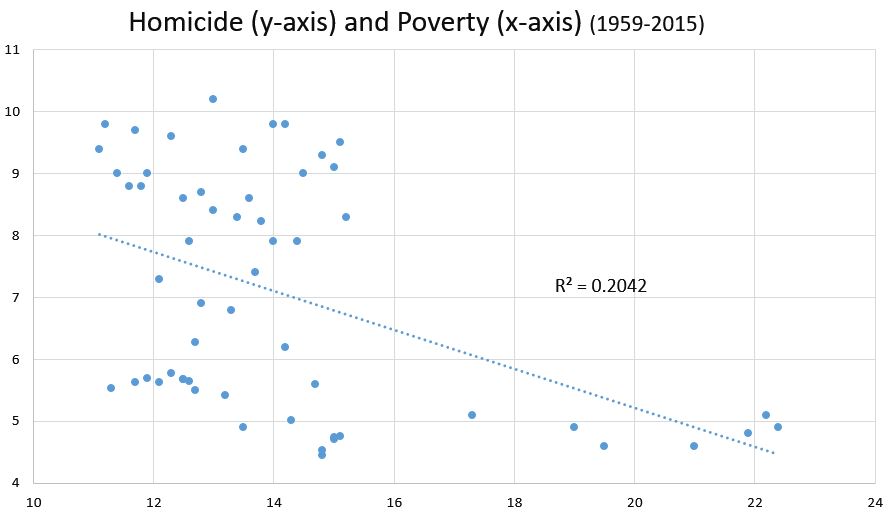
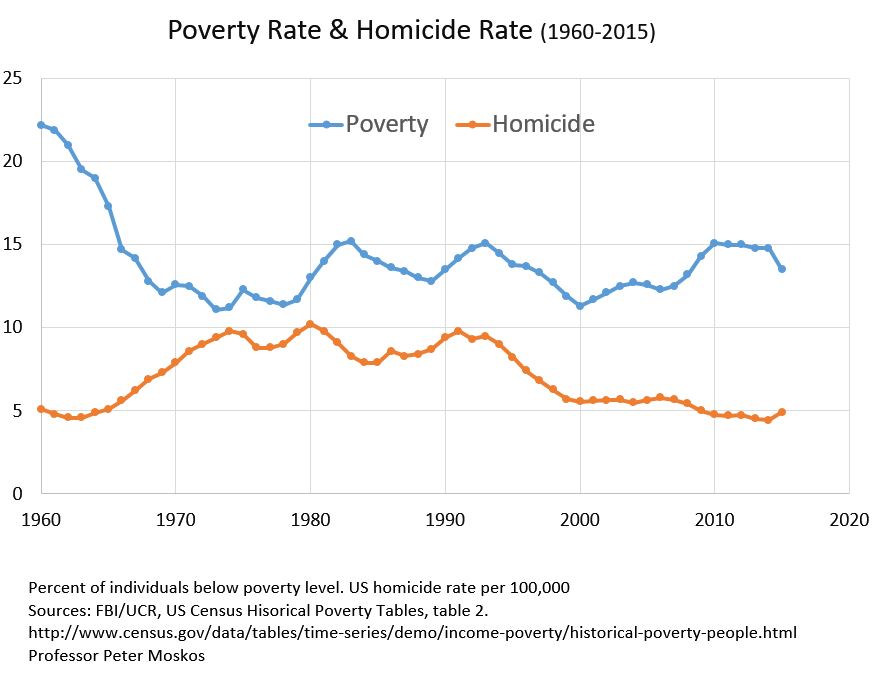
    Anyway, cause I’m not much of a football fan (or Satan fan), I thought I’d graph poverty and homicide over time. And here’s what you get:

    [click to embiggen]

    Those lines are almost flip visions of each other (Especially if one ignores the 1990s.) Turns out, at least since 1959, there an inverse correlation between poverty and homicide in the US. Homicide goes up when poverty decreases. Statically significant and everything. Well, that’s awkward.

    [Update: A commenter makes a very good point that I’m overstating any statistical significance because of the high poverty years up to 1995.]

    Does this mean we shouldn’t reduce poverty because homicide will go up? Of course not. (I often make fun of the “correlation doesn’t equal causation” mantra — because sometimes correlation does indicate causation, and correlation certainly doesn’t eliminate possible causation — but the “correlation doesn’t equal causation” mantra is well worth repeating here.) I think homicide is far less linked to macro economics than, well, macro economists would have you believe.

    But this fact remains: there is an inverse correlation between poverty and homicide. [Correction: Eh… maybe, maybe not. Probably not. See comments section.] The question then is to figure out how and why and through what intervening variables. I’ll leave that for better statisticians than me to figure out. But let’s assume, just for a moment, that this correlation isn’t random. Why might this be so?

    Hell, I don’t know. But if I had to hazard a guess… I’d think that perhaps some of same good policies that help reduce poverty and suffering in our country might go along with a certain ideology that occasionally has its head up its ass when it comes to policing and crime. Conveniently this might also explain the 1990s, when both poverty and crime decreased. President Clinton and Vice President Gore managed to reduce poverty while still being firmly on the police side of the ideological divide. Broken Windows was working in NYC. Welfare was being ended as we knew it. And the Feds even coughed up a chunk of change for a few more cops, to boot.

  • Continuing with the “Ferguson Effect”

    The other week I wrote about the so-called “Ferguson Effect.” Alex Elkins has some more thoughts on this issue, over on his blog:

    The main “take-away,” the one the authors hope the media will pick up and run with, namely, that the Ferguson Effect, as construed by conservatives and certain media outlets, is “spurious.” This is too strident, in my opinion, in light of the available evidence that *something* did change over the past year. It’s not as if the change was in aggravated assault, a notoriously unreliable classification subject to manipulation by police command. No, the change was in murder, hardly a trivial matter.

    Lastly, the authors were unable to link crime trends to the sense that police had backed off in the era of #BlackLivesMatter. They write: “It is important to note that the city-level crime data used in this analysis cannot establish whether loss of legitimacy or de-policing is at the root of an observed increase in crime, or whether contagion induced by social media was responsible for transmitting these changes.”

    That, of course, is the argument that cops have made. Police have contended that after the deaths of Mike Brown and Freddie Gray, and the intense public criticism of over-policing, they have made fewer discretionary street stops and scaled back proactive Broken-Windows-style policing, and as a result, they say, opportunistic criminals have entered the void and committed more violent crimes, like murder.

    In light of all the killing in 2015, I’m willing to entertain this idea. I don’t understand why some seem to think that conceding this premise — that protest has had some effect on police — threatens the Left and its agenda. Massive street protests and intense sustained media attention surely have affected cops — indeed, many have said as much. We can grant that and still maintain the legitimacy of protest and our concerns.

    We have lots of work to do. Refuting the so-called Ferguson Effect — which essentially asks who’s to blame, which conservatives like Mac Donald use to undermine legitimate democratic protests against abusive state practices — when the evidence actually does indicate an increase in violent crime, should be the least of our concerns.

  • Swamy Pete says…

    Swamy Pete says…

    Swamy Pete, the gypsy scryer, looks into his crystal ball.

    With eerie music in the background and an echoey voice, Swamie Pete makes a bold prediction:

    In the future, in fact tomorrow at exactly 19:00 hours eastern time, crime will not happen. The crystal ball says that for maybe three hours, somehow people will manage to have fewer problems. The root causes will remain constant, and yet fewer people will dial 911. Yes, I can see it now… for a few hours Sunday night, triggers on guns will be harder to pull and knives will be so dull they will not cut human skin….

    But… at around 10:30pm everything will be back to normal.

    I never liked that Swamie Pete and his voodoo nonsense, even if back in October he was right about the homicide increase of 2015. How did he know that? Witchcraft, I say!

    But by the way, if we accept that blizzards reduce homicide. And the Super Bowl reduces homicide. Why is it so controversial that aggressive police presence focusing on maintaining order in high-crime communities can reduce homicide? I don’t know. I’ll ask Swamie Pete if I ever see him again.

    Update (Feb 10): Surprisingly, call volume was only down a little during the Super Bowl. Not the huge dropoff I expected. Crime data isn’t out yet.

  • “The enduring commitment of antipolice progressives to the ‘root causes’ theory of crime”

    This op-ed by Heather Mac Donald is the one I wanted to write. But I didn’t. And she did.

    The point, one could say rather simply, is that police matter as a force for crime prevention. That simple concept is why I decided to study policing and then became a cop.

    In the mid 1990s I got into this gig because an entire academic field said that the crime drop couldn’t happen. Crime wouldn’t go down until we improved “root causes” and fixed a racist society. By the time I entered graduate school in 1995, it was clear that crime was going down. Something was up. And it wasn’t employment and equal opportunity.

    This link to Mac Donald’s op-ed is behind the Wall Street Journal paywall. To read it all, try googling the headline “Trying to Hide the Rise of Violent Crime” and click through. Excerpts:

    An 11% one-year increase in any crime category is massive; an equivalent decrease in homicides would be greeted with high-fives by politicians and police chiefs. Yet the media have tried to repackage that 11% homicide increase as trivial.

    Several strategies are employed to play down the jump in homicides. The simplest is to hide the actual figure. An Atlantic magazine article in November, “Debunking the Ferguson Effect,” reports: “Based on their data, the Brennan Center projects that homicides will rise slightly overall from 2014 to 2015.”

    A second strategy for brushing off the homicide surge is to contextualize it over a long period. Because homicides haven’t returned to their appalling early 1990s or early 2000s levels, the current crime increase is insignificant.

    The most desperate tactic for discounting the homicide increase is to disaggregate the average. … The “numbers make clear that violent crime is up in some major U.S. cities and down in others.”

    If there weren’t variation across the members of a set, no average would be needed. [Zing! Nice one. I always appreciate a snarky line about stats.]

    To the Brennan Center and its cheerleaders, the nation’s law-enforcement officials are in the grip of a delusion that prevents them from seeing the halcyon crime picture before their eyes.

    FBI Director James Comey noted “a chill wind blowing through American law enforcement over the last year,” and called it “deeply disturbing.”

    Obama … accused Mr. Comey of “cherry-picking data” and ignoring “the facts” on crime in pursuit of a “political agenda.”

    Critics of the Ferguson-effect analysis ignore or deny the animosity that the police now face in urban areas.

    The St. Louis area includes Ferguson…. The Justice Department later determined that the officer’s use of force was justified, but the damage to the social fabric had already been done…. The media and many politicians decry as racist law-enforcement tools like pedestrian stops and broken-windows policing—the proven method of stopping major crimes by going after minor ones.

    Consider that background. Here’s the point I’ve been trying to make:

    The puzzle is why these progressives are so intent on denying that such depolicing is occurring and that it is affecting public safety.

    The answer lies in the enduring commitment of antipolice progressives to the “root causes” theory of crime. The Brennan Center study closes by hypothesizing that lower incomes, higher poverty rates, falling populations and high unemployment are driving the rising murder rates…. But those aspects of urban life haven’t dramatically worsened over the past year and a half.

    To acknowledge the Ferguson effect would be tantamount to acknowledging that police matter, especially when the family and other informal social controls break down.

    Many of those who are driving the “there is no Ferguson effect” bandwagon still believe that police are largely irrelevant to crime prevention and, rather than having anything to do with crime prevention, serve primarily as agents of racial oppression. That sentiment lies just under the surface of anti-police protests.

    It’s not just about “Justice For [fill in the blank of latest person shot by cops].” It’s about an ideology that still won’t accept that aggressive order-maintenance policing did any good. The “root cause” brigade never accepted that crime could decrease independent of structural changes. That’s what I mean when I talk about an ideological opposition to Broken Windows.

    So the next time you hear somebody say “crime isn’t up” or “there is no Ferguson effect” or “Michael Brown had his hands up” consider that they’re not just mistaken about one detail, however important. Instead, consider that they have a fundamentally different ideological view of who police are and what they can do.

  • Meanwhile, roughly 1 in every 250 young black men was shot in Eastern District. Last month!

    Meanwhile, roughly 1 in every 250 young black men was shot in Eastern District. Last month!

    Maybe you were too busy blocking traffic into the city to notice, but this past weekend 32 people were shot in Baltimore. Nine were killed.

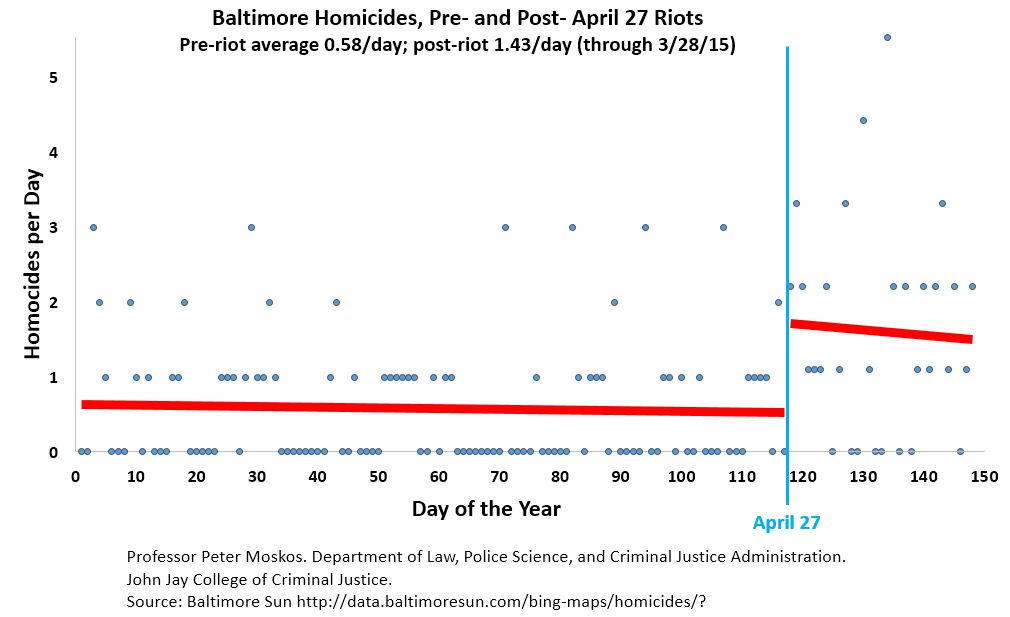
    (as usual, click to embiggen)

    This past weekend. In Charm City. With just over 620,000 people.

    Meanwhile, from April 25 to May 23, this past month, 122 people were shot or killed in Mobtown. Last year the comparable figure was 52.

    [During these same 28 days, Part One reported crimes in the Land of Pit Beef did not increase. Domestics (again, as reported to police) did not increase.]

    Where are these shootings happening? The Central District was basically steady. In the Northern District, shootings were actually down to two, from four. Shootings in the Southeast did increase, but just to eight. Not much up in the Southwest.

    The Northwestern District? Shootings were up to 13 in the past 28 days. That’s compared to 1 last year.

    The Wild West? There were 33 shootings this year (compared to 10 last year). I don’t know what the population of the Western is, but it’s probably even smaller than the Eastern.

    In my beloved “Historic” Eastern District? 22 shootings and homicides in 28 days. Last year there were 7. (For what it’s worth, homicides in the Eastern actually were lower than last year, 3 versus 4!)

    Keep in mind that these victims (and shooters) come mostly from the population of 15- to 35- year-old black men.

    The actual population of 15- to 35-year-old black men in the Eastern District is likely less than 5,000 people. (Source: See page 219 of Cop in the Hood).

    Now this is just one month, mind you. Twenty-eight days. And we’re talking about a “Formstone figure” (OK, I just made that one up) of roughly 1 out of every 250 young black men being shot. In one month! Chew on that bony Lake Trout for a while. But this ain’t no bull and oyster roast.

    I don’t know what else to say. Go ahead, if your world-view inclines you thusly, go ahead, hon, and see police as the biggest problem facing young black men in the land of Pleasant Living. And Boh, I’m not saying police are without blame. But seriously, this is about priorities. If you think police are the biggest problem facing young black men in urban America… I don’t know what else to say.

    [Maybe I did something wrong with my math? Let me know.]

  • “So what’s the big deal?”

    What’s weird, at least to me, is that many (mostly from the political left) seem to dismiss the never-before-seen increase in homicides in Baltimore as just some random uptick. “You know,” I’ve been told (and more than once), “violent crime is up in New York City, too.”

    Are you fucking crazy?!

    Homicide in Baltimore is up 250 percent over-fucking-night! And that night, April 27, 2015, just happened to be the night of the worst riots “Mobtown” has seen since 1968. This was a time when the mayor said police need to give room to people who want to destroy. (To be clear, I firmly believe this is not at all the message the mayor was trying to say… but still, a good mayor doesn’t let things slip from her lips that can be — and were — reasonably misinterpreted as letting people know that violence and destruction would be tolerated.)

    April 27th was also (and this is more Commissioner Batt’s fault) when police were confronted with some kookie young kids at Mondawmin Mall. The police, in riot gear, were told to stand down. I don’t think police should go too quickly to riot gear… but when you do use force, you go in strong! Instead, cops charged… and then retreated. This was on order, say police friends who were there, of the high-command.

    So the police charge became a half-assed charge. And 5 angry kids became 15 when police retreated. And then one more pseudo charge. And then 15 rock-throwing kids became 50. It was horribly policing, tactically. Horrible. (But not the only problem, mind you. I still want to know who the hell closed down the MTA and thus prevented school kids from leaving the mall?)

    So on April 27th, 2015, there were riots. And fires. And looting. And then starting the next day, twice as many get shot. People, this isn’t a fucking coincidence! This isn’t something that was meant to happen. It’s not like the Almighty wrote it. People on the streets, with guns, go up to other pull people, pull the trigger, and shoot them. So now, in a city of 620,000 people, this is happening one more time every goddamn day!

    So yeah, to those who point out homicides in NYC are up 13 percent compared to the same time last year: whatever.

    13 percent may be a statistical fluke. Or maybe it’s not. Maybe we can live with 40 more people murdered annually in NYC if it is at all related to half-a-million other people not stopped by police. I don’t know. But those are the discussions we should be having.

    Here’s the thing — and this is what bother me — I’m willing to discuss why crime is up, the role of police in crime prevention, what we can do to reduce violence, and the relationship between more aggressive/repressive police and less violent crime. I mean, that is kind of what I do for a living.

    But I’m not willing to debate that more people are getting killed in Baltimore and that something changed because of the fallout from the death of Freddie Gray.

    So the starting point for me is that something has changed in Baltimore vis-a-vis violence and homicide.

    The reason some people can’t accept this, I suppose, goes back to the fallacy that police don’t really matter, except as agents of racist repression. This argument says that crime is caused by society and root causes (and not criminals, per se). If racism, unemployment, and even aggressive policing cause crime, than some are happy to blame cops, society, racism, Broken Windows, Bill Bratton, and everybody but those who actually pull the trigger and kill somebody.

    Get real.

    So here we have the most sudden sustained increase in violence — overnight, mind you — in American history (best I know… please, if you know anything comparable to this, let me know). Of course it has to do with the riots. Not directly the riots, mind you. They’re over, at least for now. And nobody was actually killed during the riots, which is kind of amazing. This surge in shooting? It’s because of politics and police.

    Given that six officers were criminal charged for the death of Freddie Gray — a death that certainly not all six of them were responsible for — why would you go out and do more than have to?

    What you have — I can’t help but keep harping on the failed “gang truce” so loved by the mayor and police commissioner — is a police department that:

    A) isn’t doing much proactive police work (which means not doing more than answering calls for service);

    B) isn’t going hands-on with criminals hanging out on the corner so much (ie: not frisking people on violent drug corners means criminals are emboldened and guns are more accessible);

    C) an understaffed force that has been reduced to about 2,200 (down from more than 3,000 cops when I was there — doing more with fewer cops is yet another west-coast concept that hasn’t worked so well in Baltimore);

    and D) large crowds getting in the way of every routine call for service. (This means more cops need to respond to every call. And keep in mind that some of those getting in the way are responsible for the horrible increase in shootings. So it’s not like cops are paranoid about the situation.)

    Maybe I’ll break those down more later, but let’s just keep going with the 250 percent increase in killings.

    I’d bet (though I don’t know) that complaints against police are down equally dramatically. Probably the same 50 percent that arrests are down. Some say police arrest too many people. So fewer arrests should be good (it happened in NYC without a big increase in crime)…. so if you believe that, please try and explain this increase in murders in a way that doesn’t involve police. Or tell me what you want police to actually do. It’s not a simple question. And I’m all ears.

  • “We also gave those who wished to destroy space for that as well”

    You sure did, Baltimore Mayor Stephanie Rawlings-Blake.

    I cannot believe that the mayor of Baltimore said this yesterday.

    Unbelievable.

    You think that may encourage people to loot and burn?

    The full context in case you were wondering (I was) is:

    I’ve made it very clear that I work with police and instructed them to do everything that they could to make sure the protesters were able to exercise their right to free speech. It’s a very delicate balancing act. Because while we try and make sure that they were protected from the cars and the other things that were going on. We also gave those who wished to destroy space to do that as well. And we work very hard to keep that balance and to put ourselves in the best position to deescalate.

    (And no, it’s not “outside agitators” doing this.)

  • Crime up in NYC (this time for real)

    Compared to last year, shootings and homicides in NYC are up 20 percent. Twenty percent is a real increase.

    Here’s the compstat page and also a link to last week’s summary (no matter when you click the link).

    I don’t know why crime is up. But… I can’t help but think it’s part of (or some combination of) everything that has happened in NYC in the past year. I mean, I know what most cops think is the cause: stop and frisk has stopped; marijuana arrests have plummeted; there’s more oversight of cops; De Blasio is mayor; Obama is president; Eric Holder is Attorney General; cops find it preferable to do too little rather than do to much (“if you don’t work you can’t get in trouble”).

    Some of that is just ideological sour grapes. But some of it, part of it, is true.

    What I find amazing is I don’t hear any critic of the NYPD sounding any alarm. Oh well, I guess 60 extra murder victims per year — 54 of whom, based on passed statistics, will be black or hispanic men — is a small price to pay to keep innocent people from getting harassed by the police. I for one don’t buy that equation.

    Those who opposed past police practices (and to be clear it’s not like I loved everything the NYPD was doing) seem to be very silent right now. Shouldn’t the increase in murders lead to a discussion about what police should be doing?

    I guess the same people who think the police had little if anything to do with the crime drop now just think it’s preordained that crime goes up. But it is not “written.” Why don’t I hear debate? Instead I hear a lot of silence.