Tag: causes of crime

  • More on guns and Florida crime

    ‘Guns are everywhere,’ Orlando police chief says A surge in murder and gunfire locally since the end of the federal assault-weapons ban in 2004.
    […]
    Florida law makes it easy for any adult without a criminal record to buy a gun. Yet many legally purchased guns end up being used by criminals. The state routinely turns up in law-enforcement surveys as one of the top three sources of firearms that turn up in crimes elsewhere.
    […]
    The 9 mm pistol reigns as the state’s most-popular crime weapon.
    […]
    Drug dealing was the most common crime connected to assault weapons in Orange County.
    […]
    Cops consider assault weapons the deadliest firearms on the street. … One riddled a girlfriend’s car for jilting him. Another robbed a gas station, leaving behind his home address on a receipt for the just-purchased assault weapon. A third, who went shooting near his home, simply described himself as angry.
    […]
    Looking over the data, Orange County Sheriff Kevin Beary said that Florida has become much more dangerous — for residents and police officers — since the end of the weapons ban.

    “There should be a huge concern not just here locally but across the nation about the huge increases in the numbers of assault weapons and high-power semiautomatic pistols that our deputies and police officers are coming across,” he said. “This shows that without the ban, the criminal element has definitely taken advantage of the market.”


    Henry Pierson Curtis writes more in the Orlando Sentinel. Read the whole story here. And my previous post on Florida, guns, and crime is here.

  • The economy and crime

    Does a tough economy mean more crime? Not necessarily. Good policing is more important, sez me. Here’s the story in the New York Times.

  • Crime Platforms: Dems For Aiding Cops, GOP Tough Enforcement

    Copied from Crime & Justice News:

    The Democratic Party platform includes a four- paragraph section on criminal justice focusing principally on support for local law enforcement and ending violence against women, says the National Criminal Justice Association, which represents states and localities in Washington, D.C. The platform says, “We will reverse the policy of cutting resources for the brave men and women who protect our communities every day. At a time when our nation’s officers are being asked both to provide traditional law enforcement services and to help protect the homeland, taking police off of the street is neither tough nor smart; we reject this disastrous approach. We support and will restore funding to our courageous police officers and will ensure that they are equipped with the best technology, equipment and innovative strategies to prevent and fight crimes.” The Democrats vow to “reduce recidivism in our neighborhoods by supporting local prison-to-work programs. We will continue to fight inequalities in our criminal justice system. We must help state, local and tribal law enforcement work together to combat and prevent drug crime and drug and alcohol abuse, which are a blight on our communities. The platform includes support for ending violence against women and backing victims’ rights.

    The Republican platform includes an eight-part criminal justice section on ending child pornography, gangs, sentencing, reforming prisons, federal law enforcement, fighting illegal drugs, and protecting crime victims. The platform calls for “stronger enforcement and determined prosecution of gang conspiracies” and for the immediate deportation of “aliens involved with gangs or who are convicted of crimes of violence or sex offenses.” The Republicans are specific in their commitment for tougher sentencing for certain violent crimes, support of the death penalty, and opposition to granting parole to dangerous and repeat felons. The platform calls for reform of the nation’s correctional institutions. It discusses the need for increasing the ranks of federal law enforcement agencies to replace the resources shifted to homeland security duties. The document calls for “several thousand new FBI agents, U.S. marshals, immigration officers, and Border Patrol agents. The costs will be significant; but the social and economic costs of street gangs, identity theft, and illegal entry into this country would be much greater.” The platform endorses “state and local initiatives, such as Drug Courts, that are trying new approaches to curbing drug abuse and diverting first-time offenders to rehabilitation.” The Republicans seek ratification of a constitutional amendment on the rights of crime victims.

    You can read the whole summary here. I tend to believe this is all bullshit, anyway. But I’m especially skeptical of any platform promises from the ruling party. Because, you see, this is the party that has had time to do all this and hasn’t. Like the next four years would be different than the last eight. Republicans have not been good to police (though most police are Republicans).

    A Constitutional Amendment for victims’ rights? Be serious. Leaving aside a scary willingness to want to change the Constitution for every minor issues (flag burning, gay marriage), I have a problem with crime victim rights. Really. It sounds goods. But the devil is in the details. Many crime victims are criminals. Drug gangs aren’t shooting you. They’re shooting each other!

    There have been problems when the bad guys get money from crime victim funds. See, for instance this story.

  • A Street Corner Analysis of D.C. Crime

    “The corner boys, as they are sometimes called, are part of what is perhaps the most visibly anonymous demographic in the country. Young and black, feared and marginalized, they are the ones most likely to be viewed as a suspect in a crime and most likely to become the faceless victim of one.

    Nevertheless, if you want to know what’s behind the rash of homicides in Trinidad — 24 so far this year — and to get a different take on how to stop the killings, these are guys to go to, on their turf and on their terms.”

    So what Washington Post columnist Courtland Milloy did was get out of his car and talk to them. Kudos to you, Mr. Millow.

    The whole column is here.

  • Officials Struggle With Rise in Knife Crimes Among Britain’s Youths

    Knife crimes? If only we could be so lucky! The story is here.

    For all the panic about rising knife violence in London, let’s keep in mind that London has 7.3 million people and about 160 murders a year. That’s fewer than New York City. Hell, it’s even fewer than Baltimore (population: 650,000)! And it’s not that London has a low crime rate. It just has less lethal violence.

    London does have strong and effective gun control. Sure, you cankill somebody with a knife, but it’s a lot messier.

  • Bad Person. Bad Judge.

    Too many people refuse to believe that there are some truly bad people out there. Some people are just bad. Police know this. Judges don’t.

    Is it unfair to throw someone in prison for a long time for a technical violation of parole? Maybe. Maybe not. Depends on the person.

    Just because you can’t convict a person doesn’t mean he’s not guilty. That’s when using probation and parole violations become so important.

    There’s an attempt in Baltimore to crack down on 960 of the most violent people in Baltimore. This is exactly the kind of plan that has worked with great success in other cities to dramatically reduce violence (google: “Boston Miracle). There’s a story in today’s Baltimore Sun about a bad man, Jerrod Rowlett.

    On one hand (the wrong hand) you could see this man as a victim now being locked up for a crime he wasn’t convicted of. On the other hand, the correct hand, this is a bad and violent man who can’t be convicted because his victims are too terrified to testify about his violent and drug-dealing ways. It’s bad that Rowlett shot anybody. But his last shooting is a preventable shame that should (but probably doesn’t) rest on the conscience of Judge Stewart’s.

    Jerrod Rowlett… racked up a dozen criminal charges at a young age and earned such a street reputation that Bealefeld [the police commissioner] knows him by name.

    Rowlett’s first arrest came when he was 16 and accused of first-degree murder, but he was found not guilty. The next year he was convicted of carrying a handgun, but the five-year sentence was suspended. He was found guilty of assault in 2005 and got another five-year suspended sentence.

    In April 2006 city police raided a drug corner and charged him with dealing heroin. He made bail, and the following January a witness said Rowlett shot another man

    Rowlett pleaded guilty in both cases.

    Baltimore Circuit Judge Lynn Stewart signed off on a plea deal that suspended the 15-year prison term, allowing him to walk away with only the time he had served while waiting for the deal, and five years’ probation. This earned him a place on the state’s year-old worst-offenders list.

    The judge in Rowlett’s case, who had agreed to the plea agreement, had stern words at his August hearing. “The court will work with you,” Stewart told him. “But make no doubt about it, sir. If you violate the probation, you’re going to be gone for a long time. Do you understand?”

    Looking down, he mumbled “Yes.”

    In April, police arrested Rowlett again on a gun charge, and probation agents jumped at the chance to send him to prison. Prosecutors dropped the charges when the victim, a family member, recanted the story, but the probation agents still sought a violation.

    Since Rowlett was in the target program, a state probation agent asked Stewart to imprison him anyway by issuing a “no bail” warrant, saying Rowlett failed to tell his agent about the arrest. Stewart declined to issue the warrant on May 7.

    Twenty days later, Rowlett became a suspect in a midday shooting in Northeast Baltimore. He’s now charged with attempted first-degree murder for the fourth time in his life, and he is off the streets – being held without bail until his trial.

    May he stay off the streets. This is one guy I’m willing to pay for to keep locked up and far away from me.
  • 2nd Amendment

    I’m of two minds when it comes to gun control and the 2nd Amendment. I’m not a fan of guns. I would love to live in a society that heavily restricted gun ownership. But I don’t.

    Say what you want about the 2nd Amendment… and I’ve always said–just to be provocative to my liberal friends–that if you see the constitution as so broad that it gives women the right to have an abortion, then certainly you can see the 2nd Amendment broadly enough to give a man the right to bear arms. Now the Supreme Court has had their say.

    On one hand, it is a huge decision overturning decades of local gun control laws.

    On the other hand, gun control fans, it won’t matter. Really. Giving law abiding people the right to have a gun in their home isn’t so bad. I had a gun.

    I’m no fan of the N.R.A., but they do make one good point: we already have laws making guns illegal. If we don’t or can’t enforce our existing gun laws, it makes no sense to pass more laws making guns more illegal. Most gun control simply prevents non-criminals from having a gun. The problem is criminals with guns. What do we do about them?

    One thing I learned as a cop is that there are a lot of illegal guns out there. More than you can imagine. That’s a big problem. Gun prohibition isn’t a battle worth fighting. Best to save the political capital for something else.

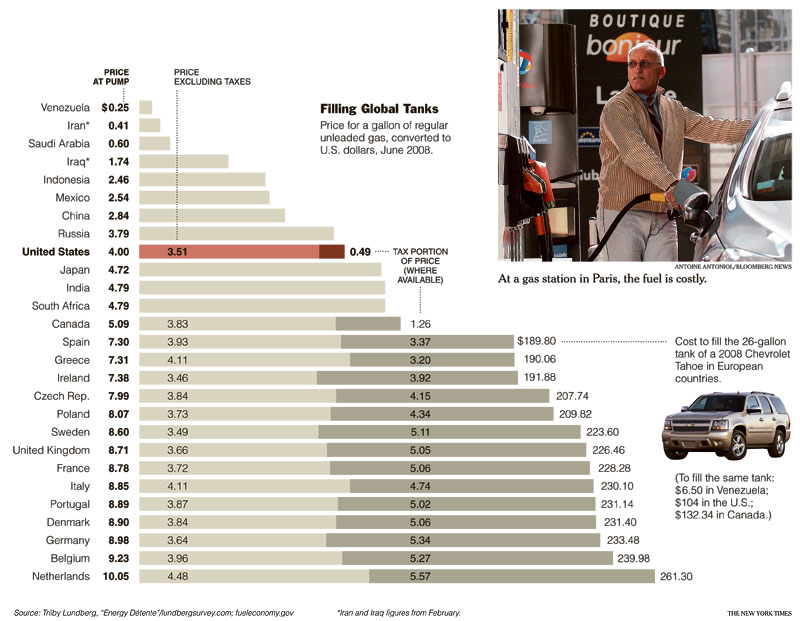
  • Does cheap gasoline cause crime?

    Does cheap gasoline cause crime?

    I wish gas were taxed more. Much more. Luckily, I’m not running for political office. I saw this figurein an article in today’s New York Times. The point of the article is that gas in the U.S. is still pretty cheap compared to most countries. But when I look at the figure, I see what I think is an inverse correlation between the price of gas and crime. Leaving aside middle-eastern countries that produce oil, countries with cheap gas have higher crime rates and countries with expensive gas have less crime. I haven’t actually looked at the crime rates for these countries (and if somebody has the time and desire, please do and let me know), because I don’t think this correlation has any real meaning. But it’s interesting.

    While I’m pretty sure that higher gas taxes won’t cut the homicide rate, there does seem to be a pretty strong correlation between expensive gas and safe streets. I’m writing this from Amsterdam, the Netherlands. Gas here tops the chart at $10 a gallon. Yet the economy seems to be doing just fine and too many people still drive to work in SUVs.

    What does the government do with all this tax money? Along with more police and safe streets, there’s also health care, job security, paid vacations, public transportation, bike paths, and a secure system of dikes and levies that actually keeps the country from being flooded. Not bad for a few bucks a gallon.

  • Don’t eat the paint

    Why is there so much violence in Baltimore? Maybe it’s the lead. Or you could say, “It’s the lead, stupid!” There’s a lot of lead paint in Baltimore, especially in poor neighborhoods.

    Greg Toppo reports in USA Today.

    In the academy, a friend and I used to joke that one of our dim classmates had licked the windowsill one too many times. Maybe he had.